NASA Adds New Science Investigations for Moon Base

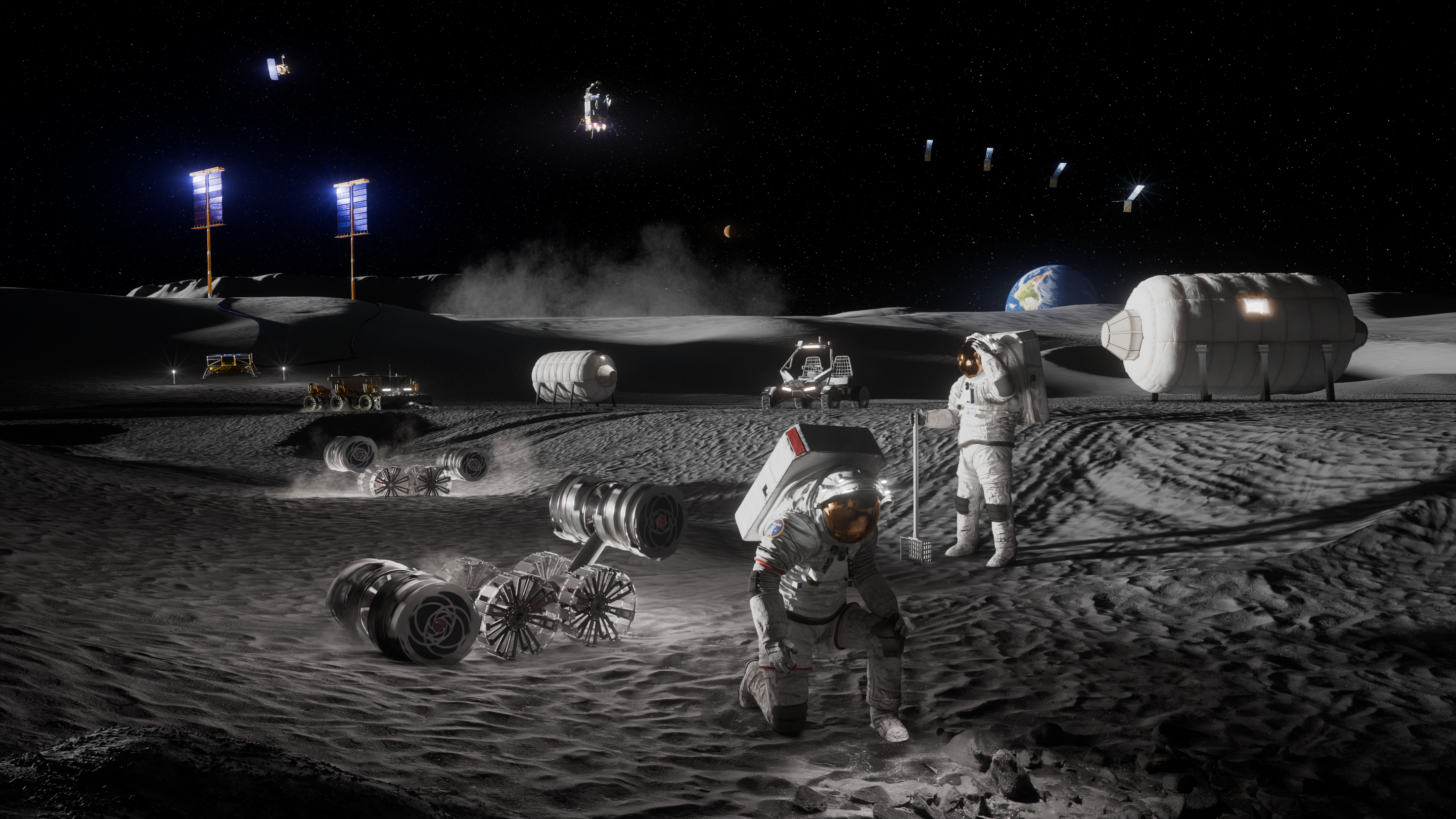
Artist’s rendering depicting astronauts, habitats, rovers, power systems, and cargo operations supporting sustained human activities at the Moon Base near the lunar South Pole.
Credit: NASA

Editor’s note: This release was updated on Sept. 30, 2026, to correct the name of the DISCO payload.

NASA selected three new scientific investigations and their payload suites to advance our knowledge of the Moon and help pave the way for building humanity’s first lunar outpost, Moon Base.

The suite of science instruments and technologies was selected through NASA’s Payloads and Research Investigations on the Surface of the Moon (PRISM) program and will fly to the lunar surface using the CLPS (Commercial Lunar Payload Services) initiative as part of the agency’s Moon Base Program. The payloads will help researchers understand lunar resources, map natural shelters, and assess environmental hazards, laying the foundational groundwork for a safe and sustained human presence under the agency’s Artemis and Moon Base programs. 

“NASA Science is building the ultimate interplanetary survival guide to ensure that science goes first to the lunar surface to provide our future astronaut crews with the vital information, resources, and safety precautions needed ahead of time to survive the night on the Moon,” said Nicky Fox, associate administrator, Science Mission Directorate, at NASA Headquarters in Washington. “These PRISM selections will directly help NASA minimize risks to our astronauts while maximizing our agency goals as we set up humanity’s first lunar outpost in preparation for sending the first astronauts to Mars.”

The three payload suites are:

Lunar Environment Monitoring Station – South Pole (LEMS-SP):

  • The autonomous LEMS-SP instrument suite will serve as a long-term environmental and hazard monitoring station. The instrument will be designed to help build a picture of the lunar environment by monitoring falling micrometeoroids and tracking the abundance of volatiles, or materials that can easily shift into gas, that drift into the Moon’s thin outer layer of gases. Using a short‑period seismometer to detect seismic events, the instrument could deliver the critical hazard assessments needed to ensure the physical safety of Moon Base hardware.

Principal Investigator: Dr. Mehdi Benna, University of Maryland, Baltimore County

 Geophysical Investigation for Mapping Lunar Interior (GIMLI):  

  • The GIMLI payload will be deployed at the Marius Hills Pit on the lunar surface to hunt for subterranean lava tubes and aid in our understanding of fundamental lunar volcanic processes. The payload will scan beneath the Moon’s surface to see whether the Marius Hills Pit leads into a large underground lava tube. If it does, these natural underground spaces could offer future astronauts ready‑made protection from extreme temperatures and harmful radiation — important groundwork for safe, long‑term living on the Moon. Confirming these void spaces now could shift future habitat planning, offering natural, ready-made shelters that provide crucial thermal stability and shielding from deadly ionizing radiation and micrometeoroid bombardment.  

Principal Investigator: Dr. Nathaniel Putzig, Planetary Science Institute

Depth Imager with Spectral and Color Optics (DISCO):  

  • The DISCO payload will provide the first direct, on-the-ground measurements of ice hidden in lunar micro-cold traps and also will lay the groundwork for lunar resource utilization and surface operations. The payload will study how the lunar surface behaves, from how rocket exhaust disturbs the ground to how stable it is for mobility, while also pinpointing where ice exists and how much of it is there. Together, this information will help NASA design safe surface operations and develop the technologies needed to turn ice into a usable resource for the future Moon Base.

Principal Investigator: Dr. Ariel Deutsch, NASA’s Ames Research Center in California’s Silicon Valley

“Each new PRISM selection strengthens our ability to deliver ambitious, transformative science to the lunar surface,” said Brad Bailey, director of the Exploration Science Strategy Integration Office in NASA’s Science Mission Directorate. “These investigations exemplify how Artemis and Moon Base are expanding the frontier of lunar exploration, advancing innovative technologies, deepening our understanding of the Moon’s environment, and paving the way for future astronaut missions.”

NASA is increasing its cadence of lunar missions to build a Moon Base, delivering science investigations and technology payloads that contribute to American scientific preeminence, strengthen a sustained presence on the Moon, and advance future human exploration.

NASA’s CLPS initiative supports the Moon Base Program, as the agency works with American companies to deliver scientific, exploration, and technology payloads to the Moon’s surface and orbit.

For more information, visit:

https://science.nasa.gov/lunar-science

-end-

Tiffany Blake
Headquarters, Washington
202-358-2546
[email protected]

Source: www.nasa.gov

Help Overlap Zoo Reveal Cosmic Dust

Galaxies, vast collections of billions of stars, gas, and dust held together by gravity, are scattered across the immensity of space. But every so often, a coincidence occurs: Two galaxies line up from our point of view on Earth (or from a space telescope) and appear to overlap in the sky. These rare overlapping galaxies give astronomers a chance to study something normally difficult to see: the dust inside one of these distant cosmic objects. That’s the focus of NASA’s new Overlap Zoo project.

Picture the background galaxy acting like a cosmic flashlight, shining through the nearer galaxy. The backlit dust creates dark silhouettes, like shadows on a screen. By studying these silhouettes, astronomers can map how dust is distributed throughout galaxies and learn how it blocks, scatters, and dims starlight traveling through space. Measurements of how dust impacts light can even help astronomers refine estimates of the distances to faraway objects.

However, before we can study galaxy pairs and their dust, we first need to find them! Overlap Zoo is asking for your help with the search. 

“As new and better observations of galaxies continue to multiply, it is becoming incredibly difficult for astronomers to classify every candidate galaxy pair,” said Trevor Butrum, Overlap Zoo project lead and graduate student. “Your help is invaluable to creating the biggest and cleanest catalog of overlapping galaxy pairs for further analysis.”

As a volunteer in Overlap Zoo, you’ll view images that volunteers in the Galaxy Zoo project have identified as containing possible overlapping galaxies. The Overlap Zoo project will teach you how to verify the presence of galaxy pairs in these images, classify key features of each galaxy, and mark their outlines. You’ll learn as you go, classifying as many of these images as you like. Your contributions will help build the first large-scale catalog of galaxy pairs suitable for dust studies and enable a huge step forward in accuracy of astronomical estimates.

Head over to Overlap Zoo and start classifying galaxies today. No prior experience needed – just curiosity and a few minutes of your time. Your observations will help unlock the secrets hidden in these rare cosmic alignments!

Two overlapping galaxies against a dark field of distant stars and galaxies. A bright, smooth galaxy at left partially overlaps a face-on spiral galaxy at right, whose winding arms are dotted with blue and pink regions.
A prime example of an overlapping galaxy pair known as VV191a/b.
Image credit: NASA, ESA, CSA, JWST PEARLS Team, Rogier Windhorst (ASU), William Keel (University of Alabama), Stuart Wyithe (University of Melbourne); Image Processing: Alyssa Pagan (STScI)

Source: science.nasa.gov

Curiosity Blog, Sols 5016–5021: Fantastic Minerals and How To Detect Them

3 min read

Curiosity Blog, Sols 5016–5021: Fantastic Minerals and How To Detect Them

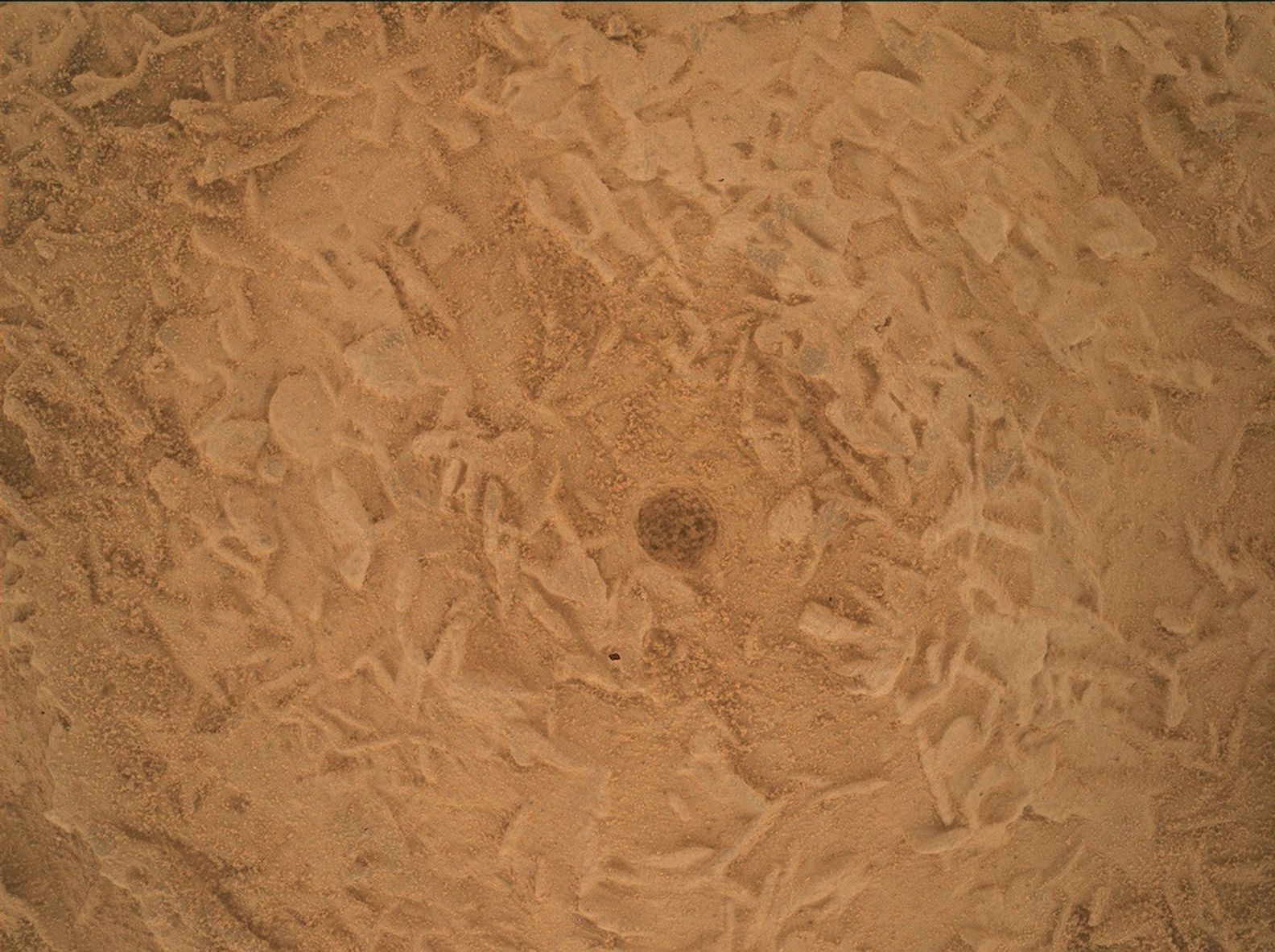
A close-up view of a dusty, reddish-brown Martian rock surface taken by the Curiosity rover. The surface is highly textured, covered with a complex network of small, raised, intersecting ridges that resemble tiny blades or crystals buried under a fine layer of sand. Right in the center of the frame is a small, distinct, dark circular hole.
NASA’s Mars rover Curiosity generated this close-up image of a brushed spot on bedrock (informally named “Salar de Vacas”), showing a jumble of roughly disc-shaped features as well as a divot generated by the brushing from the rover’s Dust Removal Tool (DRT). The features are about 3-4 millimeters across (about 0.12-0.16 inches) and about 1 millimeter thick (about 0.04 inches). Curiosity created the image using its Mars Hand Lens Imager (MAHLI), a close-up camera located on the turret at the end of the rover’s robotic arm, and an onboard focusing process that merges multiple images of the same target at different focus positions, creating a composite that brings as many features into focus as possible. Curiosity performed the focus merge on Sept. 16, 2026 — Sol 5016, or Martian day 5,016 of the Mars Science Laboratory Mission — at 02:14:02 UTC.
NASA/JPL-Caltech/MSSS

Written by Lucy Lim, Planetary Scientist at NASA Goddard Space Flight Center

Earth planning date: Friday, Sept. 18, 2026

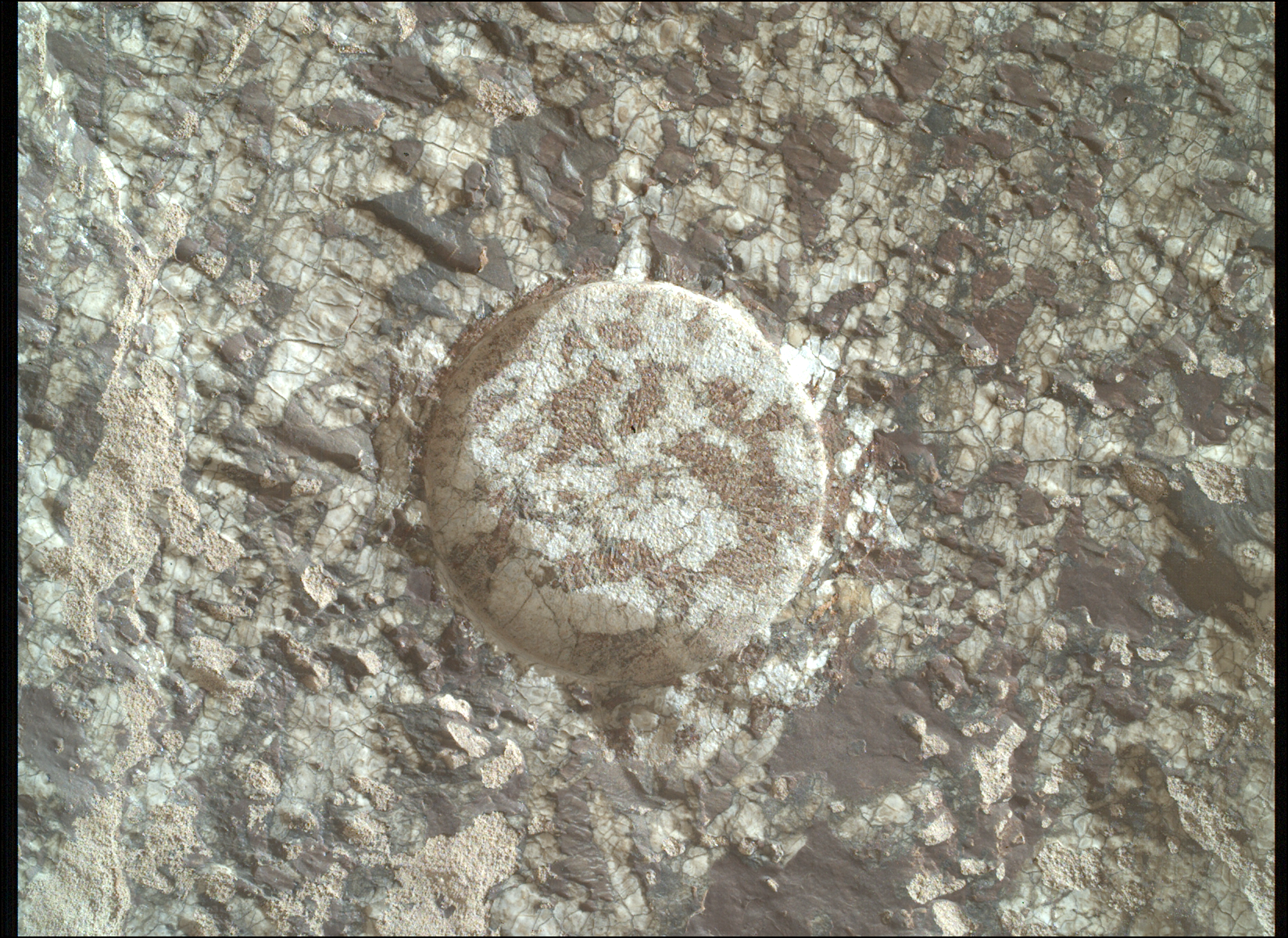
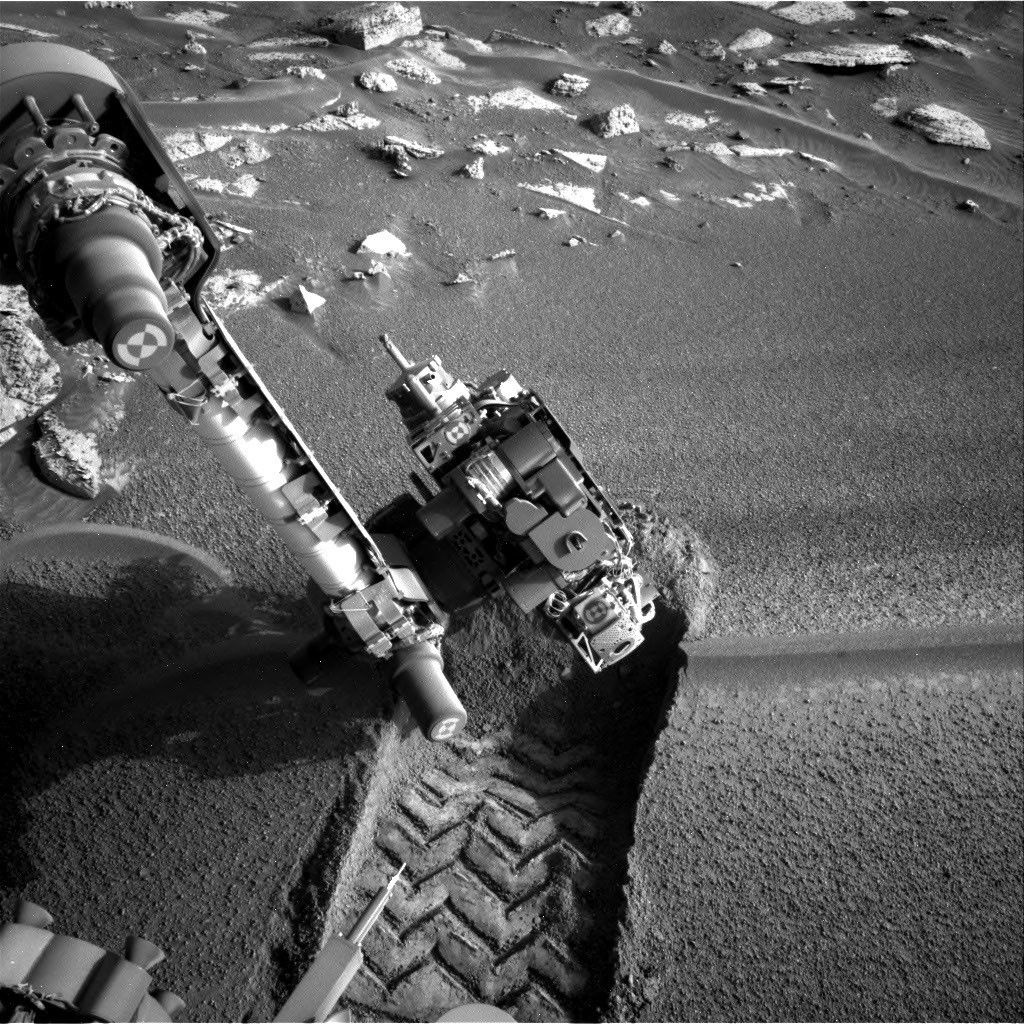
Curiosity surprised us at the beginning of the week with a change in rock texture — instead of the finely layered bedrock blocks we’ve been seeing in our recent sulfate unit workspaces, suddenly we were looking at blocks covered (and likely filled) with a jumble of small disc-shaped lumps. We’ve seen somewhat similar features before much earlier in the mission — for example, close to the Pahrump Hills back in the Murray mudstones, and they’re sometimes seen in Earth rocks as well, especially in settings in which minerals were precipitating from an evaporating fluid. The disc-like shapes could be created by the growth habits of a specific crystalline mineral that is known to grow into similar shapes, or they could be bits of a harder rock layer that broke up and collected here. We planned Mastcam and MAHLI imaging for more morphological detail on the jumbled disc blocks (“Yungay,” “Chiu Chiu”) as well as LIBS (“Puya Raimondii,” “Liolaemus Tacnae,” “Pisqu Warkatana”) and APXS (“Salar de Vacas”) to investigate their composition. 

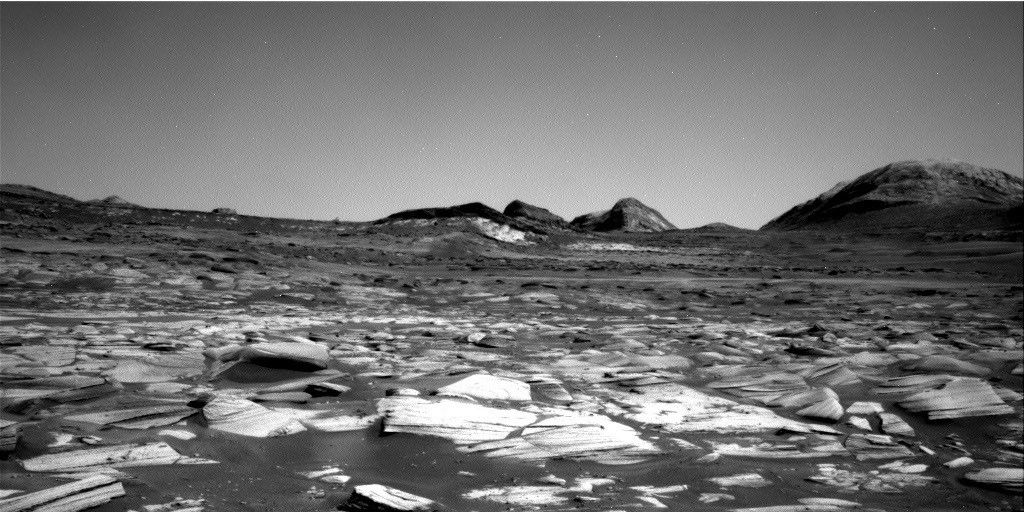
Ongoing long-distance imaging projects were furthered by ChemCam long-distance remote imager (RMI) and Mastcam mosaics of the buttes on either side of Valle Grande. These “cutaway”-view images of the strata above the rover will help us map sedimentary structures in these upcoming units and understand how these rocks formed and eroded. Views of more recent erosional deposits will also help us to understand the formation of Valle Grande itself.

In order to identify minerals, Curiosity needs data from the CheMin X-ray diffraction instrument, which means a drill campaign. We’ve driven over a kilometer since our last drill site at Campo Marte, and this will be our first drill above the erosional supersurface. The Wednesday plan’s drive brought us up next to a promising drill workspace a little beyond where we saw the disc-shaped features discussed above (imaged as “Torres del Paine” by Mastcam) and Friday’s planning included site characterization with the instruments on Curiosity’s arm (“Alberta Wild Rose,” “Moonraker Mountain”), ChemCam LIBS (“Osoyoos”), and Mastcam (“Trincomali Channel,” “Yellow Lady’s Slipper”). The team also selected a specific drill target and planned a very short drive to bring it in range of the arm — first for contact science and then, if all goes well, for the preload test and drill.

I’ll be back on planning on Monday as Geology and Mineralogy Science Theme Lead for Drill Sol 1 (Triage Contact Science) and we’ll see how things go from there!

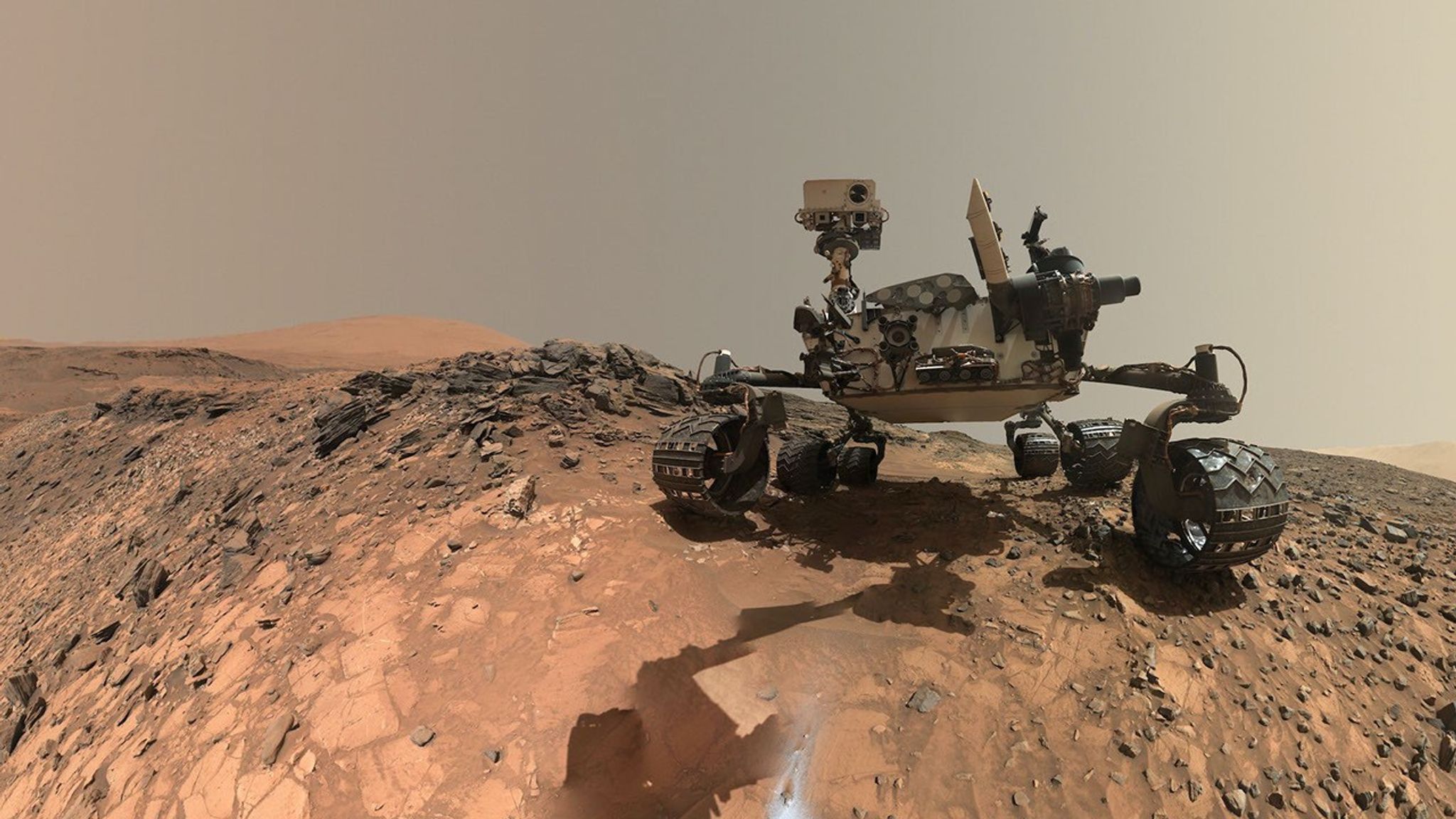
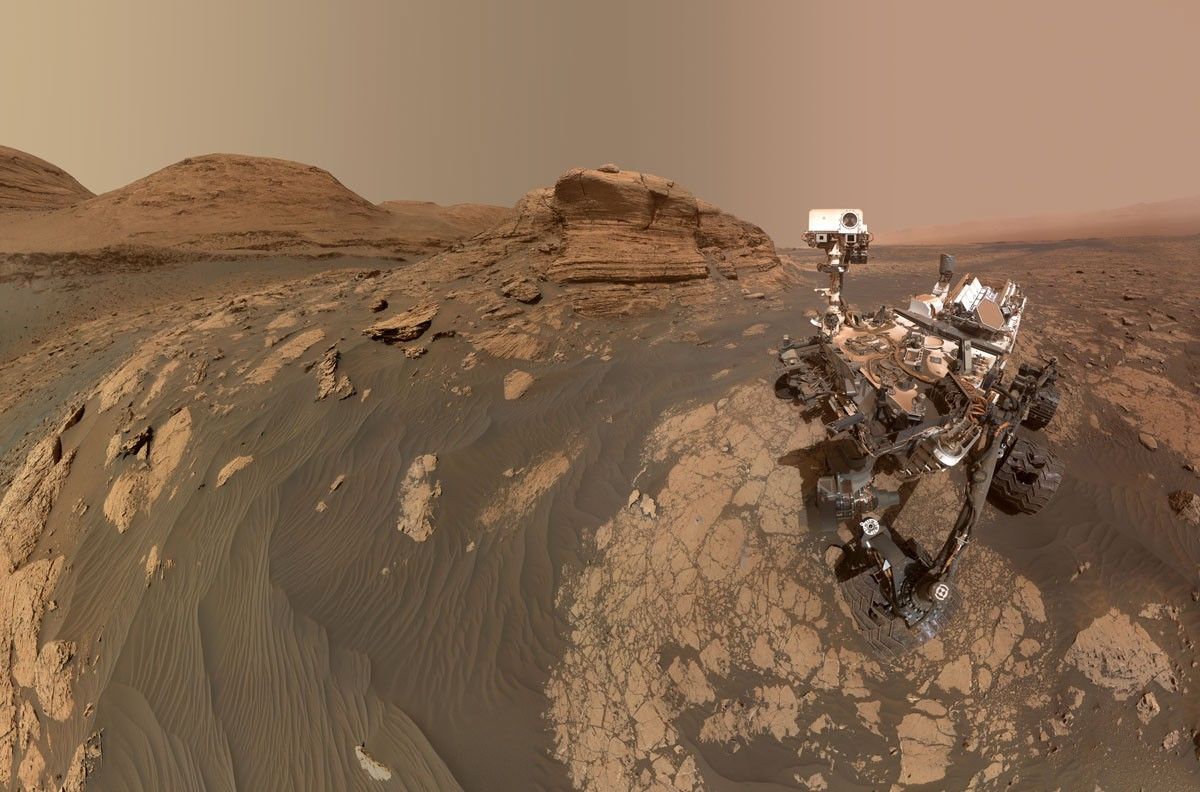
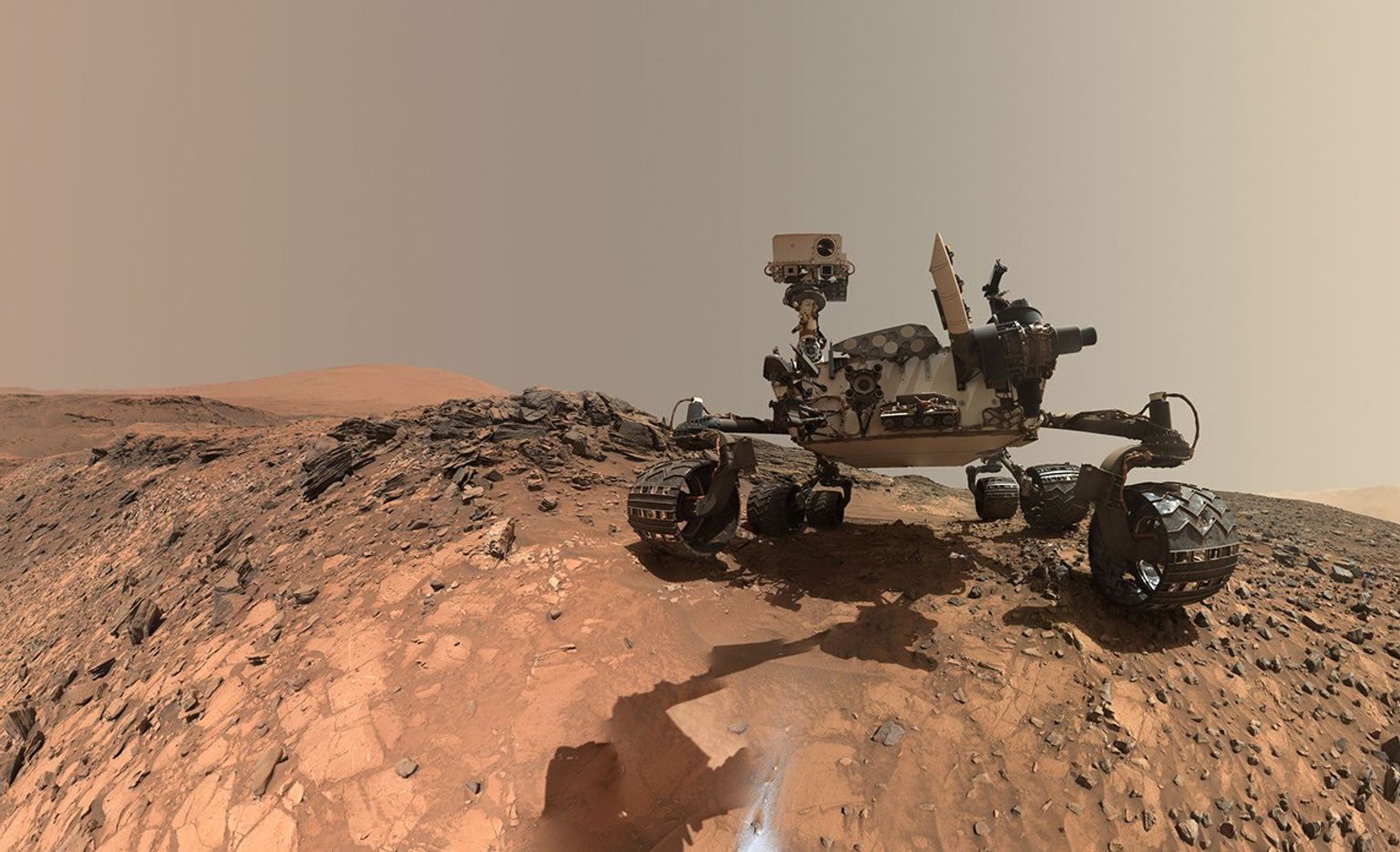
A rover sits on the hilly, orange Martian surface beneath a flat grey sky, surrounded by chunks of rock.
NASA’s Curiosity rover at the base of Mount Sharp
NASA/JPL-Caltech/MSSS

Details

Last Updated

Sep 30, 2026

Related Terms

Source: science.nasa.gov

An Agricultural “Island” in the Saskatchewan River Delta


Summer
autumn

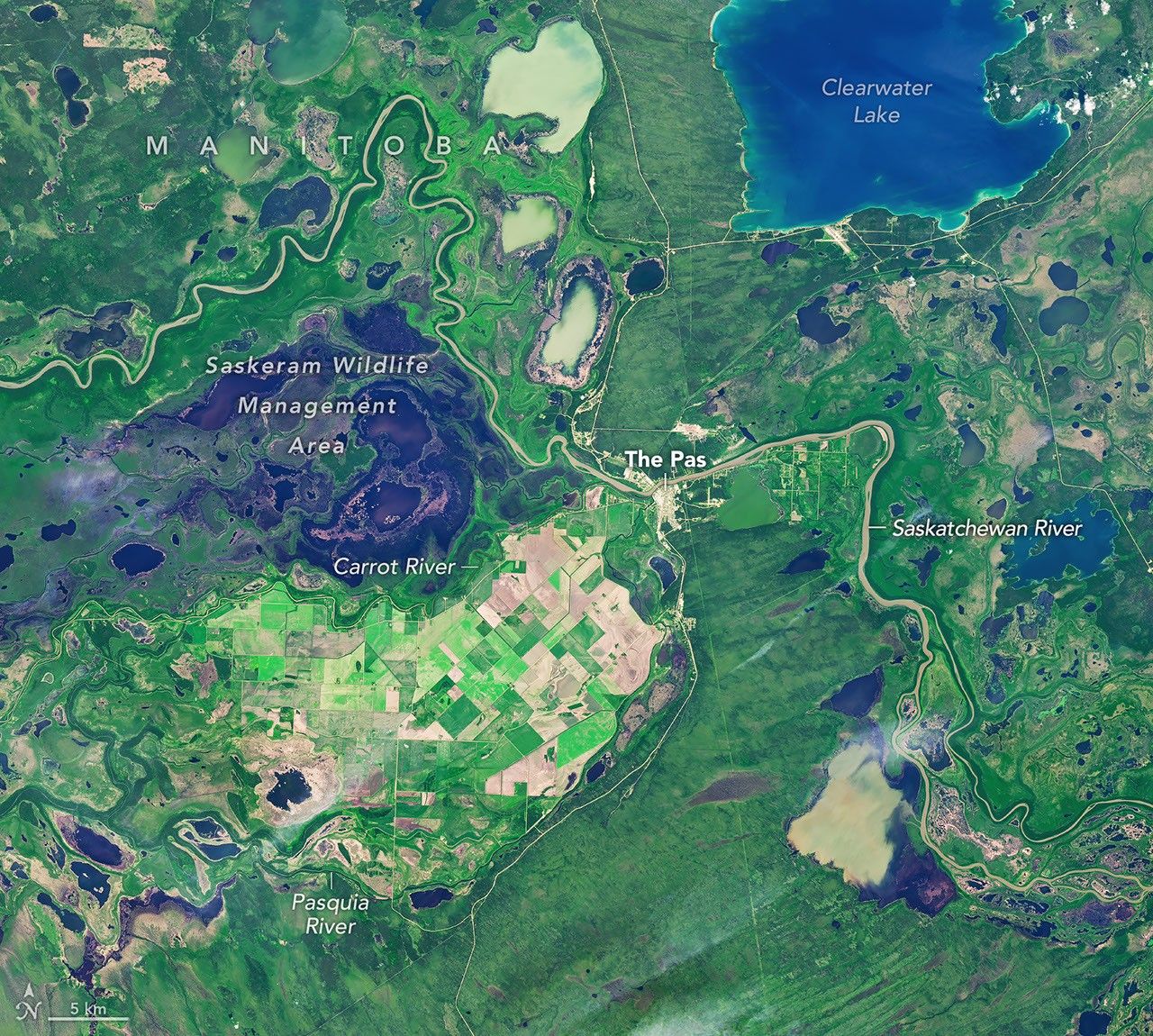
A satellite image captured in summer shows farm fields in a patchwork of green and brown, surrounded by green wetlands dotted with dark patches of open water.
NASA Earth Observatory/Michala Garrison

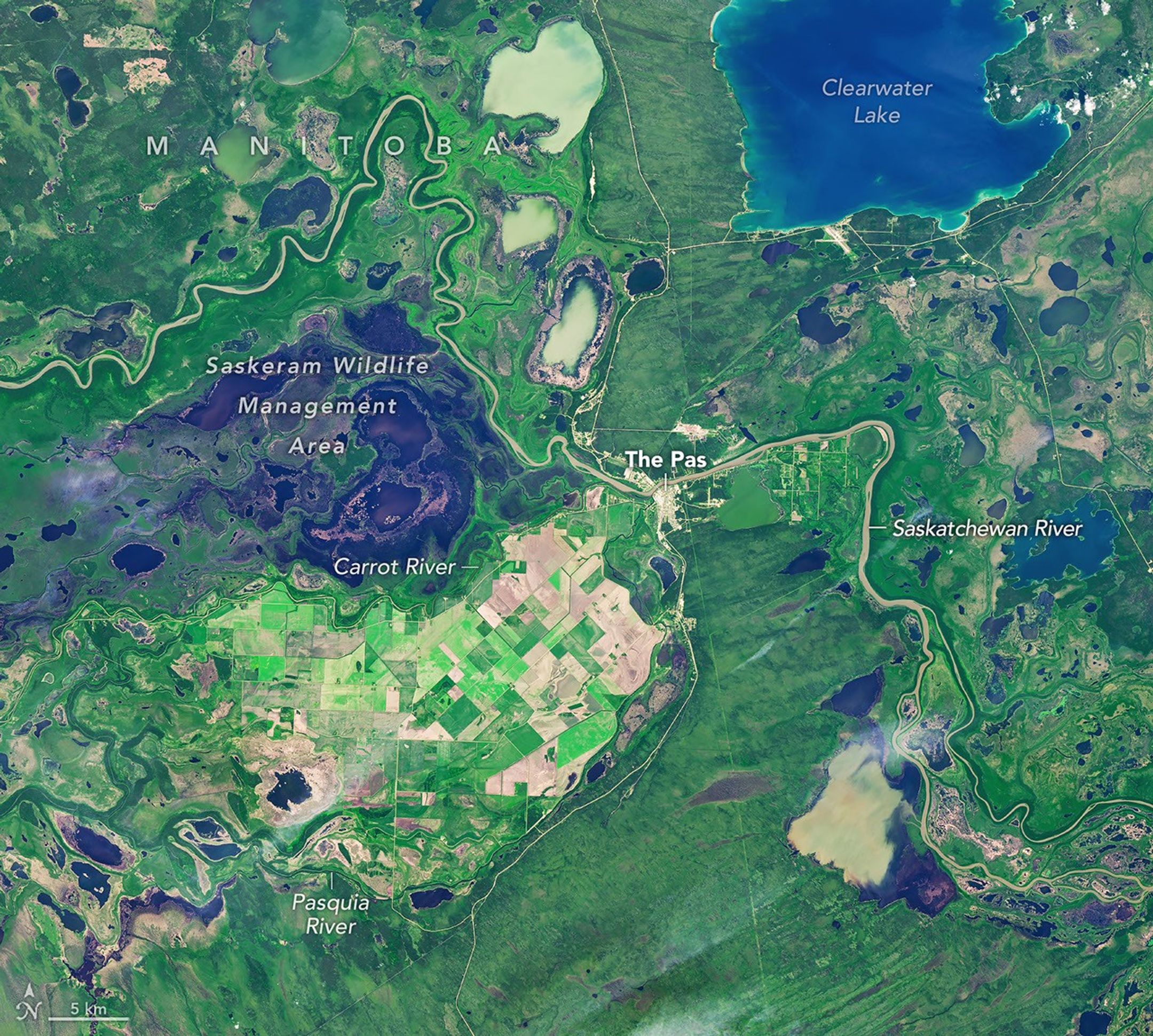
The same area in autumn shows many of the farm fields are now brown, and the surrounding wetlands hold less water.
NASA Earth Observatory/Michala Garrison

A satellite image captured in summer shows farm fields in a patchwork of green and brown, surrounded by green wetlands dotted with dark patches of open water.
NASA Earth Observatory/Michala Garrison

The same area in autumn shows many of the farm fields are now brown, and the surrounding wetlands hold less water.
NASA Earth Observatory/Michala Garrison


Summer

autumn


Farmland across the Carrot River Valley, Manitoba’s northernmost agricultural area, moves from summer growth into harvest season in images captured on July 2, 2026 (left), and September 21, 2026 (right), with the OLI (Operational Land Imager) on the NASA-USGS Landsat 9 and Landsat 8 satellites, respectively. NASA Earth Observatory images by Michala Garrison.

Much of the Saskatchewan River Delta, a large inland delta that straddles the Canadian provinces of Saskatchewan and Manitoba, is too wet for extensive farming. But amid the delta’s winding channels, lakes, and marshes, an “island” of straight-edged fields breaks up the curvy contours. These fields, west of the town of The Pas, make up Manitoba’s northernmost agricultural area.

Known as the Carrot River Valley (Pasquia Area Settlement), the area lies within the Rural Municipality of Kelsey. Its actively farmed land spans more than 40,000 hectares (100,000 acres) between the Carrot and Pasquia rivers—tributaries of the Saskatchewan River—and is surrounded by wetlands, including the marshes of the Saskeram Wildlife Management Area to the north.

These images show the valley at two points during the 2026 growing season: on July 2 (left) and September 21 (right). They were acquired with the OLI (Operational Land Imager) on the NASA-USGS Landsat 9 and Landsat 8 satellites, respectively.

Landsat data feed into the Agriculture and Agri-Food Canada annual crop inventory. The 2026 inventory was not released as of late September, but the 2025 map shows that farmers in the Carrot River Valley grew mostly canola and spring wheat that year, along with small patches of Canary seed.

The July 2026 image shows green crops across many of the valley’s fields. Planting in the area, part of Manitoba Agriculture’s Northwest crop reporting region, began later than in parts of the region to the south because of wet conditions. Still, fertile soils and long summer days at this northern latitude can help crops grow quickly.

By the time of the September image, the pattern had flipped. The Pas recorded little rainfall in the preceding week (1.6 millimeters, or 0.06 inches), while wetter weather elsewhere in the Northwest region (up to 43.9 millimeters, or 1.7 inches) held up the harvest. By then, farmers across the region had harvested about 10 percent of the canola and 50 percent of the spring wheat.

Managing water has long been a challenge in the valley. In the 1950s, a major flood control and drainage project got underway, and farming in the area today still depends on diking and pumping for agricultural flood protection.

NASA Earth Observatory images by Michala Garrison, using Landsat data from the U.S. Geological Survey. Story by Kathryn Hansen.

References & Resources

You may also be interested in:

Stay up-to-date with the latest content from NASA as we explore the universe and discover more about our home planet.

Fans of the Arctic

3 min read

Sediment eroded from ice-capped mountains splays out across a broad river valley on Russia’s Severny Island.

Article

Olympic Mountain Glory

4 min read

Snow-capped mountains carved by deep river valleys preside over northwestern Washington state.

Article

Wild, Scenic, and Increasingly Rusty

5 min read

Orange streams are now being spotted in hundreds of watersheds in permafrost areas throughout Alaska’s Brooks Range.

Article

Source: science.nasa.gov

APOD: 2026 October 1 – Harvest Moon with Erupting Mount Etna

APOD

Astronomy Picture of the Day

Discover the cosmos! Each day a different image or photograph of our fascinating universe is featured, along with a brief explanation written by a professional astronomer.

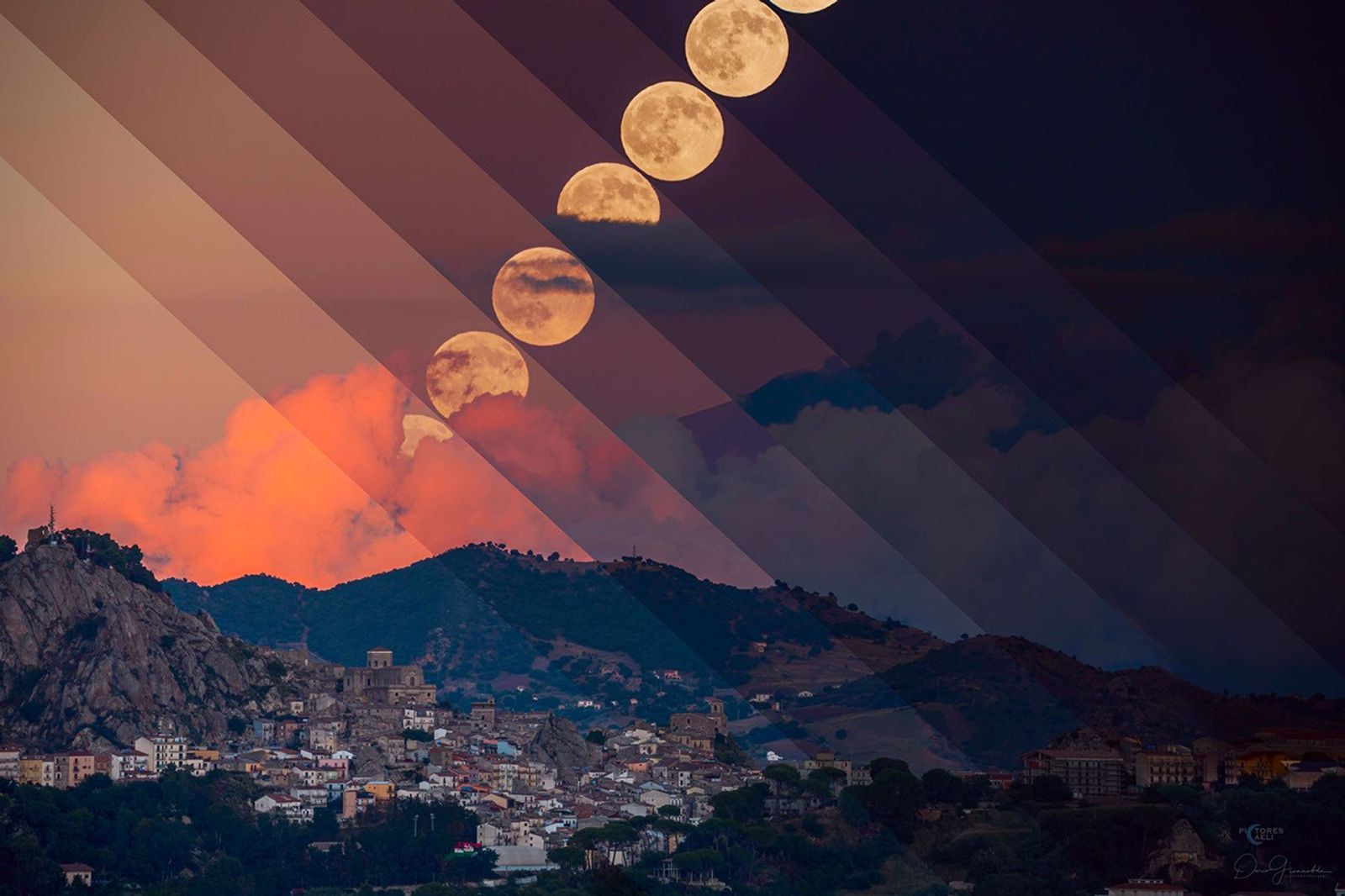
Rise of the Harvest Moon over the slopes of Mount Etna and the simultaneous play of colors in the anti-twilight.

Harvest Moon with Erupting Mount Etna

Explanation: Have you ever seen the full moon rise? This colorful image was photographed last weekend in Sicily, just outside the town of Nicosia, in Italy. It is a composite photograph that shows the Moon rising as the sky turns darker. Lower clouds are reflecting the colors of antitwilight, while ash and gas from Mount Etna are seen higher in the background. The pink band lower in the sky is called the Belt of Venus. During a full moon, the Moon and the Sun are in opposition in the sky: the moon rises as the sun sets. The lunar phase cycle lasts approximately 29.5 days (but the Moon takes approximately 27 days to orbit the Earth). In some cultures of the Northern Hemisphere, the September full moon is called the Harvest Moon. Does your culture have a special name for it? (A full moon by any other name would shine as bright.)

APOD’s email for image submissions has changed. Please see: APOD Submissions
APOD’s main NASA site has moved : From apod.nasa.gov to science.nasa.gov/apod
Tomorrow’s picture: sharpless

Date October 1, 2026
Credit & Copyright Dario Giannobile
Authors & editors: Cecilia Chirenti, Robert Nemiroff, Jerry Bonnell, Keighley Rockcliffe
A service of: ASD at NASA / GSFC,
NASA Science Activation & Michigan Tech. U.

Source: science.nasa.gov

NASA’s Webb Provides Crash Course on Planet-Shattering Collisions

6 Min Read

NASA’s Webb Provides Crash Course on Planet-Shattering Collisions

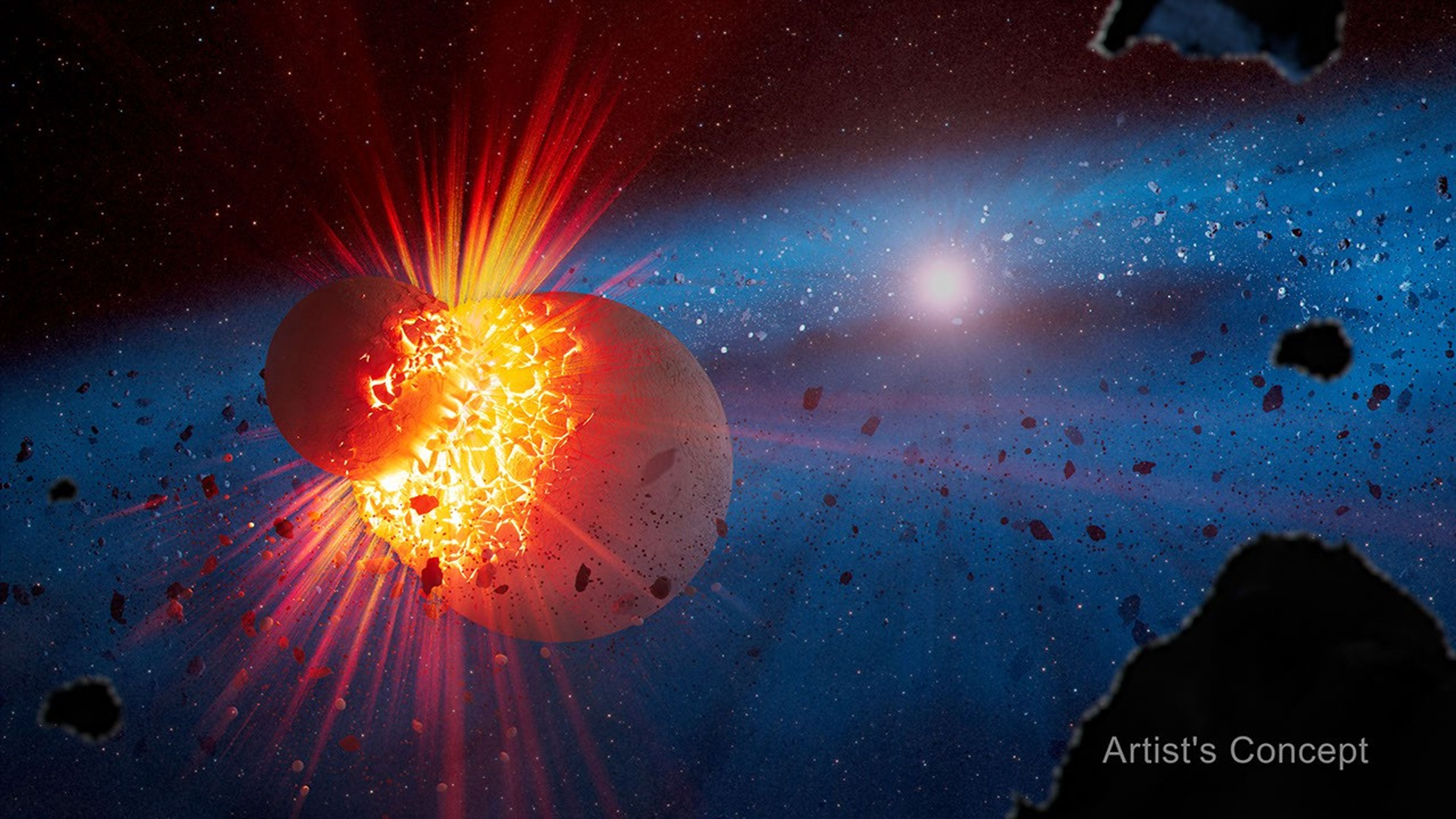
Artist’s concept of a star and its debris disk against the black background of space. The star is in the background, right of center, and depicted as a small, luminous sphere. The debris disk is a large blue ring that encircles the star. The debris disk is angled toward the viewer, so that the portion nearest to the viewer extends beyond the bottom frame of the illustration. Many dark, rocky fragments are scattered throughout the debris disk. In the foreground, toward the left, is a small planetary embryo colliding into the left side of a larger spherical object. The impact site glows bright yellow and orange and has a mottled appearance, as though chunks of both colliding bodies are breaking up and being destroyed. Orange-yellow streams of vapor extend outward from the collision area. Behind the debris disk and its star are many small stars in the background. A label in the bottom right corner reads “Artist’s Concept.”

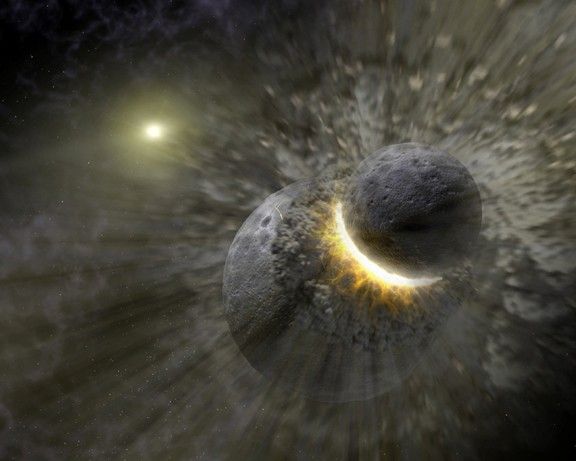
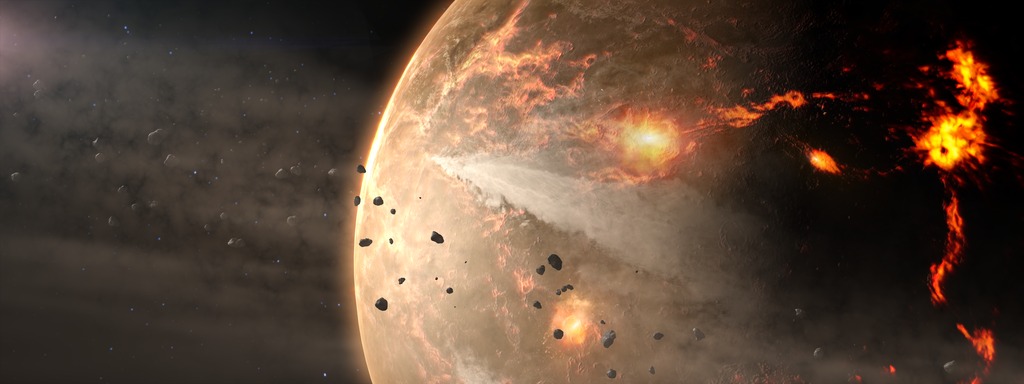
The types of collisions within young stellar systems known as extreme debris disks are relevant to scientists’ understanding of our own solar system, which is thought to have undergone similar impact events that created our Moon and shaped Earth’s initial state.

Credits:
Artwork: NASA, ESA, CSA, Joseph Olmsted (STScI)

In the early history of our solar system, scientists theorize that a Mars-sized object called Theia smashed into the infant Earth, vaporizing massive amounts of rock and blasting it into space. Some of that material coalesced into the Moon, where NASA’s Artemis program is returning humans, preparing for Mars, and shaping the future of space exploration.

That long-ago, violent collision reshaped our home planet. Astronomers have used NASA’s James Webb Space Telescope to examine a class of young stellar systems that show signs of similar upheavals, providing clues to the amount of energy in their collisions. The results offer insights into the composition and evolution of these chaotic systems.

The team’s findings published Thursday in The Astrophysical Journal.

Image: Extreme Debris Disk (Artist’s Concept)

Artist’s concept of a star and its debris disk against the black background of space. The star is in the background, right of center, and depicted as a small, luminous sphere. The debris disk is a large blue ring that encircles the star. The debris disk is angled toward the viewer, so that the portion nearest to the viewer extends beyond the bottom frame of the illustration. Many dark, rocky fragments are scattered throughout the debris disk. In the foreground, toward the left, is a small planetary embryo colliding into the left side of a larger spherical object. The impact site glows bright yellow and orange and has a mottled appearance, as though chunks of both colliding bodies are breaking up and being destroyed. Orange-yellow streams of vapor extend outward from the collision area. Behind the debris disk and its star are many small stars in the background. A label in the bottom right corner reads “Artist’s Concept.”
The types of collisions within young stellar systems known as extreme debris disks are relevant to scientists’ understanding of our own solar system, which is thought to have undergone similar impact events that created our Moon and shaped Earth’s initial state.
Artwork: NASA, ESA, CSA, Joseph Olmsted (STScI)

The environment surrounding a star changes as it ages, beginning with a juvenile, gas-rich protoplanetary disk where forming planets can reside, before evolving to a gas-poor debris disk. During its mission lifetime, NASA’s retired Spitzer Space Telescope examined the debris disk stage and discovered a subclass termed extreme debris disks. These systems harbor unusually large amounts of warm dust close to the star, in the region comparable to where rocky planets orbit in our solar system. A team of astronomers led by Kate Su of the Space Science Institute in Boulder, Colorado investigated these intriguing objects with Webb.

Contrary to theoretical predictions, which suggest we should observe many extreme debris disks, observations indicate that these environments are rare. Scientists estimate roughly only 1% of young stars show observable signatures of this phase based on the data collected so far, including possibly our own solar system during its formation. Despite their rarity, the team was able to compile a sample of 21 extreme debris disks, including five from Spitzer’s archival data and 16 from Webb, with 12 newly observed disks and follow-up observations on four of Spitzer’s.

“This is the first time we have gathered enough systems to truly understand this subclass that we call extreme debris disks,” said Su, lead author of the paper. “Before Webb, we had limited information. We knew that they are weird and very different from the typical cold debris disks that we know, like Vega and Fomalhaut. Now that we have more data, we can pin down what these disks represent for planet formation and evolution.”

The team confirmed that extreme debris disks share three key properties: smaller dust grains than those in protoplanetary or classic debris disks, a high concentration of warm dust, and irregular brightness variations, all revealed by mid-infrared spectra from Webb and Spitzer.

To determine the driving factor for these qualities, the team studied the mineralogical makeup of the disks. They found that their sample could be categorized into silica-rich and silica-poor disks. Volcanic glass like obsidian is one example of silica-rich material found on Earth, whereas the silica-poor mineral forsterite appears as green sand grains on some beaches in Hawaii. An extreme debris disk’s category relays information on the type of collisions producing the impact debris and may help account for its variability in infrared brightness.

“To just see their mid-infrared emission and beautiful spectral features with Webb, which allowed us to identify their compositions, was the most exciting thing for me,” said Agnes Kospal of Konkoly Observatory in Budapest, Hungary, and a coauthor of the study. “We have no other way to study these planetary embryos directly because they are too small.”

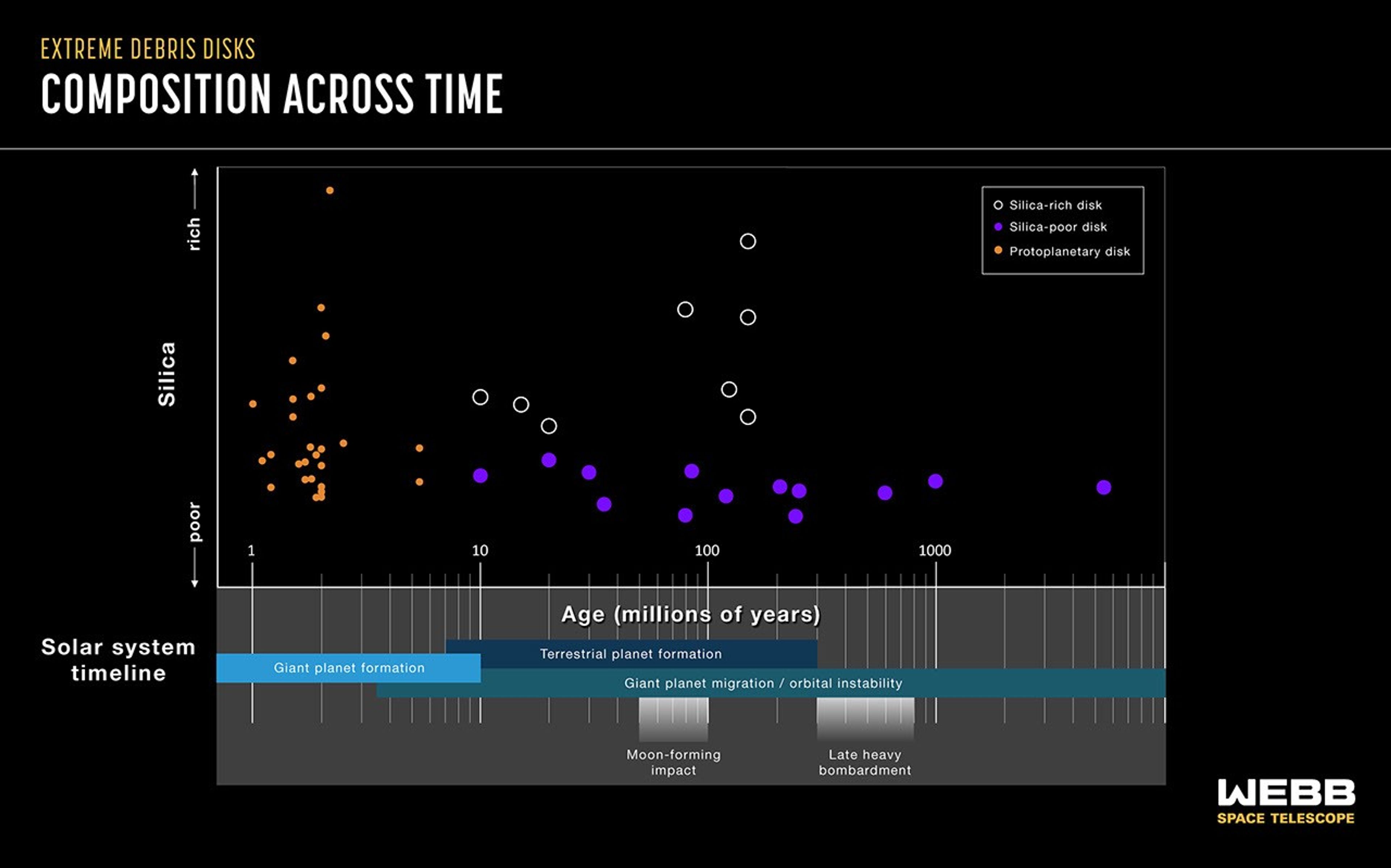
Of their sample, about one-third is silica-rich, suggesting these disks are produced by high-energy impacts between Mars-sized bodies where a significant portion of the material is vaporized. The remaining two-thirds of their sample is silica-poor, indicating that the collisions are occurring on smaller scales, like grazing, between Moon-sized objects. Silica-rich disks are found only around stars younger than 300 million years, while silica-poor disks persist across a broad range of ages and often show greater brightness variability. The team proposes that this variability is driven by the rapid evolution of fresh debris through orbital changes and additional impacts.

Their findings can be applied to our own solar system, which may have experienced more than one extreme debris disk phase.

“How rocky planets formed and giant planets evolved are part of the broader story of the solar system’s formation. It’s all one story,” said Su. “Our work on extreme debris disks helps us bring together the big picture of what we currently understand.”

Image: Composition of Extreme Debris Disks Across Time

Graphic titled Extreme Debris Disks, Composition Across Time showing a plot and corresponding timeline of the solar system. The plot’s y-axis is labeled Silica with an up arrow labeled rich and a down arrow labeled poor. X-axis is labeled Age (millions of years) and starts with 1 at the left and increases by factors of ten, ending with 1000 at right. A key at right has 3 symbols: black dot is Silica-rich disk, purple is Silica-poor disk, and orange is Protoplanetary disk. All 27 orange dots are within the first 10 million years and range in silica composition. The 8 black and 13 purple dots begin to appear around 10 million. The black dots stop around 100 million. The purple dots continue right. The timeline below has the same labels as the plot’s x-axis. A gray band before 100 marks the Moon-forming impact. A gray band before 1000 marks the Late heavy bombardment. 3 blue bands stretch from left to right: Giant planet formation, Terrestrial planet formation, and Giant planet migration/orbital instability.
By investigating the compositions of extreme debris disks, scientists inferred that silica-rich disks are produced by high-energy impacts of Mars-sized objects, while silica-poor disks are created by less energetic events from Moon-sized bodies.
Illustration: NASA, ESA, CSA, Joseph Olmsted (STScI)

Simulations suggest that terrestrial planets, such as Earth, should form within the first few hundred million years of a solar system’s formation. This period fits with the ages of silica-rich extreme debris disks observed so far and aligns with the estimation that Earth and the Moon formed around 100 million years after the Sun formed, with the Moon likely being the result of a collision between Earth and a Mars-sized object.

As for whether our Sun underwent a silica-poor extreme disk phase, if older silica-poor disks and their random intervals of infrared brightness do reflect orbital instability, this would be broadly consistent with the Late Heavy Bombardment hypothesis for our solar system. In that scenario, the gas giant planets migrated significant distances, gravitationally disrupting the orbits of smaller bodies and triggering catastrophic collisions that generated the short-lived, dust-rich phases observed in extreme debris disks.

“Of course, there’s many things we still don’t know about these disks,” said Attila Moor of Konkoly Observatory, a coauthor of the study. “We expect no silica-rich systems among older extreme debris disks. We only have three disks in our sample that fit that age criteria, so it’ll be nice to observe more of these systems to confirm our hypothesis.”

The James Webb Space Telescope is the world’s premier space science observatory. Webb is solving mysteries in our solar system, looking beyond to distant worlds around other stars, and probing the mysterious structures and origins of our universe and our place in it. Webb is an international program led by NASA with its partners, ESA (European Space Agency) and CSA (Canadian Space Agency).

To learn more about Webb, visit:

https://science.nasa.gov/webb

Downloads & Related Information

The following sections contain links to download this article’s images and videos in all available resolutions followed by related information links, media contacts, and if available, research paper and Spanish translation links.

View: Webb images of other debris disks around Vega, Fomalhaut, Beta Pictoris, and AU Microscopii

Read more: Finding Planetary Construction Zones

Explore: How did the Moon Form?

Explore: Planetary Systems

Watch: Simulation of Collision that Formed the Moon

More Webb: News | Images | Science | Home Page

Details

Last Updated

Oct 01, 2026

Contact

Media

Laura Betz
NASA’s Goddard Space Flight Center
Greenbelt, Maryland
[email protected]

Abigail Major
Space Telescope Science Institute
Baltimore, Maryland

Christine Pulliam
Space Telescope Science Institute
Baltimore, Maryland

Source: science.nasa.gov

NASA’s SpaceX Crew-13 Launches to International Space Station

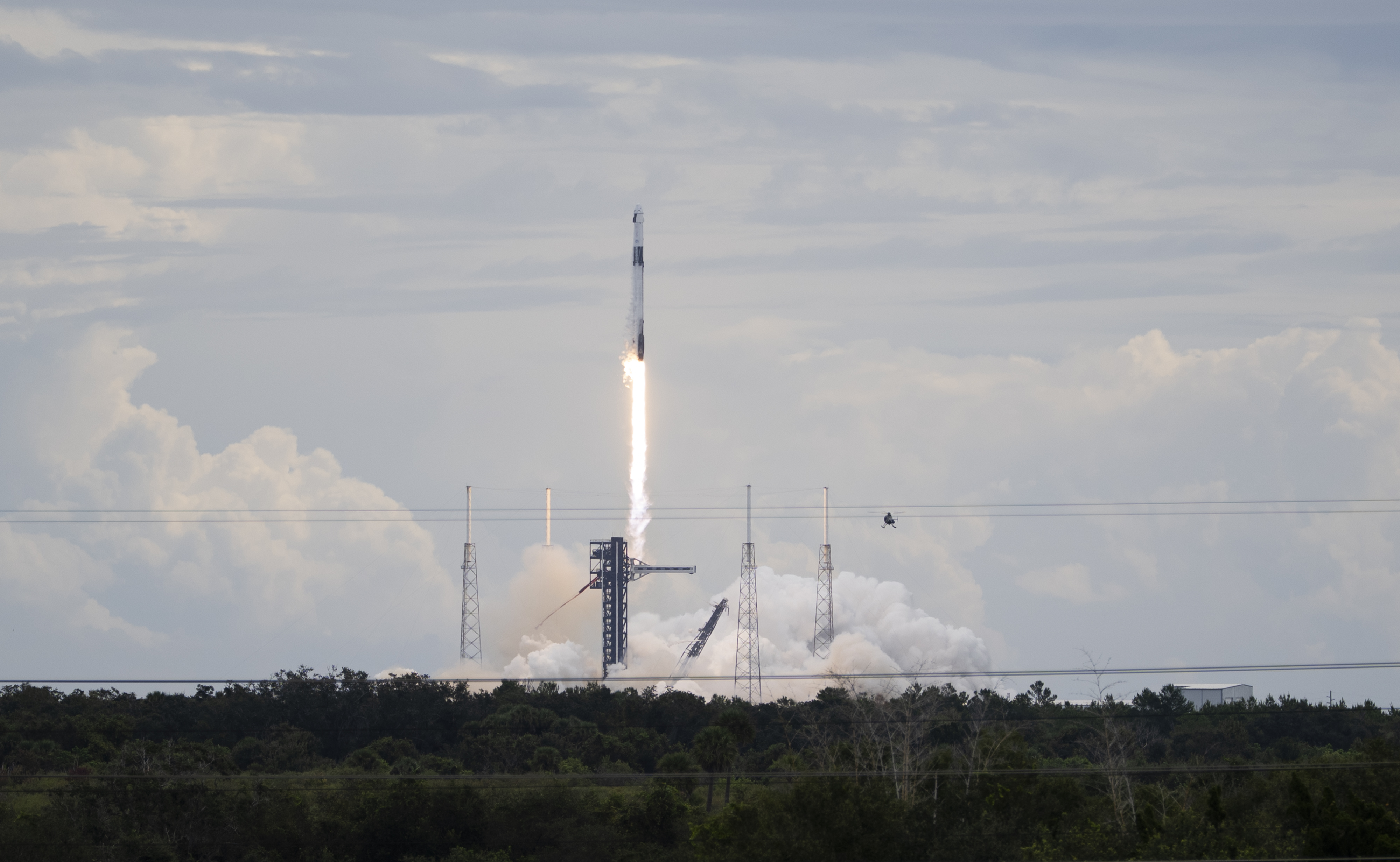
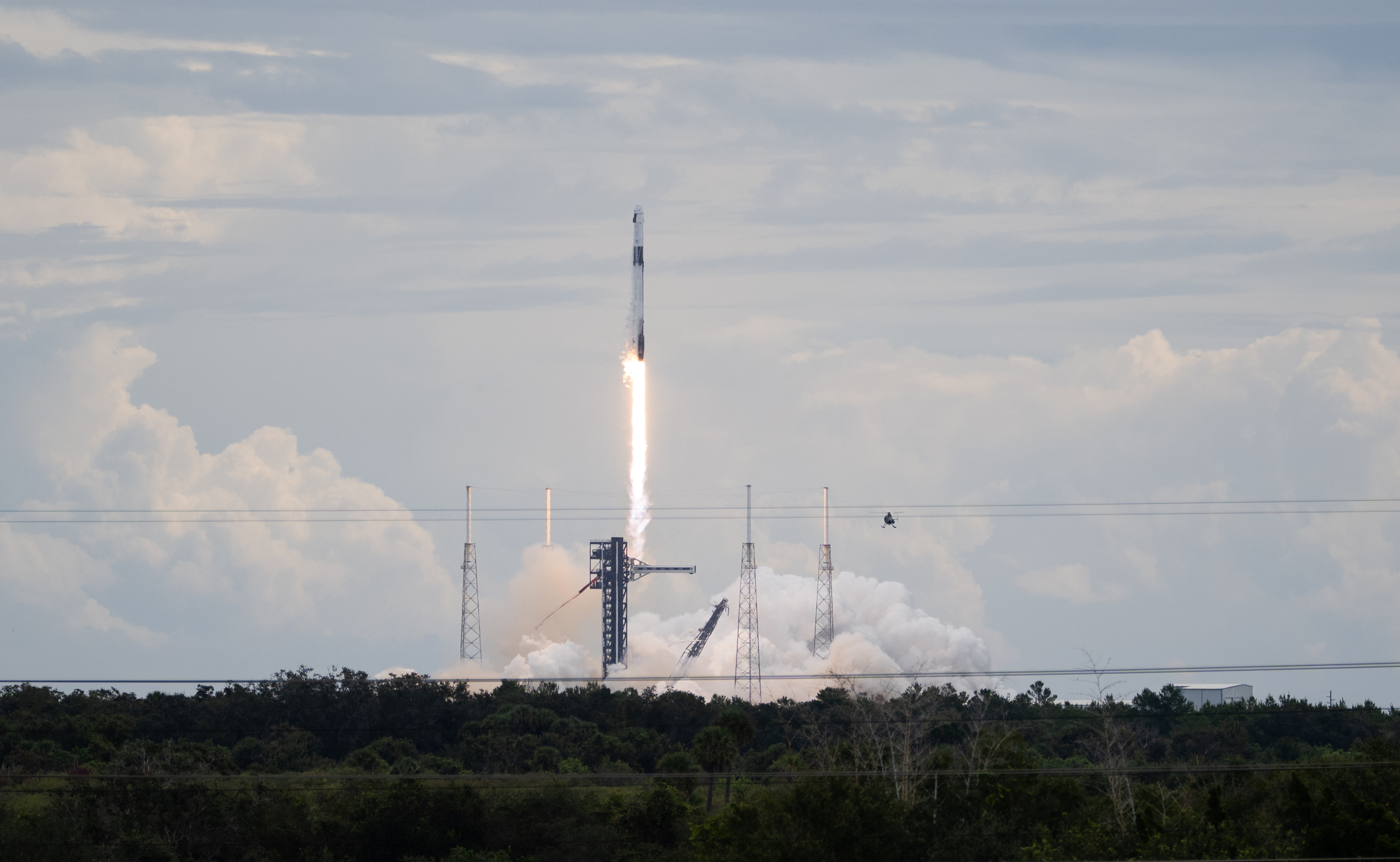
A SpaceX Falcon 9 rocket carrying the company’s Dragon spacecraft launched on NASA’s SpaceX Crew-13 mission to the International Space Station with NASA astronauts Jessica Watkins and Luke Delaney, CSA (Canadian Space Agency) astronaut Joshua Kutryk, and Roscosmos cosmonaut Sergey Teteryatnikov onboard, Thursday, Oct. 1, 2026, from Cape Canaveral Space Force Station in Florida.
Credit: NASA/Joel Kowsky

Four crew members of NASA’s SpaceX Crew-13 mission launched at 11:10 a.m. EDT Thursday from Space Launch Complex 40 at Cape Canaveral Space Force Station in Florida for a science expedition aboard the International Space Station.

“Crew-13 is another demonstration of America’s unmatched capability in human spaceflight and the strength of our commercial partnerships,” said NASA Administrator Jared Isaacman. “Jessica, Luke, Joshua, and Sergey will carry forward important work aboard the International Space Station while helping us build the experience and capabilities needed for ambitious missions to the Moon and beyond. Congratulations to the crew and the NASA and SpaceX teams who made today’s launch possible.”

A SpaceX Falcon 9 rocket propelled a Dragon spacecraft into orbit carrying NASA astronauts Jessica Watkins and Luke Delaney, CSA (Canadian Space Agency) astronaut Joshua Kutryk, and Roscosmos cosmonaut Sergey Teteryatnikov. The spacecraft will dock autonomously to the forward port of the station’s Harmony module at approximately 7 p.m., making it the fastest launch-to-docking by a U.S. spacecraft in the history of the International Space Station.

“Our steady cadence of commercial crew launches demonstrates the essential role the International Space Station plays in sustaining our presence in Earth’s orbit and sharpening the tools we’ll take forward to the Moon and Mars,” said Dr. Lori Glaze, associate administrator of NASA’s Human Spaceflight Mission Directorate at the agency’s headquarters in Washington. “Each space station mission adds to our blueprint for exploration, and the work our crews carry out guides our plans while ensuring we keep pushing the boundaries of what’s possible in human spaceflight.”

During Dragon’s approximately 7-hour, 50-minute flight, SpaceX will monitor a series of automatic spacecraft maneuvers from its mission control center in Hawthorne, California. NASA will monitor space station operations throughout the flight from the Mission Control Center at the agency’s Johnson Space Center in Houston.

NASA’s live arrival coverage begins at 5:20 p.m. for rendezvous, docking, and hatch opening. After docking, the crew members will change out of their spacesuits and prepare cargo for offload before opening the hatch to the station’s Harmony module around 8:45 p.m.

NASA will stream Crew‑13’s arrival across multiple platforms. Learn where to watch at:

https://www.nasa.gov/live

Watkins, Delaney, Kutryk, and Teteryatnikov will join the Expedition 75 crew, which includes NASA astronaut Anil Menon and Roscosmos cosmonauts Pyotr Dubrov and Anna Kikina already aboard the station. After a brief handover, NASA’s SpaceX Crew‑12 mission, with agency astronauts Jessica Meir and Jack Hathaway, ESA (European Space Agency) astronaut Sophie Adenot, and Roscosmos cosmonaut Andrey Fedyaev, will return to Earth.

During its mission, Crew‑13 will help advance research aboard the orbiting laboratory by using microgravity to produce human stem cell‑derived tissues for improved personalized medicine, disease modeling, and pharmaceutical testing for conditions such as heart disease and Parkinson’s. The crew also will explore crop production through a new, mostly autonomous plant growth system and test how plants grow outside dedicated facilities. In addition, the crew members will continue human‑health studies that examine factors linked to blood-flow abnormalities in microgravity and will test a new inflight diagnostic device to monitor astronaut health.

Crew-13 is part of NASA’s Low Earth Orbit Program, which partners with private companies to provide reliable access to space, support research and development aboard the space station, and enable future missions beyond low Earth orbit.

Learn more about NASA’s Space Crew-13 at:

https://www.nasa.gov/mission/nasas-spacex-crew-13/

-end-

Joshua Finch / Jimi Russell
Headquarters, Washington
202-358-1100
[email protected] / [email protected]

Steven Siceloff
Kennedy Space Center, Fla.
321-867-2468
[email protected]

Sandra Jones / Anna Schneider
Johnson Space Center, Houston
281-483-5111
[email protected] / [email protected]

Source: www.nasa.gov

What’s Up: October 2026 Skywatching Tips from NASA

A Meteor Shower and the Moon Near the Pleiades

See Saturn at opposition, catch the Orionid meteor shower, and watch the Moon pass close to the Pleiades, also known as the Seven Sisters.

Skywatching Highlights

  • Oct. 4: Saturn reaches opposition, making the ringed planet visible for much of the night
  • Oct. 6: A thin crescent Moon appears close to bright Jupiter before sunrise
  • Oct. 21–22: The Orionid meteor shower peaks; moonlight may interfere, so look before dawn after moonset
  • Oct. 27–28: The Moon passes near the Pleiades star cluster, also known as the Seven Sisters
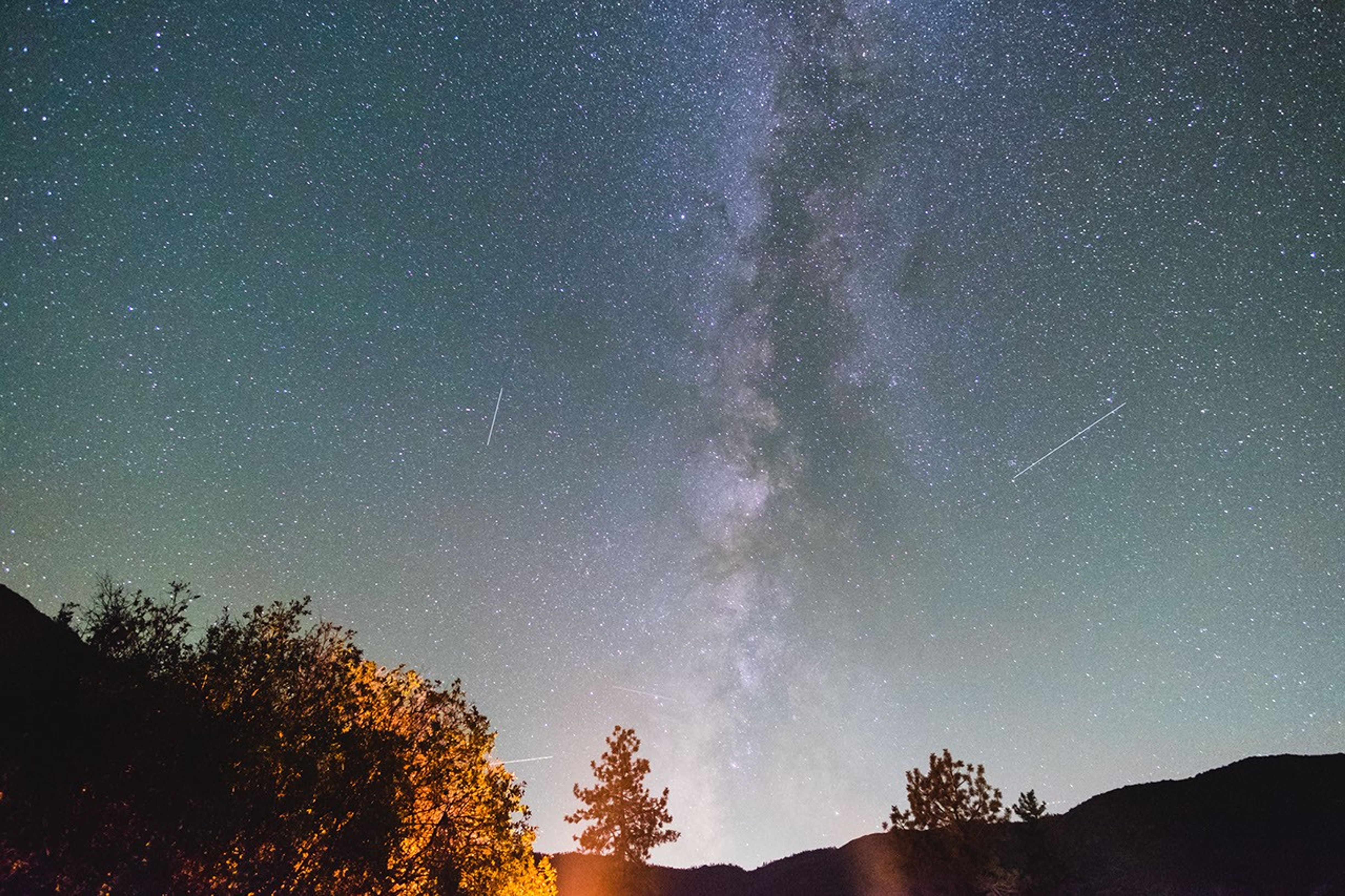
A long-exposure photograph of a clear night sky filled with countless stars, featuring the bright, dust-filled band of the Milky Way galaxy stretching vertically through the center. Faint streaks of light from meteors are visible across the sky. Along the bottom, dark silhouettes of trees and distant mountain ridges frame the horizon, with warm light glowing softly behind the foliage on the lower left.
Meteors streak across the sky during the 2017 Orionid meteor shower, with the Milky Way visible overhead.
Ben Goldstein via Flickr_CC BY-NC-SA

Transcript

Saturn takes center stage, a meteor shower lights up the sky, and the Moon visits the Seven Sisters. That’s What’s Up for October. 

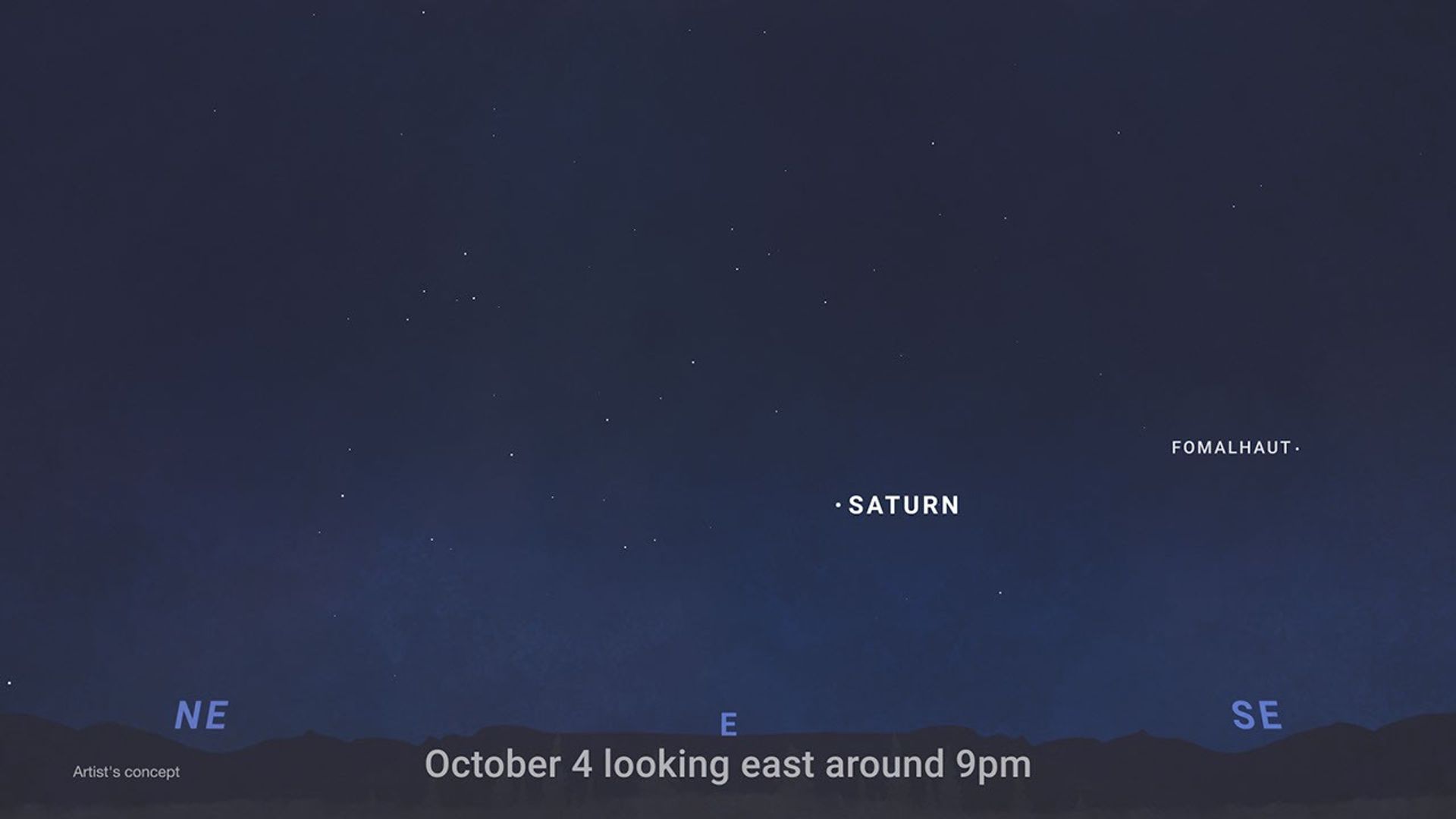
A night sky chart labeled
A sky chart showing Saturn above the eastern horizon on Oct. 4, 2026, around 9 p.m.
NASA/JPL-Caltech

On October 4th, Saturn reaches opposition, giving skywatchers one of the year’s best opportunities to see the ringed planet. Opposition happens when Earth passes between the Sun and Saturn. That puts Saturn opposite the Sun in our sky, so it rises around sunset and stays visible for much of the night.

Astronomers have long known about a hexagon-shaped jet stream that spans nearly 20,000 miles across Saturn’s north pole. But just last month, observations using NASA’s Hubble Space Telescope revealed a ten-sided atmospheric wave encircling the planet’s south pole. This southern hemisphere feature appears to be strengthening, giving scientists the rare opportunity to watch a giant atmospheric pattern develop.

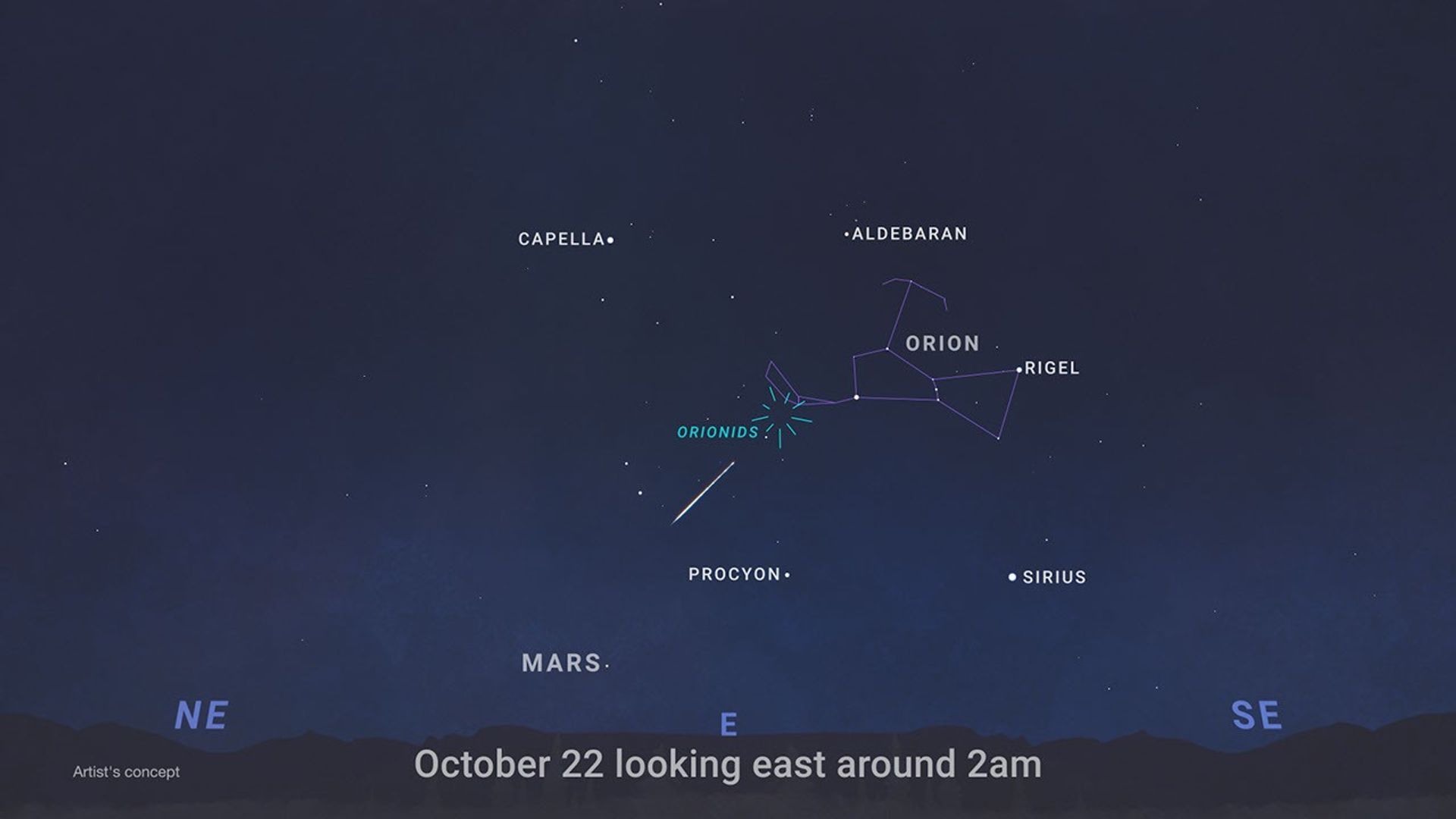
A dark night sky chart labeled
A sky chart illustrating where to view the Orionid meteor shower.
NASA/JPL-Caltech

The Orionid meteor shower peaks on the night of October 21st into the morning of October 22nd. The Orionids are created by tiny pieces of debris left behind by Halley’s Comet. They appear to radiate from the direction of Orion, but the meteors can streak across any part of the sky. A bright waxing gibbous Moon will wash out some of the fainter meteors this year. Your best chance may come in just a few hours before dawn, after the Moon sets. Find a dark location. Give your eyes time to adjust and look up.

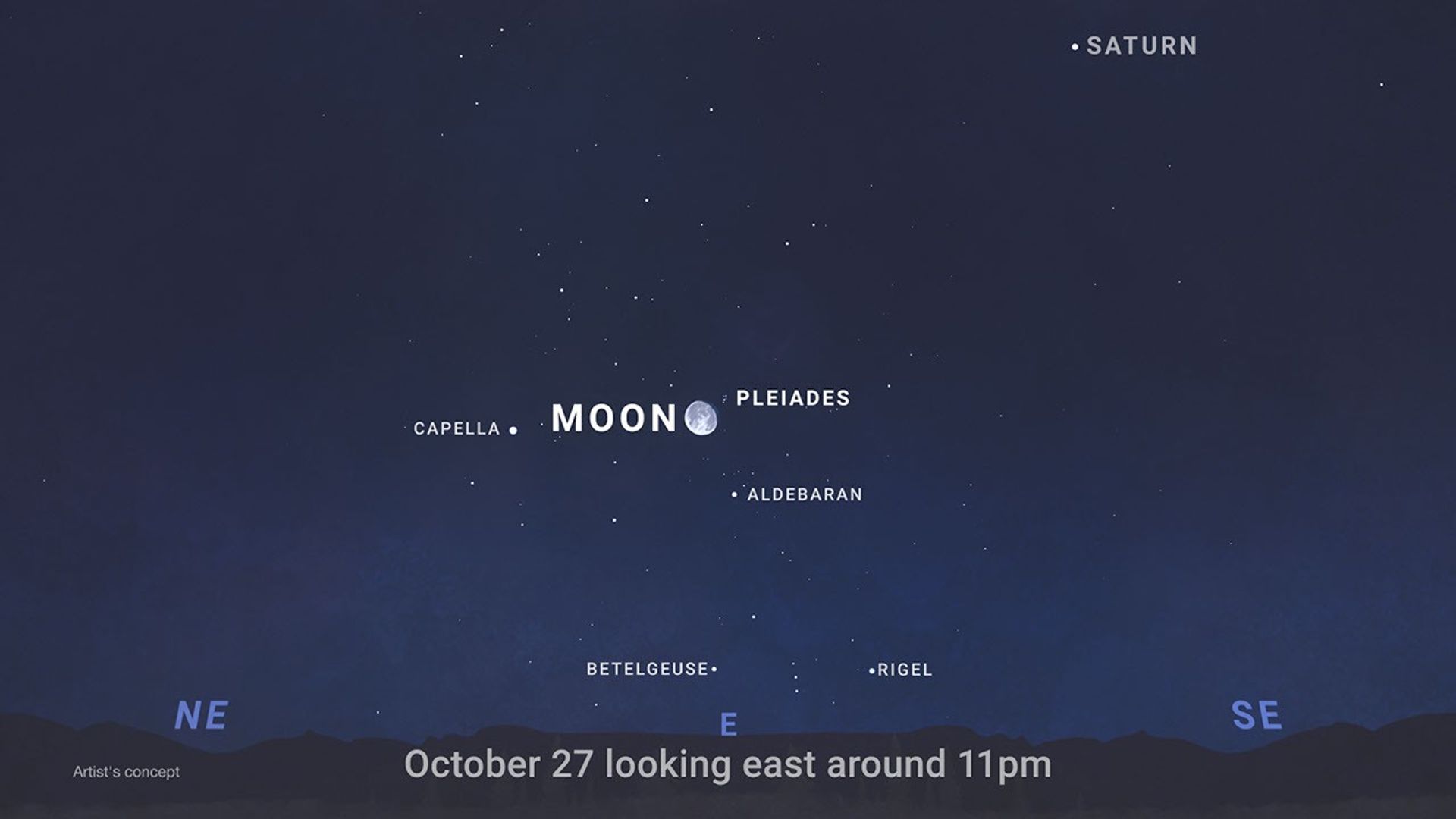
A night sky chart labeled
A sky chart showing the Moon next to the Pleiades on Oct. 27, 2026, looking east at around 11 p.m.
NASA/JPL-Caltech

On the night of October 27th into the 28th, look for the Moon passing close to a famous star cluster called the Pleiades, also known as the Seven Sisters. Many ancient cultures had stories associated with the Pleiades, due in part to the fact that the star cluster is visible from almost everywhere on the globe.

To spot them yourself, look east in the evening as the Moon and cluster climb higher into the night sky. The Pleiades appear as a slightly fuzzy grouping of 6 to 7 stars. They are visible to the unaided eye, but binoculars or a telescope reveal more spectacular detail.

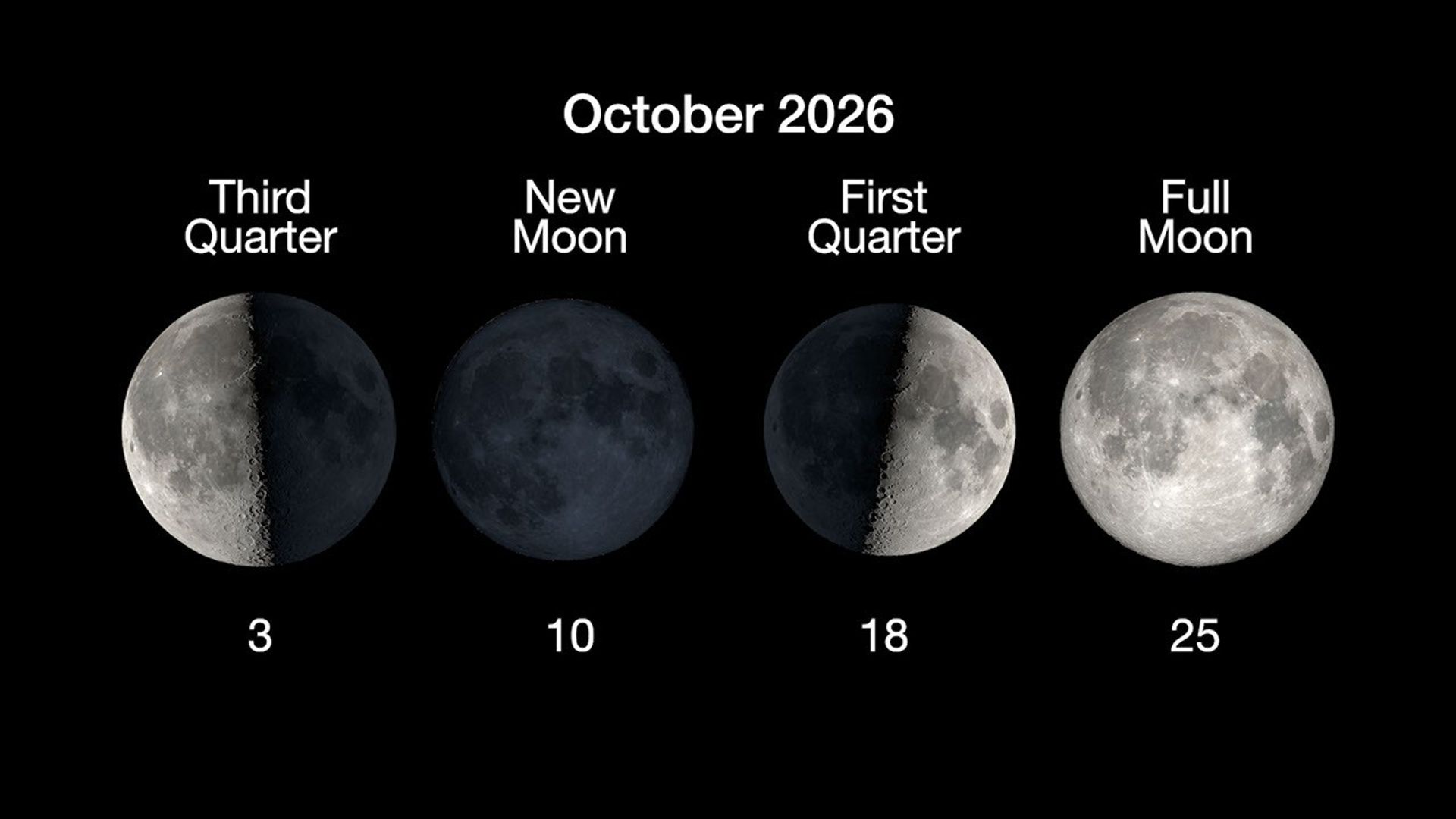
Here are the phases of the Moon for October.

An image titled
A chart showing the phases of Earth’s Moon in October 2026.
NASA/JPL-Caltech

You can stay up to date on all of NASA’s missions exploring the solar system and beyond at NASA Science.

I’m Raquel Villanueva from NASA’s Jet Propulsion Laboratory and that’s What’s Up this month.

Source: science.nasa.gov

NASA’s SpaceX Crew-13 Launches

A SpaceX Falcon 9 rocket carrying the company's Dragon spacecraft launches. There is a bright column of fire under the rocket as it moves upward. Clouds of vapor spread out below the rocket, almost blending into the similarly shaped clouds in the sky.
NASA/Joel Kowsky

In this Oct. 1, 2026, photo, a SpaceX Falcon 9 rocket and Dragon spacecraft launch from Space Launch Complex 40 at Cape Canaveral Space Force Station in Florida. The spacecraft is carrying NASA astronauts Jessica Watkins and Luke Delaney, CSA (Canadian Space Agency) astronaut Joshua Kutryk, and Roscosmos cosmonaut Sergey Teteryatnikov to the International Space Station for a long-duration science mission. They are expected to dock at the space station at 7 p.m. EDT.

NASA will stream Crew‑13’s arrival across multiple platforms. The agency’s live broadcast begins at 5:20 p.m. EDT. Learn where to watch at: https://www.nasa.gov/live

Learn more about the Crew-13 launch and mission.

Image credit: NASA/Joel Kowsky

Source: www.nasa.gov

Face of Defense: Soldier Fights Back From Cancer Diagnosis to Become a Drill Sergeant and CrossFit Athlete

Army Sgt. 1st Class Samantha Lamirand’s drive and determination drove her to continue her career after a health crisis and excel in the Army Reserve as a drill sergeant, combat engineer and competitive athlete.

Source: www.war.gov