NASA Shares Plans to Accelerate Artemis, Return to Moon

4 min read

Preparations for Next Moonwalk Simulations Underway (and Underwater)

In an update on Oct. 23, NASA Administrator Jared Isaacman and other agency leaders shared the agency’s path to returning Americans to the lunar surface in 2028.

Agency leadership provided updates on the previously announced acceleration plans for the Artemis program, advancing toward the agency’s Artemis III test flight in 2027 and Artemis IV Moon landing mission in 2028. Building on the priorities  announced at Ignition earlier this year, NASA leadership shared the agency’s significant progress across its missions, working with industry partners to test critical capabilities, reduce risk, and build toward a sustained American presence on the Moon.
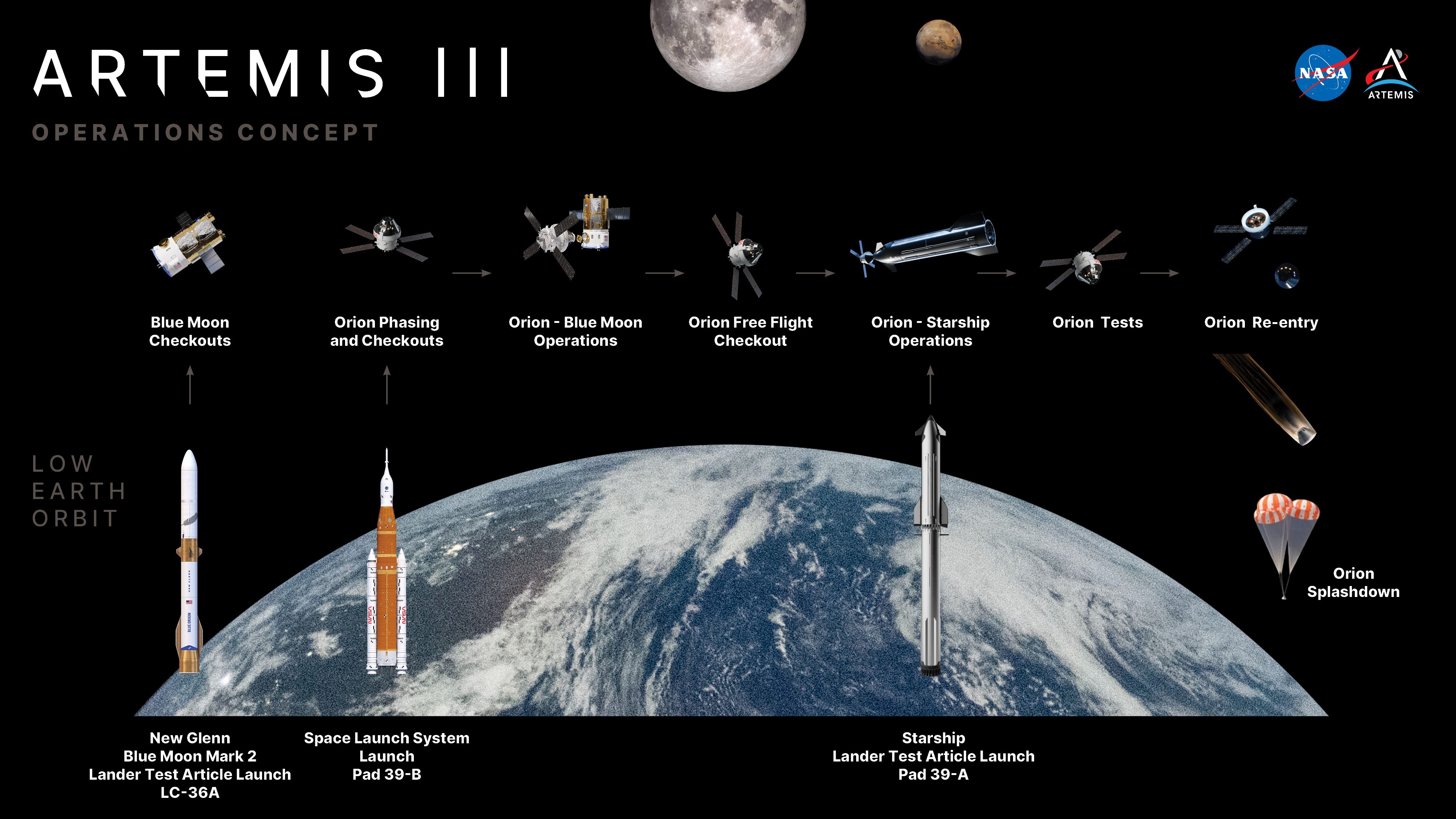
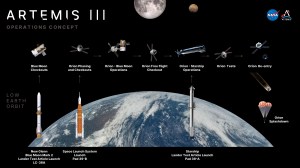
This graphic shows NASA’s concept of operations for Artemis III. The mission will send four astronauts to low Earth orbit next year to test critical systems needed for future lunar landings.
NASA

“This is a very energized NASA, and these updates are only a small part of that story. We are bringing extreme focus to the mission to ensure delivery of world-changing outcomes as quickly, safely, affordably, and successfully as possible,” said Isaacman. “NASA is driving outcomes to make Moon missions a reality, and we’re not waiting for others to bring their plans to us — the campaign must move with urgency as strategic competitors pursue a permanent presence beyond Earth.”

The agency shared details of the Artemis III mission, which will test rendezvous, docking, and operations between NASA’s Orion spacecraft and lunar lander test vehicles from SpaceX and Blue Origin in Earth orbit. Four astronauts will fly aboard Orion, launched on NASA’s SLS (Space Launch System) rocket, for a planned 14-day mission in Earth orbit to reduce risk ahead of the Artemis IV moon landing mission.

The Artemis III mission will unfold in sequence: Blue Origin will launch a Blue Moon lander test article into Earth orbit, SLS will launch Orion and its crew, docking with the Blue Moon lander test article, then SpaceX will launch a Version 3 Starship lander test article while Orion will undock from Blue Moon and dock with Starship.

The Oct. 23 updates follow other recent updates about the Artemis missions. Hardware for Artemis III is on track, with processing timelines sharply reduced by about half. NASA also redesigned, built, and tested a critical fuel-line component in-house in five months, at roughly a tenth of the cost of an earlier outside-vendor estimate.

“NASA should be expected to do this kind of work, and we have some of the best technical knowledge in the world on rocket hardware and operations to do it,” said Jeremy Parsons, the agency’s Artemis program manager. “It’s an example of how we are rebuilding our core competencies and developing centers of excellence in technical functions instead of continuing to outsource expertise.”

Artemis IV: Pursuing multiple paths to Moon landing

For the agency’s Artemis IV mission in 2028, astronauts will launch aboard Orion on the SLS rocket from NASA’s Kennedy Space Center in Florida. NASA is working with SpaceX and Blue Origin to develop lunar landers to carry those astronauts to the Moon’s surface. Both companies have redesigned their approaches to simplify the missions and make them more efficient and flexible as compared to previous mission designs.

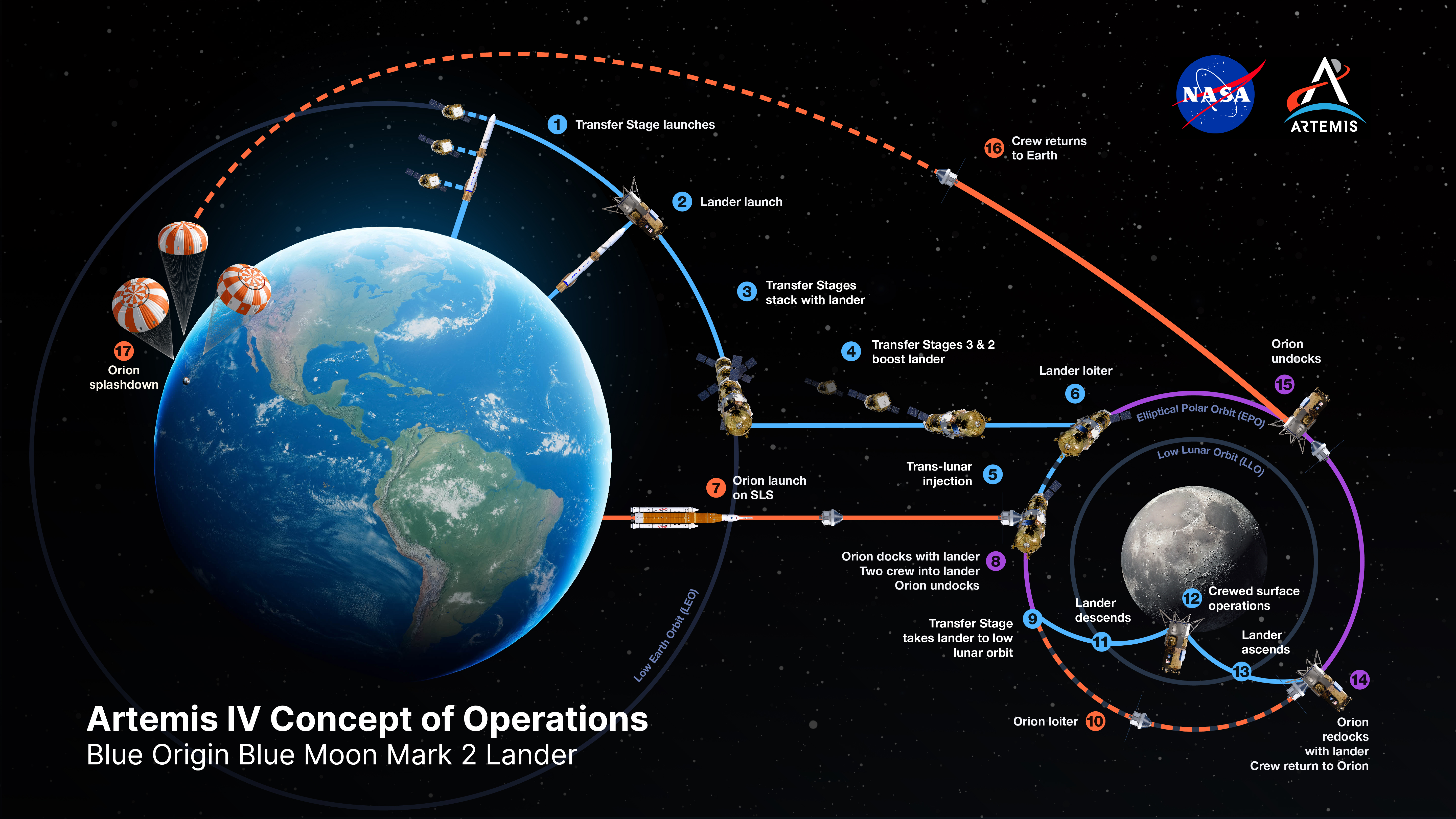
SpaceX’s Starship will refuel in Earth orbit, rendezvous with Orion, and then carry the spacecraft toward the Moon. Blue Origin’s approach involves transfer stages in Earth orbit to push its Blue Moon Mark 2 lander toward the Moon, where it will meet Orion in a closer lunar orbit before descending to the surface.
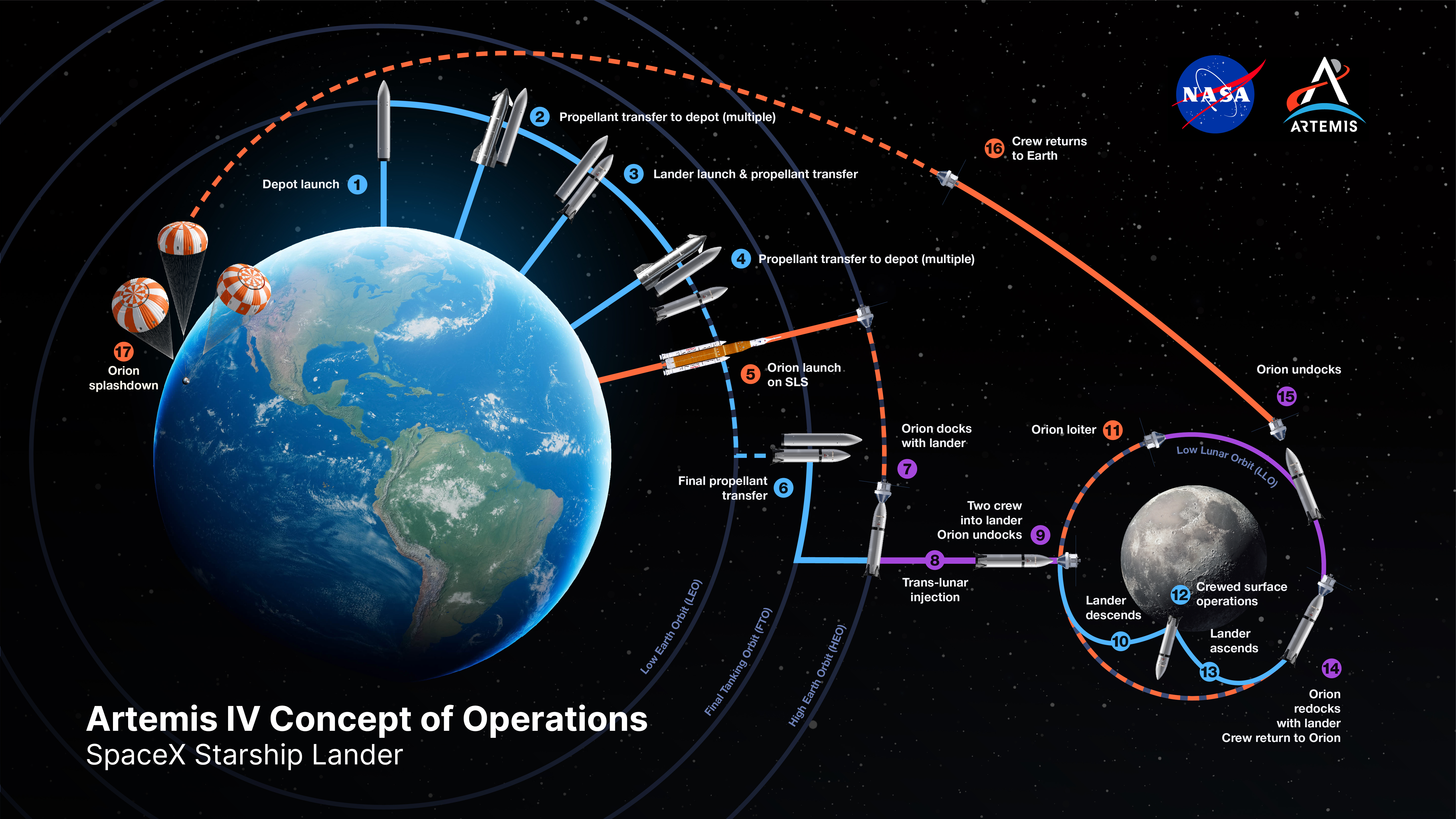
Artemis IV Concept of Operations (SpaceX Starship Lander) infographic.
NASA
Artemis IV Concept of Operations (Blue Origin Moon Mark 2 Lander) infographic.
NASA

Both SpaceX and Blue Origin are targeting to be able to support a crewed lunar landing in 2028.  

For Artemis IV, NASA is pursuing two upper-stage options for the SLS rocket: its current stage, the interim cryogenic propulsion stage; and a stretched version of ULA’s Centaur V which can carry more propellant. Pursuing both options ensures NASA is maintaining flexibility and preventing single-point dependency.

NASA also announced plans with spacesuit provider Axiom Space to develop a second, lighter suit design called the “Sortie suit” to enable the first moonwalks. The Sortie suit will not replace Axiom’s primary suit, which will be used for longer, more demanding missions in the future. The Sortie suit is roughly half the weight of the larger suit and lets NASA move faster on the earliest surface missions.

As part of a Golden Age of innovation and exploration, NASA will send Artemis astronauts on increasingly difficult missions at the lunar South Pole to explore more of the Moon than ever before. In addition to providing economic benefits and advancing scientific discovery through its Moon missions, NASA will establish an enduring human presence on the lunar surface and build on the agency’s foundation for the first crewed mission to Mars.
Learn more about Artemis:

https://www.nasa.gov/artemis

About the Author

Jonathan Deal

Public Affairs Officer

Source: www.nasa.gov
Cyprus: Island of Snakes, Cats, and Ophiolites

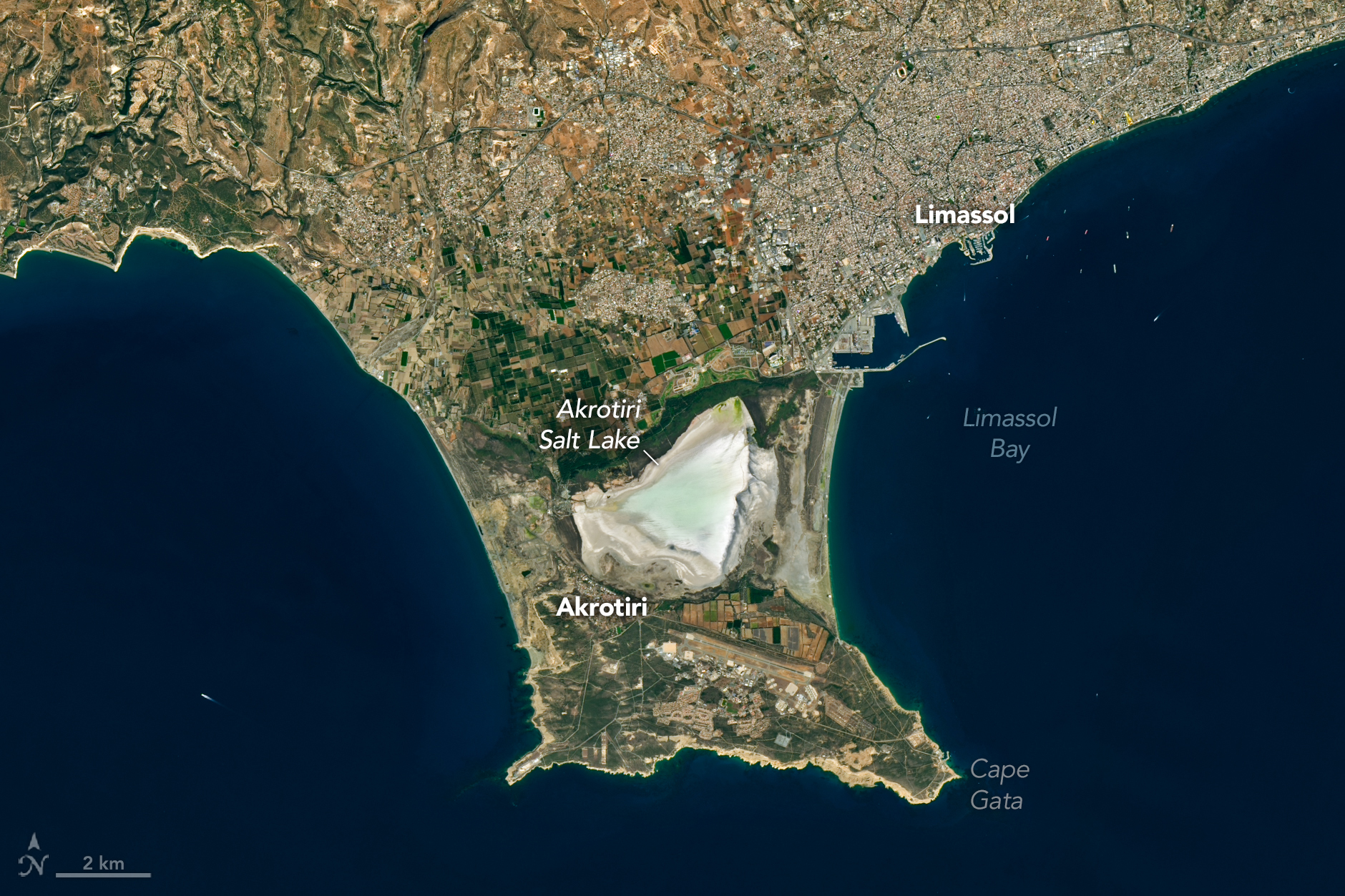
The bright salt flats of Akrotiri Salt Lake stand out in a satellite image of the Akrotiri peninsula. Gray urban areas around Limassol spread across the landscape north of the lake, and the blue waters of the Mediterranean Sea surround the peninsula to the south.
Seasonal rains had started to fill Akrotiri Salt Lake when the OLI (Operational Land Imager) on Landsat 8 captured this image of Cyprus’s Akrotiri Peninsula on October 10, 2026.
NASA Earth Observatory/Michala Garrison

The island of Cyprus began to form some 90 million years ago during the Late Cretaceous, with molten rock pouring from the seafloor, solidifying, and building new oceanic crust. Over time, portions of this oceanic rock were wrenched upward by tectonic forces, eventually emerging as a rugged island made of ophiolite, a type of rock with a mottled green appearance said to look like the skin of a snake. Remnants of that ancient island are still visible in the dark rocks of the Troodos Mountains.

During the Miocene, considerably younger layers of chalk, limestone, marl, and other marine sedimentary rocks accumulated around the island, providing material that developed into a second, smaller island to the south during a later period of geologic uplift. Over time, sediment poured from rivers into the channel separating the two islands and combined with marine sediments to create deltas and eventually two land bridges, or tombolos. The joined landmass comprises the Akrotiri Peninsula, now the southernmost tip of Cyprus.

The sandy edges of the peninsula were visible when Landsat 8 captured these images on October 10, 2026. Akrotiri Salt Lake, a coastal lagoon that was once an arm of the Mediterranean Sea, lies between the two tombolos. The more westerly feature, the Kouris River tombolo, formed first, developing about 50,000 years ago from river-deposited gravels and sands. The eastern tombolo extended southward from Cyprus, cutting off the Mediterranean Sea only within the past 2,000 years, according to geologists.

The lake’s water levels now vary markedly with the seasons, typically filling in the late autumn and winter and drying out in the summer. The influx of winter water has historically attracted sizable overwintering flamingo populations, averaging about 4,000 birds. However, the wintering flamingo population has declined in recent years, plummeting to 30 birds in 2025, according to news reports. Flamingos have long flocked to the lake to feed on fairy shrimp, which are rich in colorful substances called carotenoids that give the birds their famously pink hue.

Snakes are another of the island’s more notorious animal inhabitants. In antiquity, Cyprus was known as Ophiousa, or “land of snakes,” likely due to its robust population of blunt-nosed vipers. According to legend, the island’s snake communities grew to be so problematic during a drought in the fourth century that the Roman Empress Helena, mother of Constantine the Great, called for shiploads of cats to be sent from Egypt to control the venomous reptiles.

The first feline imports were released in a particularly snake-infested area on the southeastern part of the Akrotiri Peninsula, an area that came to be known as Cape Gata (Cape Cat in Greek). The cape today is still home to the Holy Monastery of St. Nicholas of the Cats, a place where legend says that monks encouraged newly arrived Egyptian cats to hunt snakes. Today, Cyprus has as many cats as people, with more than one million of the feline predators stalking the island. The handful of nuns who now live in the monastery still care for hundreds of cats, according to the St. Nicholas Center. 

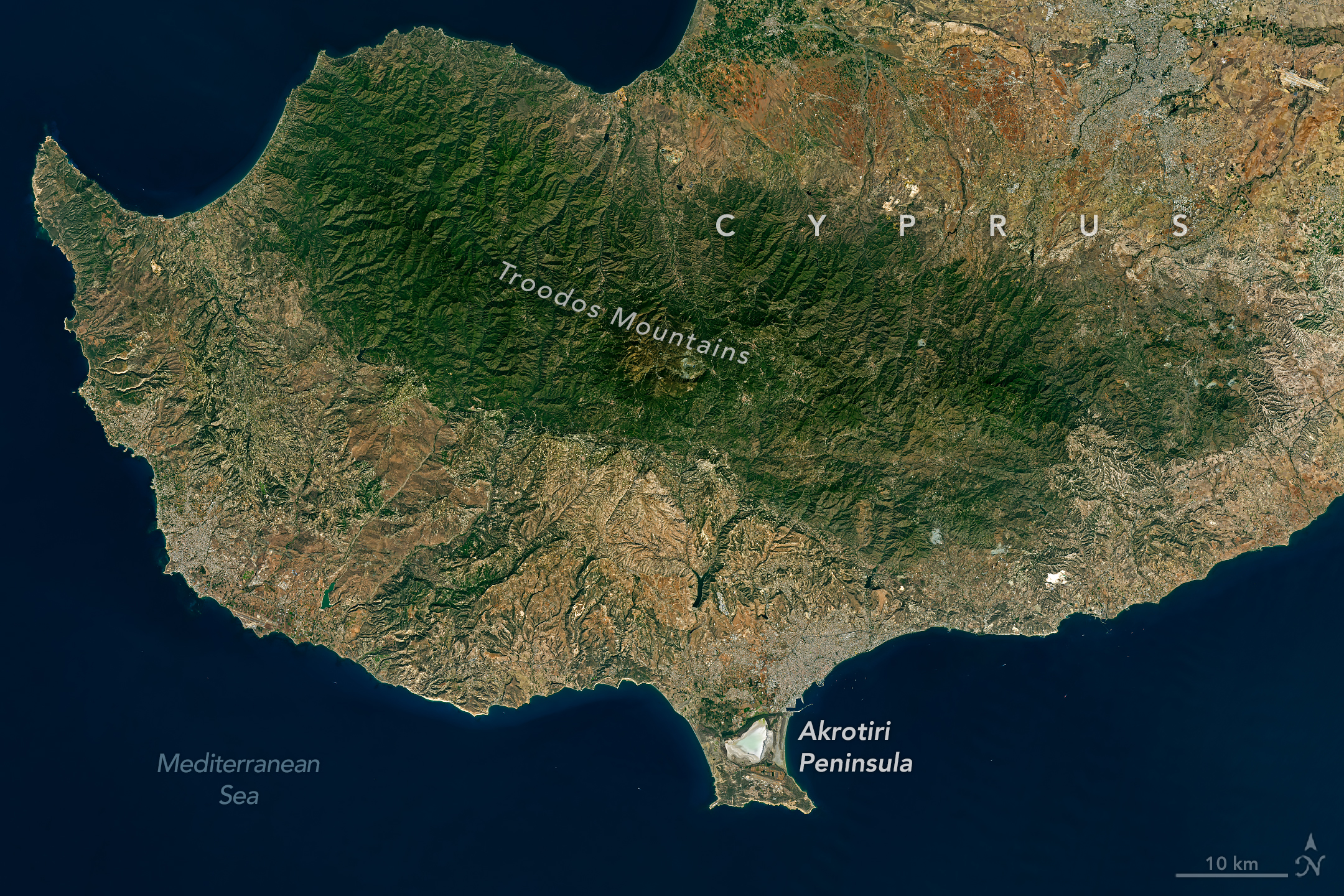
The Troodos Mountains’ vegetation and dark underlying rocks make a swath of land in the southwestern part of the island appear darker green than the rest of the island.
A broader image of Cyprus captured by the OLI (Operational Land Imager) on Landsat 8 shows the western half of the island on October 10, 2026.
NASA Earth Observatory/Michala Garrison

NASA Earth Observatory images by Michala Garrison, using Landsat data from the U.S. Geological Survey. Story by Adam Voiland.

References & Resources

You may also be interested in:

Stay up-to-date with the latest content from NASA as we explore the universe and discover more about our home planet.

New Zealand’s Southern Wilderness

3 min read

Stewart Island/Rakiura, New Zealand’s third-largest island, is known for its vibrant birdlife, unique forests, wilderness beaches, and views of the…

Article

What Lake Bonneville Left Behind

5 min read

The drying of the massive lake exposed playas that became the setting for feats of engineering and technological ingenuity, as…

Article

The Battle for Sullivan’s Island

5 min read

Marshy, sandy terrain and an impassable inlet helped colonial forces repel British forces during a pivotal battle on the barrier…

Article

Source: science.nasa.gov

APOD: 2026 November 5 – Enceladus in Silhouette

APOD

Astronomy Picture of the Day

Discover the cosmos! Each day a different image or photograph of our fascinating universe is featured, along with a brief explanation written by a professional astronomer.

Saturn moon Enceladus in silhouette

Enceladus in Silhouette

Explanation: One of our Solar System’s most tantalizing worlds, Enceladus is backlit by the Sun in this Cassini spacecraft image from November 1, 2009. The dramatic illumination reveals the plumes that continuously spew into space from the south pole of Saturn’s 500 kilometer diameter moon. Discovered by Cassini in 2005, the icy plumes are likely connected to an ocean beneath the ice shell of Enceladus. They supply material directly to Saturn’s outer, tenuous E ring and make the surface of Enceladus as reflective as snow. Across the scene, Saturn’s icy rings scatter sunlight toward Cassini’s cameras. Beyond the rings (lower right), the night side of 80 kilometer diameter moon Pandora is faintly lit by Saturnlight.

Tomorrow’s picture: pixels in space

Date: November 5, 2026
Credit: Cassini Imaging Team, SSI, JPL, ESA, NASA
Authors & editors: Jerry Bonnell, Cecilia Chirenti, Robert Nemiroff, Keighley Rockcliffe
A service of: ASD at NASA / GSFC,
NASA Science Activation & Michigan Tech. U.

Source: science.nasa.gov

Hubble Learns Galactic History From Stars

3 min read

Hubble Learns Galactic History From Stars

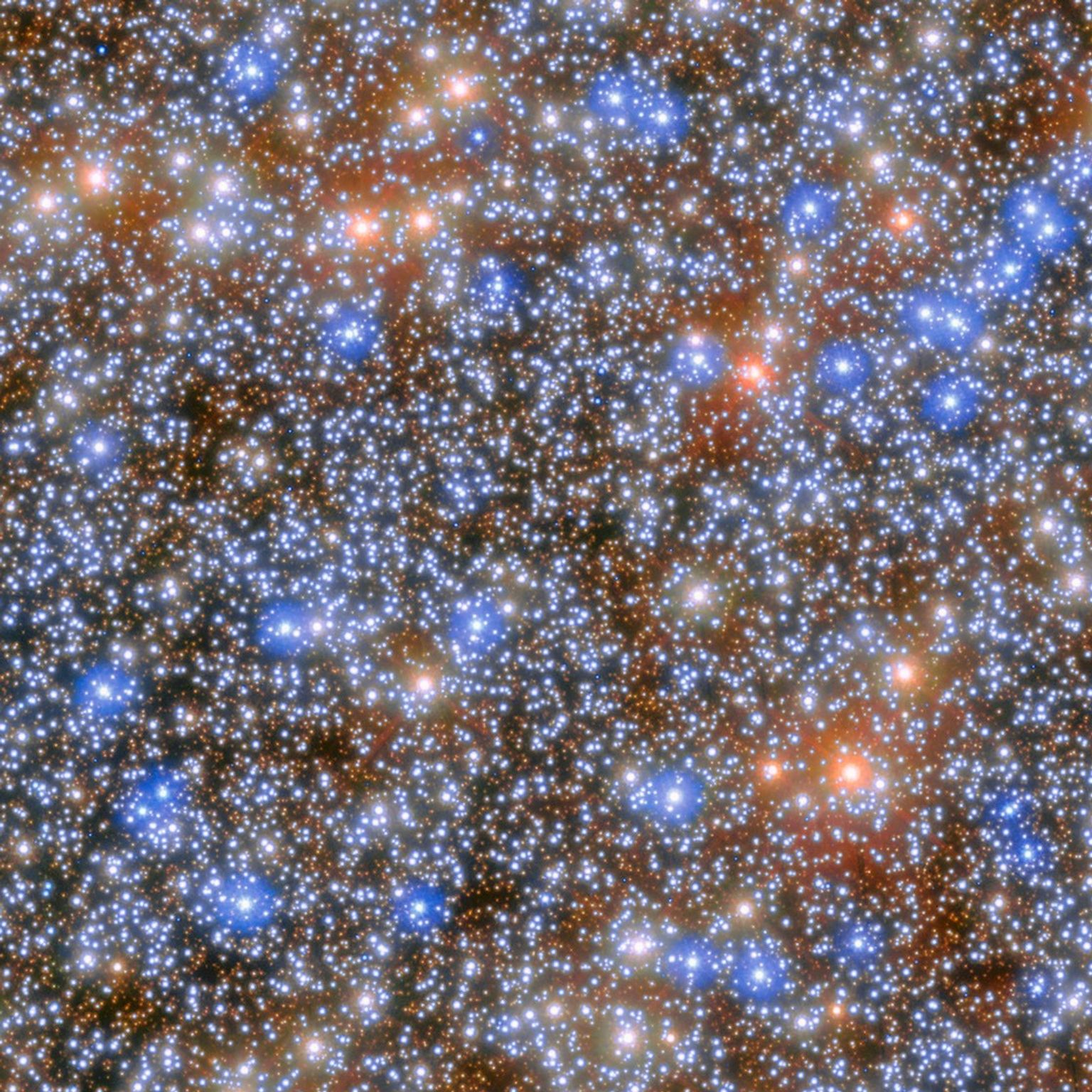
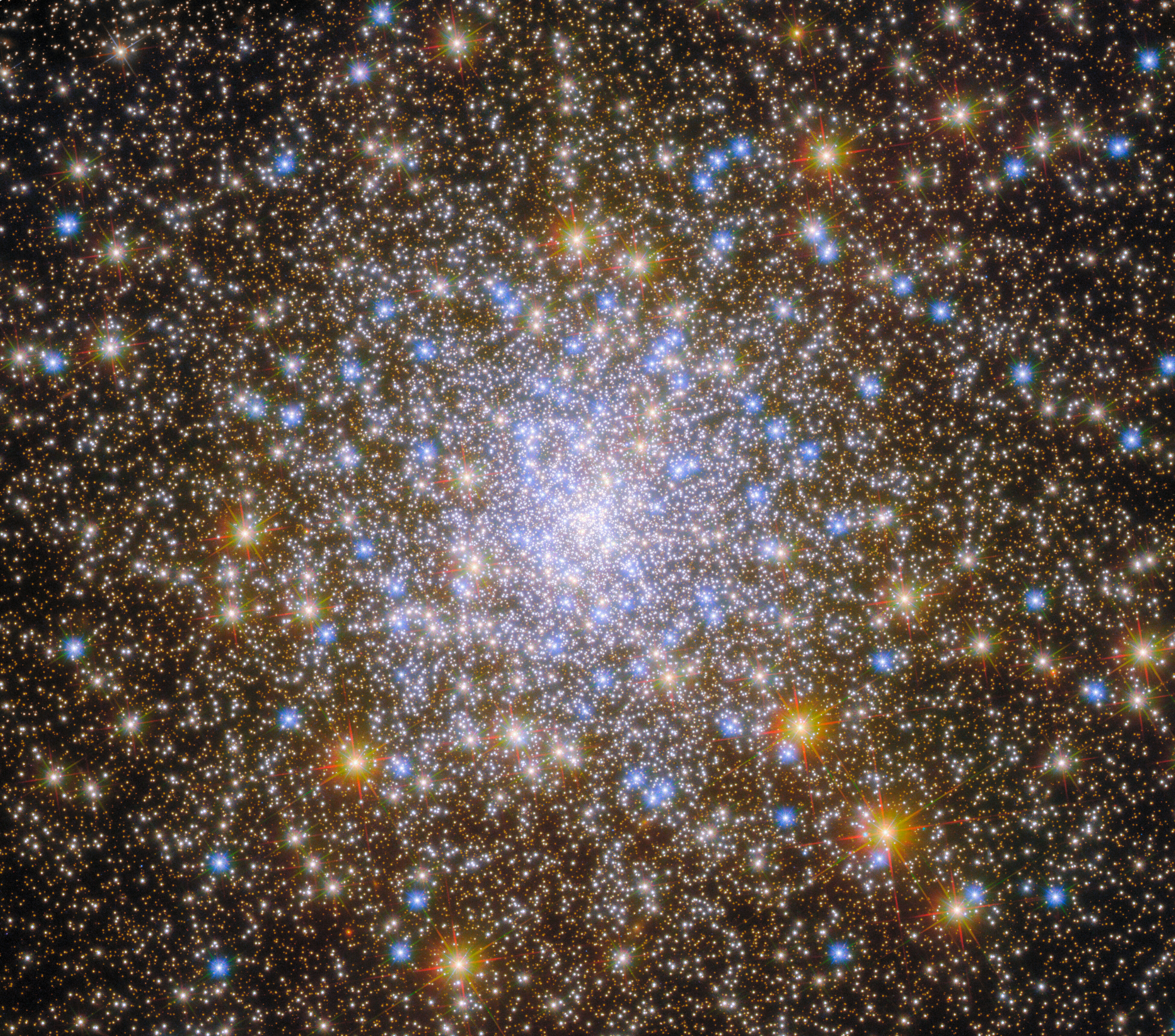
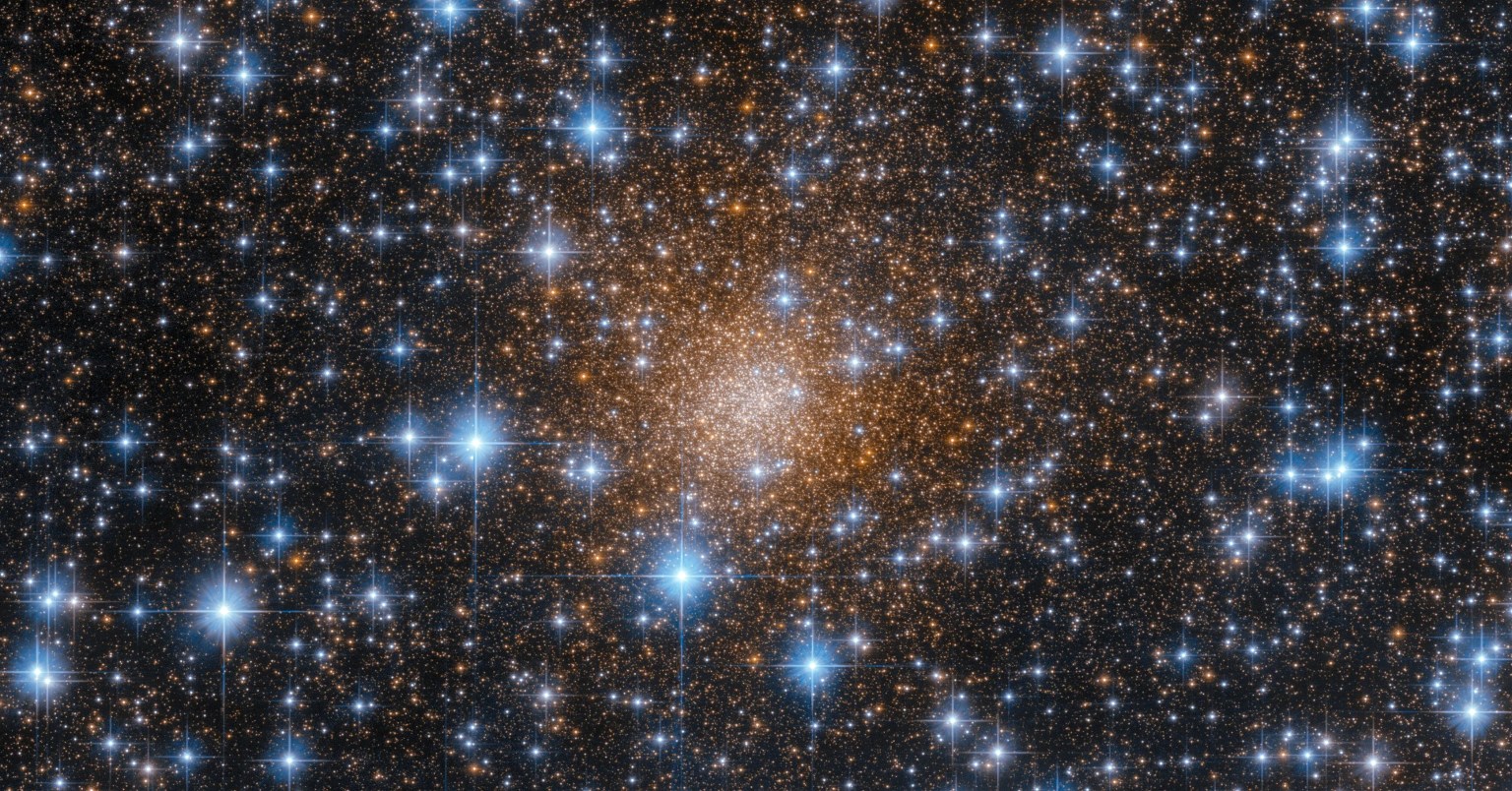
A star cluster seen up close, filling the view with thousands of stars. They are clearly divided between blue ones, which are scattered around the outskirts of the image but more towards the center and are the majority in the bright core of the cluster, and yellow stars, which are present in the core but make up most of the cluster outside of that. A few orange stars are closer to us and appear noticeably larger.
This NASA/ESA Hubble Space Telescope image features the globular star cluster called Messier 30 (M30), also called NGC 7099.
ESA/Hubble & NASA, M. Libralato, G. Piotto, A. Sarajedini

This NASA/ESA Hubble Space Telescope image provides a lesson in galactic history. The sparkling collection of stars is named Messier 30 (M30) after the French astronomer, Charles Messier, who cataloged M30 and other diffuse objects that might be mistaken for comets in the early telescopes of Messier’s time. M30 lies about 27,500 light-years away in the constellation Capricornus.

M30 is a globular cluster: a roughly spherical grouping of stars containing anywhere from tens of thousands to millions of stars. These clusters generally reside on the outskirts of galaxies, orbiting within a vast, diffuse region called the halo like a swarm of moths around a lightbulb. Our Milky Way galaxy has at least 150 globular clusters, the nearest of which is about 6,000 light-years away. These clusters are impressively ancient: astronomers estimate their ages are between 11.5 to 13.5 billion years, making certain globular clusters nearly as old as the universe itself.

Globular clusters have long played an important role in helping us learn about our galaxy. More than a century ago, astronomer Harlow Shapley used observations of a particular type of variable star to measure the locations of and distances to dozens of globular clusters within our galaxy. His work showed that the Sun is not in the center of our galaxy, and that the galactic center lies toward the constellation Sagittarius. (His distance measurements were incorrect, however, and he concluded that our galaxy is about twice as large as it really is.)

Today, astronomers continue to learn about our galaxy by observing globular clusters. Because globular clusters are so ancient, they can give us clues about how our galaxy developed long ago. Globular clusters that formed within our galaxy can act as time capsules, preserving the original chemistry of our young galaxy.

However, it’s possible that not all globular clusters that orbit within our galaxy today formed there. Researchers have discovered that M30 and many other globular clusters orbit in the direction opposite from the way our galaxy spins. This may mean that these clusters did not form within our galaxy at all. Instead, our Milky Way galaxy may have captured them in the distant past!

Hubble has observed M30 multiple times. A previously released image of M30 featured data from Hubble’s Advanced Camera for Surveys (ACS) and was part of an observing program (#10775; PI: Sarajedini) that surveyed dozens of Milky Way globular clusters in red and near-infrared light, revealing stars down to just 20% of the mass of the Sun. A more recent program (#13297; PI: Piotto) returned to M30 and other globular clusters in our galaxy, this time observing the clusters with Hubble’s Wide Field Camera 3 and using three filters that captured bluer light. This program collected data that was critical for studying exotic objects like “blue straggler” stars as well as for investigating the multiple populations of stars that can inhabit a single globular cluster.

More recently, Hubble’s ACS viewed many of these globular clusters again. Those observations were part of a program (#16298, PI: Libralato) that looked at how different populations of stars in globular clusters moved over the 15 years since Hubble first observed them — a feat made possible by Hubble’s longevity and ability to discern fantastically small details in distant objects.

The image above was created with data from all three observing programs and includes the wide range of wavelengths Hubble can see — ultraviolet, visible, and near-infrared light. Each wavelength helps us better understand how these groups of stars formed and evolved.

Text credit: ESA/Hubble

Media Contact:

Claire Andreoli
NASA’s Goddard Space Flight Center, Greenbelt, MD
[email protected]

Source: science.nasa.gov

NASA Astronauts to Answer Questions from Florida Students

From left, SpaceX Crew-13 pilot Luke Delaney and commander Jessica Watkins, both NASA astronauts, are pictured in their pressure suits during a training session at SpaceX headquarters in Hawthorne, California.
Credit: SpaceX

Students in Florida will hear from NASA astronauts Jessica Watkins and Luke Delaney as they answer prerecorded STEM questions while aboard the International Space Station.

The Earth-to-space call will begin at 10:40 a.m. EST Tuesday, Nov. 10, and will stream live on the agency’s Learn With NASA YouTube channel.

This event is hosted by Freedom Crossing Academy in St. Johns, Florida, for students in grades K-12, and the community. This unique opportunity aims to deepen understanding of space exploration and enhance awareness of STEM careers.

Media interested in covering the event must RSVP no later than 5 p.m. EST, Monday, Nov. 9, to Christina Upchurch at (904) 547-7517, or at [email protected].

For more than 26 years, people have lived and worked continuously aboard the International Space Station, advancing scientific knowledge and making research breakthroughs not possible on Earth. The space station helps NASA understand and overcome the challenges of human spaceflight, expand commercial opportunities in low Earth orbit, and build on the foundation for long-duration missions to the Moon, as part of the Artemis program, and to Mars.

For more information on NASA in-flight calls, visit:

https://www.nasa.gov/stemonstation

Details

Last Updated

Nov 05, 2026

Source: www.nasa.gov
Midwestern City Lights

City lights from the Midwestern United States to the East Coast sparkle across the landscape a couple of hours before sunrise.
CSA/Joshua Kutryk

City lights from the Midwestern United States to the East Coast sparkle across the landscape a couple of hours before sunrise on Oct. 18, 2026. Major urban areas visible in the photograph include Chicago, Illinois; Detroit, Michigan; and the New York metropolitan region. The International Space Station was orbiting 259 miles above Earth when this photograph was taken.

Image credit: CSA/Joshua Kutryk

Source: www.nasa.gov
NASA Announces X-70 Experimental Aircraft to Advance Flight Research 

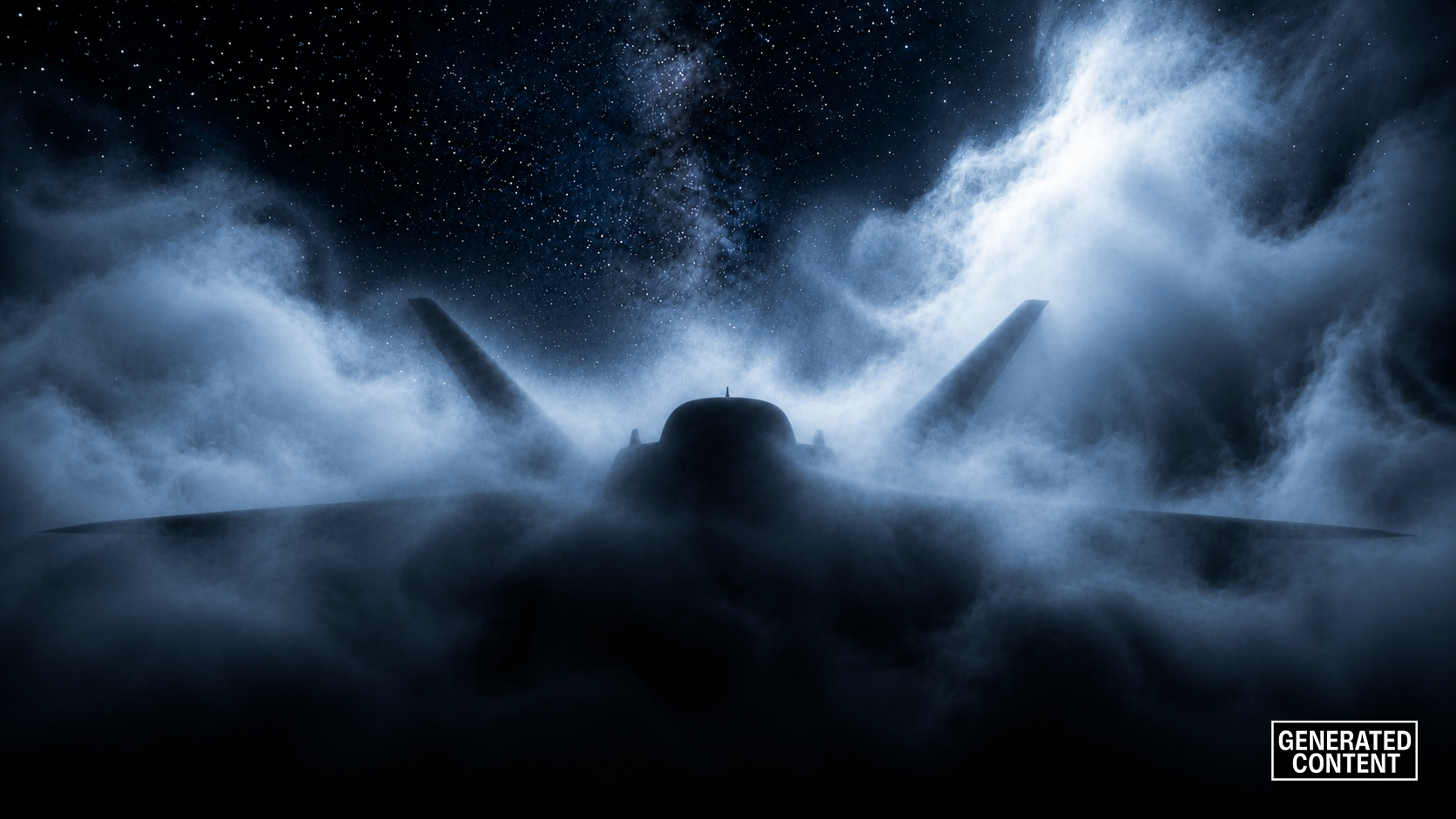
Generated image of the silhouette of a dark plane on a dark background surrounded by vapor.
Generated image of NASA’s new X-70 Fractal experimental aircraft, a crewed, rapidly reconfigurable research platform for advanced aviation technologies.

On Wednesday, NASA unveiled its newest experimental aircraft, the X-70 Fractal, during the UP.Summit at the agency’s Kennedy Space Center in Florida. This high-performance, highly adaptable research platform is designed to accelerate the development and testing of advanced aviation technologies. 

The crewed X-70 features advanced, rapidly reconfigurable flight-control technology that will allow NASA to explore aircraft maneuverability in ways never before demonstrated in crewed flight. The aircraft can also accommodate up to 2,000 pounds of experimental payloads in internal and external locations, enabling a wide range of research and flight-testing opportunities. 

“The X-70 Fractal gives NASA a crewed, high-performance platform to test advanced flight-control, maneuverability, and other cutting-edge technologies in real flight,” said NASA Administrator Jared Isaacman. “Its modular design and ability to rapidly swap internal and external payloads will keep our teams flying, learning, and moving quickly from one experiment to the next. We expect her first flight under the NASA banner within the next two years, and X-70 is just one part of this new beginning for aeronautics. This is why people come to NASA: to build, to learn, and most importantly, to fly.” 

The X-70 Fractal has a takeoff weight of 10,000 pounds and is designed to cruise at Mach .75, reach altitudes of up to 45,000 feet, and provide an operational range exceeding about 1,726 miles (1,500 nautical miles). These capabilities will enable NASA to conduct demanding flight research across a broad range of operating conditions. 

“For decades, NASA Aeronautics has used X-planes to develop technologies that advance aviation,” said Laurie Grindle, director of the Aeronautics Division within NASA’s Research and Technology Mission Directorate. “It’s exciting to bring on another X-plane to accelerate and drive aeronautics research.” 

The X-70 joins a storied legacy of experimental aircraft that have helped establish America’s leadership in aviation. From the Bell X-1, which first broke the sound barrier in 1947, to the X-15 hypersonic research aircraft and today’s X-59 quiet supersonic demonstrator, NASA has spent decades pushing the boundaries of flight. 

With the X-70, NASA will expand its capacity to conduct experimental flight research, accelerate the testing of emerging technologies, and advance the next generation of American aviation. 

For more information about NASA’s aeronautics research, visit: 

https://www.nasa.gov/aeronautics

-end- 

George Alderman / Cheryl Warner
Headquarters, Washington 
202-358-1600
[email protected] / [email protected] 

Details

Last Updated

Nov 05, 2026

Editor
Jennifer M. Dooren

Details

Last Updated

Nov 05, 2026

Editor
Jennifer M. Dooren

Source: www.nasa.gov