Discover the cosmos! Each day a different image or photograph of our fascinating universe is featured, along with a brief explanation written by a professional astronomer.
NASA’s Webb Captures Commotion From Nebula’s Stellar Jets
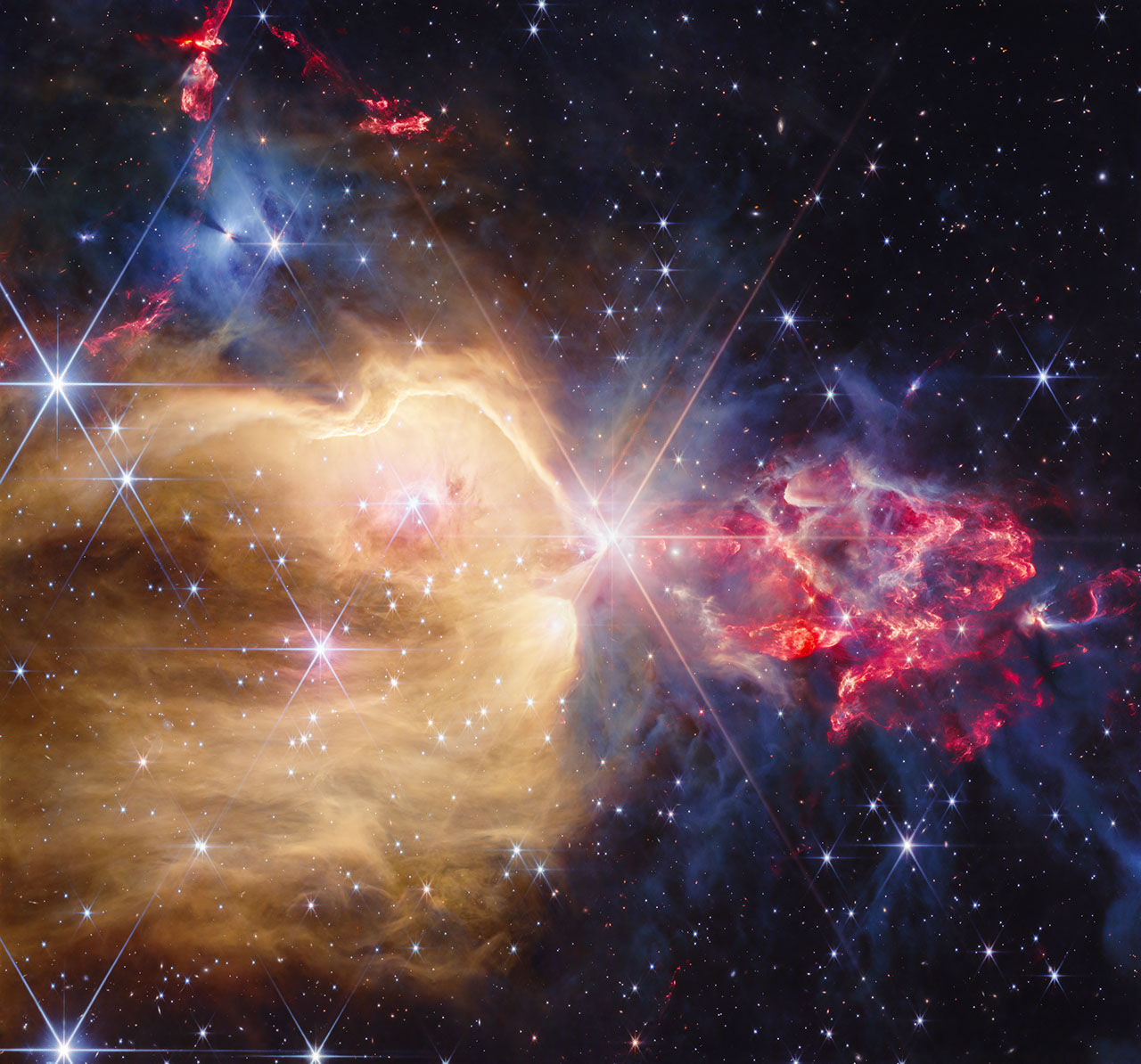
NASA’s James Webb Space Telescope has revealed many protostars and stars within the glowing gases of NGC 7129. Hot, atomic hydrogen gas is shown here in the golden region, while cooler, molecular hydrogen gas, shocked by embedded protostars, is represented in red.
A cauldron of cosmic creation is being revealed in a new image from NASA’s James Webb Space Telescope. Webb has unveiled numerous stars formerly hidden by clouds of dust in a stellar nursery known as NGC 7129, which resides about 3,300 light-years from Earth.
Stars, the engines of elemental creation, have life cycles that begin with their birth in molecular clouds – cold, dense regions of dust and gas. Because of these dusty cocoons, young stars are often impossible to view by many telescopes, particularly those incapable of capturing infrared light. Webb, however, has a high degree of infrared sensitivity, allowing astronomers to peer through that dust and study the beginning of the star life cycle.
Image: NGC 7129 (NIRCam Image)
NASA’s James Webb Space Telescope has revealed many protostars and stars within the glowing gases of NGC 7129. Hot, atomic hydrogen gas is shown here in the golden region, while cooler, molecular hydrogen gas, shocked by embedded protostars, is represented in red.
Image: NASA, ESA, CSA, STScI; Image Processing: Alyssa Pagan (STScI)
The stars from this cluster are in different stages of their development, as the more massive stars form and evolve the fastest. The most massive (and the most mature) is the region’s luminous central star, LkH(alpha) 234 (pronounced Lick-H-alpha). This star, which sports the image’s most prominent diffraction pattern, is a pre-main-sequence star weighing around 5 to 8 times the mass of our Sun. Pre-main-sequence stars like these have mostly finished gathering mass and are contracting under the force of gravity, causing their temperatures to rise. In time, this star will fuse its own hydrogen like our Sun.
The cavity to its left, which appears in gold and spans about 3.5 light-years, is the largest demonstration of the central star’s impact. Outflows from an earlier stage of the star’s life cycle carve into the dense molecular cloud of hydrogen. Both the outflows and the star’s light energize the gas, causing it to glow. While much of this hydrogen gas is blown away, a large amount is also compressed, creating the conditions for even more stars to form.
Interactive: The Colorful Clouds of NGC 7129
Unable to render the provided source
Explore the details of NGC 7129 in to uncover the hidden features and activity within the clouds of this young star-forming region. In this interactive, venture to individual points of interest or follow guided tours through related locations and stories. Launch in full-screen for the complete interactive experience — or view directly in your browser.
NASA and STScI
A few of these stars are visible within the cavity. Several of them are also pre-main-sequence and emit stellar winds. The nearby bow shocks, the curved compressed gas that appears near the stars, are created as those winds push into the energetic gas and create their own, smaller cavities.
Together, the central and embedded stars also create the sharp ridge seen at the top of the golden cavity. Their light generates a hot environment that pushes against the colder and denser molecular gas outside the cavity, and creates a boundary known as a photodissociation region. In this region, the molecules of hydrogen break down into atoms. By influencing the temperature and chemistry of the region, this collection of stars offers insight into how these molecular clouds will gradually erode over millions of years.
The region to the right of the central star narrates a different, but equally chaotic tale. This clumpy matter represented in red hides much younger objects than those on the left: protostars. The protostar stage is earlier than the pre-main-sequence stage and occurs after molecular clouds of gas and dust initially compress and fragment.
As the protostars accumulate matter and increase their mass, they eject outflows of superheated material. These outflows interact with the dense, gray, translucent matter the protostars are wrapped within, creating shocks that cause a textured appearance. The red glow is also the result of the interaction. Multiple outflows from multiple stars overlap from our point of view, leading to the scene’s chaotic look.
Image: NGC 7129 Side-by-Side (Spitzer and Webb Image)
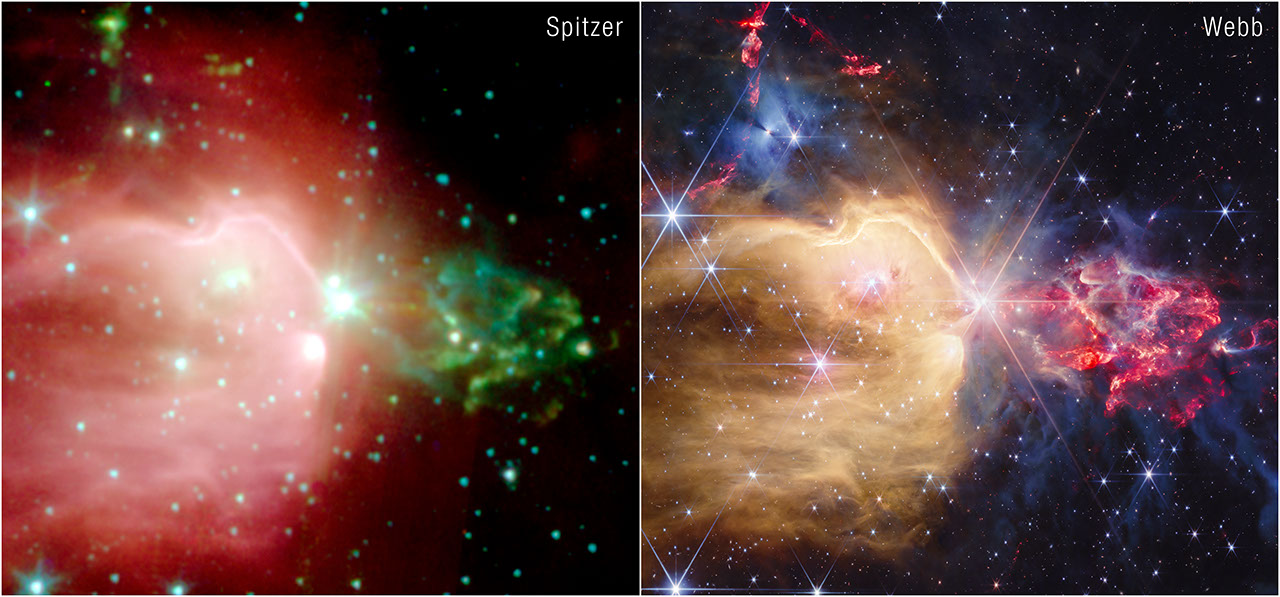
NASA’s retired Spitzer Space Telescope observed the gas and dust within NGC 7129; however, NASA’s James Webb Space Telescope’s improved resolution shows more detailed gas and dust filaments, along with many background galaxies.
More of these protostellar outflows can be seen at the upper left of the image, near a blue-colored nebula. The center of this blue region hosts a protostar surrounded by a donut-shaped disk of material. This disk casts a shadow against the surrounding nebula, reminiscent of a similar structure known as the “Bat Shadow” that was observed by NASA’s Hubble Space Telescope.
Webb’s high spatial resolution reveals many rich structures in the region’s gas, building on research done previously by NASA’s retired Spitzer Space Telescope. Astronomers will continue to use this Webb data to study how the stars and protostars in this region influence the surrounding gas and dust.
The James Webb Space Telescope is the world’s premier space science observatory. Webb is solving mysteries in our solar system, looking beyond to distant worlds around other stars, and probing the mysterious structures and origins of our universe and our place in it. Webb is an international program led by NASA with its partners, ESA (European Space Agency) and CSA (Canadian Space Agency).
The following sections contain links to download this article’s images and videos in all available resolutions followed by related information links, media contacts, and if available, research paper and Spanish translation links.
Related Images & Videos
NGC 7129 (NIRCam Image)
NASA’s James Webb Space Telescope has revealed many protostars and stars within the glowing gases of NGC 7129. Hot, atomic hydrogen gas is shown here in the golden region, while cooler, molecular hydrogen gas, shocked by embedded protostars, is represented in red.
NGC 7129 Side-by-Side (Spitzer and Webb Image)
NASA’s retired Spitzer Space Telescope observed the gas and dust within NGC 7129; however, NASA’s James Webb Space Telescope’s improved resolution shows more detailed gas and dust filaments, along with many background galaxies.
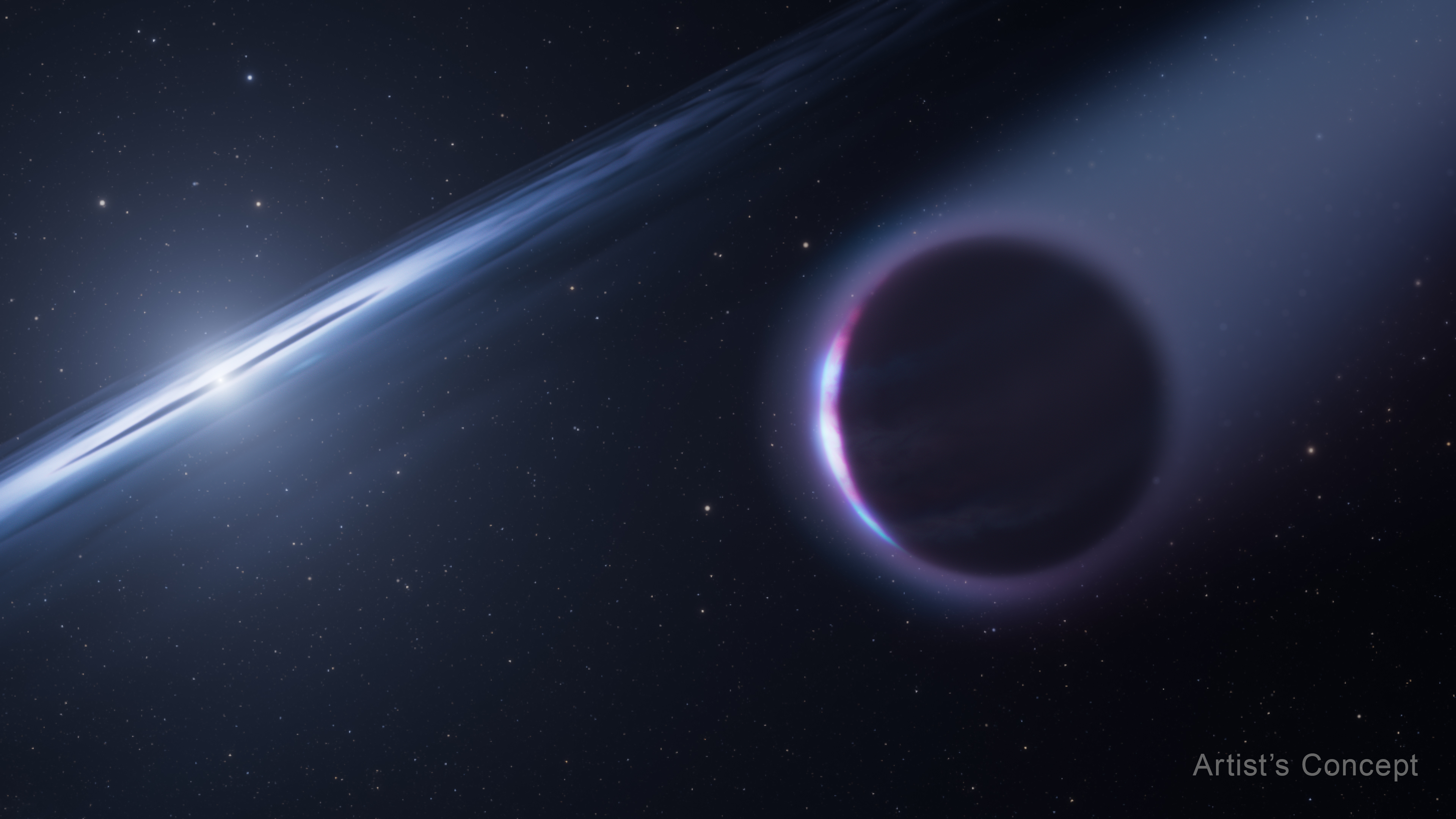
Diligent sleuthing by astronomers uncovered a surprising chemical clue that indicates the white dwarf star HS 0209+0832 may host a second-generation planet. This artist’s concept released on Oct. 5, 2026, depicts that possible explanation.
The white dwarf is the “dead” core of a star that burned through all of its nuclear fuel and lost its outer envelope of gas and dust to space. The second-generation planet formed from that cast-off gas and dust, which is why its chemical content is very different from a planet that formed as its host star was forming.
NASA’s Glenn Research Center in Cleveland is seeking Phase 1 proposals for the design and construction of the Aerospace Power Systems Laboratory. The principal purpose of this procurement is to deliver a laboratory facility to support the testing and development of power systems, with associated site work, infrastructure, and systems.
The laboratory will provide modern test facilities to advance power research and enable NASA to meet current and future mission needs. Glenn’s expertise in power is crucial to the Artemis program, the Moon Base, and the exploration of Mars and beyond.
Proposals submitted in response to this solicitation are due no later than Oct. 30, 2026, at 1 p.m. EST.
NASA will conduct this acquisition as a full and open competition. The North American Industry Classification System (NAICS) code for this acquisition is 236220, and the small business size standard of $45 million.
The anticipated contract award date is Dec. 16, 2026. The contract will be performed on-site at NASA Glenn and off-site at the contractor’s facilities.
Proposals for this solicitation are required to be submitted through NASA’s Enterprise File Sharing and Sync Box (EFSS Box), a FedRAMP Moderate certified platform.
All questions regarding this request should be submitted electronically, in writing, to John Christel, contracting officer, at [email protected] on or before Oct. 12, 2026. Offerors are encouraged to submit questions as soon as possible for consideration.
For more information about NASA and agency programs, visit:
Preparations for Next Moonwalk Simulations Underway (and Underwater)
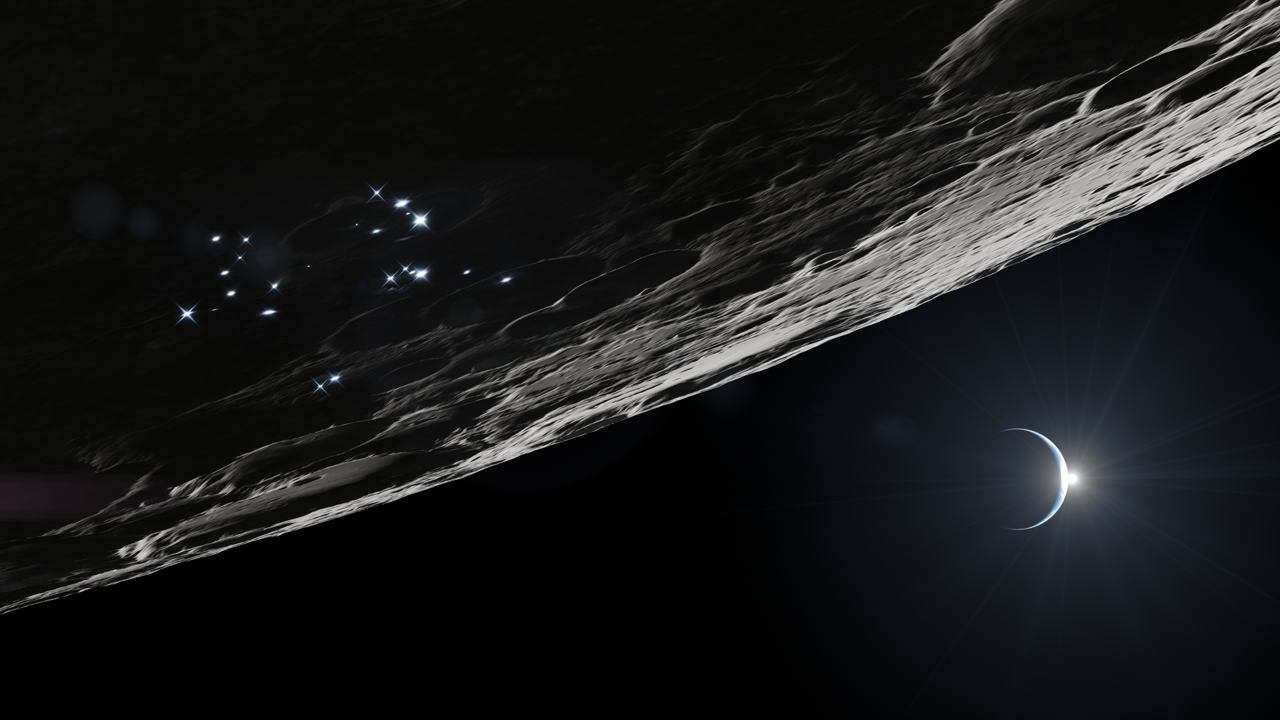
Artist’s rendering of the lunar South Pole region. Glowing points of light scattered across the lunar surface represent surface assets supporting sustained human and robotic operations near the South Pole.
NASA
As an astronaut traverses the lunar South Pole, tribocharging from walking on the lunar surface and plasma charging from the ambient plasma generate electric charge on the spacesuit. This problem is severely compounded when entering lunar shadows and Permanently Shadowed Regions (PSRs). In these dark zones, the spacesuit can buildup a substantial negative potential due to a lack of ambient ion flux and the absence of photoelectron emission to balance ambient electron collection.
The risk occurs when an astronaut returns to the spacecraft. Because the lunar surface lacks a natural environmental mechanism to bleed the charge accumulated on spacesuit away, the astronaut may become a walking, high voltage capacitor.
In the sunlit region, the stationary lander will hold slightly positive electrical potential. When a highly negatively-charged astronaut approaches the vehicle, the extreme voltage differential can trigger electrostatic discharge (an instantaneous electrical arc, or a spark) during physical contact. A rapid discharge from the astronaut to the lander risks degrading vital suit layers, damaging sensitive suit electronics, threatening the oxygen-rich environment inside the suit, and delivering dangerous electrical shocks to the crew.
Through the Lunar Grounding Challenge, NASA is seeking innovative designs and operational solutions to provide a lunar bringing to equilibrium capability to safely discharge a suited astronaut from high triboelectric charge buildup during lunar surface EVAs in the South Pole. This challenge seeks innovative concepts for an Electrostatic Discharge (ESD) mitigation solution to neutralize the astronaut in a safe and timely manner under this extreme charge differential before astronauts directly interact with the lander.
Northrop Grumman’s Cygnus XL cargo spacecraft rests at its capture point on April 13, 2026, 12 meters from the International Space Station, as the Canadarm2 robotic arm prepares to grapple the resupply ship.
Credit: NASA/Jessica Meir
After delivering more than 11,000 pounds of supplies, science experiments, and other cargo to the International Space Station for NASA, Northrop Grumman’s Cygnus XL spacecraft is scheduled to depart Friday, Oct. 9, as part of the company’s Commercial Resupply Services-24 mission, or Northrop Grumman CRS-24.
Watch NASA’s live coverage of undocking and departure beginning at 12:30 p.m. EDT through a variety of platforms. Learn where to watch online:
Flight controllers on the ground will send commands for the space station’s Canadarm2 robotic arm to detach the Cygnus XL spacecraft from the Unity module’s Earth-facing port and maneuver it into position for release at 12:45 p.m. NASA astronaut Luke Delaney will monitor the operation from aboard the orbital complex.
Loaded with thousands of pounds of disposal items and other unneeded cargo, Cygnus XL will deorbit Sunday, Oct. 11, for a destructive re-entry into Earth’s atmosphere, where it will safely burn up. NASA will not provide coverage of the spacecraft’s deorbit.
The resupply spacecraft launched on April 11 on a SpaceX Falcon 9 rocket from Space Launch Complex 40 at Cape Canaveral Space Force Station in Florida.
Learn more about this NASA commercial resupply mission at:
Preparations for Next Moonwalk Simulations Underway (and Underwater)
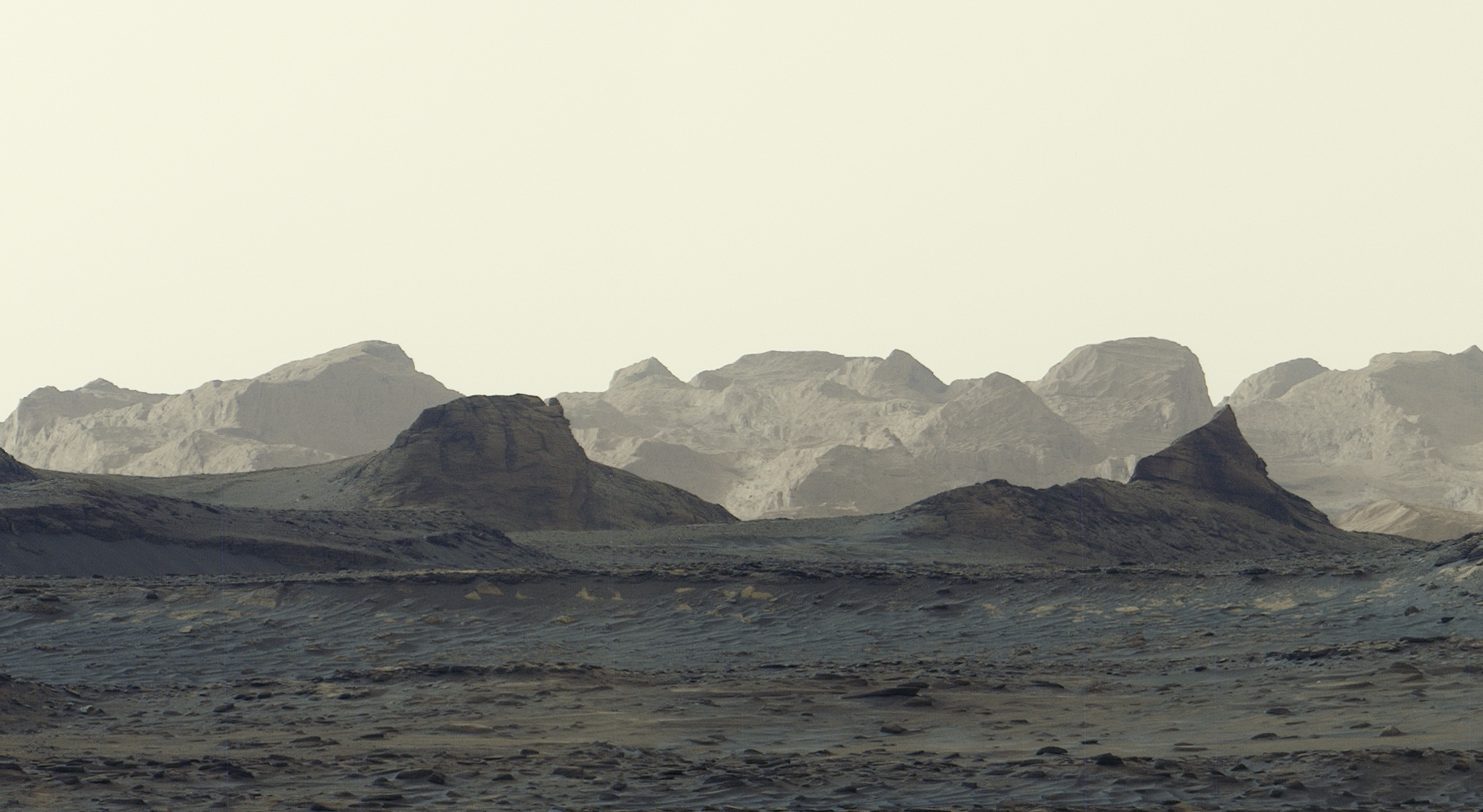
The captivating shapes of wind-carved crags called yardangs are revealed in this zoomed-in crop of a broader panorama captured by NASA’s Curiosity Mars rover on Aug. 11, 2026. Scientists are eager to learn more about how the yardang layer formed.
NASA/JPL-Caltech/MSSS
A newly released panorama captured by NASA’s Curiosity rover offers the most detailed view yet of distant, wind-carved Martian cliffs, highlighting features the mission’s scientists have long been waiting to see up close. The scene was snapped at 8:30 a.m. local Mars time, showing striking blue hues in the foreground as bright morning light illuminates crags known as yardangs on the horizon.
The panorama was captured by Curiosity’s Mastcam on Aug. 11, the 4,982nd Martian day, or sol, of the mission, and comprises six individual images that were stitched together after being sent to Earth. Unlike most of Curiosity’s Mastcam images, this one was processed without white balancing, preserving the early morning appearance.
The six shots that make up this panorama, captured by NASA’s Curiosity on Aug. 11, were stitched together after being sent back to Earth. Unlike most images from the rover’s Mastcam, this one was processed without the usual white balancing — an artistic choice that preserves the early morning appearance.
NASA/JPL-Caltech/MSSS
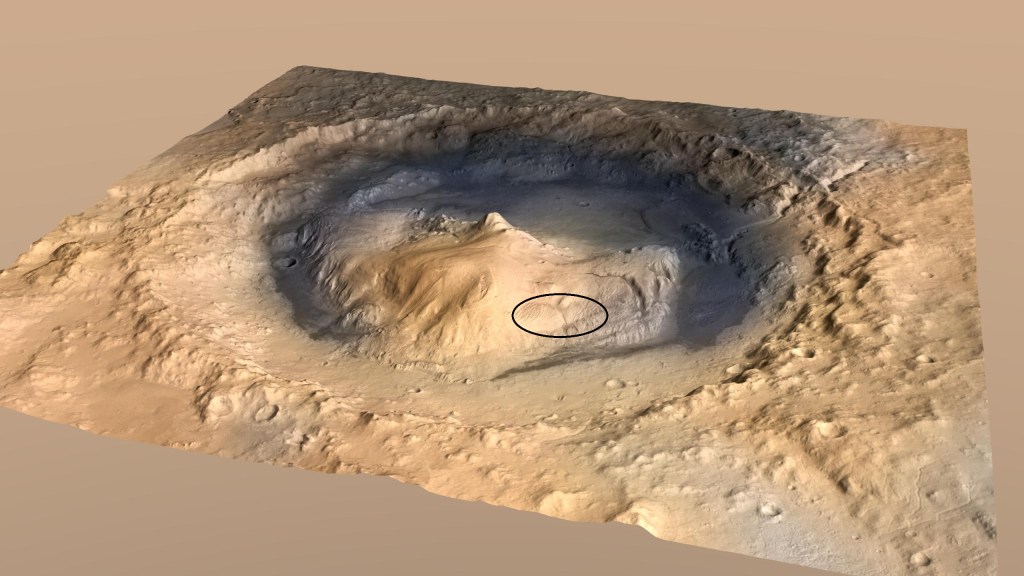
The yardang layer extends roughly 10 miles (16 kilometers) across the northwestern reaches of Mount Sharp, a 3-mile-tall (5-kilometer-tall) mountain that Curiosity has been ascending since 2014. In fact, the rover recently passed another milestone in its ascent, reaching 0.6 miles (1 kilometer) of elevation — the most ever climbed on Mars. As it draws ever-closer to the yardangs, mission scientists expect to get even more amazing imagery — and, they hope, answers to how these cliffs were created.
Mount Sharp is made up of layers, each recording a distinct period of Mars’ history. By studying them, scientists have been able to learn more about lakes and streams that covered this part of the Red Planet billions of years ago. Eventually, the water dried up and left salty minerals behind. After new material stopped settling on the mountain, some of it may have been stripped away by wind, giving rise to the yardangs.
This artist’s concept shows Mount Sharp, the 3-mile-tall (5-kilometer-tall) mountain that NASA’s Curiosity has been ascending since 2014. The location of the yardang layer, which the rover recently captured from a distance, is indicated by an ellipse annotation on the mountain’s northwestern shoulder.
NASA/JPL-Caltech/ESA/DLR/FU Berlin/MSSS
NASA’s Curiosity Mars rover captured this view looking back at the floor of Gale Crater on Sept. 5, 2026. Just nine days prior, the rover had marked 1 kilometer of elevation gain above the crater floor since beginning its ascent of Mount Sharp in 2014.
NASA/JPL-Caltech/MSSS
“The yardang layer looks out of place. It’s the wrong color, the layers tilt at an odd angle, and it almost appears plastered on,” said Ashwin Vasavada, Curiosity project scientist of NASA’s Jet Propulsion Laboratory in Southern California. “But that’s what makes it exciting to reach. No one is sure exactly what created this layer, but one idea is it may be ash deposited by ancient volcanic eruptions.”
Curiosity is in the second year of its fifth extended mission, which started with an exploration of the spiderweb-like boxwork ridges. The rover will spend most of the next year or so driving through layers enriched with sulfates and carbonates, both signs of ancient drying on the surface. Sometime in 2027, scientists hope to reach the base of the yardangs, where Curiosity will be able to use its robotic arm to collect one-of-a-kind data on these mysterious features.
More about Curiosity
Curiosity was built by NASA JPL, which is managed by Caltech in Pasadena, California. NASA JPL leads the mission on behalf of the agency’s Science Mission Directorate in Washington as part of its Mars Exploration Program portfolio. Malin Space Science Systems in San Diego built and operates Mastcam.
NASA’s SpaceX Crew-12 members gather for a portrait in the pressure suits they will wear when they depart the International Space Station inside the SpaceX Dragon spacecraft. From left, Roscosmos cosmonaut and mission specialist Andrey Fedyaev, NASA astronauts Jack Hathaway and Jessica Meir, Crew-12 pilot and commander respectively, and ESA (European Space Agency) astronaut and mission specialist Sophie Adenot.
Credit: NASA/Anil Menon
NASA and SpaceX are targeting no earlier than 8:05 a.m. EDT, Wednesday, Oct. 7, for the undocking of the agency’s SpaceX Crew-12 mission from the International Space Station, pending weather conditions.
An Oct. 7 undock puts NASA astronauts Jessica Meir and Jack Hathaway, ESA (European Space Agency) astronaut Sophie Adenot, and Roscosmos cosmonaut Andrey Fedyaev on schedule to splash down off the coast of California at approximately 11:34 a.m. on Thursday, Oct. 8.
NASA’s live Crew-12 return coverage will stream through a variety of platforms. Learn where to watch online:
Mission managers continue monitoring conditions in the recovery area, as undocking of the SpaceX Dragon depends on spacecraft readiness, recovery team readiness, weather conditions in the Pacific off the coast of California, and other factors.
NASA’s coverage is as follows (all times Eastern and subject to change based on real-time operations):
Wednesday, Oct. 7
6 a.m.: Hatch closure coverage begins
6:20 a.m.: Hatch closing
7:45 a.m.: Undocking coverage begins
8:05 a.m.: Undocking
Following the conclusion of undocking coverage, NASA will provide audio-only communications between Crew-12, the space station, and flight controllers during Dragon’s transit away from the orbital complex.
Bill Spetch, deputy manager of Commercial, NASA’s Low Earth Orbit Program
Dr. Liz Warren, deputy chief scientist, NASA’s Low Earth Orbit Program
Lee Echerd, senior mission manager, Customer Operations and Integration, SpaceX
Andreas Mogensen, leader, Human Exploration Group, ESA
To participate virtually in the teleconference, media must contact the NASA Johnson newsroom for call details by 12 p.m., Oct. 8, at: [email protected] or 281-483-5111. To ask questions, media must dial in no later than 10 minutes before the start of the call. The agency’s media credentialing policy is available online.
For more information about the Crew-12 mission, visit:
The Cree word pahtaaunaakun seems particularly apt for describing the distinctive brown hues of the waters that drain into Hannah Bay and Rupert Bay in Canada. Meaning the “color of singed beaver” in Southern East Cree, the word evokes the rich brown of the humic-substance-stained waters that were flowing into the two bays in late September 2026, as well as the role that beavers have long played in the mythology and history of the region.
As the rivers and streams that flow into the two bays—the southernmost extensions of James Bay—wind through the boreal forests and boggy wetlands of northern Quebec and Ontario, they often carry water stained brown by colored dissolved organic matter(CDOM), which absorbs light in the blue and ultraviolet parts of theelectromagnetic spectrumand causes water to appear brown. CDOM, including organic substances derived from tannins and lignins, leaches from decaying leaves, roots, bark, and soils into streams and rivers. Similar substances are what stain tea water brown.
When the OLI (Operational Land Imager) on Landsat 9 captured this image on September 27, 2026, the Moose, Nottaway, and Harricanaw rivers were carrying tea-colored water across the broad mudflats of Hannah and Rupert bays and mingling with the darker blue waters of James Bay.
The mudflats, the light brown areas along the shore, are a product of the shallow, sloping bathymetry in the southernmost part of James Bay. Postglacial rebound is slowly lifting the entire landscape, and rivers continually deposit fine mud particles and other sediments that build up the flats. The comings and goings of tides and river currents often stir up the mud, producing the lighter brown plumes of suspended sediment that mix with the incoming river water.
Differences in moisture levels and vegetation patterns likely contribute to the green dendritic, veinlike patterns visible onshore. Denser, more forested growth along stream channels appears dark green, while the poorly drained landscapes in the surrounding peat bogs have less extensive tree cover and appear lighter green.
Beavers have long played a role in the history and mythology of the lake-dotted landscapes in this part of Canada. The Cree people, who have lived in the region for thousands of years, have traditionally hunted beaver for both meat and pelts. European traders arrived in Rupert Bay as early as the 1660s to pursue the animals as well, leading to the establishment of several trading posts along the bay’s shores and the founding of the Hudson’s Bay Company to cultivate the fur trade, especially in beaver pelts.
Beavers also feature prominently in the area’s Cree mythology and environmental history in other ways. For instance, one Cree myth about this area, recorded by the anthropologist Alanson Skinner, tells of a giant pursuing an enormous mythical beaver down the Nottaway River until the beaver escaped into Rupert Bay. According to the myth, the giant then picked up a huge rock and hurled it at the fleeing animal, missing the beaver but creating Stag Rock, the distinctive island found in the river’s mouth today.
In an early example of a managed beaver preserve in Canada, the Hudson’s Bay Company worked with local Cree people in the 1830s and again a century later to set up Charlton Island as a place to raise beavers for later trapping. After predators had been removed and several breeding pairs delivered to the island, its beaver population ballooned, according to historical accounts.
NASA Earth Observatory images by Lauren Dauphin, using Landsat data from the U.S. Geological Survey. Story by Adam Voiland.
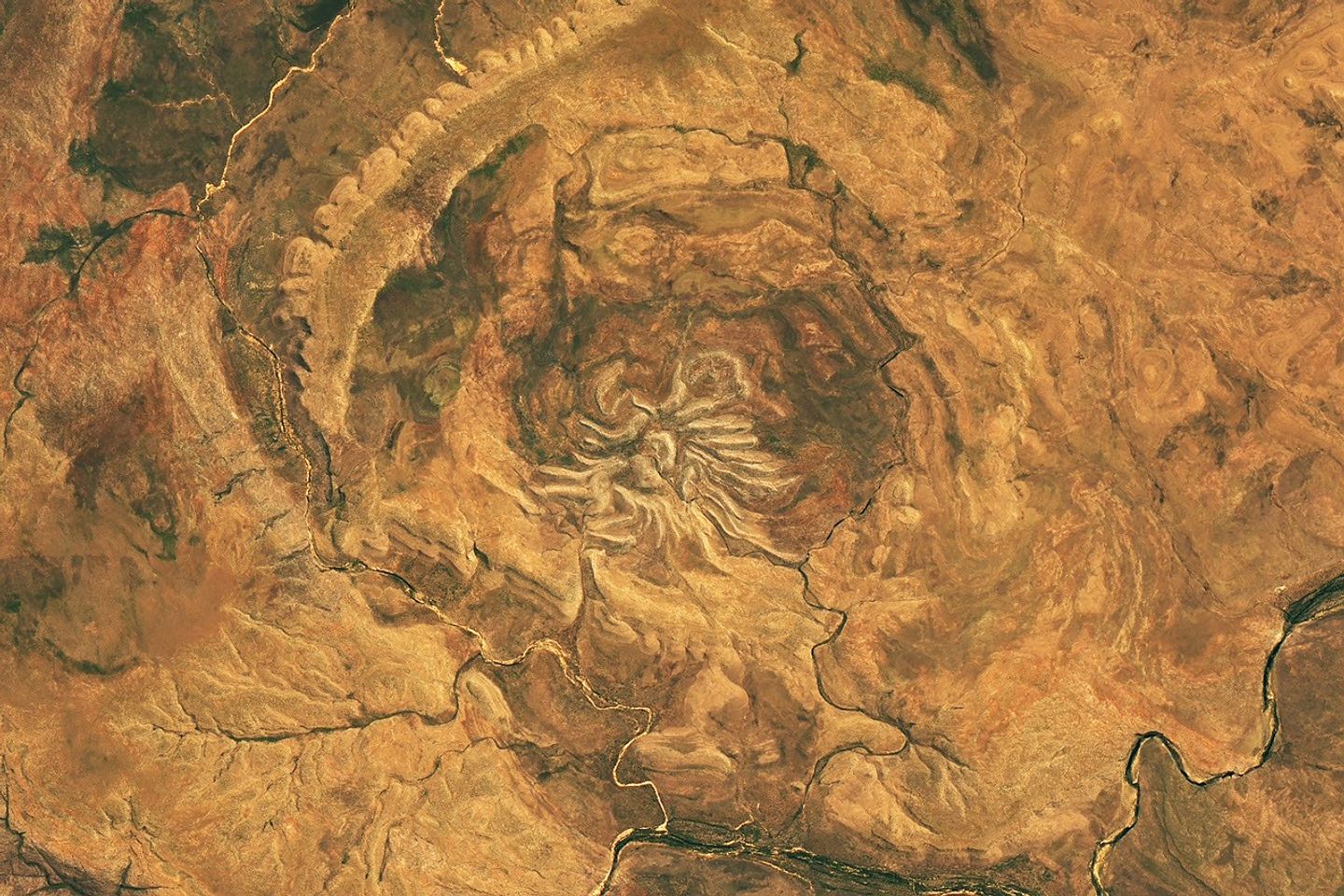
Every month, NASA Earth Observatory features a puzzling satellite image. The October 2026 puzzler appears above.
Your Challenge Identify the location shown in this satellite image. Share what clues you see, where you think it is, and what makes this place interesting or unique to you.
How to Answer Submit your response using this form and select “Puzzler Answer” as the topic. Please include your preferred name or alias.
You can keep it simple and just guess the location. Want to impress us? Tell us which satellite and instrument captured the image, which spectral bands were used, or point out a subtle detail about the geology or history of the area. If something catches your eye, or if this is your home or means something to you, we’d love to hear about it.
The Prize We can’t offer prize money or a trip to space to see Earth like satellites and astronauts do. But we can offer something almost as rewarding: puzzler bragging rights.
About a week after the challenge, we’ll post the answer at the top of this page, along with a link to an Earth Observatory Image of the Day story that explains the image in more detail. We’ll recognize the first person who correctly guesses the location, and we may also highlight readers who share especially thoughtful or interesting answers. By submitting a response, you acknowledge that your comments may be edited, excerpted, and published on this page.
Until then, zoom in, look closely, and enjoy the challenge. See you at the reveal!