
3 min read
NASA Advances LISA Mission Contributions With New Test Telescope
NASA has taken the next step in the process of developing a new all-glass telescope for the LISA (Laser Interferometer Space Antenna) mission, a space observatory designed to detect ripples in space-time called gravitational waves.
L3Harris Technologies will design, assemble, and integrate the new telescope for NASA. Called the Engineering Test Unit, this contribution represents a final step toward the future production of flight hardware.
Led by ESA (European Space Agency), the LISA mission is slated for launch in the mid-2030s. As a collaborative partner, NASA is contributing the telescopes, other critical hardware, and engineering and scientific support as part of its mission to better understand how the universe works.
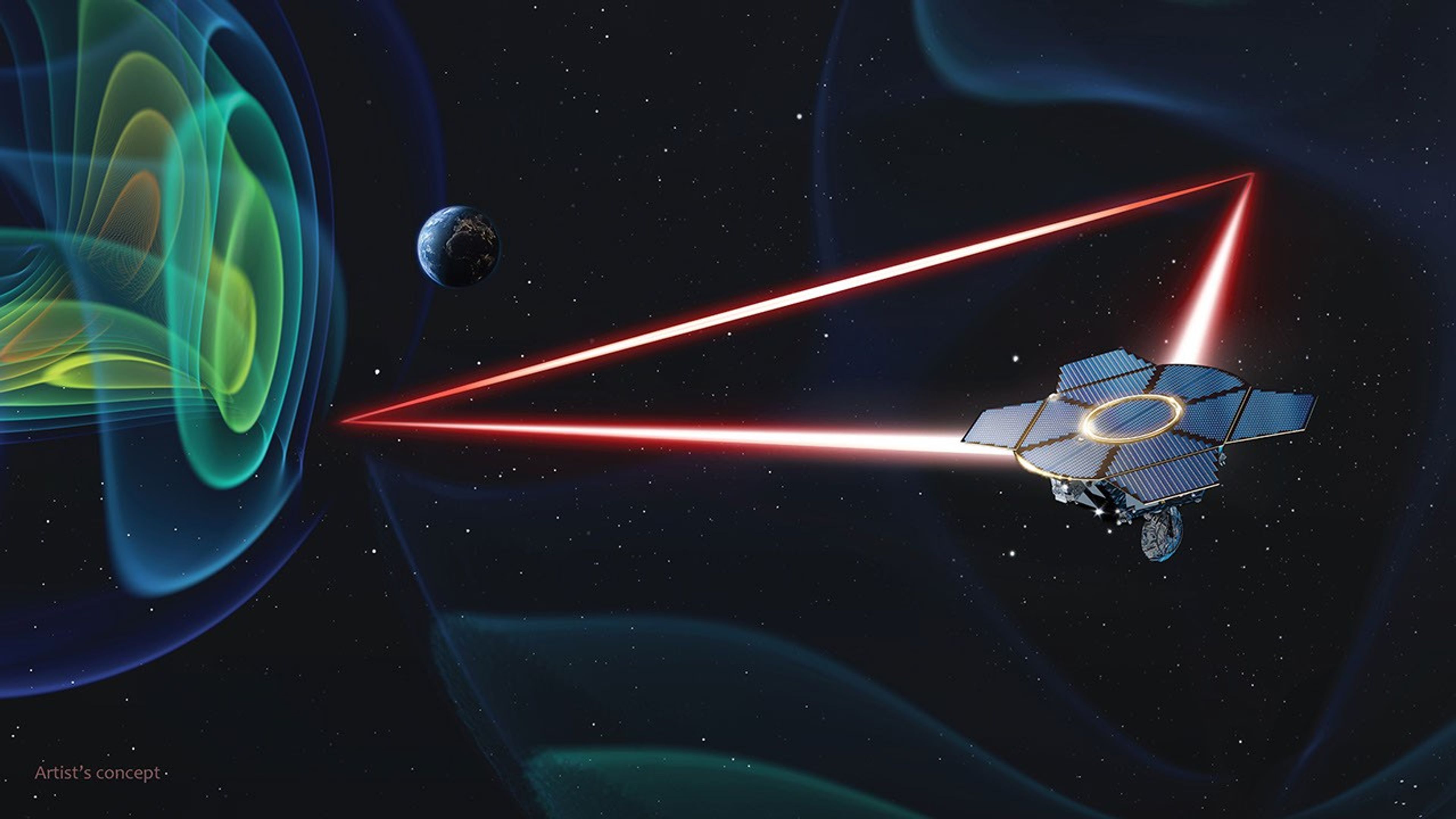
The LISA mission will deploy a trio of satellites into an Earth-following orbit, creating a vast triangular array stretching 1.6 million miles (2.5 million kilometers) on each side. Each satellite will include two telescopes that will use infrared laser beams to simultaneously transmit and receive signals between adjacent spacecraft. Through these telescopes, the spacecraft will measure miniscule changes in their relative distances, the signals of passing gravitational waves.
“These changes are tiny, smaller than the width of a helium atom, but through them LISA will reveal a sea of low-frequency gravitational waves that we cannot currently detect through facilities on Earth,” said Ira Thorpe, the NASA project scientist for the mission at the agency’s Goddard Space Flight Center in Greenbelt, Maryland. “The LISA mission will be able to detect mergers of monster black holes billions of light-years away, map compact pairs of white dwarfs, neutron stars, and stellar-mass black holes in our own cosmic backyard, and perhaps provide new insights into gravity itself.”
Each telescope will be entirely made of an amber-colored ceramic-glass composite called Zerodur, which is widely used in high-precision applications because it resists changes in shape across a wide range of temperatures. In 2024, L3Harris delivered a prototype telescope to NASA that served as an engineering development unit for this next step.

“We’ve put the prototype through rigorous testing, and we’re bringing everything we’ve learned into this new telescope,” said Ritva Keski-Kuha, lead for the LISA Telescope program at NASA Goddard. “This will be our last pre-flight unit and our first optical telescope delivery to ESA.” Earlier this year, in June, the team delivered a structural model of the telescope made from metal instead of glass.
Gravitational waves were predicted by Albert Einstein’s 1916 general theory of relativity and first detected by ground-based observatories in 2015. The waves form whenever massive objects accelerate, such as two stars in orbit around each other. They flow across space-time, moving at the speed of light, and are unaffected by objects they encounter along the way. These properties make them a valuable tool for probing the cosmos.
Each of the three LISA spacecraft contains a free-floating gold-platinum cube called a proof mass. The spacecraft will fly around the cube and manage its environment so the cube falls through space only under the influence of gravity. In 2016, ESA’s LISA Pathfinder mission showed that it was possible to reduce non-gravitational forces on the proof masses to the level needed for gravitational wave detection.
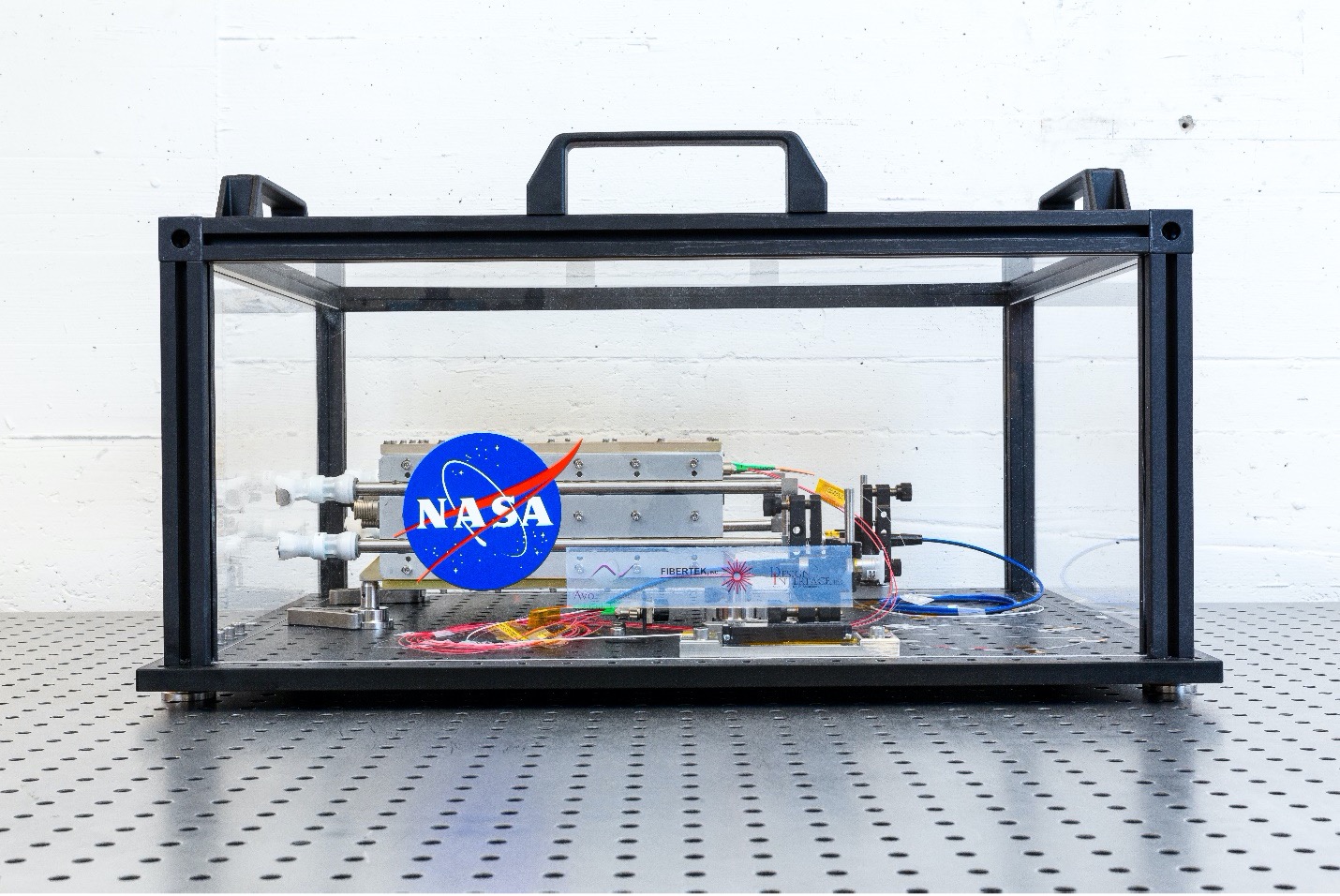
Additional NASA contributions include the laser system, devices to manage the buildup of electric charge on the proof masses, data analysis for identifying and characterizing individual gravitational wave sources, and additional scientific and engineering expertise.
To learn more about the LISA mission, visit:
Share
Details
Related Terms
Explore More


Source: science.nasa.gov