Samuel Chase, William Paca and Thomas Stone were among Maryland’s four delegates to the Second Continental Congress who adopted the Declaration of Independence on July 4, 1776, and are considered Founding Fathers.
Source: www.war.gov
Samuel Chase, William Paca and Thomas Stone were among Maryland’s four delegates to the Second Continental Congress who adopted the Declaration of Independence on July 4, 1776, and are considered Founding Fathers.
Source: www.war.gov
Marine Corps Air Station Miramar, Calif., is releasing herds of goats in a targeted effort to reduce dry brush and invasive grasses, a nature-based solution to protect military infrastructure and the neighboring civilian communities.
Source: www.war.gov

NASA has selected SpaceX to provide launch services for the agency’s StarBurst mission, a small satellite designed to investigate neutron star mergers and the origins of short gamma-ray bursts.
StarBurst will launch aboard a Bandwagon rideshare mission on a Falcon 9 rocket from Space Launch Complex 40 at Cape Canaveral Space Force Station in Florida no earlier than 2028.
The selection is a firm-fixed-price task order under NASA’s VADR (Venture-Class Acquisition of Dedicated and Rideshare) launch services contract. This indefinite-delivery/indefinite-quantity contract allows NASA to acquire launch services during a 10-year ordering period, with a maximum total value of $1 billion across all contracts.
The StarBurst mission is designed to observe the entire portion of the sky not blocked by Earth to search for brief, powerful explosions called gamma-ray bursts. The satellite will focus on detecting the initial high-energy emission from short gamma-ray bursts, which occur when dense stellar remnants called neutron stars merge.
By combining StarBurst’s observations with gravitational-wave measurements and follow-up observations from other telescopes, researchers will study these events through multiple types of signals, an approach known as multimessenger astronomy.
StarBurst is part of NASA’s Astrophysics Pioneers Program, which supports lower-cost investigations using small spacecraft and other platforms.
NASA’s Launch Services Program Office, based at the agency’s Kennedy Space Center in Florida, manages the VADR contract.
For more information about NASA’s StarBurst, visit:
https://science.nasa.gov/mission/starburst
-end-
Joshua Finch / Jimi Russell
Headquarters, Washington
202-358-1100
[email protected] / [email protected]
Leejay Lockhart
Kennedy Space Center, Fla.
321-747-8310
[email protected]
Source: www.nasa.gov
APOD
Astronomy Picture of the Day
Discover the cosmos! Each day a different image or photograph of our fascinating universe is featured, along with a brief explanation written by a professional astronomer.
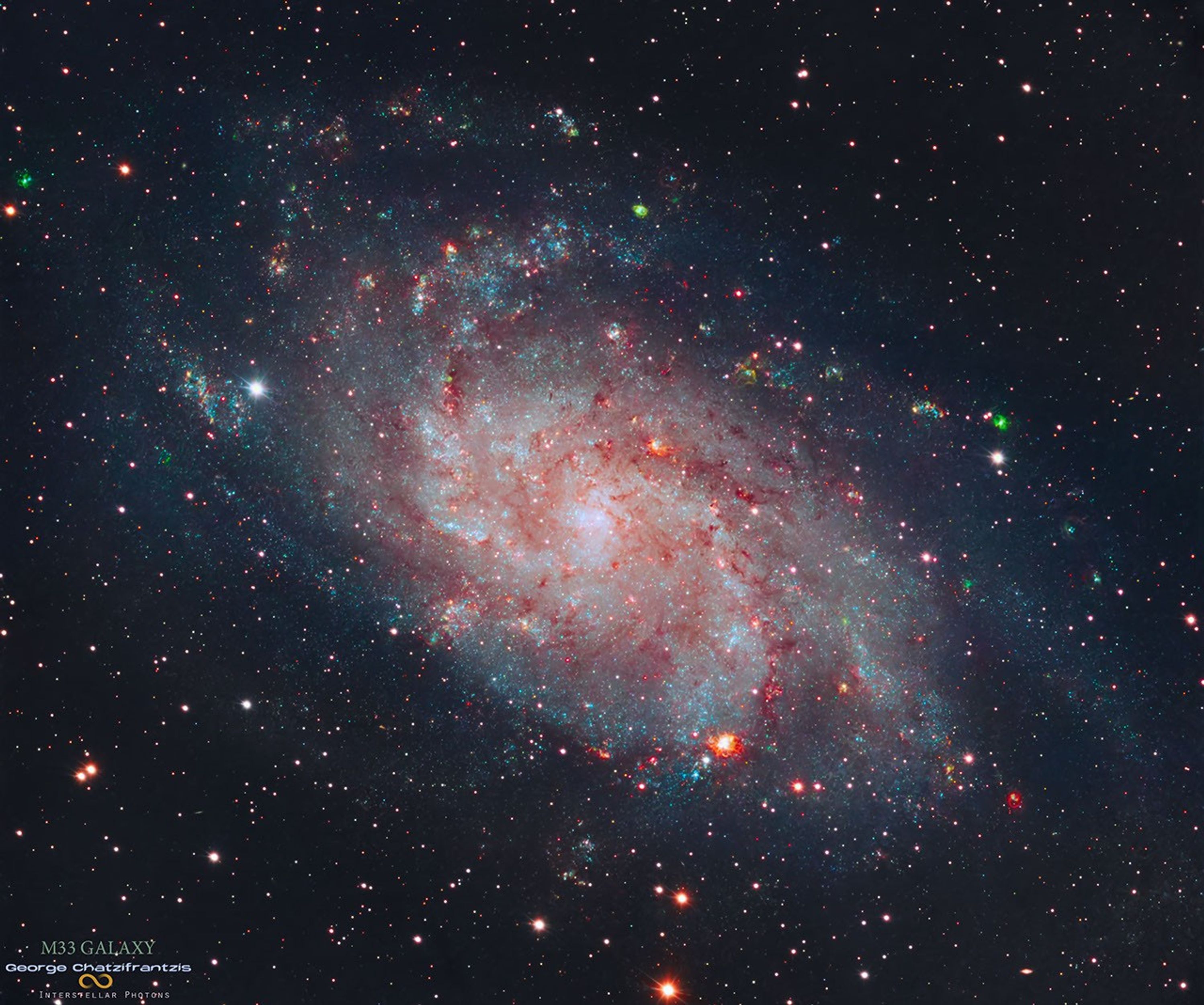
Explanation: The small, northern constellation Triangulum harbors this magnificent face-on spiral galaxy, Messier 33. Its popular names include the Pinwheel Galaxy or just the Triangulum Galaxy. M33 is over 50,000 light-years in diameter, third largest in the Local Group of galaxies after the Andromeda Galaxy (M31), and our own Milky Way. About 3 million light-years from the Milky Way, M33 is itself thought to be a satellite of the Andromeda Galaxy and astronomers in these two galaxies would likely have spectacular views of each other’s grand spiral star systems. As for the view from the Milky Way, this sharp telescopic image shows off M33’s blue star clusters and pinkish star forming regions along the galaxy’s loosely wound spiral arms. In fact, the cavernous NGC 604 is the brightest star forming region, seen here at about the 5 o’clock position from the galaxy center. Like M31, M33’s population of well-measured variable stars have helped make this nearby spiral a cosmic yardstick for establishing the distance scale of the Universe.
APOD’s main NASA site is moving: From apod.nasa.gov to science.nasa.gov/apod
Tomorrow’s picture: star party weekend
| Date | September 18, 2026 |
|---|---|
| Credit & Copyright: | George Chatzifrantzis |
| Authors & editors: | Jerry Bonnell, Cecilia Chirenti, Robert Nemiroff, Keighley Rockcliffe |
| A service of: |
ASD at NASA / GSFC, NASA Science Activation & Michigan Tech. U. |
Source: science.nasa.gov
3 min read
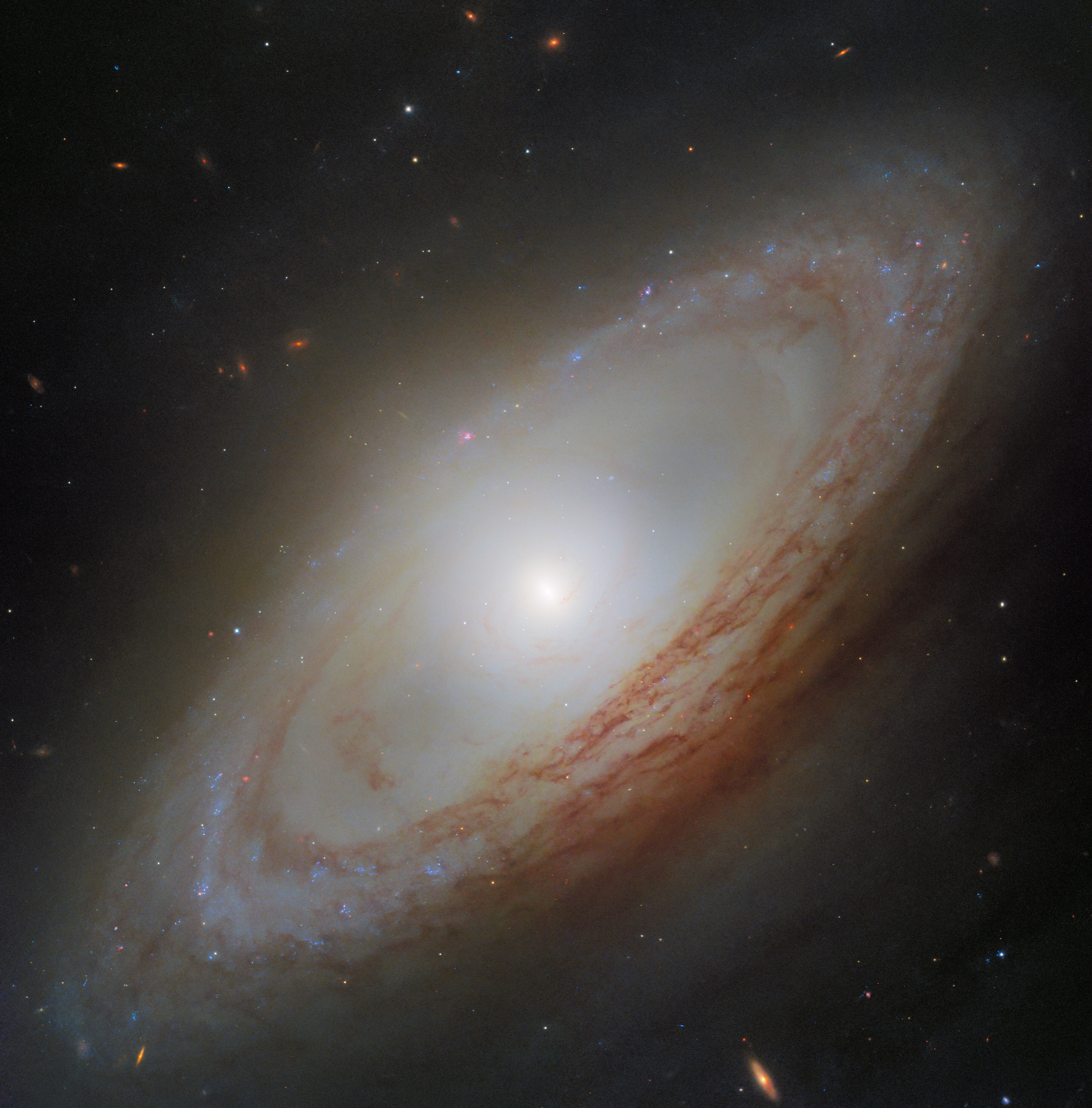
Though the spiral galaxy in this new image from the NASA/ESA Hubble Space Telescope seems serene, it hides a chaotic secret. This galaxy is NGC 4698, and it lies about 55 million light-years away in the constellation Virgo. It’s one of over a thousand galaxies in the Virgo Cluster, the nearest large cluster of galaxies bound together by gravity.
As a spiral galaxy similar to our own Milky Way galaxy, NGC 4698 has spiral arms that curl around within a thin disk of stars, gas, and dust. These arms are marked by opaque clumps of brown dust and dotted with small collections of bright blue stars. Unlike many other spiral galaxies, like this one recently photographed by Hubble, NGC 4698’s delicate spiral arms are only prominent in the outer reaches of the disk; spiral arms often wind down to the very center of a galaxy, but NGC 4698’s spiral arms appear to shy away from its glowing center. The arms instead hover in a ring-like structure around the perimeter of the galaxy.
NGC 4698’s center is dominated by an elongated galactic bulge . The diffuse off-white glow of the galaxy’s bulge comes from stars smaller, older, and cooler than the massive blue stars that dot the galaxy’s outer disk. These tightly packed stars orbit a supermassive black hole containing millions of times the Sun’s mass. Scientists have found signs that this black hole is actively growing, drawing gas inward with its gravitational pull.
With a flat, starry disk and diffusely glowing center, NGC 4698 looks a lot like a typical spiral galaxy — but this galaxy is far from normal. NGC 4698 is one of only a few known spiral galaxies with a bulge that extends out from the disk at a right angle. The elongation is faintly visible in this Hubble image, which shows the ghostly glow of the starry bulge peeking above and below the dusty disk. What’s more, the stars and gas nearest the galaxy’s center rotate perpendicular to the rest of the disk!
What could cause a galaxy to be so out of sync? Astronomers have found that the culprit likely lies outside the galaxy. If NGC 4698 funneled in gas from an outside source, the newly collected gas could have formed a disk of gas and stars in the galaxy’s center, at an angle relative to the rest of the disk. Some observations suggest that this galaxy once experienced a minor galactic merger, as evidenced by a short ‘tail’ of hydrogen streaming from one side of the galaxy.
The data used to create this image come from an observing program focusing on galaxies in the Virgo Cluster. This program zooms in on the details of these relatively nearby galaxies, such as individual star clusters and nebulae. At the same time, researchers will use these data to take stock of the larger picture, learning how a galaxy’s journey through a cluster affects the galaxy’s evolution and ability to form new stars.
Text credit: ESA/Hubble
Media Contact:
Claire Andreoli
NASA’s Goddard Space Flight Center, Greenbelt, MD
[email protected]
Source: science.nasa.gov
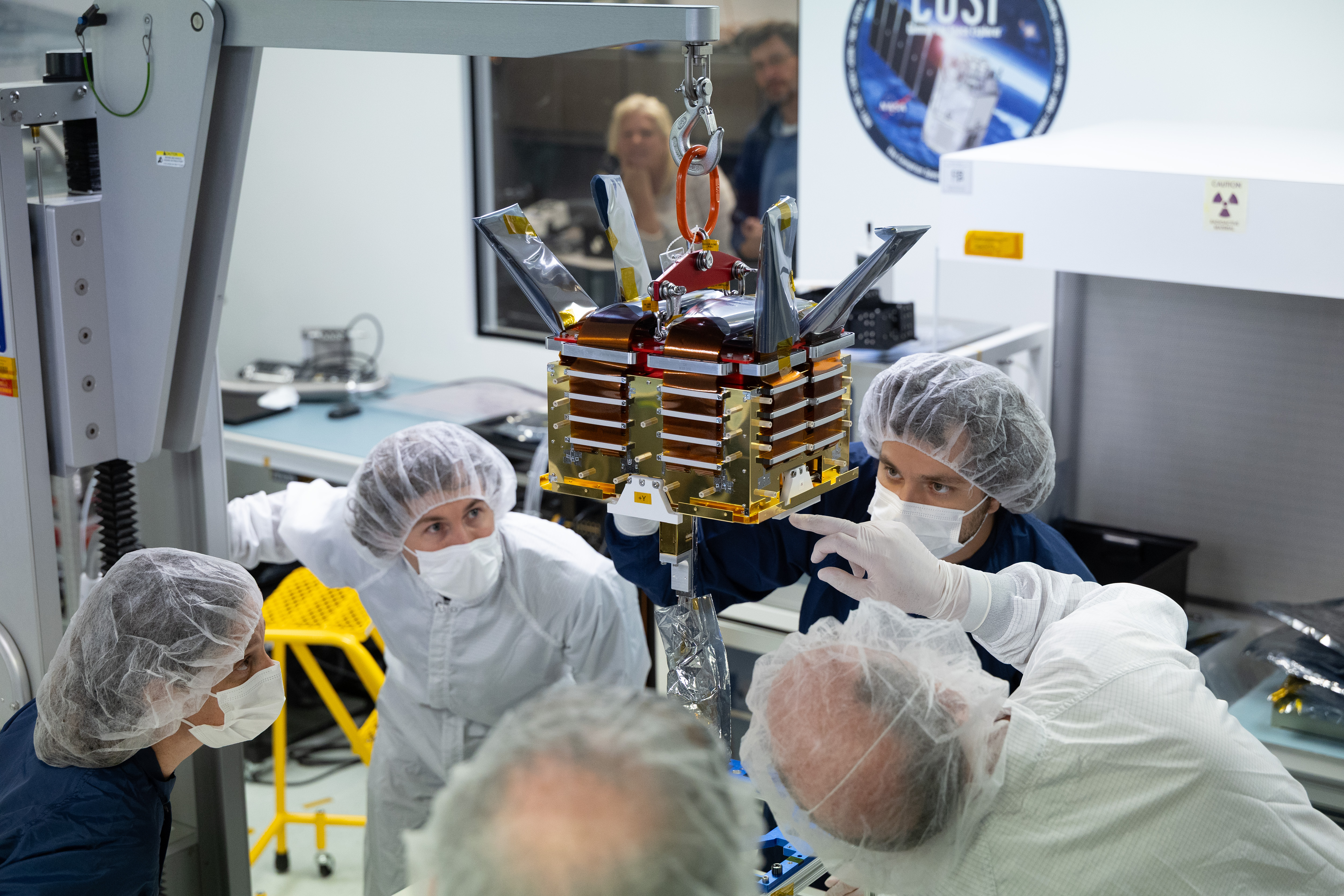
UC Berkeley engineers and managers watch as the COSI (Compton Spectrometer and Imager) detector assembly is slowly raised from a table in this July 8, 2026, image. The four pieces of silver material on the top of the detector box cover the flex circuits, which carry signals from the detectors to the readout electronics.
COSI is a wide-field gamma-ray telescope that will study energetic phenomena in the Milky Way and beyond, including the creation and destruction of matter and antimatter and the final stages of the lives of stars. The mission is a collaboration between the University of California, Berkeley’s Space Sciences Laboratory; the University of California, San Diego; the Naval Research Laboratory; NASA’s Goddard Space Flight Center; Northrop Grumman; Space Dynamics Laboratory; the Italian Space Agency; and a number of research institutions.
Image credit: UC Berkeley/Alan Toth
Source: www.nasa.gov

To continue regular crew transportation to the International Space Station, NASA has awarded SpaceX three additional missions through a contract modification.
As part of the agency’s Commercial Crew Transportation Capability (CCtCap) contract, this change brings the total missions for SpaceX to 17 and helps NASA to maintain access to the space station with two unique commercial crew industry partners.
This is a firm fixed-price, indefinite-delivery/indefinite-quantity contract modification for the Crew-15, Crew-16, and Crew-17. The value of this modification for all three missions and related mission services is $946 million. The amount includes ground, launch, in-orbit, and return and recovery operations, cargo transportation for each mission, and a lifeboat capability while docked to the International Space Station. The period of performance runs through 2030 and brings the total CCtCap contract value with SpaceX to $5.92 billion.
The award follows the agency issuing a notice of intent in May to purchase the additional missions. The current sole source modification does not preclude NASA from seeking future contract modifications for additional transportation services, as needed.
In 2014, NASA awarded the CCtCap contracts to Boeing and SpaceX through a public-private partnership as part of the agency’s Commercial Crew Program. Under CCtCap, NASA certifies that a provider’s space transportation system meets the agency’s requirements prior to flying missions with astronauts.
SpaceX was certified by NASA for crew transportation in November 2020. The company’s twelfth crew rotation mission for the agency, the Crew-12 mission, is currently in orbit docked to the space station. As part of the missions, SpaceX’s Dragon spacecraft and Falcon 9 rocket transport up to four astronauts, along with critical cargo, to the space station.
For information about NASA’s Commercial Crew Office, visit:
https://www.nasa.gov/exploration/commercial/crew
Source: www.nasa.gov
5 min read
Using data from the Japan-led XRISM (X-ray Imaging and Spectroscopy Mission) observatory, astronomers have directly observed a giant star’s outflow, called a stellar wind, being captured by its compact companion and providing the power source for strong X-ray flares. The research is part of NASA’s exploration of the extreme universe to better understand how the cosmos works.
“We’ve never before seen clear indications of wind plasma falling onto a compact object,” said Roi Rahin, a researcher at UMBC (University of Maryland, Baltimore County) and NASA’s Goddard Space Flight Center in Greenbelt, Maryland. “We can now test our understanding of these processes in much greater detail.”
A paper describing the findings published Friday in the journal Science Advances.
The target system is BP Crucis, a high-mass X-ray binary located about 13,000 light-years away in the southern constellation Crux. The primary star, known as Wray 977, is a blue hypergiant about 40 times the Sun’s mass and 60 times its size. It’s so big, hot, and luminous that ionized gas constantly streams away from it, a phenomenon astronomers call a stellar wind.
The supergiant’s companion is a tiny-but-mighty neutron star called GX 301-2. The crushed core of a star that long ago exploded as a supernova, it packs more than the Sun’s mass into a ball roughly 12 miles (20 kilometers) across. Rotating every 11 minutes, it sweeps an X-ray beam toward Earth, which classifies it as a pulsar.
Twice during the pulsar’s 41.5-day orbit, near its closest and farthest points from the primary star, strong X-ray flares occur for several days. Astronomers think the pulsar’s gravitational influence on the star creates an especially dense stream of plasma. Flares occur when the pulsar traverses this stream and captures some of its matter. The strongest eruptions happen closer to the star, where the stream is denser.
The researchers targeted the system with XRISM on Feb. 1, 2025, observing it for about 16 hours near the end of one of these stronger flares. The observatory’s Resolve instrument, jointly developed by NASA and JAXA (Japan Aerospace Exploration Agency), captured highly detailed X-ray spectra, revealing rapidly changing emission and absorption lines. In particular, absorption lines from highly ionized iron revealed the speed and direction of plasma relatively close to the pulsar.
When Rahin first saw these spectra, he realized he hadn’t seen anything like them before. He scoured the scientific literature for similar observations and came up empty-handed.
“It was clear that these observations were groundbreaking, but at the same time this meant the analysis had to be especially detailed,” said Nazma Islam, a co-author formerly at UMBC and NASA Goddard and now an assistant professor at Manipal Centre for Natural Sciences, India. “We could see how the dense stream of plasma acts very close to the neutron star.”
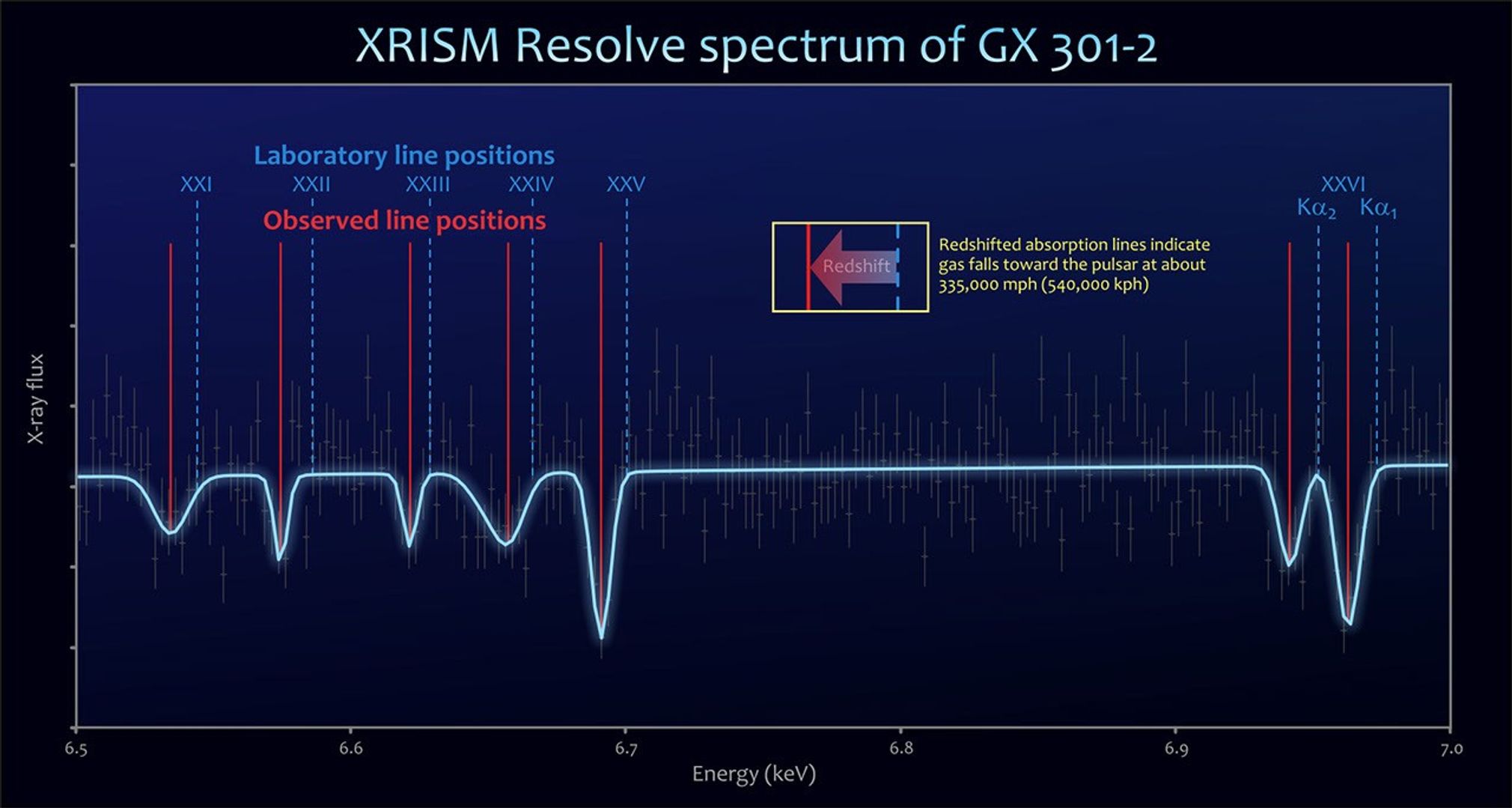
Rahin and his team show that the iron absorption lines they observed are displaced to lower energies than they would be if measured in a laboratory. This displacement, called a redshift, indicates motion away from the observer, which means the gas is flowing toward the pulsar. The extent of the redshift indicates the plasma’s velocity. The team’s analysis indicates gas is racing toward the pulsar at speeds of around 335,000 mph (540,000 kph).
Here’s what the researchers think is going on: As the pulsar enters the stream, it sweeps up gas into a thick, messy, turbulent disk. This gas spirals down to the pulsar, heats up, and emits X-rays to power the flares.
As the pulsar pushes farther into the stream, the turbulent disk breaks down. Astronomers suspect that as the pulsar moves more directly into the flow, the stream no longer has the angular momentum required to maintain the disk. Once the disk dissipates, plasma flows directly onto the neutron star. Observations with XRISM occurred near the end of this phase.
Then, as the pulsar nears the end of the stream, a messy disk briefly returns, this time spinning in the opposite direction. And then it, too, disappears as the pulsar exits. In all, the pulsar takes about four days to transit the stream.
“The BP Crucis system is an ideal laboratory for studying wind-fed pulsar accretion, and XRISM’s sensitive, high-resolution Resolve spectrometer is an ideal instrument for advancing our understanding of the processes involved,” said Brian Williams, the mission’s project scientist at NASA Goddard.
To learn more about the XRISM mission, visit:
Source: science.nasa.gov