NASA Sets Spacewalk for Station Maintenance, Live Coverage Planned

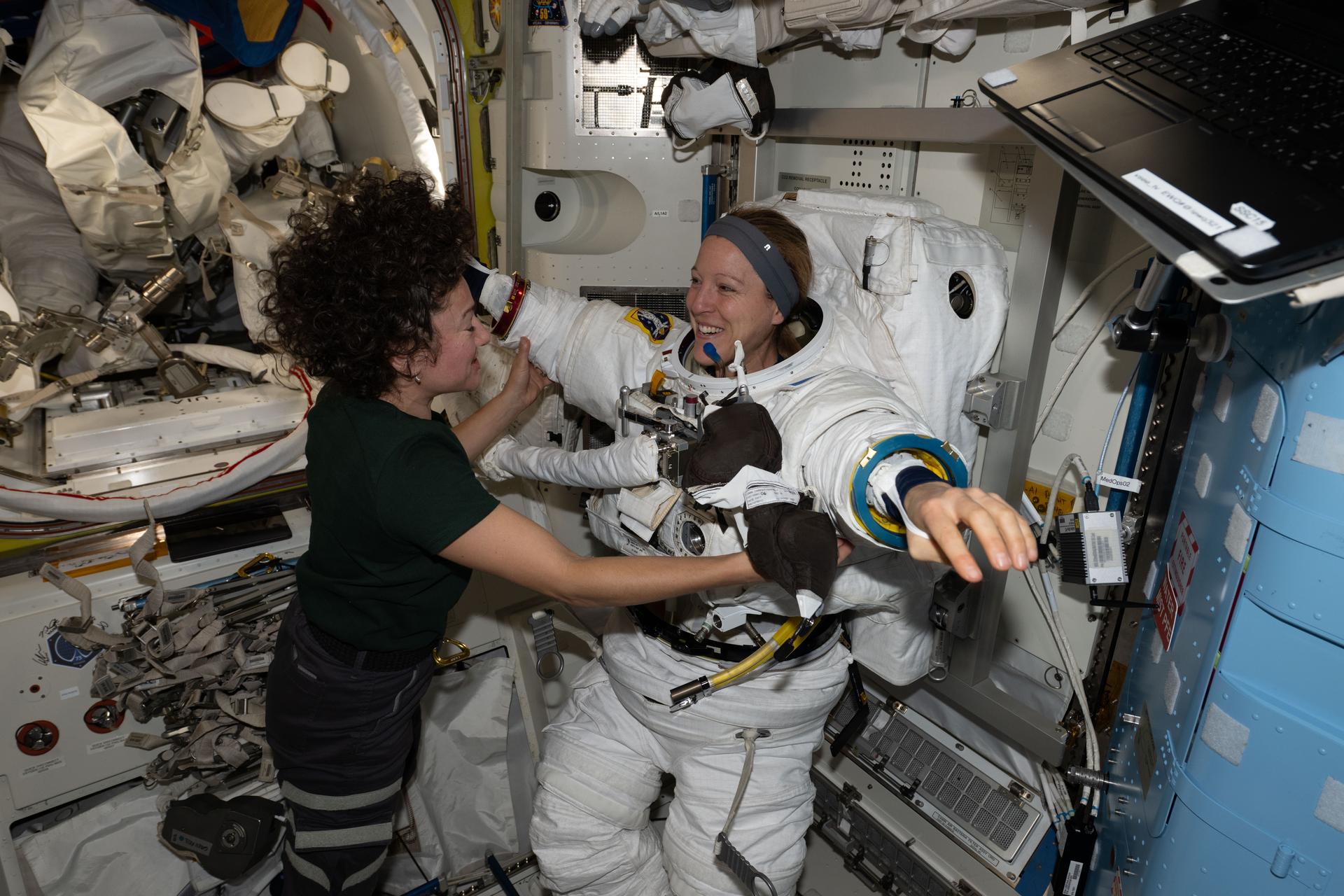
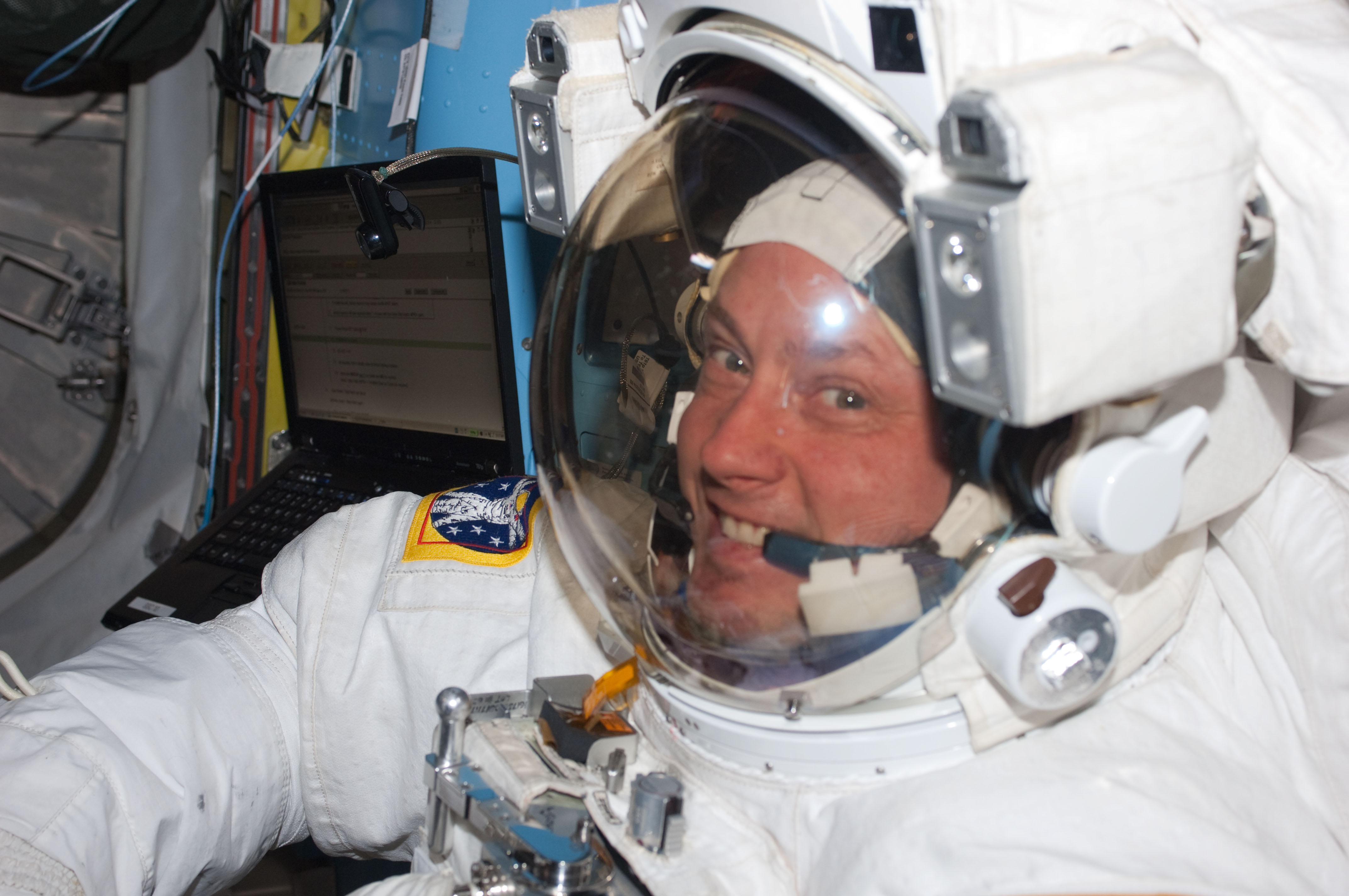
Expedition 74 flight engineers Sophie Adenot of ESA (European Space Agency) and Jessica Meir of NASA work together inside the International Space Station’s Quest airlock. Adenot is wearing a spacesuit in a powered and pressurized configuration to test its mobility, comfort, and optimal fit. Meir also assisted Adenot in conducting suit leak and pressure checks while verifying the suit’s communications hardware and life‑support systems.
NASA astronaut Jessica Meir and ESA (European Space Agency) astronaut Sophie Adenot work together inside the International Space Station’s Quest airlock during spacesuit fit and leak checks.
Credit: NASA

NASA will provide coverage as two astronauts step outside the International Space Station on Tuesday, Sept. 1, to replace a spacecraft navigational aid and complete several maintenance tasks in support of space station operations.

Watch live coverage beginning at 7 a.m. EDT. The spacewalk is expected to start at approximately 8:30 a.m. and last about six and a half hours. NASA’s spacewalk coverage will stream through a variety of platforms. Learn where to watch online:

https://nasa.gov/live

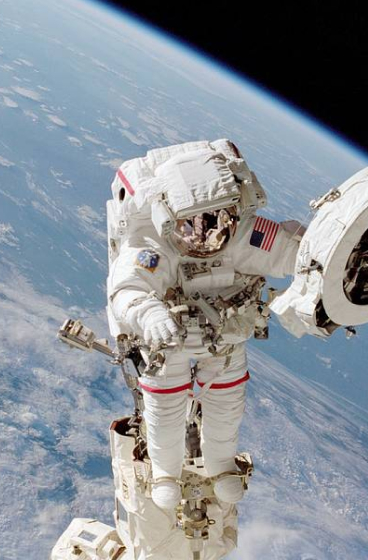
During U.S. spacewalk 99, NASA astronaut Jessica Meir and ESA (European Space Agency) astronaut Sophie Adenot will replace a retroreflector on the forward port of the space station’s Harmony module to support spacecraft navigation during rendezvous and docking operations. After installing the reflector, the crew will work to install jumper cables for the data-relay systems, prepare the Alpha Magnetic Spectrometer’s radiator for future maintenance, and replace a high-definition camera on the station’s truss.

Adenot will serve as spacewalk crew member 1 and will wear a suit with red stripes. Meir will serve as crew member 2 and will wear an unmarked suit.

This will be Meir’s seventh spacewalk and Adenot’s third. Meir will move into third all-time for total spacewalks among women at NASA, trailing Peggy Whitson (10) and Suni Williams (9). The excursion also marks the 284th spacewalk supporting space station assembly, maintenance, and upgrades.

To learn more about International Space Station research, operations, and its crews, visit:

https://www.nasa.gov/station

-end-

Jimi Russell
Headquarters, Washington
202-358-1100
[email protected]

Sandra Jones / Anna Schneider
Johnson Space Center, Houston 
281-483-5111
[email protected] / [email protected] 

Details

Last Updated

Aug 26, 2026

Editor
Jennifer M. Dooren

Source: www.nasa.gov

Astronauts Anil Menon and Sophie Adenot on Spacewalk

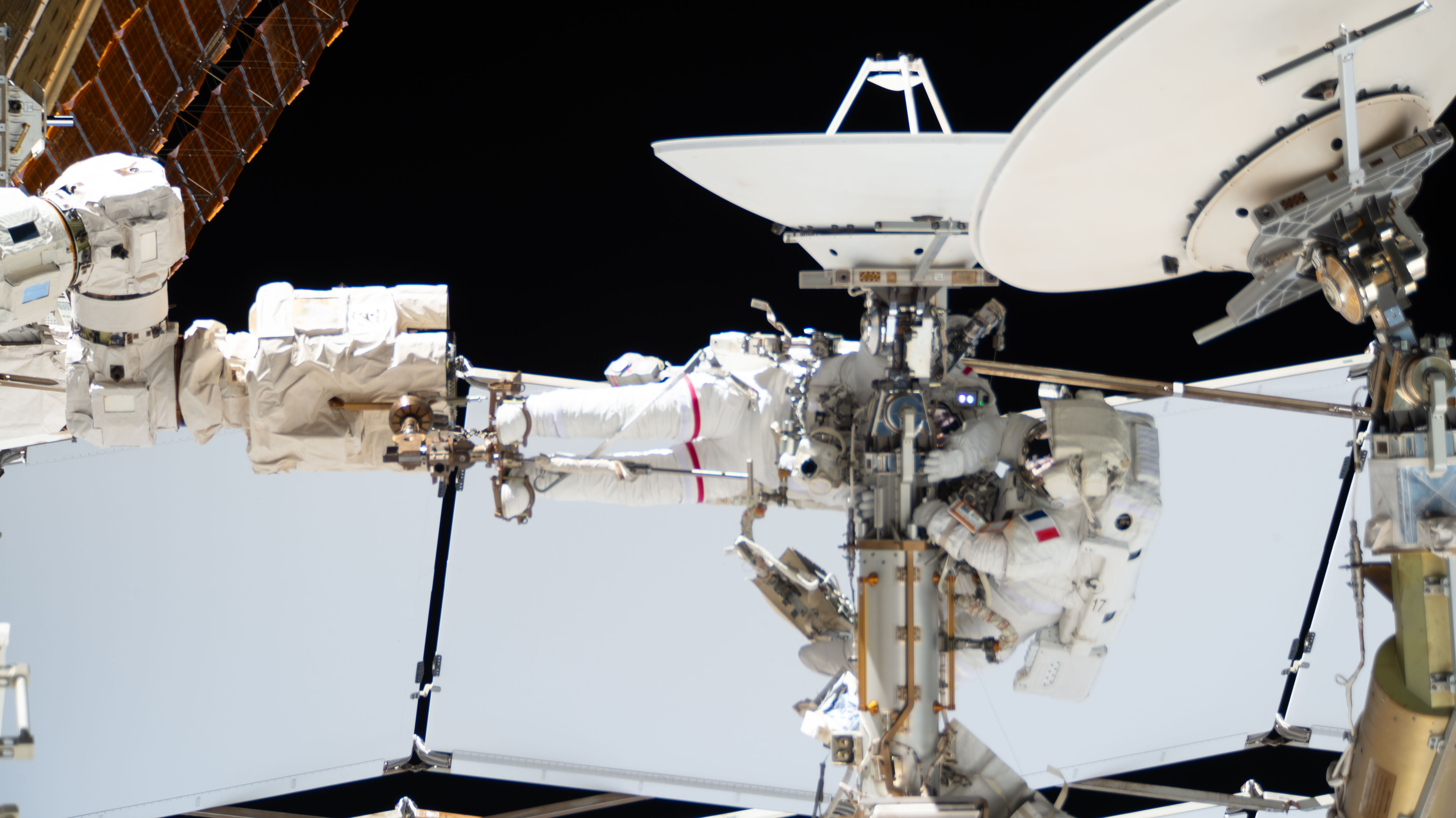
From left, Expedition 75 flight engineers Anil Menon of NASA (partially obscured and wearing the spacesuit with a red stripe on the legs) and Sophie Adenot of ESA (European Space Agency) work outside the International Space Station.
NASA

From left, Expedition 75 flight engineers Anil Menon of NASA (partially obscured and wearing the spacesuit with a red stripe on the legs) and Sophie Adenot of ESA (European Space Agency) work together during a six‑hour and 23‑minute spacewalk outside the International Space Station on Aug. 18, 2026. The pair will finish installing a high-speed communications antenna on Aug. 25, 2026.

Watch the spacewalk live.

Image credit: NASA

Source: www.nasa.gov

Human-Related Microbes May Survive Moon’s South Pole, NASA Finds

The gray-brown, heavily cratered Moon dominates the frame against black space, with a partially lit crescent Earth setting behind its upper-left edge.
This image was taken by an Artemis II astronaut from the Orion capsule in April 2026, as the spacecraft traveled past the Moon and back over 10 days. The gray-brown, heavily cratered Moon dominates the frame against black space, with a partially lit crescent Earth setting behind its upper-left edge.
NASA

Lee esta historia en español aquí.

Some of Earth’s microbes likely to hitch a ride to space with human explorers could survive in the shaded nooks and crannies of the Moon’s South Pole region, NASA scientists say. 

Published on Aug. 19, 2026, in Science Advances, these findings highlight a need to better understand microbial persistence in extreme lunar environments. As humans build a permanent presence on the Moon, it may become difficult to distinguish ancient lunar chemistry from contamination delivered by visiting astronauts. The concern extends beyond the Moon and on to Mars, scientists say. 

“Humans are natural explorers, and with them come their voices, their memories … and their microbes,” said Prabal Saxena, a planetary scientist who led the study from NASA’s Goddard Space Flight Center in Greenbelt, Maryland. “For some scientists, myself included, that reality can be unsettling. But it also creates an opportunity to turn an imperfect situation into a useful experiment.”

Bringing microbes along is unavoidable: Humans have, on average, 1 million bacteria living on each patch of skin the size of a pencil eraser, for example. These bacteria vent from spacesuits and habitats. Though the paper’s authors worry about contamination interfering with the search for chemical clues to ancient geology or biology, they also argue that the Moon should be used as a natural lab. In shaded areas around the South Pole, scientists could carefully test the real-life limits of microbial survival in an environment that can’t easily be reproduced on Earth. 

The Apollo program landed six pairs of astronauts on the Moon between 1969 and 1972. All six landing sites are near the lunar equator. In this visualization, the Apollo sites are contrasted with the South Pole, an area with enormous potential for future exploration. Time passes as we zoom toward Shackleton crater at the South Pole, revealing illumination conditions quite different from those near the equator. While many craters remain in permanent shadow, some nearby mountains and ridges are in persistent sunshine, making them attractive candidates for solar power and long-term habitation.
NASA’s Scientific Visualization Studio/Ernie Wright

Before any surface science can happen, scientists need a baseline measurement of what contaminants humans bring, the authors say.

“We need to understand what was there before us, because when we go to Mars to search for signs of life beyond our planet, we will want to make sure it’s not stuff we brought,” said Andrew Needham, a NASA Goddard-based paper co-author who is an Artemis contamination‑control scientist for lunar samples.

Even with strict sterilization procedures, some organisms are stubbornly resilient. A good example is Aspergillus niger, which is a fungus that thrives in warm, damp places like household bathrooms and heating, ventilation, and air conditioning systems. Astronauts have sampled it inside the International Space Station, and experiments demonstrate that the fungus can survive outside the station as well. Aspergillus niger was one of five microbes, including bacteria and fungi, selected for this study because of its known toughness in spaceflight environments. 

That microbes survived on the space station’s exterior surprised scientists. These species are typically not considered “extremophiles” that can withstand harsh conditions, such as the vacuum of space, according to Aaron Regberg, a geomicrobiologist at NASA’s Johnson Space Center in Houston.

“I would have expected these microbes to have dried out,” said Regberg, who studies space station bacteria and was a co-author on the paper.

Astronaut conducts scientific work aboard the International Space Station, floating in microgravity surrounded by equipment and research tools.
NASA astronaut Kate Rubins on Oct. 14, 2016, collecting microbes in the Japanese Experiment Module aboard the International Space Station.
JAXA/Takuya Onishi

He pointed out that NASA often bakes robotic spacecraft at temperatures above 400 degrees Fahrenheit to reduce the number of living organisms on them. But that’s not possible with astronauts, so contamination concerns take on new meaning in crewed exploration of the Moon’s south polar environment.

A clearer picture of where microbes might survive comes from understanding how sunlight behaves at the poles. Survival in this study means the microbe can stay alive for at least one Earth day, which does not mean that it can grow and reproduce.

Because the Moon has a very small tilt on its axis, the view from its poles is of a Sun that appears to hover just above the horizon, skimming the surface like a flashlight laying on a table. As a result, elevated parts of the surface, including crater ridges, mountains, and even small bumps, block light from reaching low-lying terrain. This produces pockets of shadowed areas that can remain cold and preserve water, as well as shield fragile molecules and possible microorganisms from lethal radiation.

With that scientific context in mind, the team set out to test which Earth microbes could survive extreme polar conditions. They focused on organisms commonly found in spaceflight environments and those common on human skin. Besides Aspergillus niger, these included Bacillus subtilis, Staphylococcus aureus, Deinococcus radiodurans, and several species of Fusarium. Based on an analysis of previous studies, the scientists noted the maximum amount of heat and ultraviolet (UV) radiation each organism can withstand.

Then, the organisms were tested in simulations of three regions near the lunar South Pole — Nobile Rim, Connecting Ridge, and De Gerlache Rim. Those simulations used detailed environmental maps built from elevation and temperature data collected by instruments aboard NASA’s Lunar Reconnaissance Orbiter, combined with models of how radiation strikes the surface.

The models showed maps of “survivable niches” that range in size from a miles-wide crater floor to an astronaut’s boot print. Aspergillus niger, which was most resistant to UV radiation, was able to survive even in areas with some sunlight exposure. UV radiation is so deadly to most microbes that it’s used for sterilization in hospitals. 

“When we think of the Moon, we don’t typically think of biology,” said Heather Graham, a paper co-author at NASA Goddard who helps develop tools and techniques for detecting biology that may look nothing like Earth’s. “But the Moon is a place where a cell can survive, so our first exploration of these sites should pay extra attention to our microbial hitchhikers and work hard to characterize lunar chemistry before our visits change what we will find.”

The authors note that while some microbes can survive in a dormant state in regions around the South Pole, and thereby confuse some future scientific investigations, there is no evidence the Moon has key ingredients to sustain growth and replication. Such ingredients include liquid water, which typically requires an atmosphere and moderate temperatures.  

For more information, visit:

https://science.nasa.gov/astrobiology

About the Author

Lonnie Shekhtman

Lonnie Shekhtman

Senior Science Writer

Shekhtman helps communicate NASA planetary science to the world through news and feature stories on NASA.gov, videos for NASA+ and YouTube, and by working with the media. She reports on lunar and Mars science and exploration; NASA’s search for life; missions to Venus, Titan, and Jupiter’s Trojan asteroids; and many other topics related to NASA’s exploration of our solar system and beyond.

Source: science.nasa.gov

NASA’s LRO Images Falcon 9 Crater on Moon, Learns New Details

3 min read

NASA’s LRO Images Falcon 9 Crater on Moon, Learns New Details

Two-frame animation showing a new crater, with ejecta rays extending outward, appearing on the Moon.
This is an animated before-and-after view of the crater formed after a Falcon 9 upper stage struck the Moon’s surface on Aug. 5, 2026. These images were taken between Aug. 11 and 12 by the Narrow-Angle Camera on NASA’s Lunar Reconnaissance Orbiter. These images are enlarged three times from the original, with north facing up, and they cover an area about a quarter of a mile wide.
NASA Goddard/Intuitive Machines

Between Aug. 11 and 12, NASA’s Lunar Reconnaissance Orbiter (LRO) captured a series of images of a new crater on the Moon. The crater formed on Aug. 5, when a SpaceX Falcon 9 upper stage impacted the surface following its January 2025 launch of the Firefly Blue Ghost 1 mission.

To capture imagery of the impact, engineers tilted the spacecraft so its cameras would point toward the crater each time LRO passed about 60 miles above the Moon, traveling 1 mile per second. The orbiter circles the Moon from pole to pole every two hours, while the Moon slowly rotates underneath it. To photograph a specific spot, the spacecraft must wait until that location turns into view, which took six days in this case.

Getting the pointing right was only half the challenge; timing had to be accurate as well. If the camera snapped even 10 seconds too early or too late, the target would drift off-center by 10 miles.

An artist concept video showing NASA’s Lunar Reconnaissance Orbiter circling the Moon.
NASA’s Goddard Space Flight Center Conceptual Image Lab

Because of the variety of viewing angles, scientists could see the crater under multiple lighting conditions that revealed unique features. In images where the crater rim stood out, scientists measured its 60‑foot width. Scientists also determined the crater is less than 10 feet deep based on the length of its shadow.

To capture these details, LRO used its Narrow-Angle Camera, which can spot features as small as 3 feet wide.

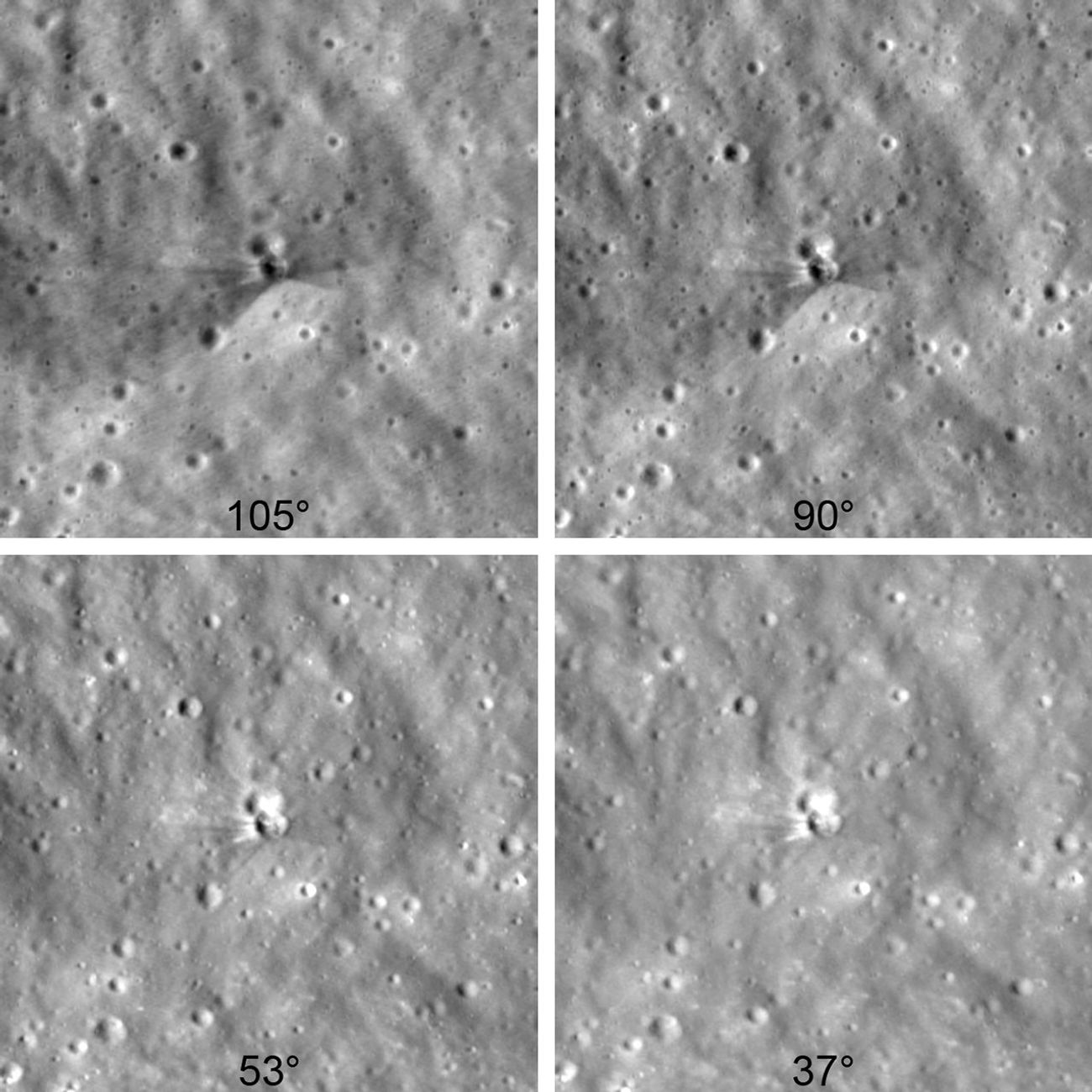
Four black-and-white views of the same cratered lunar surface, each taken from a different angle. A small, bright boulder or mound near the center casts shadows that change direction across the images. The panels are labeled 105°, 90°, 53°, and 37°.
Collected between Aug. 11 and 12 by NASA’s Lunar Reconnaissance Orbiter, six days after a Falcon 9 upper-stage booster impacted the Moon, these images were taken from different viewing angles, bringing out different features. The darker area that fans around the crater in the upper-left image is rougher than the surroundings, as this surface material has been altered over a long time by solar wind, galactic cosmic rays, and micrometeorite impacts. The brighter rays and splotch above the crater in the lower-right image is fresher material that was excavated from deeper below the surface. The pictures are arranged in the order they were taken, starting at the top left and moving toward the bottom right, with the lighting angle from the Sun gradually changing from one image to the next. Each image is enlarged two times and shows an area of the Moon about 1,000 feet wide.
NASA Goddard/Intuitive Machines

The images above show bright and dark rays stretching out from the crater. The darker streaks are made of surface dust and rocks altered over a long time by solar wind, galactic cosmic rays, and micrometeorite impacts. This weathered material was excavated by the collision from 1.5 feet into the lunar surface. The brighter streaks near the crater rim are made of fresh material excavated from deeper underground.

Grayscale view of a cratered surface with two overlapping, vertical translucent shapes—one red and one blue, and three small colored dots.
This image from NASA’s Lunar Reconnaissance Orbiter shows two oval regions where the Falcon 9 upper stage was likely to impact the Moon, based on calculations by engineers with NASA’s Center for Near Earth Object Studies. Both ellipses are 2.1 miles long and 0.4 miles wide. Both predictions use the same booster-trajectory calculations, but only the blue ellipse takes into account the lunar terrain. The red and blue dots show predicted impact locations, whereas the cyan dot shows the actual impact site.
NASA/JPL-Caltech

Finding the impact site took global coordination among experts and hobbyists. Independent astronomers first identified the rocket’s trajectory using publicly available data. NASA’s Center for Near Earth Object Studies, which tracks natural objects that could pose hazards to Earth for the agency’s Planetary Defense program, used this opportunity to test and validate tools and techniques for predicting impacts.

Based at NASA’s Jet Propulsion Laboratory in Southern California, the center incrementally refined the trajectory until identifying the location of impact, which it provided to the Republic of Korea for their Korea Pathfinder Lunar Orbiter (Danuri) team. The team used the high-resolution LUTI camera on Danuri a few hours later to image the crater, finding the prediction was accurate to about 0.6 miles. 

After capturing images of the crater, the Danuri mission sent coordinates to NASA’s LRO team to help refine their follow-up imaging sequence. Comparing their new crater images with the pre-impact images, the LRO team updated the crater center coordinates: 19.4759°N, 266.7138°E, 511 meters elevation.

About the Author

NASA Science Editorial Team

NASA Science Editorial Team

Source: science.nasa.gov

NASA Astronaut Mike Fincke Leaves NASA, Career Includes 4 Spaceflights

NASA astronaut Mike Fincke is pictured inside the International Space Station’s Quest airlock prior to the start of the third spacewalk for the STS-134 mission.
Credit: NASA

NASA astronaut Mike Fincke is departing the agency on Wednesday after 30 years of service. Throughout his career, he flew four missions, spent 549 days in space, and completed nine spacewalks in support of the International Space Station.

“Few people have had the opportunity to shape as many chapters of NASA’s history as Mike Fincke,” said NASA Administrator Jared Isaacman. “Over a remarkable career, Mike served our nation as a pilot, engineer, astronaut, and mentor. From long-duration missions aboard the International Space Station to helping prepare the Artemis generation, his contributions have helped position NASA for what comes next. The success we’re building on today is possible because of people like Mike, who dedicated their careers to moving our space program forward and preparing the next generation to carry the mission even further. I’d like to congratulate Mike on an incredible career and thank him for his decades of service to NASA, our nation, and the countless people who had the opportunity to learn from and fly alongside him.”

He ranks fourth among NASA astronauts in accumulated time in space, and his spacewalks total 48 hours and 37 minutes. Most recently, Fincke piloted NASA’s SpaceX Crew‑11 mission, which launched in August 2025 and returned in January. During the mission, he served as a flight engineer for International Space Station Expedition 73 and commander of Expedition 74.

Fincke joined NASA’s 16th astronaut class in 1996 and first flew to space in 2004 aboard Soyuz TMA‑4 in support of the space station’s Expedition 9. Serving as a science officer and flight engineer, he helped maintain station systems and performed four spacewalks. He returned to space in 2008 on Soyuz TMA‑13 as commander of Expedition 18, preparing the space station for its transition to six‑person crews at the time and completing two more spacewalks.

In 2011, Fincke flew on STS‑134, the final flight of space shuttle Endeavour. As mission specialist and robotic arm operator, he completed three spacewalks and helped deliver and install the Alpha Magnetic Spectrometer.

“Mike’s remarkable career reflects three decades of dedication to NASA’s mission and the advancement of human spaceflight,” said Vanessa Wyche, director of NASA’s Johnson Space Center in Houston. “From his time aboard the International Space Station to his commitment to mentoring the next generation, Mike has made an immense impact across our agency. His legacy of service, mentorship, and dedication to exploration will continue to inspire the generations to come.”

Throughout his career, Fincke bridged spacecraft development, flight testing, and mission operations. Early in the International Space Station Program, he helped test and integrate several of the station’s initial modules before launch. His flight experience spanned multiple generations of human spacecraft, including two missions aboard Soyuz, one aboard the space shuttle, and later piloting the SpaceX Dragon.

Fincke was a foundational contributor to NASA’s Commercial Crew Program. As chief of the Astronaut Office’s Commercial Crew Branch, he worked to ensure astronaut needs, crew safety, and human spaceflight experience informed development of the nation’s next generation of crewed spacecraft. He spent five years supporting Boeing’s Crew Flight Test program training as a crew member and backup pilot, contributing to flight software, systems integration, integrated testing, and spacecraft interfaces.

Fincke also supported station operations from the ground as a crew test support team member in Russia, a capsule communicator, or capcom, and crew procedures team lead. He helped translate complex engineering and operational requirements into clear instructions for crews working in orbit. His continuity across development, integration, mission support, and long‑duration flight gave him an end‑to‑end perspective on space station assembly and operation.

“Mike approached every assignment with experience, humility, and an unwavering focus on the mission,” said Scott Tingle, chief of the Astronaut Office at NASA Johnson. “Whether flying aboard the station, supporting crews from the ground, or helping shape the spacecraft that future crews will rely on, he consistently strengthened our team. His legacy is woven into the way we fly today.”

A native of Emsworth, Pennsylvania, Fincke holds bachelor’s degrees in aeronautics and astronautics and in Earth, atmospheric, and planetary sciences from the Massachusetts Institute of Technology, where he also studied in the Soviet Union through an exchange program with the Moscow Aviation Institute. He earned master’s degrees in aeronautics and astronautics from Stanford University and in planetary geology from the University of Houston, Clear Lake.

Fincke is a retired U.S. Air Force colonel and distinguished graduate of the U.S. Air Force Test Pilot School. He served as a space systems engineer and flight test engineer at Edwards and Eglin Air Force Bases and later as the U.S. flight test liaison to the Japanese‑U.S. XF‑2 fighter program at Gifu Air Base in Japan. He accumulated more than 2,000 flight hours in more than 30 aircraft types.

“After exactly 30 years, I am departing NASA, but I remain deeply committed to the work of exploration.” Fincke said. “NASA gave me the extraordinary privilege of serving alongside remarkable people, flying and helping develop spacecraft, and contributing to the International Space Station from its earliest days through command in orbit. I am profoundly grateful to my crewmates, the teams on the ground, our international partners, and the families who make this work possible. I am excited to carry those lessons forward and help prepare the next generation of engineers, explorers, and leaders. Together, we will return humanity to the Moon, travel to Mars, journey outward to the planets and moons beyond Earth, and someday reach for the stars – all while caring for Earth, the most beautiful planet in our solar system.”

To learn more about NASA’s astronauts and space exploration, visit:

https://www.nasa.gov/astronauts

-end-

Jimi Russell
Headquarters, Washington
202-358-1100
[email protected]

Anna Schneider
Johnson Space Center, Houston
281-483-5111
[email protected]

Details

Last Updated

Aug 12, 2026

Source: www.nasa.gov

How Online Casinos Work in the United States

Online casinos have transformed the gambling industry by giving players access to casino games from virtually anywhere. Instead of visiting a physical casino, users can enjoy slot machines, blackjack, roulette, poker, baccarat, and live dealer games through websites and mobile apps. As internet technology has improved, online casinos have become faster, safer, and more interactive than ever before.

Understanding How Online Casinos Work in the United States is important because the market is different from many other countries. Gambling laws vary by state, meaning online casino access depends on where a player lives. Licensed platforms use advanced security, certified game software, and secure banking systems to create a reliable gaming environment while complying with state regulations.

This guide explains everything you need to know about how online casinos operate in the United States, from creating an account to making deposits, playing games, and withdrawing winnings. Whether you are new to online gambling or simply curious about the technology behind it, this article provides a clear overview of the entire process. For additional insights, industry updates, and expert resources on U.S. online gambling, visit getodds.us.

What Are Online Casinos?

An online casino is a digital platform that offers traditional casino games over the internet. Instead of walking into a casino building, players log into a website or mobile application to access hundreds or even thousands of games.

Most online casinos feature:

  • Online slots
  • Blackjack
  • Roulette
  • Baccarat
  • Video poker
  • Craps
  • Live dealer games
  • Specialty games

These games are developed by professional software providers that use certified technology to ensure fairness and random outcomes.

Unlike traditional casinos, online casinos operate around the clock, allowing players to enjoy their favorite games whenever they choose.

How Online Casinos Work in the United States?

Understanding How Online Casinos Work in the United States starts with knowing the technology behind every platform. An online casino combines gaming software, secure payment systems, customer verification, encryption technology, and state licensing into one digital platform.

The basic process works like this:

  1. A player creates an account.
  2. The casino verifies the player’s identity and eligibility.
  3. The player deposits funds using an approved payment method.
  4. Games are accessed through secure gaming software.
  5. Each game produces random and fair results using certified technology.
  6. Any winnings are added to the player’s casino balance.
  7. Players can request withdrawals using supported banking methods.

Every action takes place on encrypted servers that protect financial and personal information.

Licensed casinos also monitor accounts for fraud prevention, responsible gambling compliance, and anti-money laundering requirements.

How Do Players Register at an Online Casino?

Registration is designed to be quick while meeting legal requirements.

Most online casinos require users to provide:

  • Full legal name
  • Date of birth
  • Residential address
  • Email address
  • Mobile phone number
  • Username
  • Secure password

Players must also confirm that they meet the legal gambling age in their state.

After registration, some casinos immediately verify identity, while others complete verification before allowing withdrawals.

Identity verification may require documents such as:

  • Government-issued ID
  • Driver’s license
  • Passport
  • Utility bill
  • Bank statement

This process helps prevent fraud and ensures casinos comply with gambling regulations.

Why Is Identity Verification Important?

Many new players wonder why online casinos ask for personal documents.

Identity verification serves several important purposes:

Preventing Underage Gambling

Only adults meeting the legal gambling age may participate.

Protecting Against Fraud

Verification prevents stolen identities and unauthorized accounts.

Complying With Financial Regulations

Casinos must follow anti-money laundering rules and know-your-customer (KYC) requirements.

Ensuring Secure Withdrawals

Before releasing winnings, casinos verify that funds are sent to the correct individual.

Although verification may seem inconvenient, it significantly improves player safety.

How Do Deposits Work?

Once an account has been verified, players can fund their casino balance using supported payment methods.

The deposit process generally follows these steps:

  1. Log into the casino account.
  2. Open the cashier or banking section.
  3. Select a payment method.
  4. Enter the deposit amount.
  5. Confirm the payment.
  6. Funds are added to the gaming balance.

Many online casinos process deposits instantly, allowing players to begin playing within minutes.

Deposit limits often vary depending on:

  • Payment provider
  • Casino policies
  • Account verification status
  • State regulations

Some casinos also offer flexible minimum deposits, making online gambling accessible to players with different budgets.

Common Deposit Methods in the United States

Most licensed online casinos support multiple payment options to make funding convenient.

Debit and Credit Cards

Visa and Mastercard remain among the most widely accepted payment methods.

Benefits include:

  • Fast processing
  • Familiar payment process
  • Strong security protections

However, some banks may decline gambling-related transactions depending on their policies.

Bank Transfers

Direct bank transfers are popular for larger deposits.

Advantages include:

  • High transaction limits
  • Secure transfers
  • Reliable processing

Processing times may vary depending on the financial institution.

E-Wallets

Digital wallets provide an extra layer of convenience by separating banking information from casino accounts.

Popular features include:

  • Fast deposits
  • Easy account management
  • Additional privacy
  • Quick payment confirmation

Availability varies by state and casino.

Online Banking Services

Some casinos connect directly with supported banking networks, allowing players to transfer funds securely from checking accounts.

These systems often provide:

  • Real-time verification
  • Instant deposits
  • Secure encryption
  • Simplified payment approval

Prepaid Cards

Prepaid gaming cards allow players to deposit only the funds loaded onto the card.

Many users prefer prepaid options because they help maintain gambling budgets while protecting primary bank accounts.

Are Deposits Secure?

Security is one of the most important aspects of How Online Casinos Work in the United States.

Licensed casinos invest heavily in cybersecurity technologies to protect player information.

Most platforms use:

  • SSL encryption
  • Secure payment gateways
  • Firewalls
  • Fraud monitoring systems
  • Multi-factor authentication
  • Continuous server monitoring

These technologies help protect sensitive information such as:

  • Banking details
  • Personal identification
  • Login credentials
  • Transaction history

In addition to technical security, regulated casinos undergo regular audits to ensure compliance with licensing standards.

Players can further improve account security by:

  • Creating strong passwords
  • Enabling two-factor authentication when available
  • Avoiding public Wi-Fi when making transactions
  • Logging out after each session
  • Monitoring account activity regularly

Learning How Online Casinos Work in the United States also means recognizing the importance of choosing licensed operators that prioritize security and responsible gaming. Players looking for additional educational resources, industry updates, and betting information can also explore getodds.us for useful insights related to the U.S. online gambling landscape.

How Do Online Casino Games Work?

After making a deposit, players gain access to a wide selection of casino games. Although the gameplay varies by title, every game follows software-driven rules designed to produce fair and consistent results.

Online casinos partner with established game developers that create games using advanced programming and certified mathematical models. These games are hosted on secure servers and are available through desktop computers, smartphones, and tablets.

Players simply choose a game, adjust their betting amount, and begin playing. Wagers are deducted from the account balance, and any winnings are credited automatically once a round is completed.

Modern online casinos continually update their game libraries, ensuring players have access to both classic favorites and the latest releases.

What Is a Random Number Generator (RNG)?

One of the most important technologies behind How Online Casinos Work in the United States is the Random Number Generator, commonly known as an RNG.

An RNG is a computer program that continuously generates random sequences of numbers. Every spin of a slot machine, shuffle of virtual cards, or roll of digital dice is determined by this system.

The purpose of the RNG is to ensure that:

  • Every game outcome is independent.
  • Results cannot be predicted.
  • Neither the casino nor the player can influence the outcome.
  • Every player has an equal opportunity based on the game’s rules.

Licensed online casinos use independently tested RNG software to maintain fairness and transparency. Testing laboratories regularly audit these systems to confirm that games meet strict regulatory standards.

What Types of Casino Games Are Available?

Most online casinos offer hundreds or even thousands of games across multiple categories.

Slot Games

Online slots are the most popular casino games due to their simple gameplay and entertaining themes.

Players can enjoy:

  • Classic three-reel slots
  • Five-reel video slots
  • Progressive jackpot slots
  • Megaways slots
  • Branded slot games

Many slot games also include bonus rounds, free spins, multipliers, and expanding wild symbols.

Table Games

Traditional casino games remain a favorite among experienced players.

Common table games include:

  • Blackjack
  • Roulette
  • Baccarat
  • Craps
  • Casino Hold’em
  • Three Card Poker

Many of these games offer several variations with different betting limits and rule sets.

Video Poker

Video poker combines elements of slot machines and poker. Players aim to build the strongest possible poker hand while following a fixed payout table.

Popular versions include:

  • Jacks or Better
  • Deuces Wild
  • Bonus Poker
  • Double Bonus Poker

Specialty Games

Many casinos also feature unique entertainment options such as:

  • Keno
  • Bingo
  • Scratch cards
  • Virtual sports
  • Instant-win games

These games appeal to players looking for quick gameplay and simple rules.

What Are Live Dealer Casinos?

Live dealer games bridge the gap between online gambling and land-based casinos.

Instead of relying entirely on computer graphics, live dealer games are streamed in real time from professional gaming studios. Human dealers manage the cards, roulette wheels, and other equipment while players interact through live video.

Features of live dealer casinos include:

  • HD video streaming
  • Professional dealers
  • Real-time betting
  • Live chat functionality
  • Multiple camera angles

Popular live dealer games include:

  • Live Blackjack
  • Live Roulette
  • Live Baccarat
  • Live Poker
  • Game Shows

Because the action is broadcast live, players can watch every card shuffle, wheel spin, and dice roll, adding an extra level of transparency and engagement.

How Do Bonuses Work?

Bonuses are promotional offers designed to attract new players and reward existing customers.

Most online casinos provide a variety of promotions, including:

Welcome Bonuses

New players often receive a bonus based on their first deposit. This may include bonus funds, free spins, or a combination of both.

Reload Bonuses

Existing customers can receive additional bonus funds when making future deposits during promotional periods.

Cashback Offers

Cashback promotions return a percentage of eligible losses, helping extend a player’s bankroll.

Free Spins

Many slot promotions award free spins that allow players to enjoy selected games without using additional cash from their balance.

Loyalty Programs

Regular players may earn points through casino loyalty programs. These points can often be exchanged for bonus funds, prizes, or other rewards.

Before claiming any promotion, players should review the terms and conditions, including wagering requirements, eligible games, and expiration dates.

How Are Wins and Losses Calculated?

Every casino game has predefined payout rules.

For example:

  • Slots pay according to their paytable.
  • Blackjack payouts depend on the final card combinations.
  • Roulette payouts vary according to the type of bet placed.
  • Baccarat payouts depend on whether the Player, Banker, or Tie wins.

Once a game ends, the software automatically calculates the result and updates the player’s account balance. This process happens within seconds, providing instant feedback and allowing players to continue without delays.

What Is RTP?

Return to Player (RTP) represents the theoretical percentage of wagered money that a game is expected to return to players over a very large number of plays.

For example:

  • A slot with a 96% RTP theoretically returns $96 for every $100 wagered over millions of spins.
  • The remaining percentage represents the casino’s mathematical advantage, often called the house edge.

It’s important to remember that RTP is a long-term statistical measure. Individual gaming sessions can produce results that differ significantly from the theoretical average.

Understanding RTP helps players compare games and make more informed choices when selecting what to play.

How Do Online Casinos Protect Player Data?

Security is a fundamental part of How Online Casinos Work in the United States. Licensed operators use multiple layers of protection to keep customer information safe.

Common security measures include:

  • SSL encryption for secure data transmission
  • Secure payment gateways
  • Encrypted password storage
  • Fraud detection systems
  • Regular security audits
  • Continuous network monitoring

These technologies protect sensitive information such as:

  • Personal details
  • Payment information
  • Account balances
  • Transaction records

Players can also improve account security by using strong passwords, enabling two-factor authentication when available, and avoiding sharing login credentials with others.

How Does Customer Support Help Players?

Reliable customer support is an essential feature of reputable online casinos. Players may need assistance with account verification, payment issues, bonus questions, or technical problems.

Most casinos provide several support options, including:

  • Live chat
  • Email support
  • Telephone assistance
  • Help centers
  • Frequently Asked Questions (FAQs)

Many licensed operators offer 24/7 customer service, ensuring players can receive assistance whenever they need it. Prompt and knowledgeable support contributes to a safer and more enjoyable gaming experience.

How Do Withdrawals Work?

Withdrawing winnings is generally straightforward at licensed online casinos. Before processing a withdrawal, the casino may complete identity verification if it has not already been done. This helps protect both the player and the operator from fraud.

The withdrawal process typically includes these steps:

  1. Log in to your casino account.
  2. Open the cashier or banking section.
  3. Select the preferred withdrawal method.
  4. Enter the withdrawal amount.
  5. Submit the request.
  6. Wait for the casino to review and approve the transaction.
  7. Receive the funds once processing is complete.

Processing times vary depending on the payment method, casino policies, and verification status. Some methods may be completed within hours, while others can take several business days.

Is Online Casino Gambling Legal in the United States?

One of the most important aspects of How Online Casinos Work in the United States is understanding that online gambling laws are regulated at the state level rather than by a single nationwide law.

Some states have legalized and regulate online casino gaming, allowing licensed operators to offer real-money casino games. Other states permit only certain forms of online gambling, such as sports betting or poker, while some prohibit online casino gaming altogether.

Because regulations differ from one state to another, players should always ensure they are using a licensed platform that is authorized to operate in their location.

Why Is Responsible Gambling Important?

Online casinos are designed for entertainment, and responsible gambling helps ensure that players enjoy the experience without financial or personal harm.

Good responsible gambling habits include:

  • Setting a gambling budget before playing.
  • Limiting playing time.
  • Avoiding chasing losses.
  • Taking regular breaks.
  • Never gambling with money needed for essential expenses.
  • Viewing gambling as entertainment rather than a source of income.

Many licensed online casinos also provide responsible gambling tools such as:

  • Deposit limits
  • Loss limits
  • Session reminders
  • Cooling-off periods
  • Temporary account suspension
  • Self-exclusion programs

These features help players maintain control over their gaming activities.

Tips for Choosing a Reliable Online Casino

Not every online casino offers the same level of quality or security. Before registering, consider the following factors:

  • Valid state license
  • Strong reputation among players
  • Secure encryption technology
  • Fair and independently tested games
  • Transparent bonus terms
  • Multiple trusted payment methods
  • Responsive customer support
  • Responsible gambling tools

Researching a casino before signing up can help you find a platform that offers a safe and enjoyable gaming experience.

The Future of Online Casinos in the United States

The U.S. online casino industry continues to evolve as technology advances and more states explore regulated online gambling.

Some of the trends shaping the future include:

  • Improved mobile gaming experiences
  • Faster payment processing
  • Expanded live dealer offerings
  • Artificial intelligence for customer support
  • Personalized promotions
  • Enhanced security technologies
  • Integration of new payment solutions

As regulations continue to develop, players can expect online casinos to become even more secure, innovative, and user-friendly.

Conclusion

Understanding How Online Casinos Work in the United States allows players to make informed decisions when choosing where and how to play. From creating an account and verifying identity to depositing funds, enjoying games, and withdrawing winnings, every step is supported by advanced technology designed to provide security, fairness, and convenience.

Licensed online casinos use certified Random Number Generators (RNGs), encrypted payment systems, and responsible gambling tools to create a trustworthy gaming environment. However, because gambling laws vary by state, players should always verify that an online casino is legally authorized to operate in their jurisdiction.

Whether you enjoy slots, blackjack, roulette, poker, or live dealer games, selecting a reputable and licensed platform is essential for a positive experience. For additional insights, betting resources, and educational information about the U.S. gambling industry, getodds.us can be a valuable source of up-to-date information.

Frequently Asked Questions

1. How do online casinos work in the United States?

Online casinos allow players to register, deposit funds, play games using certified software, and withdraw winnings through secure payment systems. Licensed operators follow state regulations and use advanced security technologies to protect player information.

2. Are online casino games fair?

Yes. Licensed online casinos use independently tested Random Number Generators (RNGs) to ensure game outcomes are random and unbiased.

3. Can I play online casinos from any state?

No. Online casino availability depends on state laws. Some states regulate and allow online casino gaming, while others have different restrictions or do not permit it.

4. What payment methods do online casinos accept?

Most online casinos support debit cards, credit cards, bank transfers, online banking services, e-wallets, and prepaid payment options, although availability varies by casino and state.

5. How long do withdrawals usually take?

Withdrawal times depend on the payment method and the casino’s processing procedures. Some transactions are completed within hours, while others may take several business days.

6. Is identity verification required?

Yes. Most licensed online casinos require identity verification to comply with legal regulations, prevent fraud, and ensure winnings are paid to the correct account holder.

7. Can I play online casino games on my mobile phone?

Yes. Most modern online casinos are fully optimized for smartphones and tablets, allowing players to enjoy games from almost anywhere with an internet connection.

8. How can I gamble responsibly?

Set a budget, play within your financial limits, avoid chasing losses, take regular breaks, and use responsible gambling tools such as deposit limits or self-exclusion if needed.