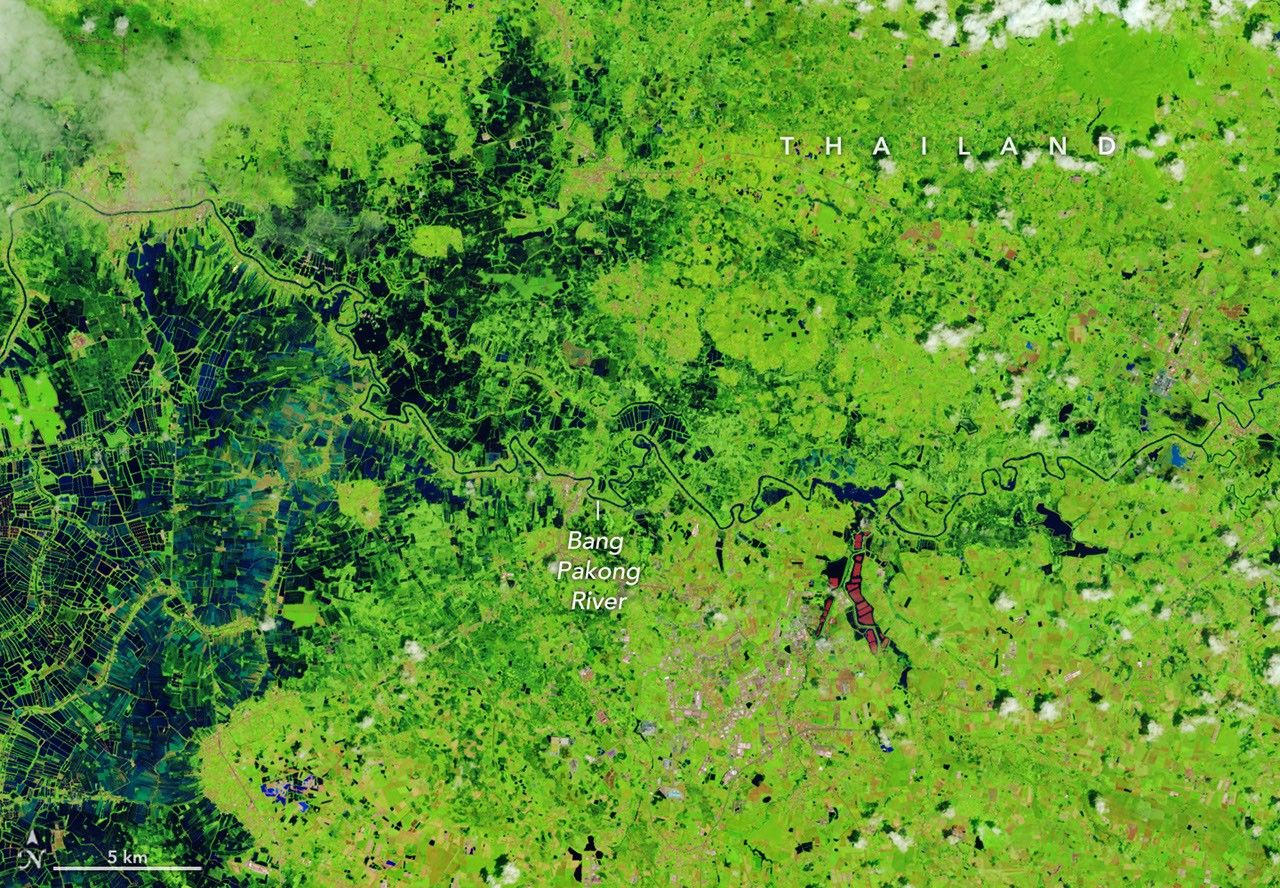
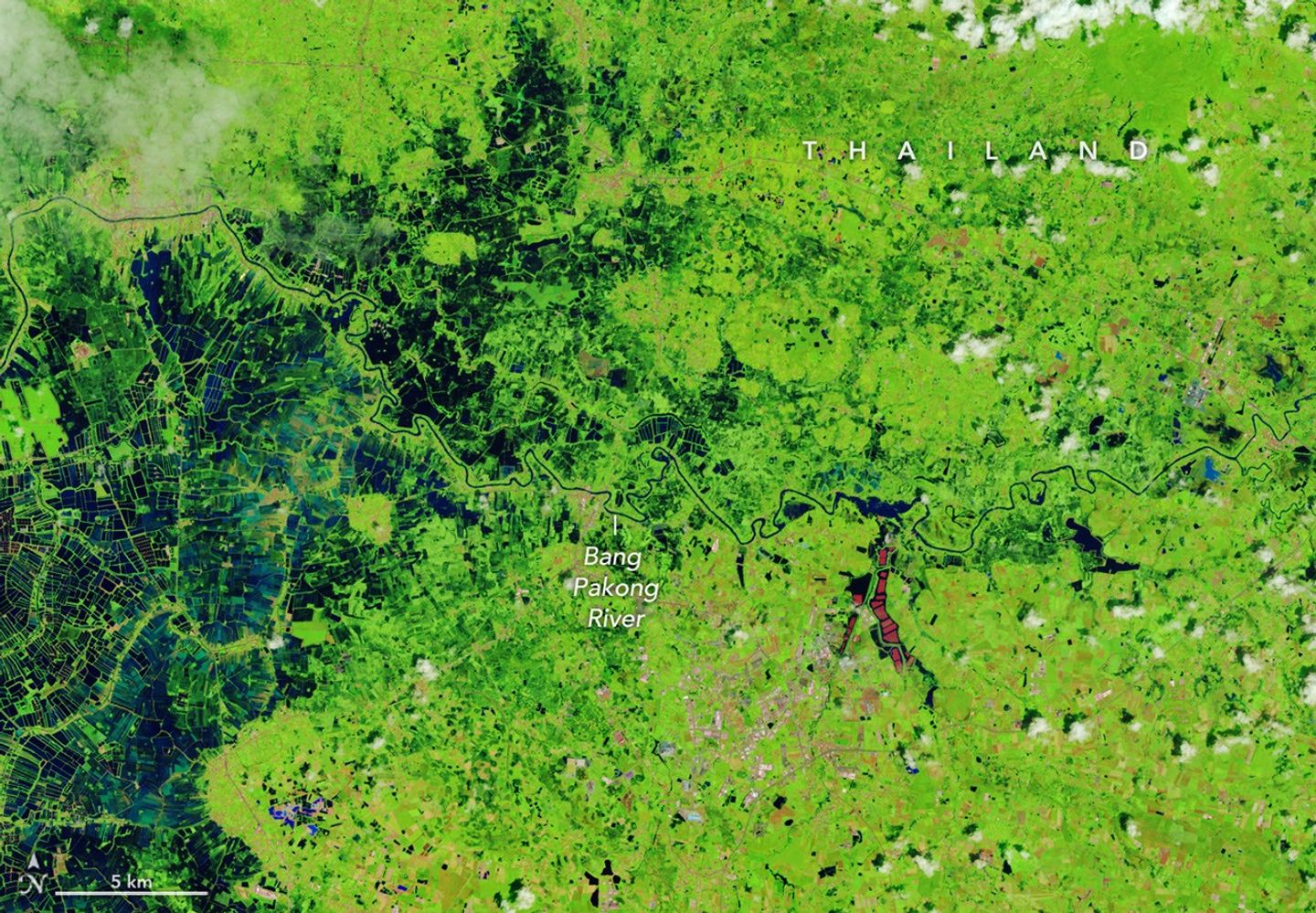
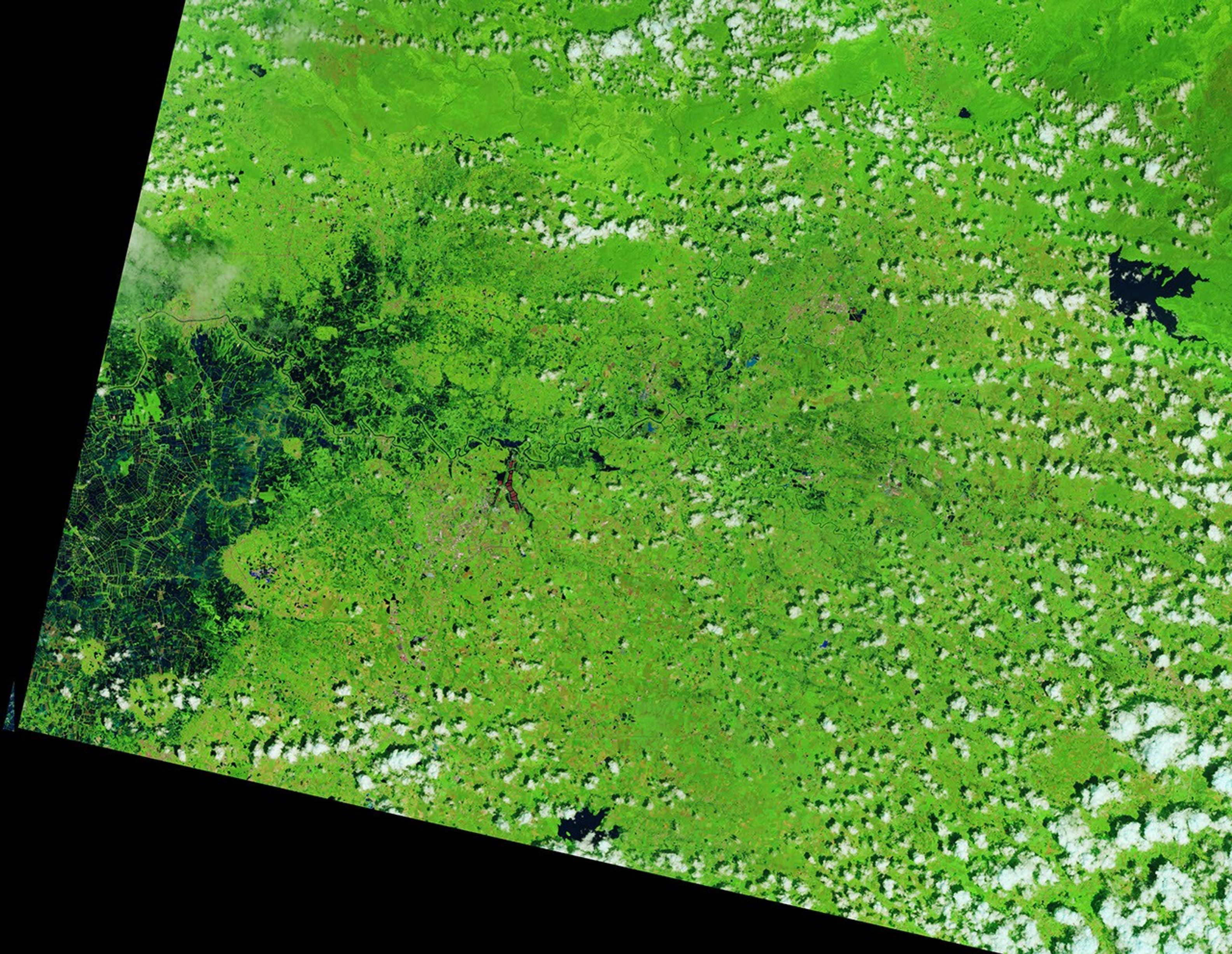
A narrow river (dark blue) meanders across vegetated land (bright green) in a false-color satellite image. Small geometric ponds or waterlogged fields appear on the left side of the scene.
NASA Earth Observatory / Lauren Dauphin
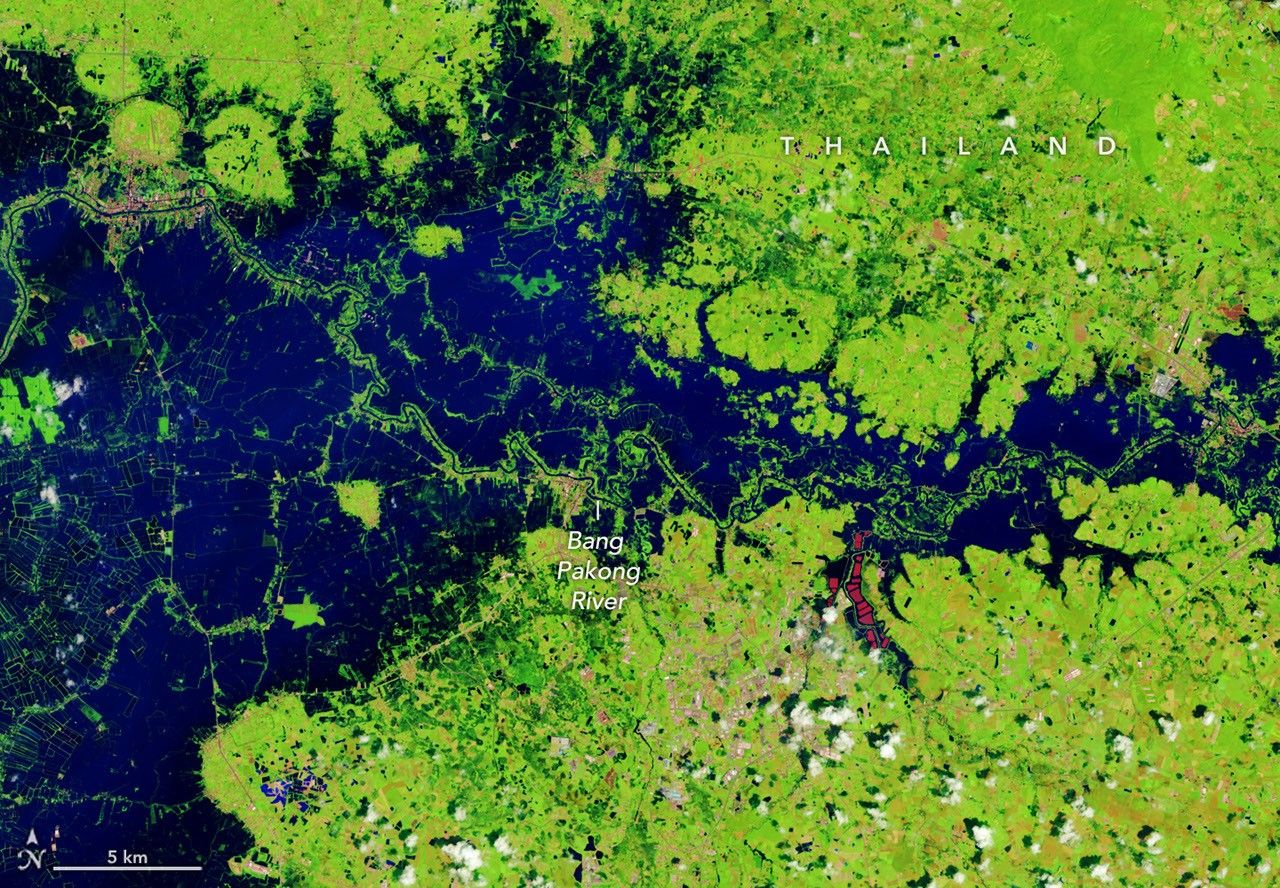
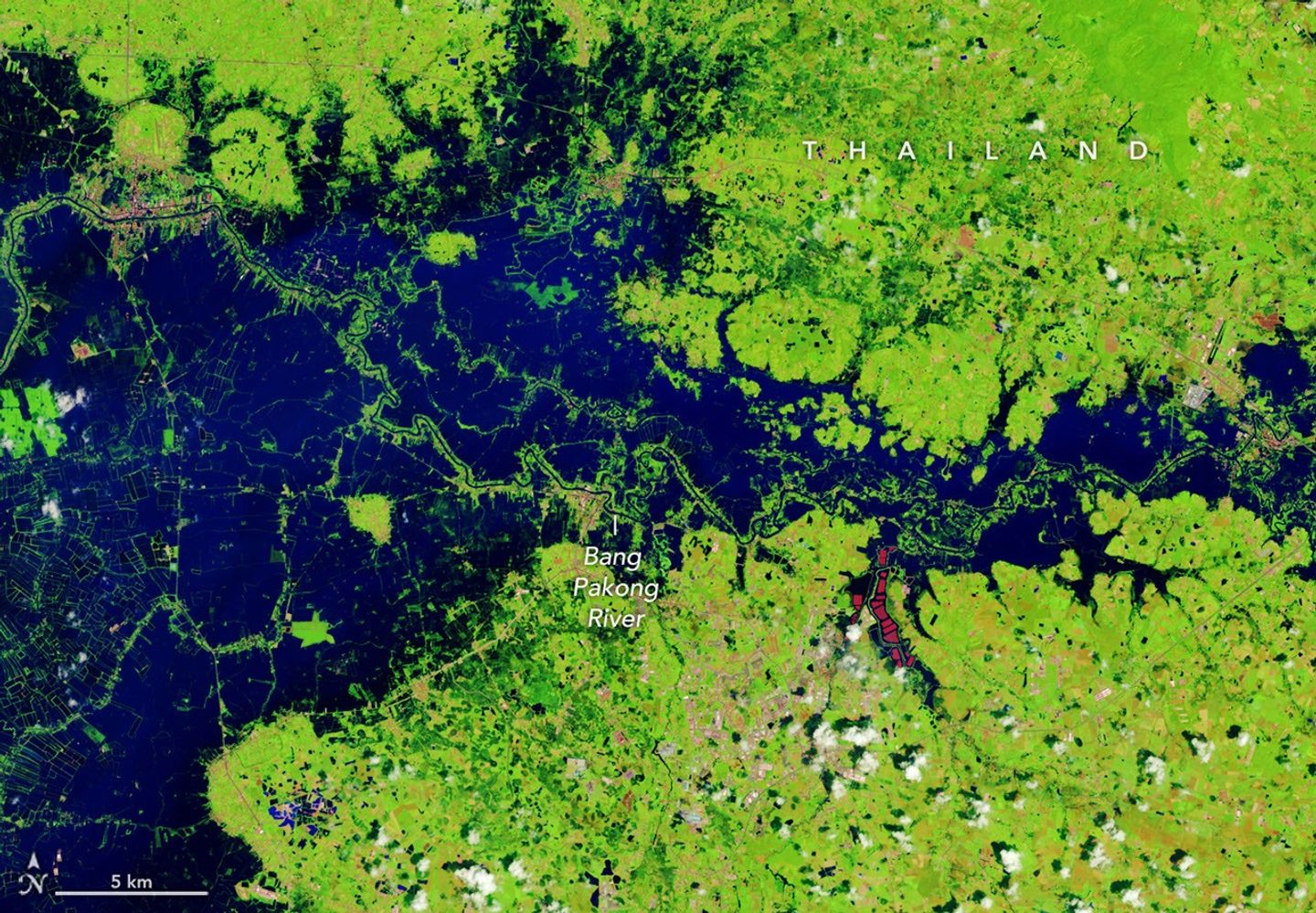
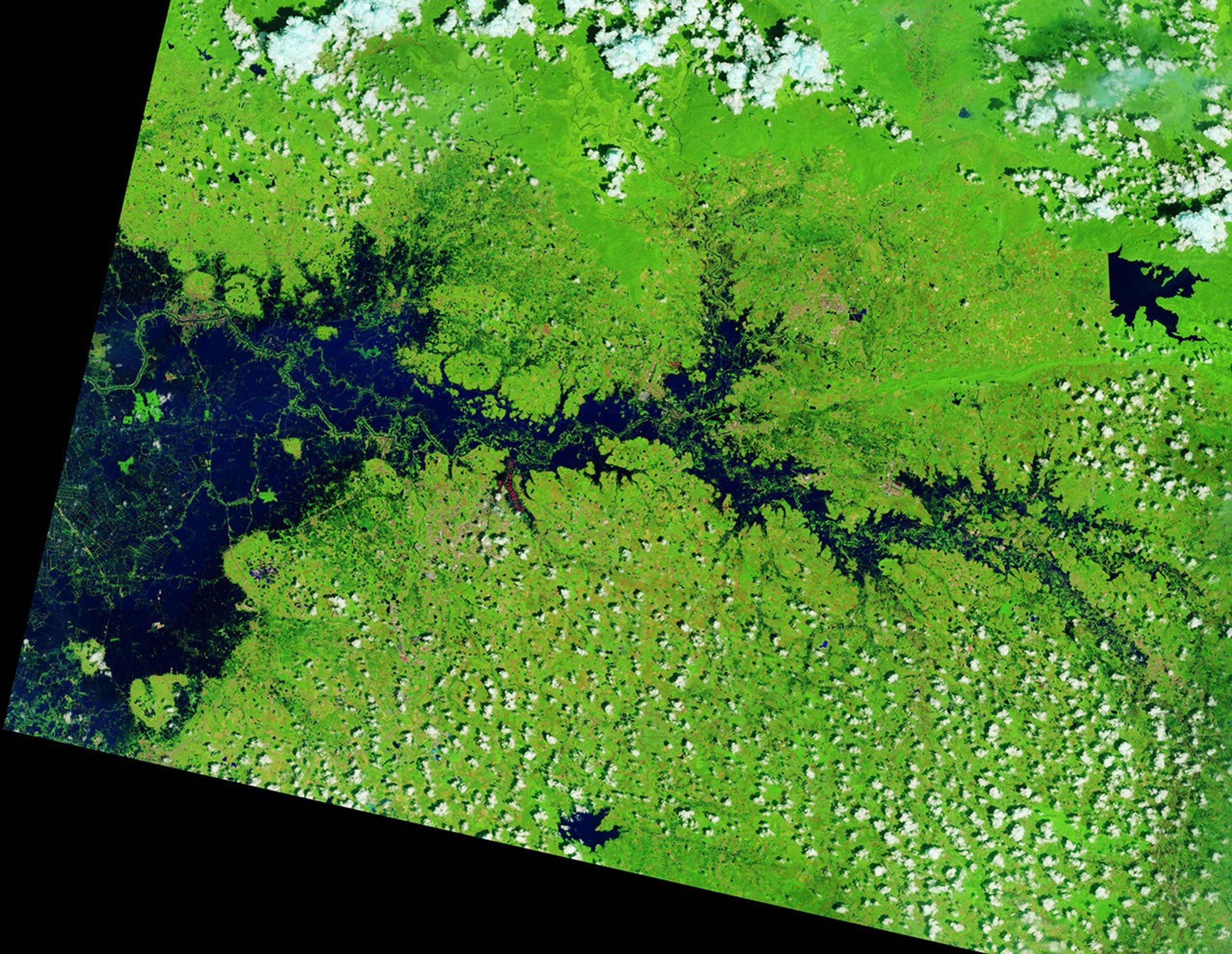
In a false-color satellite image of the same area, floodwaters (dark blue) flank a meandering river and cover a large swath of agricultural or aquacultural land primarily on the left side of the scene.
NASA Earth Observatory / Lauren Dauphin
A narrow river (dark blue) meanders across vegetated land (bright green) in a false-color satellite image. Small geometric ponds or waterlogged fields appear on the left side of the scene.
NASA Earth Observatory / Lauren Dauphin
In a false-color satellite image of the same area, floodwaters (dark blue) flank a meandering river and cover a large swath of agricultural or aquacultural land primarily on the left side of the scene.
NASA Earth Observatory / Lauren Dauphin
October 7, 2025
October 2, 2026
September falls in the heart of the monsoon season in Thailand, where cities and towns are accustomed to the afternoon rains and thunderstorms that frequently roll through. But throughout late September and early October 2026, persistent heavy rains punctuated by intense downpours left low-lying areas across the country in Southeast Asia under sustained flooding.
Prachin Buri province was among the areas where flooding was widespread. The right image above shows land along the Bang Pakong River and nearby agricultural areas and aquaculture facilities inundated on October 2, 2026. The left image shows the same area at the same time of year in 2025. Acquired with NASA-USGS Landsat satellites, the images are false-color to better distinguish water from vegetation, developed land, and other surfaces. The bright red shapes are floating solar arrays.
Some of the flooding likely stemmed from a low-pressure system that stalled over the area for several days in late September. Stoked by moisture and energy from the warm Gulf of Thailand nearby, the system delivered especially intense rains to the region. About 100 kilometers (60 miles) to the west, Bangkok received nearly 300 millimeters (11.8 inches) of rain over a 48-hour period, according to news reports, close to the average monthly rainfall total for September of 344 millimeters (13.5 inches).
Since mid-September, flooding has occurred in 50 provinces across the country, affecting over 4 million people and causing dozens of deaths, according to the International Federation of Red Cross and Red Crescent Societies. Government agencies estimate about 270,000 hectares (670,000 acres) of farmland, including rice fields and fruit orchards, have been damaged.
NASA Earth Observatory images by Lauren Dauphin, using Landsat data from the U.S. Geological Survey. Story by Lindsey Doermann.
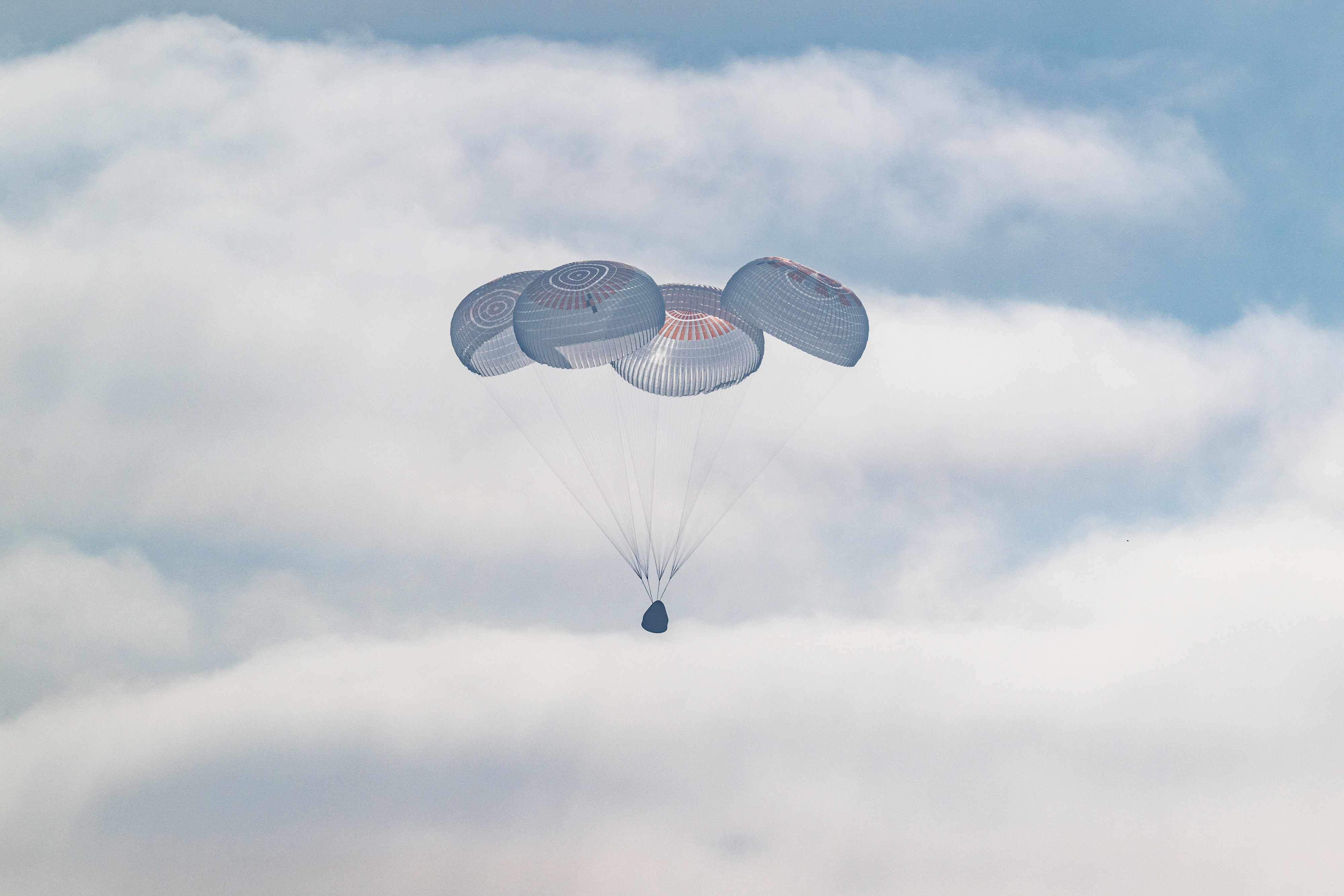
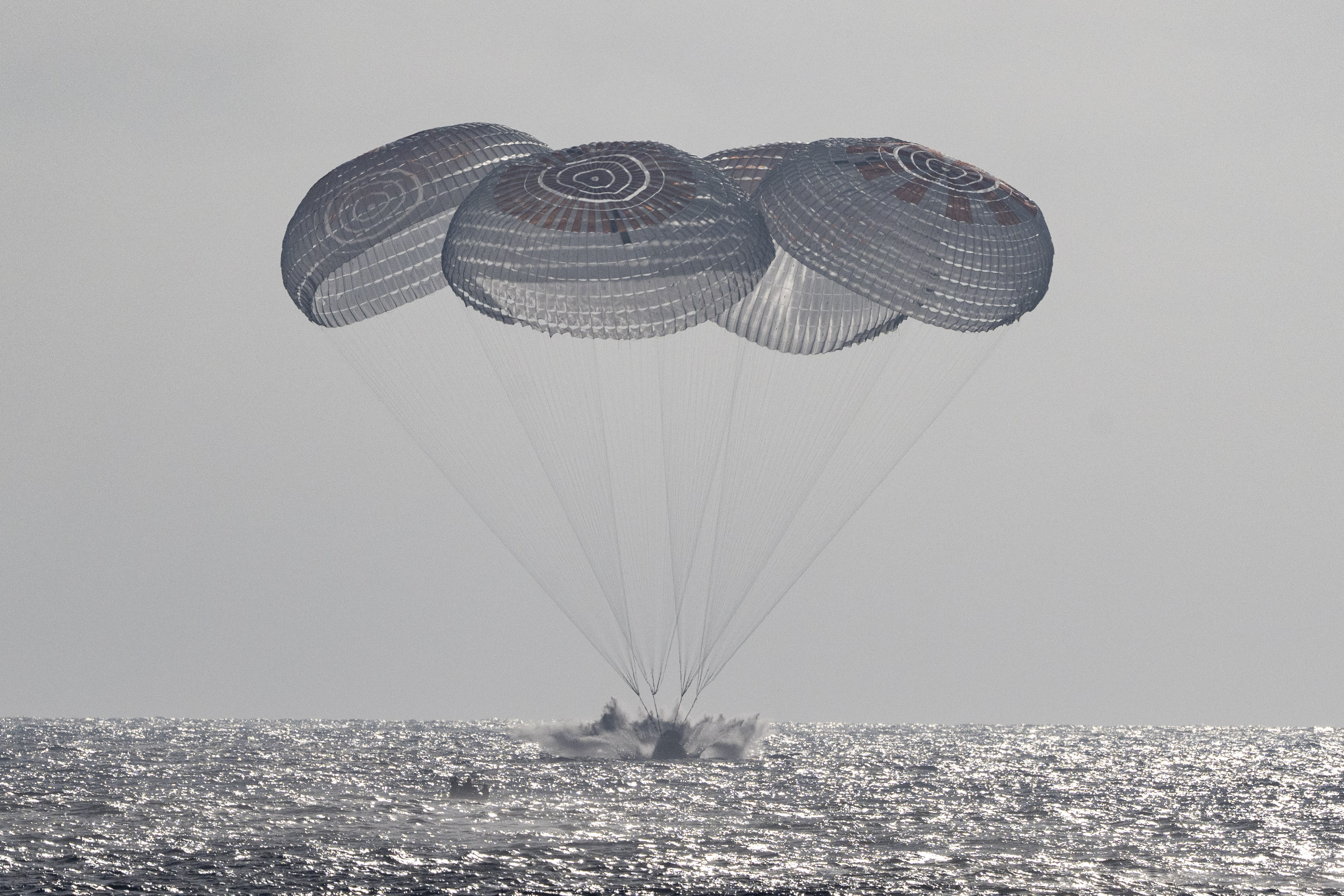
The SpaceX Crew Dragon Freedom spacecraft is seen moments before splashing down in the Pacific Ocean off the coast of California in this Oct. 8, 2026, photograph. Aboard were NASA’s SpaceX Crew-12 members NASA astronauts Jessica Meir and Jack Hathaway, ESA (European Space Agency) astronaut Sophie Adenot, and Roscosmos cosmonaut Andrey Fedyaev. The four spent nearly eight months aboard the International Space Station.
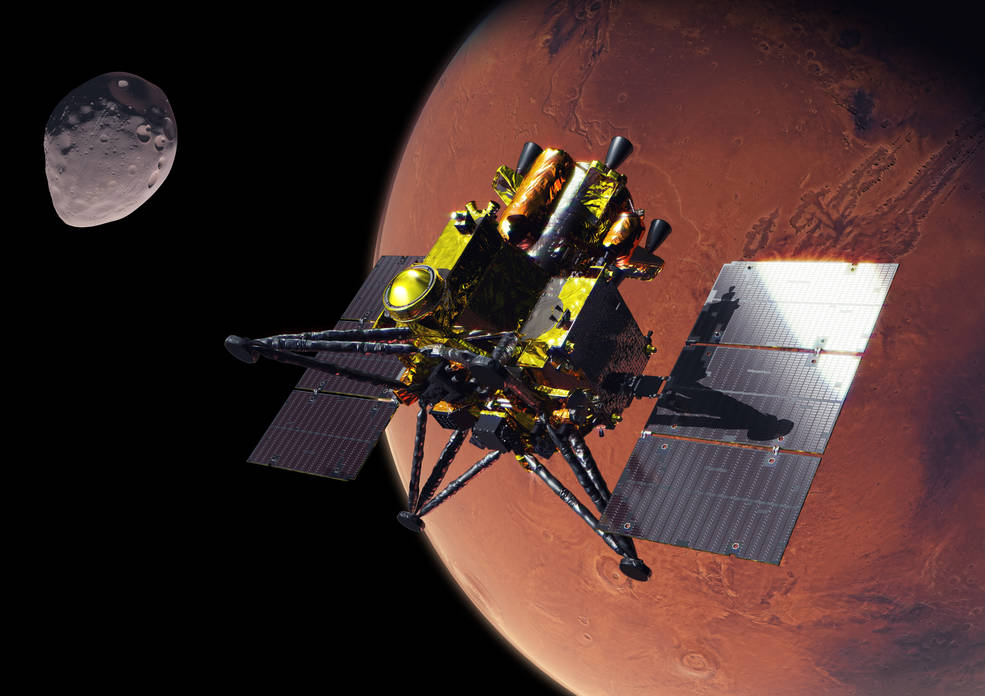
An artist’s concept of JAXA’s (Japan Aerospace Exploration Agency) Martian Moons eXploration (MMX) spacecraft at Mars.
Credit: JAXA
Media are invited to join NASA for a media teleconference at 4 p.m. EDT, Thursday, Oct. 15, to preview the agency’s contributions to JAXA’s (Japan Aerospace Exploration Agency) Martian Moons eXploration (MMX) mission. The mission is scheduled to launch from JAXA’s Tanegashima Space Center in Japan on Monday, Oct. 19 EDT (Tuesday, Oct. 20 JST).
Audio of the media teleconference will stream on the agency’s website at:
Participants in the briefing, who will provide an overview of the mission and NASA’s contributions, include:
Lindsay Hays, acting director, Planetary Science Division, NASA Headquarters in Washington
Tom Statler, MMX program executive and scientist, Planetary Science Division, NASA Headquarters
David Lawrence, MEGANE (Mars-moon Exploration with Gamma-rays and Neutrons) principal investigator, Johns Hopkins Applied Physics Laboratory
Kris Zacny, vice president, Blue Origin’s Honeybee Robotics
Media interested in participating by phone must RSVP no later than two hours prior to the start of the teleconference to Molly Wasser at [email protected]. A copy of NASA’s media accreditation policy is online.
The MMX spacecraft will arrive at Mars in August 2027 to begin its survey of the Red Planet’s two moons, Phobos and Deimos. After surveying Phobos in detail, the spacecraft will collect a sample of the moon’s surface no earlier than December 2028 and deliver it to Earth in 2031. NASA’s contributions to the mission include the MEGANE gamma-ray and neutron spectrometer, the spacecraft’s surface sampler mechanism, and communications and navigation support from the agency’s Deep Space Network, as well as funding United States scientists participating on the MMX science team.
The MEGANE instrument was developed by Johns Hopkins Applied Physics Laboratory. Honeybee Robotics, a Blue Origin company, developed the spacecraft’s pneumatic sampler mechanism. NASA’s contributions to the MMX mission were funded by the agency’s Discovery Program, which provides frequent flight opportunities for high-value, focused planetary science investigations. The Discovery Program is managed by NASA’s Marshall Space Flight Center in Huntsville, Alabama, for the agency’s Science Mission Directorate in Washington.
For more information about the MMX mission, visit:
Editor’s note: This release was updated Oct. 8, 2026 with the formal name of the summit.
NASA is launching two new science and technology initiatives to deepen scientific understanding and accelerate the innovation that will shape America’s future in space.
The initiatives are announced in conjunction with the White House Office of Science and Technology Policy’s (OSTP) “Science: A Golden Age Summit” in Washington on Thursday with top U.S. agency leaders. The programs reflect NASA’s commitment to pioneering research and transformative technologies and advancing the Trump Administration’s vision as outlined in the July report to the President, Science: A New Golden Age. One focuses on peer review and the other on fellowship researchers.
“NASA has a proud history of pursuing bold ideas and achieving the near impossible,” said NASA Administrator Jared Isaacman. “Under President Trump’s leadership, we are building on that legacy by creating new opportunities for great science, experimenting with how we evaluate and accelerate the best ideas, and investing in the next generation of researchers through the Genesis Mission Fellowships. We are entering a new Golden Age of American innovation and discovery, and NASA will be at the forefront.”
During a fireside chat, Isaacman and Michael Kratsios, assistant to the President for science and technology and director of OSTP, will discuss the following:
Establishing a coordinated metascience initiative within NASA’s Science Mission Directorate to strengthen the reliability, efficiency, transparency, and overall productivity of the agency’s scientific practices. As part of this effort, NASA is expanding the agency’s use of dual anonymous peer review to ensure proposals are evaluated solely on their intrinsic scientific merit. This approach enhances fairness and supports innovative and unconventional research ideas. Started as a pilot program during the first Trump Administration, this initiative has helped position NASA as a leader in advancing best practices in scientific review.
NASA will support 10 Genesis Mission Fellows, who are accelerated doctoral students with dual competencies in super intelligence (SI) and science or engineering. Fellows will work directly on NASA mission areas and conduct research at NASA laboratories, advancing SI-enabled scientific discovery. The fellowships will be based on NASA’s successful Future Investigators in NASA Earth and Space Science and Technology program.
NASA leads the nation in space exploration, scientific discovery, and technological innovation. Through these new initiatives, NASA will continue to inspire the world and drive progress in science and technology.
NASA is advancing American leadership in space by taking the next step toward a future where commercial space stations lead the way in low Earth orbit. On Friday, the agency released its final Request for Proposals inviting industry to submit plans for the next generation of commercial space stations.
“In alignment with the President’s National Space Policy, NASA is committed to maintaining a sustained American presence in low Earth orbit long after the International Space Station retires,” said NASA Administrator Jared Isaacman. “We will continue to need a place to conduct research, develop technologies, train crews, and prepare for missions to the Moon and Mars. Commercial space stations may provide that capability while creating new opportunities for American industry and allowing NASA to concentrate more of our resources on the near-impossible missions ahead.”
Building on the agency’s Ignition event earlier this year, NASA regularly has engaged with private industry to shape the agency’s future direction in low Earth orbit. This included publishing two Requests for Information in March to gather industry’s perspective on low Earth orbit destinations and transportation. The agency also published a draft Request for Proposals in July, followed by an industry day and one-on-one meetings that allowed interested companies to review and comment on the planned acquisition approach.
“We’ve made it clear that NASA will never give up its presence in low Earth orbit,” said Isaacman. “Since Ignition, we have spent a lot of time listening to industry and working through what it will take to make this transition successful. The opportunity is significant, but the economics ultimately have to work. We want to see credible plans, strong technical execution, and companies prepared to invest in destinations that can serve NASA while developing additional customers and markets of their own.”
Proposals are due Tuesday, Dec. 8, with contract awards expected in spring 2027.
Under the solicitation, NASA outlines requirements for companies interested in designing, building, testing, certifying, and operating commercial low Earth orbit destinations capable of providing end-to-end destination and transportation services for human spaceflight use.
NASA intends to award firm-fixed-price, multi-award, indefinite-delivery/indefinite-quantity contracts supporting development, certification, and services for continued low Earth orbit research and exploration. This will allow NASA to select two or more contractors through early development, followed by a competitive task order for final design, test, and evaluation, as well as certification and services from one or more contractors.
Learn more about NASA’s missions on the agency’s website:
The SpaceX Crew Dragon Freedom spacecraft is seen as it lands with NASA astronauts Jessica Meir, Jack Hathaway, ESA (European Space Agency) astronaut Sophie Adenot, and Roscosmos cosmonaut Andrey Fedyaev aboard in the Pacific Ocean off the coast of Los Angeles on Oct. 8, 2026.
Credit: NASA/Keegan Barber
After more than seven months aboard the International Space Station, NASA’s SpaceX Crew-12 mission safely splashed down Thursday in the Pacific Ocean off the coast of Los Angeles. The crew members will discuss their science mission during a news conference at 3:30 p.m. EDT, Thursday, Oct. 15, at the agency’s Johnson Space Center in Houston.
“Jessica, Jack, Sophie, and Andrey spent 237 days living and working in orbit, traveled more than 100 million miles, advanced important science, and returned safely home because of the extraordinary expertise and competence of thousands across NASA, SpaceX, and our international partners,” said NASA Administrator Jared Isaacman. “Building the capability, experience, and confidence to do this repeatedly is exactly what will allow us to go farther, and I am grateful to Crew-12 and their families for their service to humanity’s greatest adventure.”
NASA astronauts Jessica Meir and Jack Hathaway, ESA (European Space Agency) astronaut Sophie Adenot, and Roscosmos cosmonaut Andrey Fedyaev returned to Earth at 8:34 a.m. PDT. Teams aboard SpaceX recovery vessels retrieved the spacecraft and its crew shortly after. Following standard postflight medical screenings, the crew will fly to shore before returning to NASA’s Johnson Space Center in Houston.
“NASA’s activities supporting the International Space Station — transporting crew, conducting impactful research, and maintaining critical national assets — enable the science, engineering, and risk‑reduction needed for future missions across the solar system,” said Dana Weigel, manager of NASA’s Low Earth Orbit Program at the agency’s Johnson Space Center. “We’re grateful for the dedication across the human spaceflight team that makes this possible, and we’re thrilled to welcome Jessica, Jack, Sophie, and Andrey home.”
During their 237-day mission, the four crew members traveled more than 100 million miles and completed more than 3,792 orbits around Earth. The mission was the second for Meir and Fedyaev and the first for Hathaway and Adenot. Crew-12 lifted off at 5:15 a.m. EST on Feb. 13 and docked to the orbiting laboratory a day later.
Crew‑12 logged hundreds of hours of scientific research to support human exploration beyond low Earth orbit and advance benefits for people on Earth. The crew members’ work included testing stem cell production for cell‑based therapies, demonstrating on‑demand IV fluid generation for future missions, and studying how the bacteria that causes pneumonia can lead to long‑term heart damage. The crew also conducted nutrition-focused research and examined how physical characteristics may affect blood flow during spaceflight to help keep astronauts safe and healthy on future missions. Research conducted aboard the space station advances knowledge and demonstrates new technologies that enable us to prepare for human exploration of the Moon and Mars.
Meir completed four spacewalks, bringing her career total to seven. That places her third all-time in total spacewalks among women at NASA, behind former agency astronauts Peggy Whitson and Suni Williams. Adenot completed three spacewalks, becoming the first French woman to venture outside the orbital outpost.
United States-based media interested in attending the crew news conference in person with Meir, Hathaway, and Fedyaev, must contact the NASA Johnson newsroom no later than 5 p.m. EDT, Tuesday, Oct. 13, at [email protected]. Media joining by phone must request dial-in details by 9:30 a.m., Oct. 15. To ask a question, media must join no later than 15 minutes before the start of the news conference. The agency’s media credentialing policy is available online. Adenot will return to Europe and not be available during the news conference.
NASA’s Low Earth Orbit Program provides reliable access to space, maximizing the use of the International Space Station for research and development by partnering with private U.S. companies, including SpaceX, to transport astronauts to and from the space station.
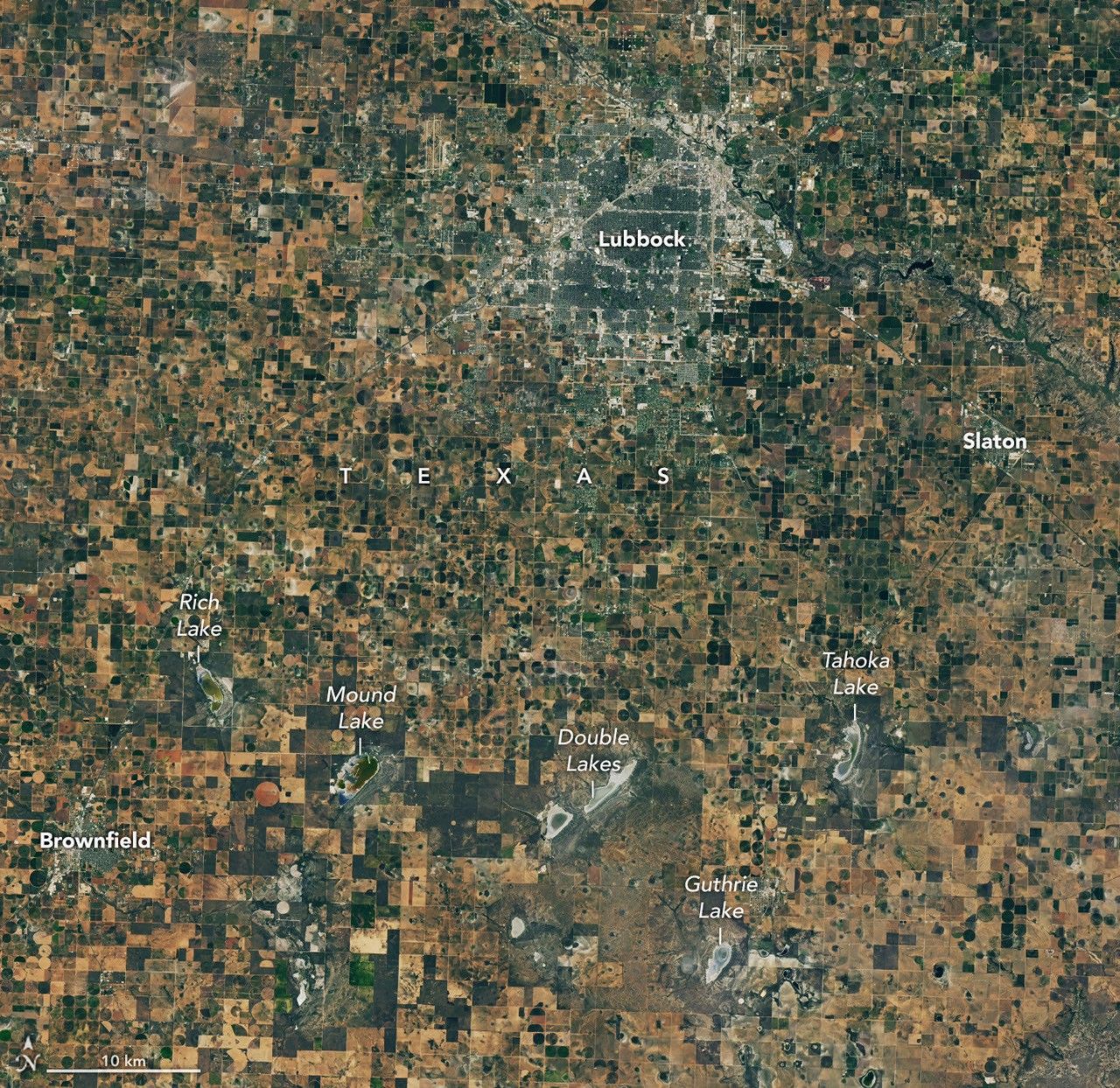
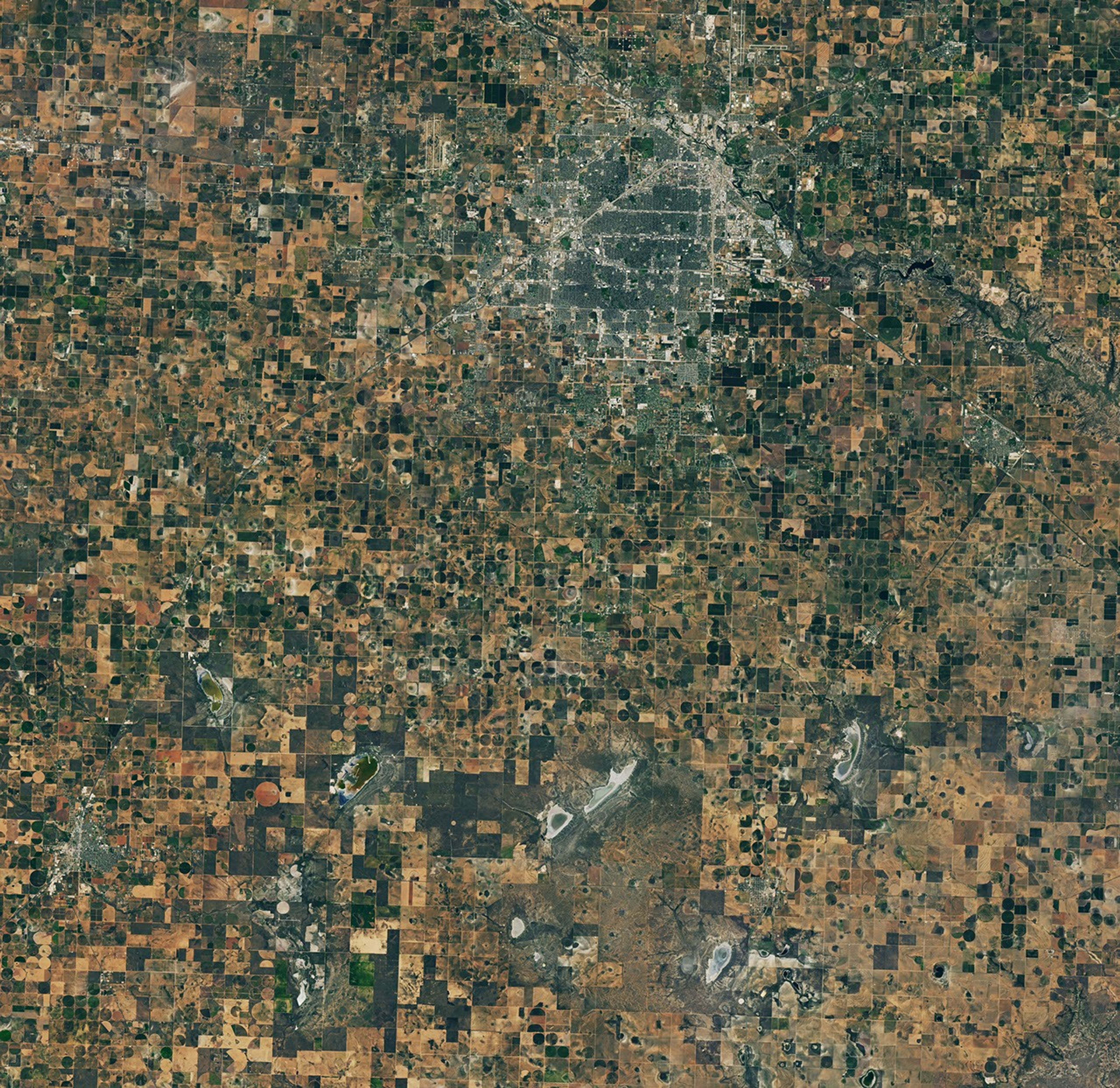
A satellite image of farmland around Lubbock, Texas, on September 22, 2025, features a patchwork of green and brown agricultural fields and several playa lakes with varying amounts of water.
NASA Earth Observatory / Lauren Dauphin
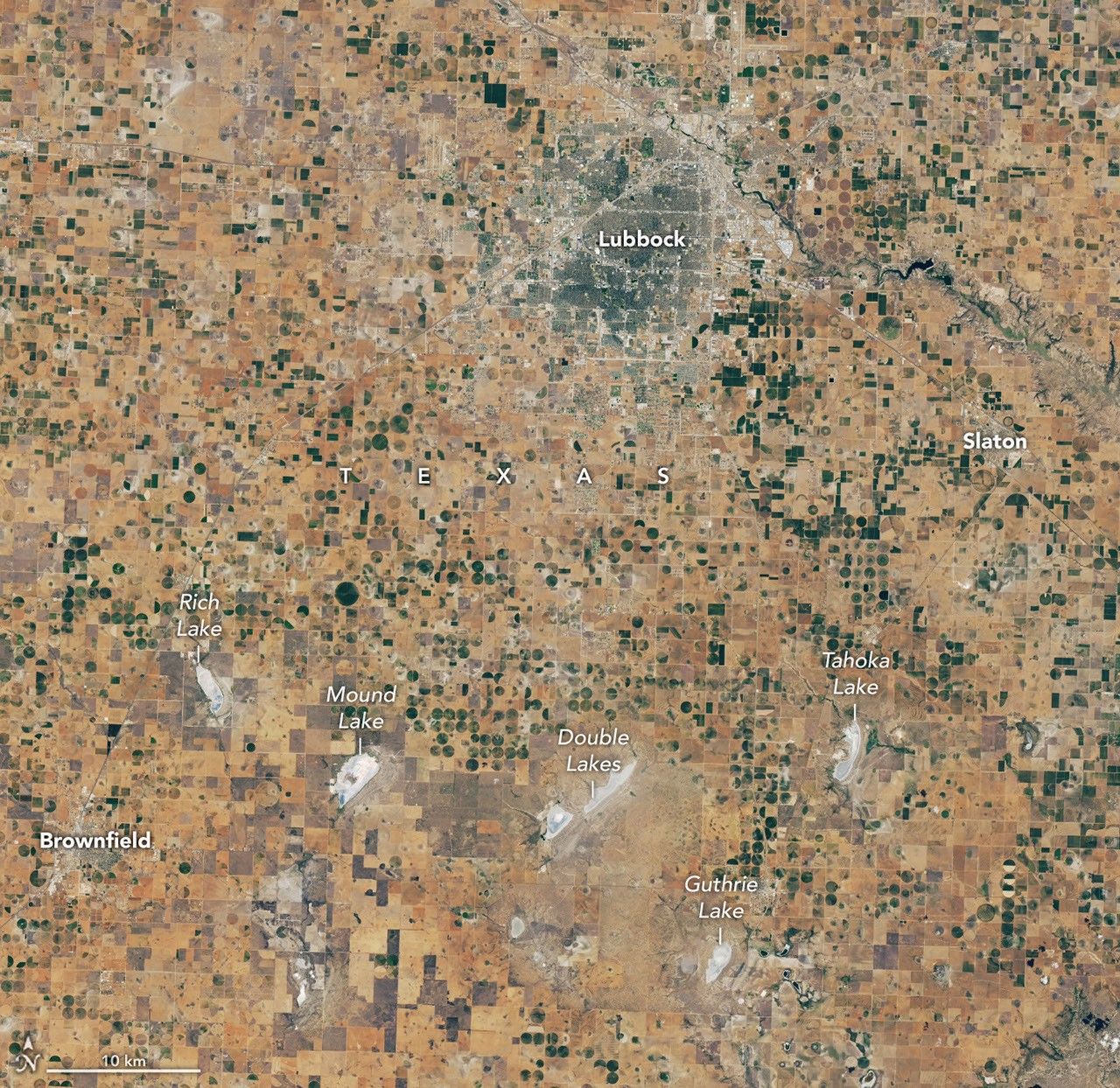
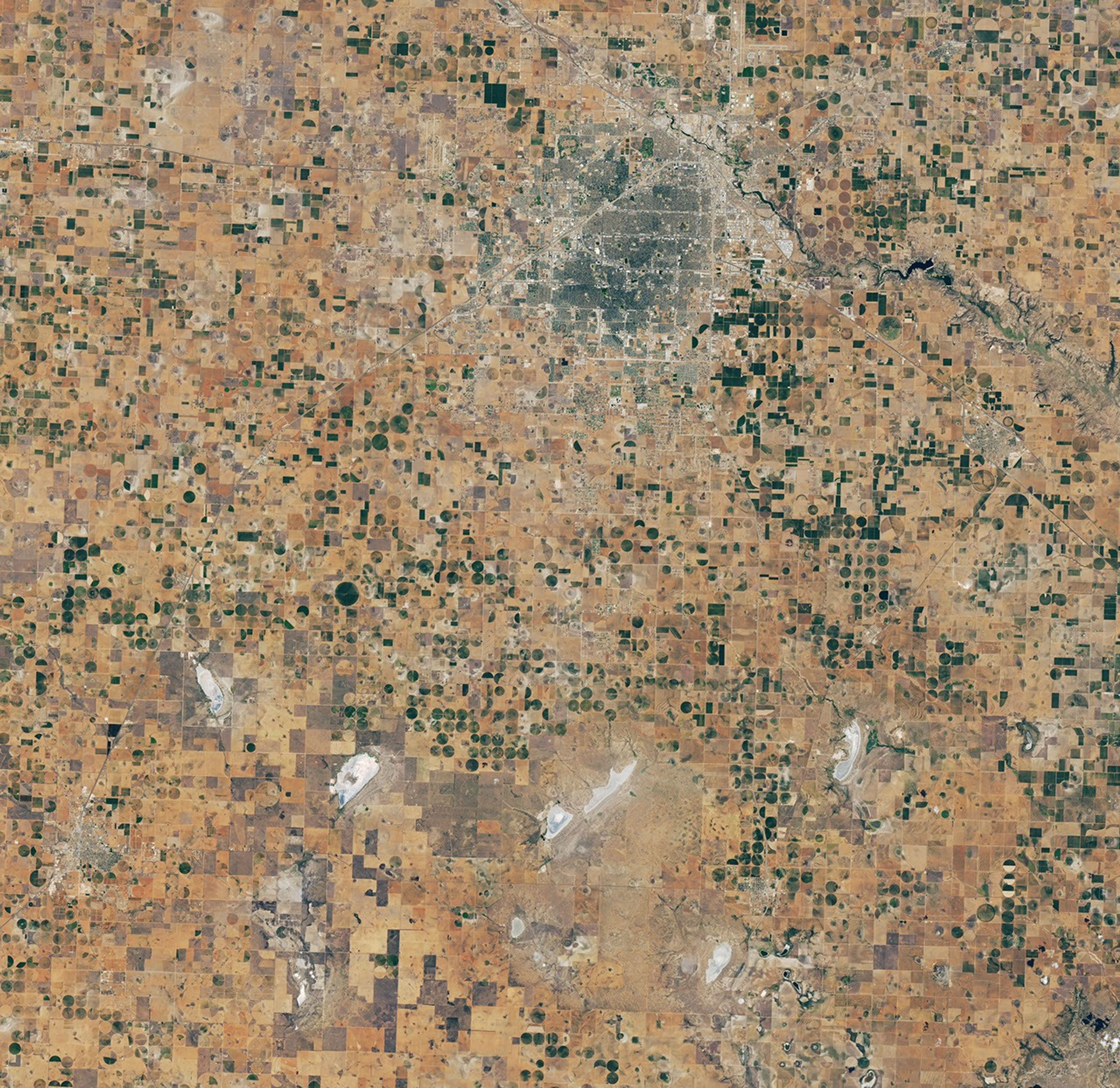
A satellite image of the same Lubbock region on September 9, 2026, appears parched, with much less green vegetation and mostly dry lakes.
NASA Earth Observatory / Lauren Dauphin
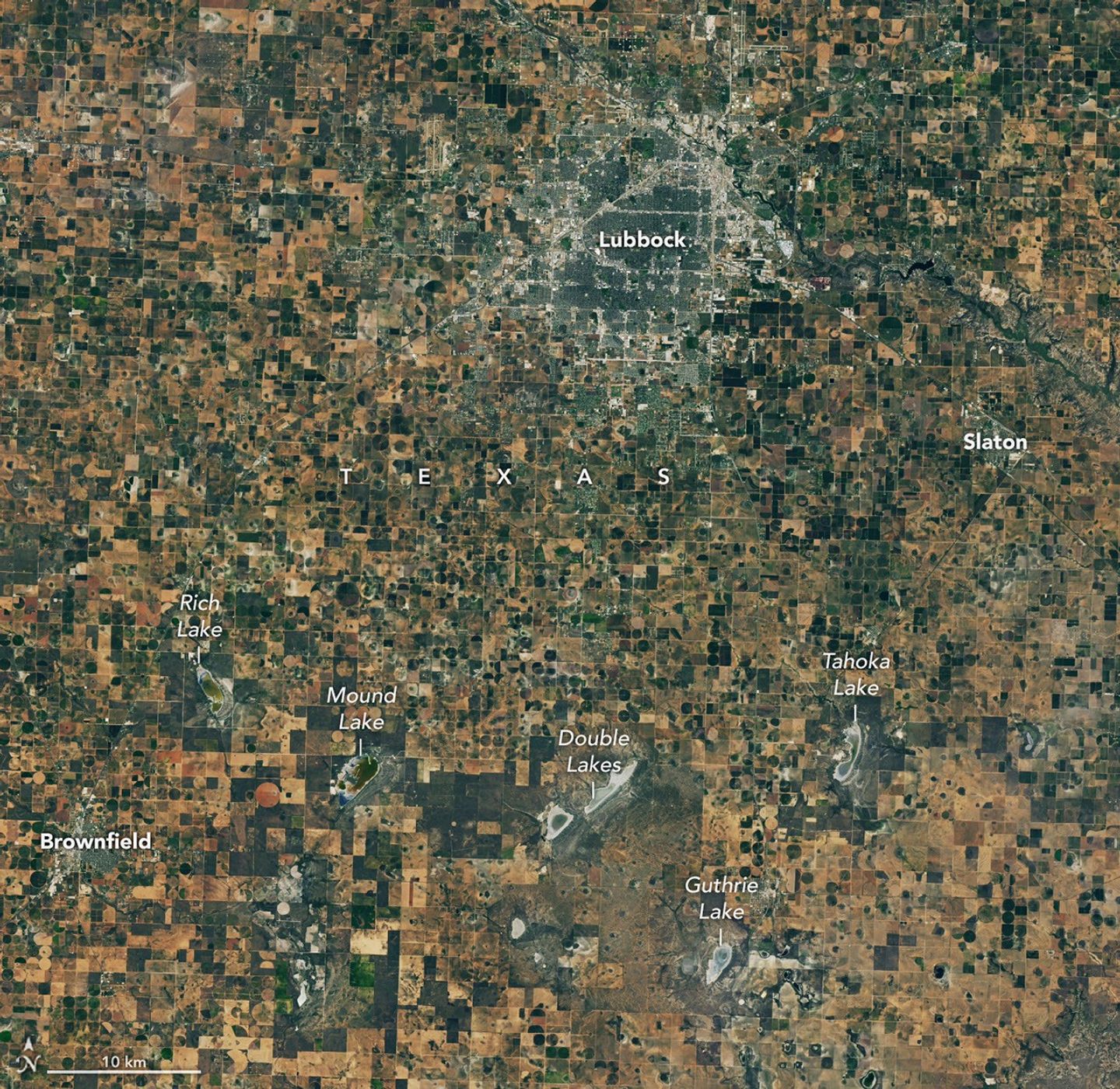
A satellite image of farmland around Lubbock, Texas, on September 22, 2025, features a patchwork of green and brown agricultural fields and several playa lakes with varying amounts of water.
NASA Earth Observatory / Lauren Dauphin
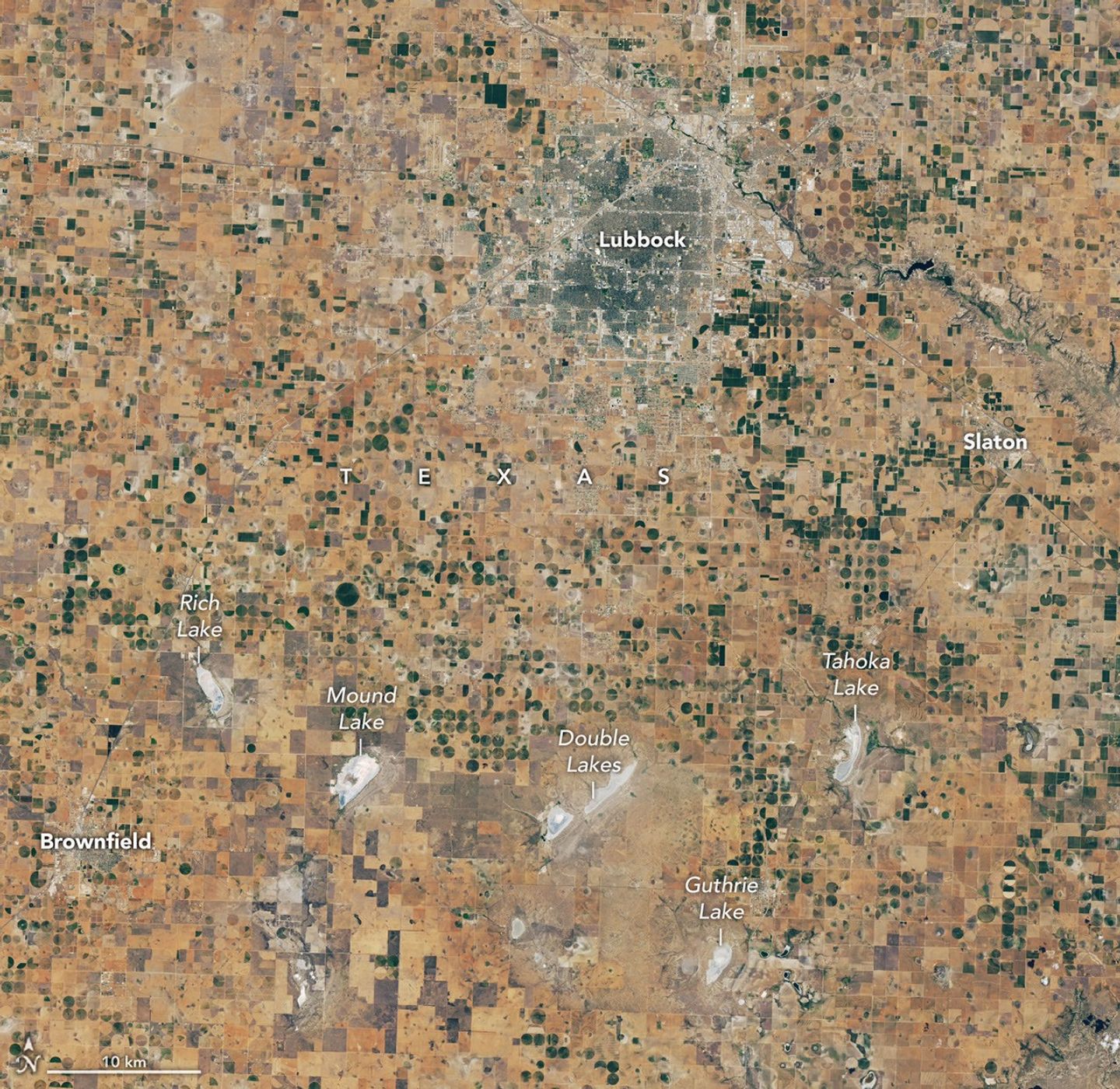
A satellite image of the same Lubbock region on September 9, 2026, appears parched, with much less green vegetation and mostly dry lakes.
NASA Earth Observatory / Lauren Dauphin
September 22, 2025
September 9, 2026
Fields were parched and brown, and playa lakes mostly dry, in Lubbock County in September 2026 (right) compared to September 2025 (left) in imagery captured by the OLI (Operational Land Imager) on the NASA/USGS Landsat 8 satellite. NASA Earth Observatory/Lauren Dauphin
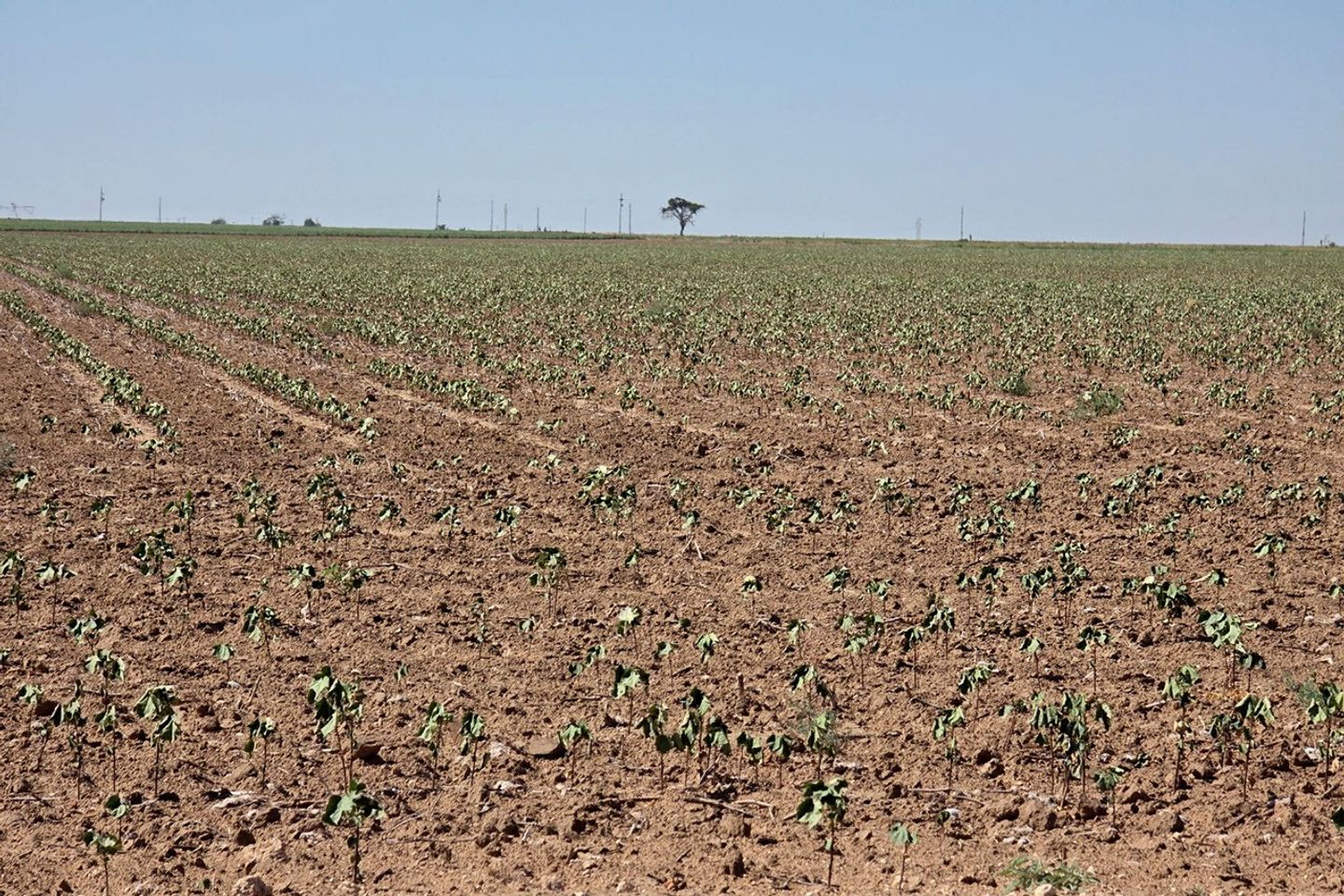
For many longtime cotton farmers in the Texas High Plains, the 2026 drought sparked flashbacks to catastrophic harvests of the past. Miserably dry seasons forced farmers in America’s largest cotton-producing region to abandon massive portions of their dryland crop, including 72 percent in 2022 and 66 percent in 2011.
But in some ways, farmers felt the drought in 2026 entered new territory. “This is the first year that we’ve had cotton completely die,” said Lacy Cotter-Vardeman, a farmer based in Lubbock County whose family has worked the land there for several generations. “I was just talking to our insurance people, and they said they’d never seen this before,” she said, adding that roughly 90 percent of her dryland cotton was dead.
Satellite images highlight the scale of the problem in Lubbock and adjacent counties. Brown, parched crops and vacant plots dominated the landscape on September 9, 2026, when the OLI (Operational Land Imager) on Landsat 8 captured the image above (right). In contrast, much greener landscapes prevailed on September 22, 2025 (left), when the sensor captured an image of the same area during a more typical year with a relatively healthy harvest.
Rows of spindly, wilted cotton photographed in one of Cotter-Vardeman’s fields in Slaton, Texas, appear stressed and near death on August 14, 2026.
Lacy Cotter-Vardeman
Subtler signs of the drought are also visible. With groundwater growing scarce in the High Plains aquifer, many farmers in the region have started irrigating just one-half or one-third of their center-pivot fields, explained Tillery Timmons-Sims, an agricultural conservationist who owns land in Brownfield, Texas, and used to grow cotton. In the imagery, these appear as green semicircles and quarter circles.
Note also the many shallow water features known as playa lakes—sometimes called mud holes, buffalo wallows, and lagoons—scattered throughout the image. Some, like Double Lakes and Mound Lake, are fairly large, but most of the more than 19,300 playa lakes in the Texas High Plains are quite small, less than 30 acres.
Many of these ephemeral lakes were dry in September 2026, unlike the previous year. Playa lakes are critical in this water-stressed region because the clay-lined features, if active, collect rainfall and provide pathways for water to seep underground and recharge the aquifer below, the region’s primary source of irrigation water. However, about 80 percent are modified by tilling or buried with sediment, and many no longer function that way.
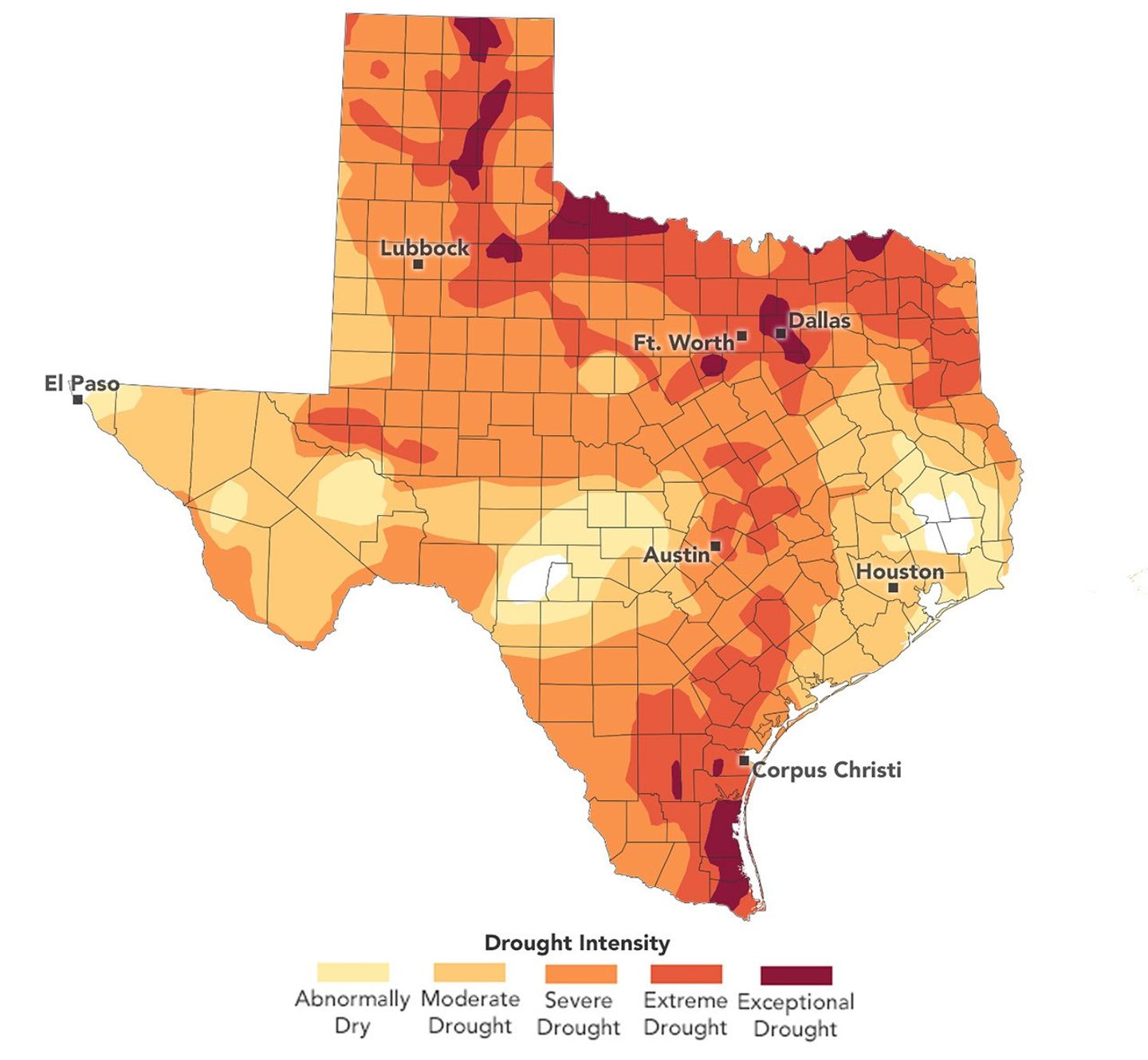
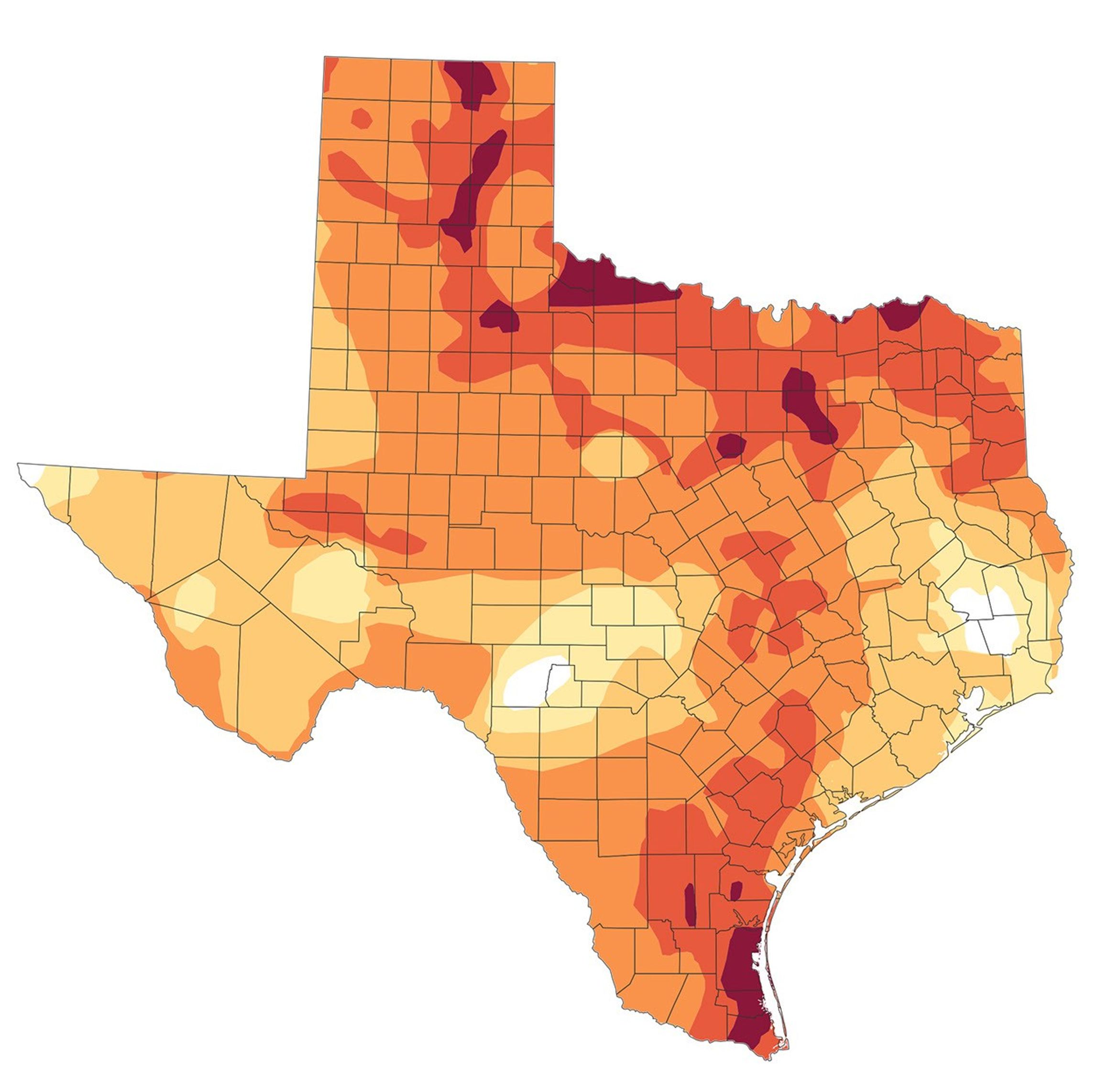
Drought remained severe across many parts of the Texas High Plains in October 2026 despite some rain falling in recent weeks. The data depicted in the map are produced by the U.S. Drought Monitor, a partnership between the National Drought Mitigation Center at the University of Nebraska-Lincoln, the U.S. Department of Agriculture (USDA), the National Oceanic and Atmospheric Administration, and NASA.
NASA Earth Observatory/Lauren Dauphin
Farmers in this region operate along the eastern margin of the aquifer, which has declined sharply in recent decades. According to U.S. Geological Survey data, the water table across much of Lubbock County has dropped by between 25 and 100 feet since 1950, around when people began drawing large volumes of water from the aquifer to irrigate. Losses have been even more extreme (150 feet or more) in counties to the north, including Parmer, Castro, Swisher, and Briscoe.
The aquifer’s long-term decline, combined with the 2026 drought, left many wells “pumping air” this summer for some of the farmers Timmons-Sims knows. “We simply don’t have groundwater to fall back on anymore,” she said. Many farmers she knows thought that water might run out during the next generation; instead, it’s “happening now,” she said. For Cotter-Vardeman, the problem couldn’t be more tangible. Many of her irrigation wells stopped working in August.
Rains in September and October, aided by a strong El Niño in the Pacific, are bringing needed moisture to the region, but they haven’t been enough, according to analysis from the U.S. Drought Monitor. “It will take about 7 inches of rain over a three-month period to ‘end’ the current drought,” said Jonathan Case, a meteorologist at NASA’s Marshall Space Flight Center and one of the Drought Monitor’s authors.
The deteriorating aquifer is one of the reasons Timmons-Sims stopped farming in 2007. She now spends most of her time searching for ways to keep farms in business, such as converting irrigated croplands to grasslands to earn water credits, developing alternative energy projects, adopting water-efficient techniques, and working with conservation organizations to plan for the long term.
Through that work, the Sandhills Area Research Association, a conservation organization she helps run, partnered with NASA Acres, a research consortium that connects farmers with NASA science to address agricultural challenges.
In August, a NASA Acres Space for Agriculture listening tour brought NASA officials to Cotter-Vardeman’s farm in Slaton, a vineyard in Meadow, and parched cotton fields in Kress (below). At each stop, the conversation returned to water: how to preserve the ailing aquifer, and how farmers could manage their land in ways that would help restore playa lakes and return billions of gallons of water to the aquifer.
Farmers and NASA scientists inspect wilted cotton in Kress, Texas, during a NASA Acres Space for Agriculture listening tour on August 25, 2026.
NASA Acres/Adam Zwerner
The playa lakes around Lubbock were among the first scientific topics researchers studied after Landsat 1 launched in 1972. One early analysis by a Texas Tech geoscientist highlighted the Double Lakes playa (shown above), estimating that monitoring lakes from space would cost just a fraction of what ground surveys would.
More recently, a team of Texas Tech University researchers used a deep learning framework to identify and track changes affecting thousands of playa lakes over three decades. Their results, published in September 2026, showed that since 1995, playa lakes declined significantly in 15 of the 45 counties analyzed, highlighting the water challenges facing farmers like Cotter-Vardeman, a member of the NASA Acres Farm Innovation Ambassador Team (FIAT).
In Texas, Timmons-Sims and FIAT are working to connect farmers and NASA scientists, making it easier for farmers to use NASA data to decide what and when to plant, how to use cover crops and irrigation, and how to manage sediment and playa lakes. “We’re simply running out of time and water,” Timmons-Sims said. “Farmers need information, innovation, optimization, and solutions—and they need it now.”
NASA Earth Observatory images by Lauren Dauphin, using Landsat data from the U.S. Geological Survey and the U.S.Drought Monitor at the University of Nebraska-Lincoln. Photos by Lacy Cotter-Vardeman and Adam Zwerner. Story by Adam Voiland.
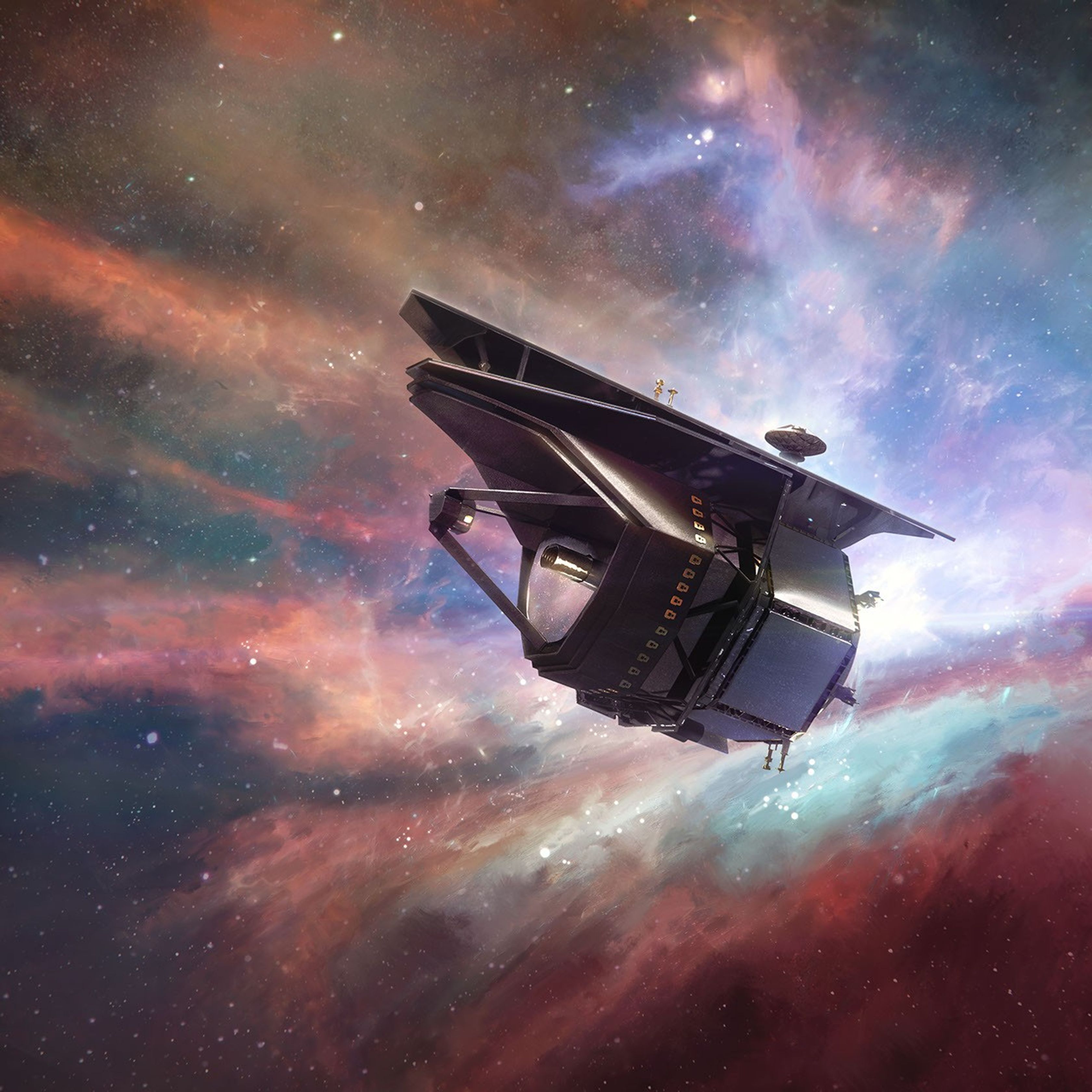
This artist’s concept depicts the proposed design for NASA’s PRobe far-Infrared Mission for Astrophysics (PRIMA), which was selected by the agency in September 2026. The PRIMA observatory is the first in a new class of NASA astrophysics missions, called Probe Explorers, within the agency’s longstanding Explorers Program. By observing far-infrared light, PRIMA will enable scientists to study cosmic objects heavily obscured by dust, providing new insights into the formation of planets, stars, and black holes, and even how water on Earth came to be. If confirmed by the agency, PRIMA will be targeted to launch in 2033, for a planned five-year mission.
Webb Measures Distance to Farthest Fast Radio Burst, Suggesting Origin
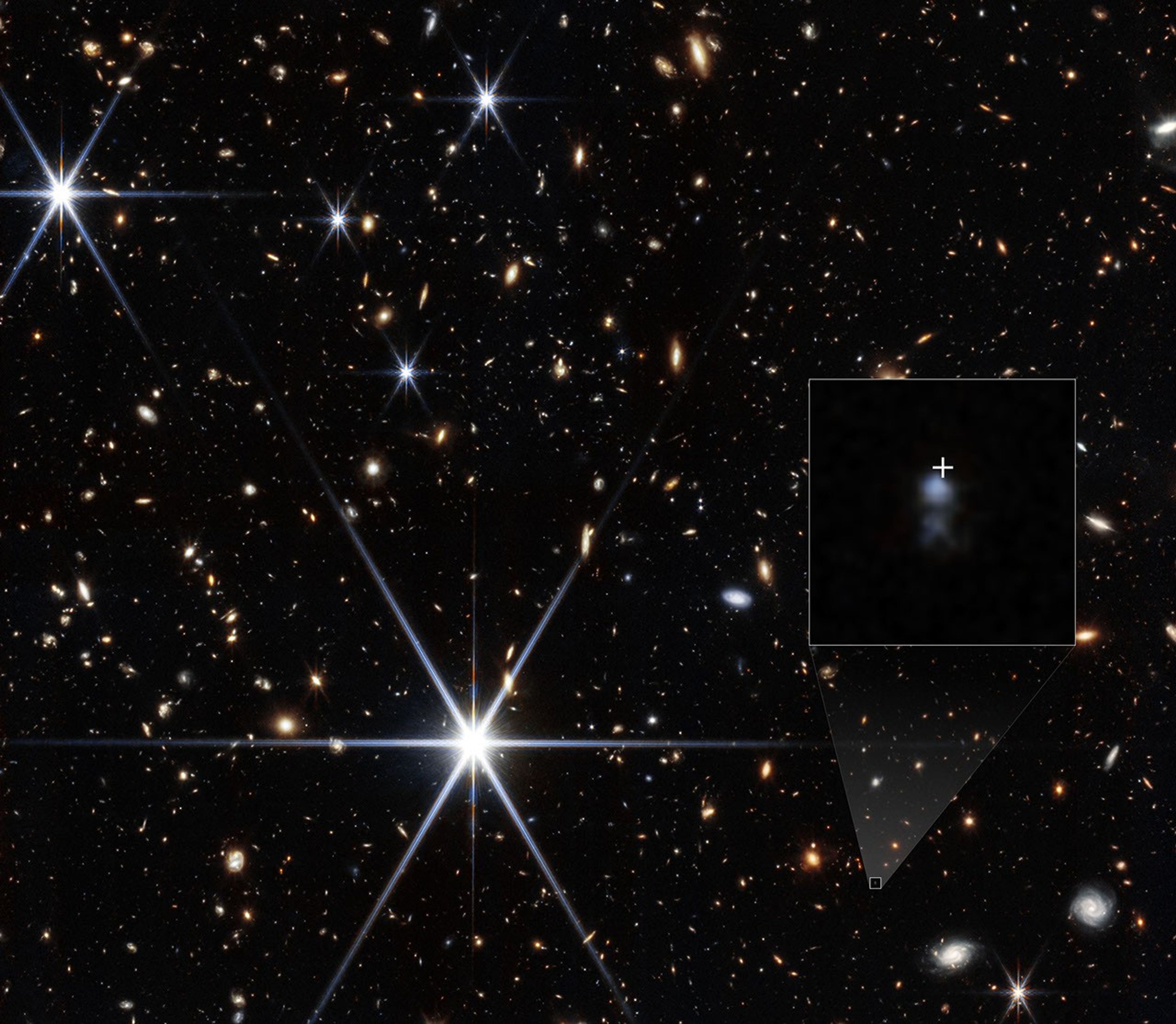
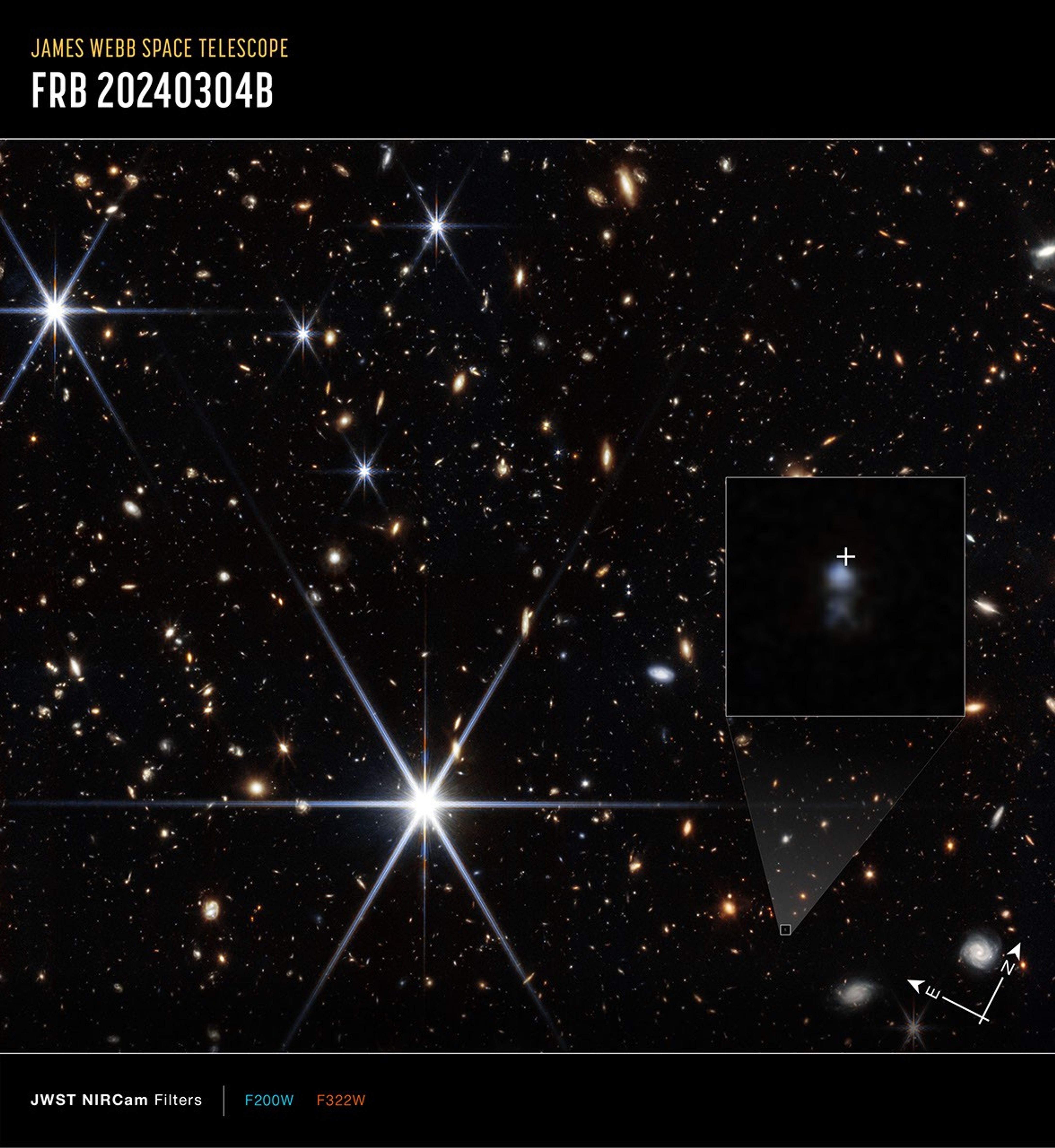
NASA’s James Webb Space Telescope’s NIRCam (Near-Infrared Camera) was able to detect the host galaxy of the fast radio burst called FRB 20240304B, whose location is shown by the white cross. They found it is a small dwarf galaxy actively forming stars.
Credits: Image: NASA, ESA, CSA, STScI, Themiya Nanayakkara (USYD); Image Processing: Joseph DePasquale (STScI)
First discovered in 2007, fast radio bursts are enigmatic, millisecond-long flashes of radio emission from the distant universe. Their origin remains uncertain, particularly since most are seen once and never again. Astronomers using NASA’s James Webb Space Telescope have pinpointed the host galaxy of the most distant fast radio burst (FRB) seen to date. Their finding has implications for what kind of energetic event creates these bursts.
“What makes fast radio bursts interesting is that we don’t know what generates them. We have theories for what objects produce them, but we don’t have conclusive proof,” said Manisha Caleb of the University of Sydney, lead author on the study published Thursday in the journal Science.
The MeerTRAP team used the MeerKAT telescope to detect the burst on March 4, 2024, leading to its designation as FRB 20240304B. The radio data from this burst suggested that it was extremely distant, possibly the most distant one seen to date. To confirm that distance, though, astronomers would need to study its host galaxy. Although they knew the location of the FRB very precisely, the world’s largest ground-based telescopes could not see any galaxy at that spot in the sky. As a result, the team turned to the Webb telescope.
Image: FRB 20240304B (NIRCam Image)
NASA’s James Webb Space Telescope’s NIRCam (Near-Infrared Camera) was able to detect the host galaxy of the fast radio burst called FRB 20240304B, whose location is shown by the white cross. They found it is a small dwarf galaxy actively forming stars.
Image: NASA, ESA, CSA, STScI, Themiya Nanayakkara (USYD); Image Processing: Joseph DePasquale (STScI)
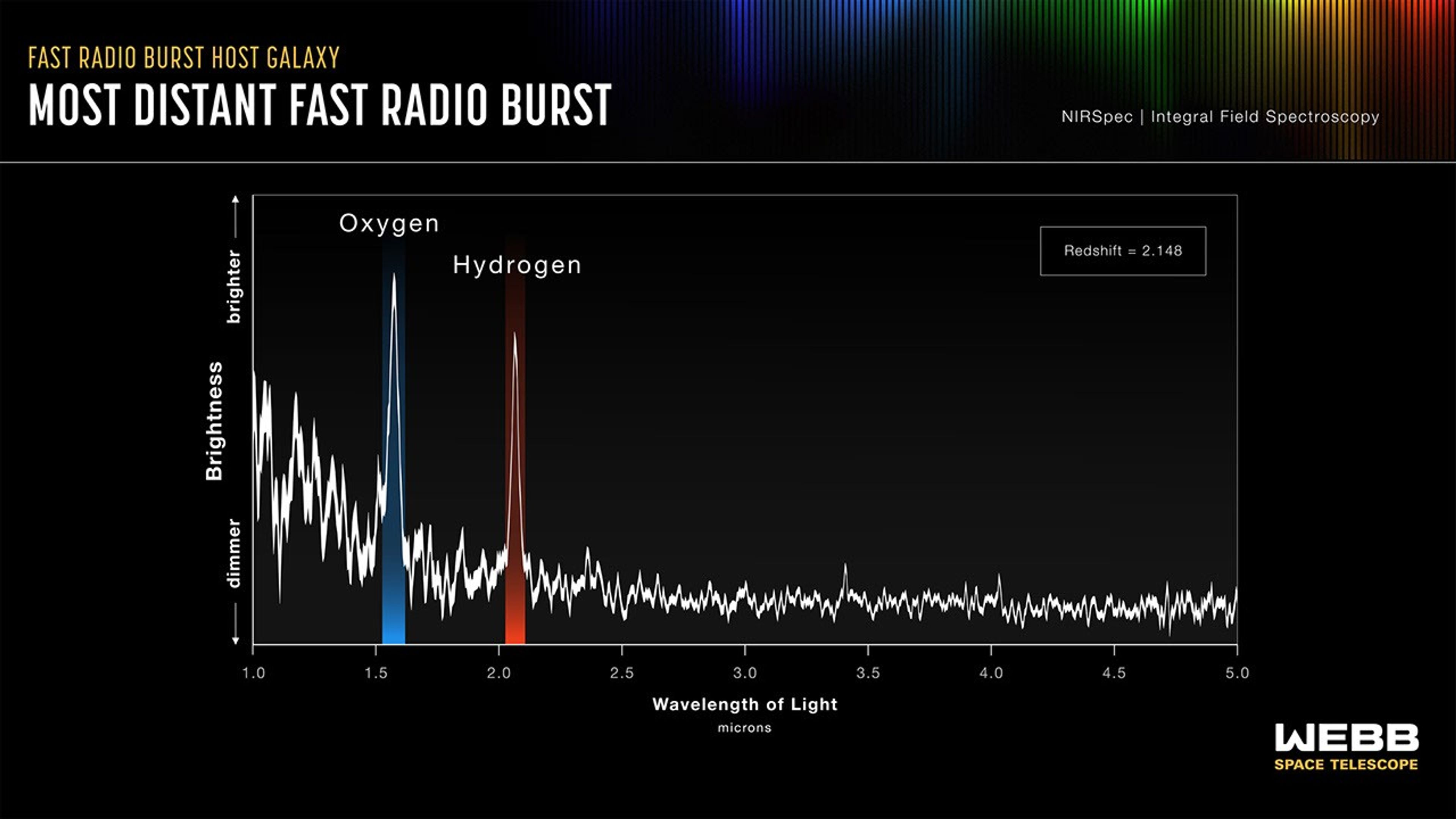
Webb’s NIRCam (Near-Infrared Camera) instrument detected a galaxy in the right location, and its NIRSpec (Near-Infrared Spectrograph) instrument provided a precise measurement of the galaxy’s redshift: 2.148, corresponding to a time just 3 billion years after the big bang. The vast majority of FRBs detected to date occurred billions of years later in cosmic history.
The team discovered that the host galaxy of FRB 20240304B was not typical of other galaxies with FRBs. Most FRB galaxies are massive star-forming galaxies, but the galaxy they found was 1,000 times less massive than they expected.
“We thought it would be a big, nicely formed galaxy with lots of stars, and instead it was a little dwarf galaxy, although it was actively forming stars,” said Caleb.
“The host sticks out in the whole galaxy sample that we have. And it definitely was not what we were expecting,” said Ben Stappers of the University of Manchester, United Kingdom, a co-author on the paper. “This combination of using the MeerTRAP project on the MeerKAT telescope to discover and localize these distant bursts and Webb to study their hosts is very exciting.”
The galaxy existed at the height of “cosmic noon” – a period in the history of the universe when star formation was at its peak. The galaxy’s rate of star formation suggested that the majority of its stars may have formed within just 30 million years.
This has important implications for the origin of fast radio bursts. One theory suggests that FRBs may originate from the merger of two neutron stars. However, the process of orbiting neutron stars gradually approaching closer and closer until they collide is expected to take billions of years. As a result, FRBs would be expected to be associated with older galaxies containing more evolved stellar populations.
A second theory proposes that an FRB can originate from a single, young, highly magnetic neutron star known as a magnetar through a mechanism like starquakes. In that case, once a massive star explodes as a supernova and leaves behind a magnetar, an FRB might occur relatively quickly with no large time delay. As a result, FRBs would also be expected to be found in younger galaxies like the host of FRB 20240304B.
“Our work suggests that it’s very unlikely that this FRB was produced by a merger,” said Caleb.
“Our results further show the amazing capability of Webb where we can push boundaries beyond what was previously possible,” said co-author Themiya Nanayakkara of the University of Sydney, Australia.
In addition to being a record-holder, the new FRB enabled the team to learn more about the billions of light-years of apparently empty space between the burst and Earth.
“A fast radio burst is almost like a cosmic flashlight. It lights up everything along the path. It carries an imprint of everything that it travels through, so you can use it to trace the ‘cosmic web’ – the otherwise invisible matter and structures that it encounters along the way,” said co-author J. Xavier Prochaska of the University of California, Santa Cruz.
The team found the imprint of two cosmic structures on the FRB’s signal – one previously unknown galaxy cluster at a redshift of 0.3 (about 3.5 billion light-years from Earth), and the nearby Virgo Cluster, which is located about 54 million light-years from Earth.
Image: Farthest Fast Radio Burst Host Galaxy Spectrum
Astronomers using NASA’s James Webb Space Telescope were able to study the host galaxy of the most distant known fast radio burst (FRB). They confirmed it has a cosmological redshift of 2.148 and that the FRB occurred just 3 billion years after the big bang.
Illustration: NASA, ESA, CSA, Joseph Olmsted (STScI); Science: Manisha Caleb (SIfA)
In the future, the team is excited about the potential to discover more distant FRBs. They estimate that the MeerKAT telescope may be able to detect and localize several FRBs per year at a redshift greater than 1.0, meaning they existed more than halfway back to the start of the universe. As other new radio telescope facilities and instruments come online, that discovery pace may grow. The Webb telescope will be essential for characterizing those distant host galaxies.
The James Webb Space Telescope is the world’s premier space science observatory. Webb is solving mysteries in our solar system, looking beyond to distant worlds around other stars, and probing the mysterious structures and origins of our universe and our place in it. Webb is an international program led by NASA with its partners, ESA (European Space Agency) and CSA (Canadian Space Agency).
The following sections contain links to download this article’s images and videos in all available resolutions followed by related information links, media contacts, and if available, research paper and Spanish translation links.
Related Images & Videos
FRB 20240304B (NIRCam Image)
NASA’s James Webb Space Telescope’s NIRCam (Near-Infrared Camera) was able to detect the host galaxy of the fast radio burst called FRB 20240304B, whose location is shown by the white cross. They found it is a small dwarf galaxy actively forming stars.
Farthest Fast Radio Burst Host Galaxy Spectrum
Astronomers using NASA’s James Webb Space Telescope were able to study the host galaxy of the most distant known fast radio burst (FRB). They confirmed it has a cosmological redshift of 2.148 and that the FRB occurred just 3 billion years after the big bang.
FRB 20240304B (NIRCam Compass Image)
This image of the host galaxy of fast radio burst FRB 20240304B, captured by the James Webb Space Telescope’s Near Infrared Camera (NIRCam), shows compass arrows, scale bar, and color key for reference.
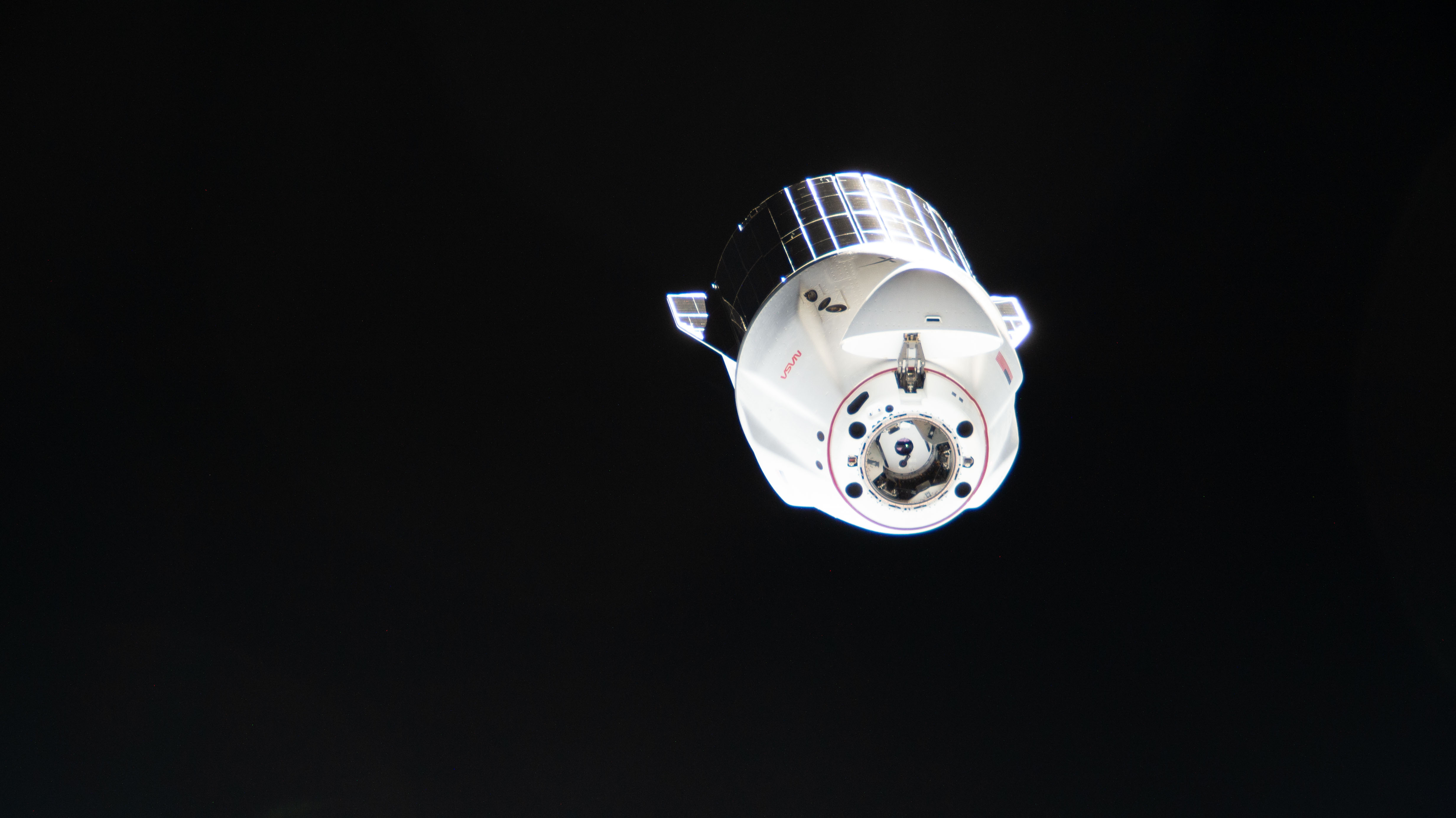
A SpaceX Dragon cargo spacecraft departs from the International Space Station on June 16 after undocking from the Harmony module’s forward port. Dragon, packed with completed science experiments and cargo for retrieval and analysis on Earth, parachuted to a splashdown off the coast of southern California the following day.
Credit: NASA
NASA and SpaceX are targeting 6:33 a.m. EDT, Tuesday, Oct. 13, for the next launch to deliver science investigations, supplies, and equipment, including the final set of International Space Station Roll-Out Solar Arrays, to the space station. This is the 35th SpaceX commercial resupply services mission to the orbital complex for NASA.
NASA also will host a media teleconference on Thursday, Oct. 8 that will preview the cargo resupply flight, as well as provide a post-splashdown update for the agency’s SpaceX Crew-12 mission, which will have returned to Earth from the space station Thursday morning.
Loaded with more than 6,300 pounds of supplies, a SpaceX Dragon spacecraft on a Falcon 9 rocket will lift off from Space Launch Complex 40 at Cape Canaveral Space Force Station in Florida. Dragon will dock autonomously around 11 a.m. on Thursday, Oct. 15, to the space-facing port of the station’s Harmony module.
NASA’s live launch and docking coverage will stream through a variety of platforms. Learn where to watch online:
In addition to the solar arrays, the Dragon spacecraft will deliver hardware to manufacture artificial retinas in microgravity to help restore vision on Earth and 3D heart tissues models to advance large‑scale drug testing on future missions. The spacecraft will carry materials to study how a new type of glass forms in microgravity and brain organoids that could reveal treatment targets for neurodegenerative diseases, such as Alzheimer’s, Parkinson’s, and multiple sclerosis.
The Dragon spacecraft is scheduled to remain at the space station until mid-November when it will depart the orbiting laboratory and return to Earth with time-critical research and cargo, splashing down off the coast of California.
NASA’s mission coverage is as follows (all times Eastern and subject to change based on real-time operations):
Thursday, Oct. 8
1:15 p.m.: International Space Station briefing for Crew-12 return, and SpaceX’s 35th Commercial Resupply Services launch with the following participants:
Bill Spetch, deputy manager of Commercial, Low Earth Orbit Program
Dr. Liz Warren, deputy chief scientist, NASA’s International Space Station Office
Lee Echerd, senior mission manager, Customer Operations and Integration, SpaceX
Andreas Mogensen, leader, Human Exploration Group, ESA (European Space Agency)
To participate in the teleconference, media must contact the NASA Johnson Space Center newsroom for call details by 12 p.m., Oct. 8, at: [email protected] or 281-483-5111. To ask questions, media must dial in no later than 10 minutes before the start of the call. The agency’s media credentialing policy is available online.
Tuesday, Oct. 13
6:15 a.m.: Launch coverage begins
6:33 a.m.: Launch
Thursday, Oct. 15
9:15 a.m.: Arrival coverage begins
11 a.m.: Docking
NASA website launch coverage
Launch day coverage of the mission will be available on the NASA website. Coverage will include live streaming and blog updates beginning no earlier than 6 a.m. on Oct. 13, as the countdown milestones occur. On-demand streaming video on NASA+ and photos of the launch will be available shortly after liftoff. For questions about countdown coverage, contact the NASA Kennedy Space Center newsroom at 321-867-2468. Follow countdown coverage on our International Space Station blog for updates.
Attend launch virtually
Members of the public can register to attend this launch virtually. NASA’s virtual guest program for this mission also includes curated launch resources, notifications about related opportunities or changes, and a stamp for the NASA virtual guest passport following launch.
Watch, engage on social media
Let people know you’re watching the mission on X, Facebook, and Instagram by following and tagging these accounts: