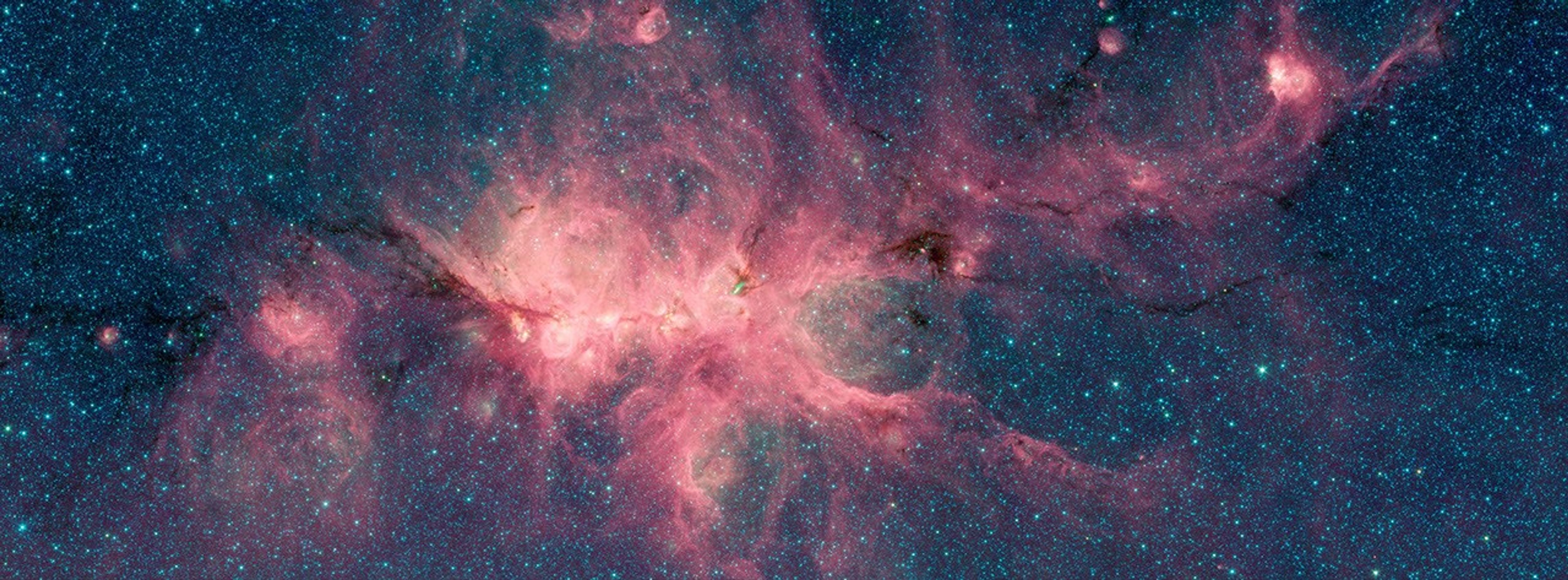
This artist’s concept depicts the proposed design for NASA’s PRobe far-Infrared Mission for Astrophysics (PRIMA), which was selected by the agency in September 2026. The PRIMA observatory is the first in a new class of NASA astrophysics missions, called Probe Explorers, within the agency’s longstanding Explorers Program. By observing far-infrared light, PRIMA will enable scientists to study cosmic objects heavily obscured by dust, providing new insights into the formation of planets, stars, and black holes, and even how water on Earth came to be. If confirmed by the agency, PRIMA will be targeted to launch in 2033, for a planned five-year mission.
Discover the cosmos! Each day a different image or photograph of our fascinating universe is featured, along with a brief explanation written by a professional astronomer.
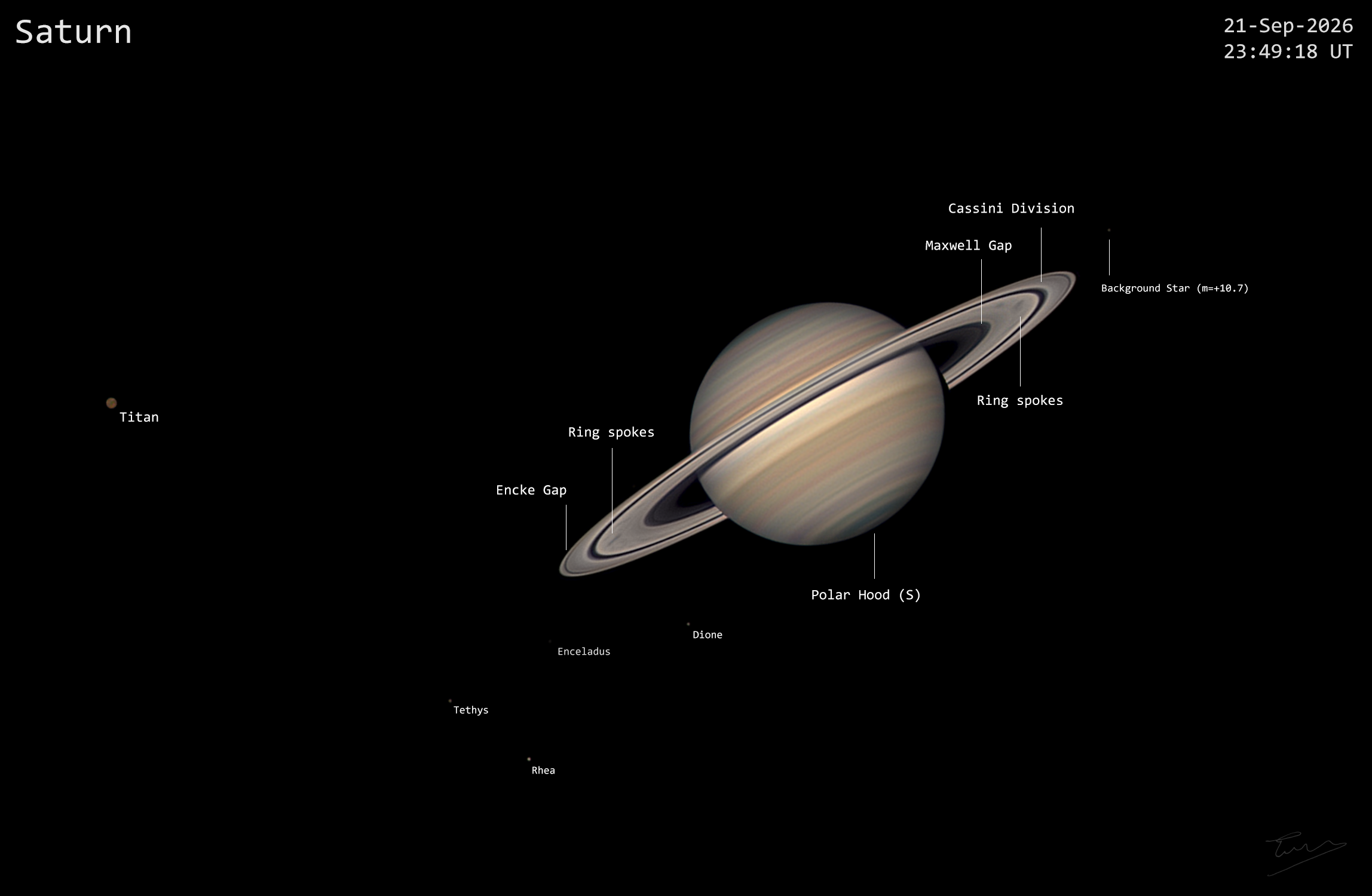
The Saturn System Smörgåsbord
Explanation: How was the Saturn system imaged so clearly? Astrophotographer Tom Williams captured such exquisite details due to one night of exceptional atmospheric conditions above the United Kingdom. This means more than a cloudless sky. Pockets of air at different temperatures and densities move around and bend light as it travels through Earth’s atmosphere, distorting astronomy images. This is called “seeing.” Less atmospheric turbulence means clearer images. The astrophotographer reduced the impact of seeing with the lucky imaging technique: thousands of short-exposure images are taken very quickly with a high-speed camera and the clearest images are added up. Which object in this smörgåsbord interests you? Perhaps Titan or the icy stripes of Enceladus? Maybe the gaps and spokes in Saturn’s rings? Saturn’s opposition, when Earth passes in between the planet and the Sun, occurred on October 4th. Due to the planet’s proximity and full illumination from the Sun, now is a great time of year to observe it!
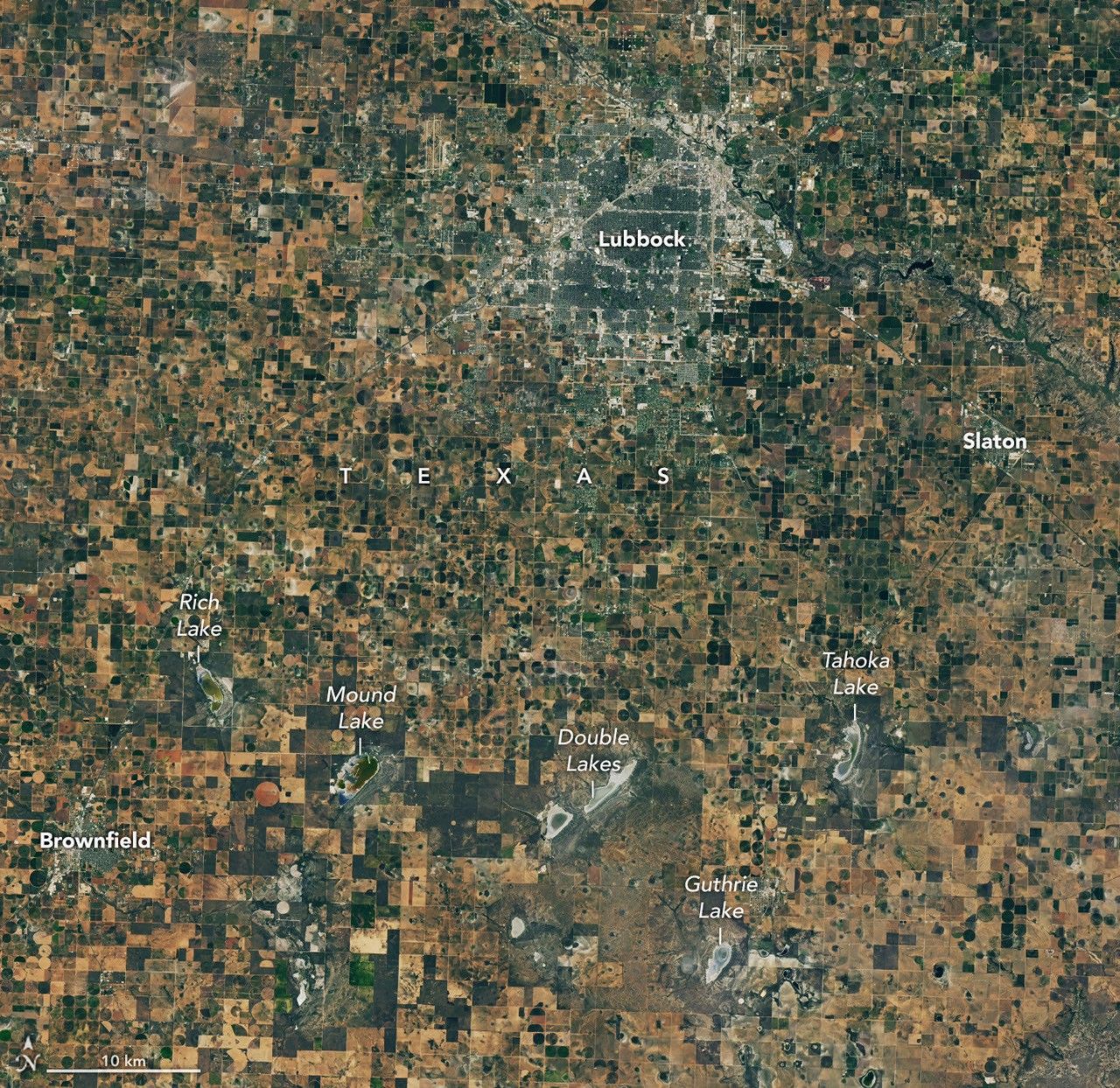
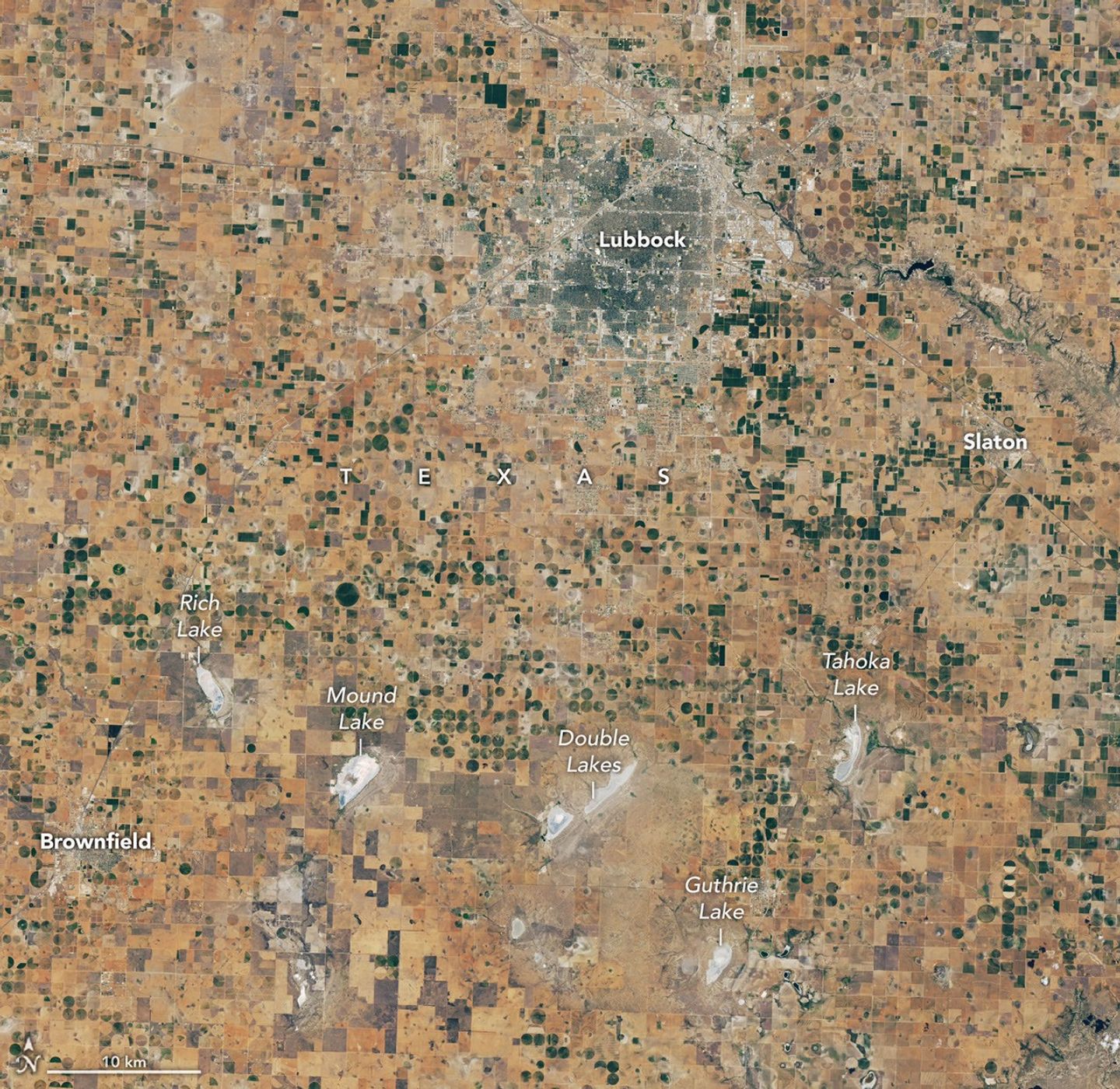
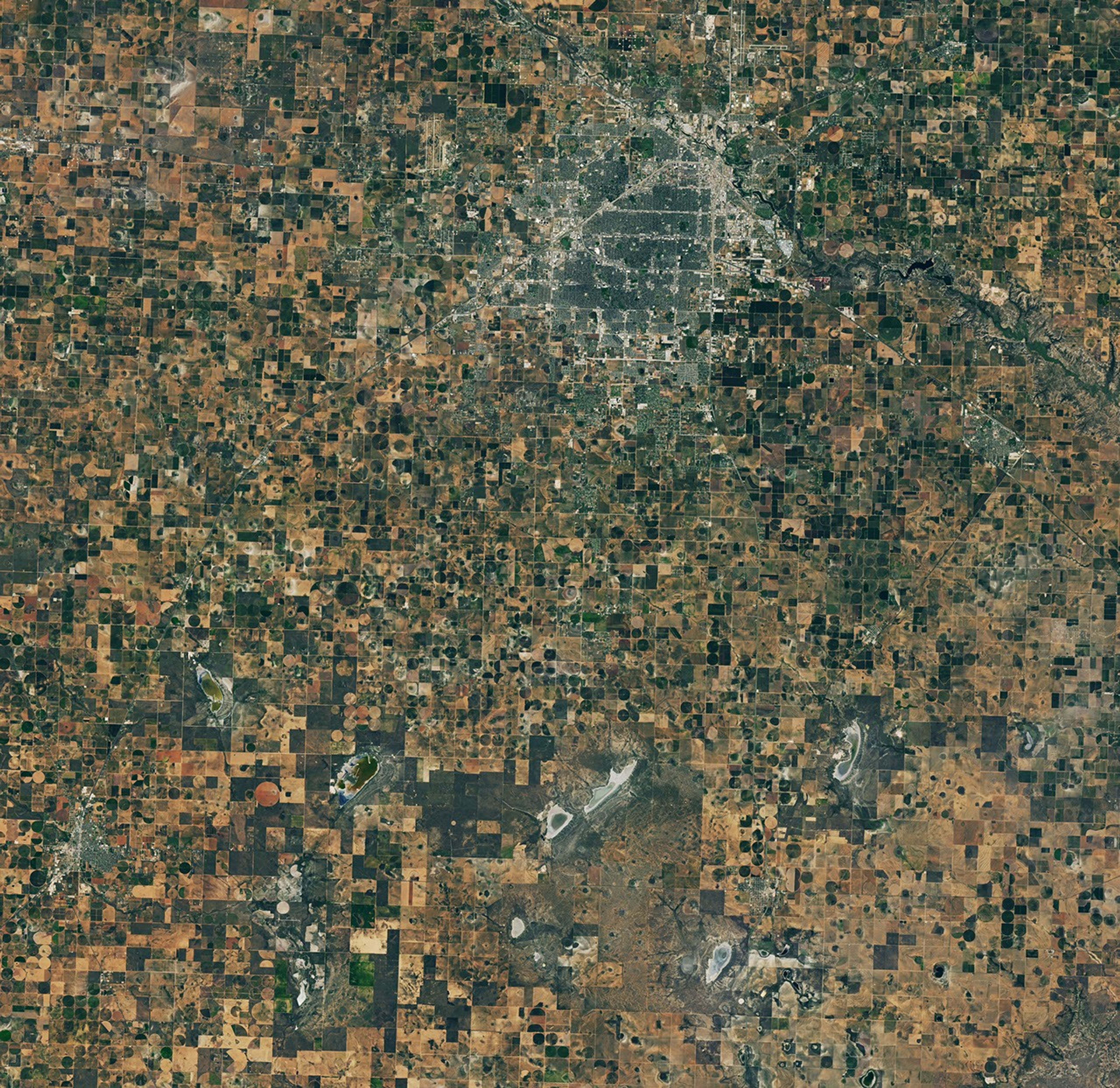
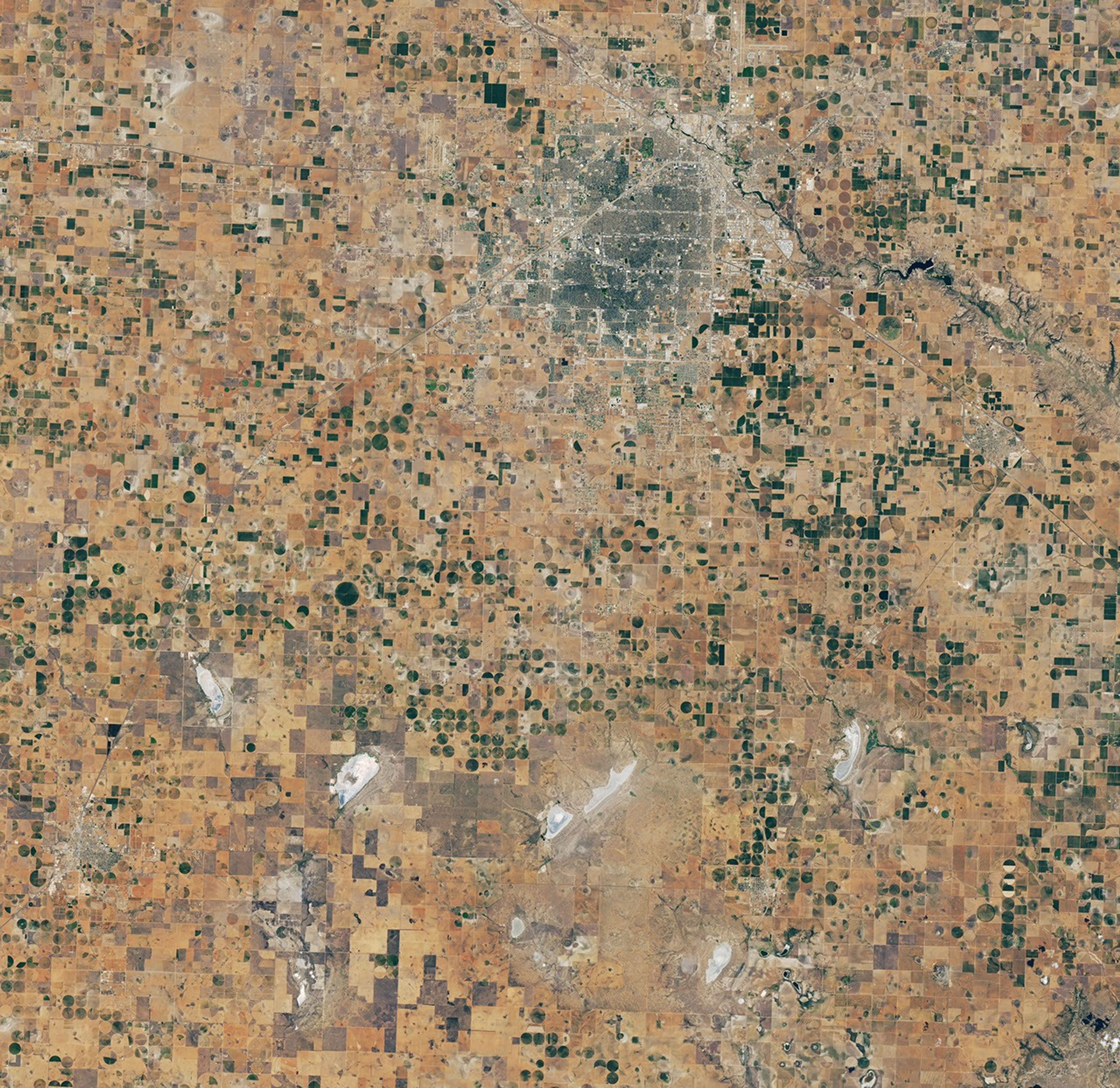
A satellite image of farmland around Lubbock, Texas, on September 22, 2025, features a patchwork of green and brown agricultural fields and several playa lakes with varying amounts of water.
NASA Earth Observatory / Lauren Dauphin
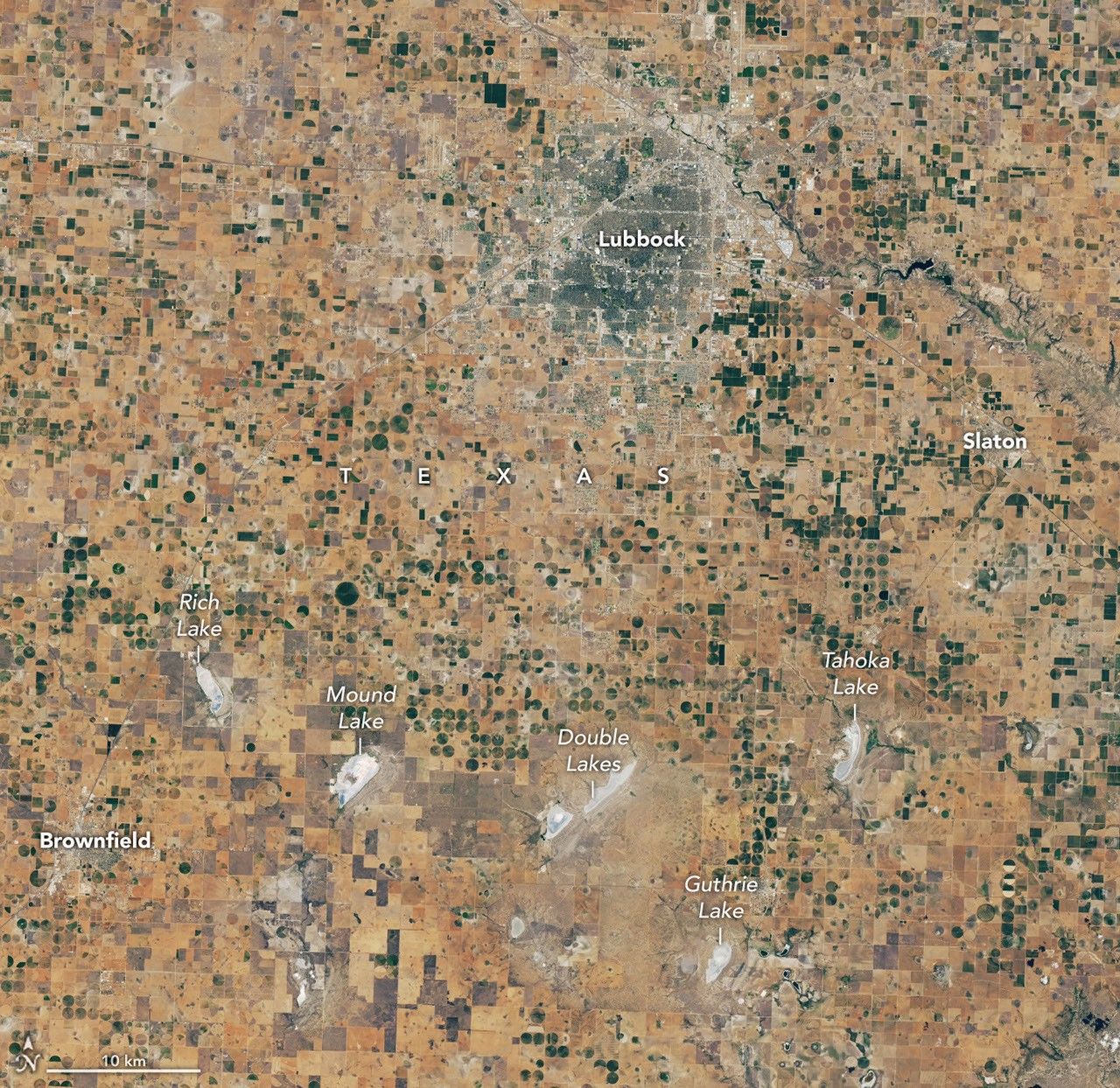
A satellite image of the same Lubbock region on September 9, 2026, appears parched, with much less green vegetation and mostly dry lakes.
NASA Earth Observatory / Lauren Dauphin
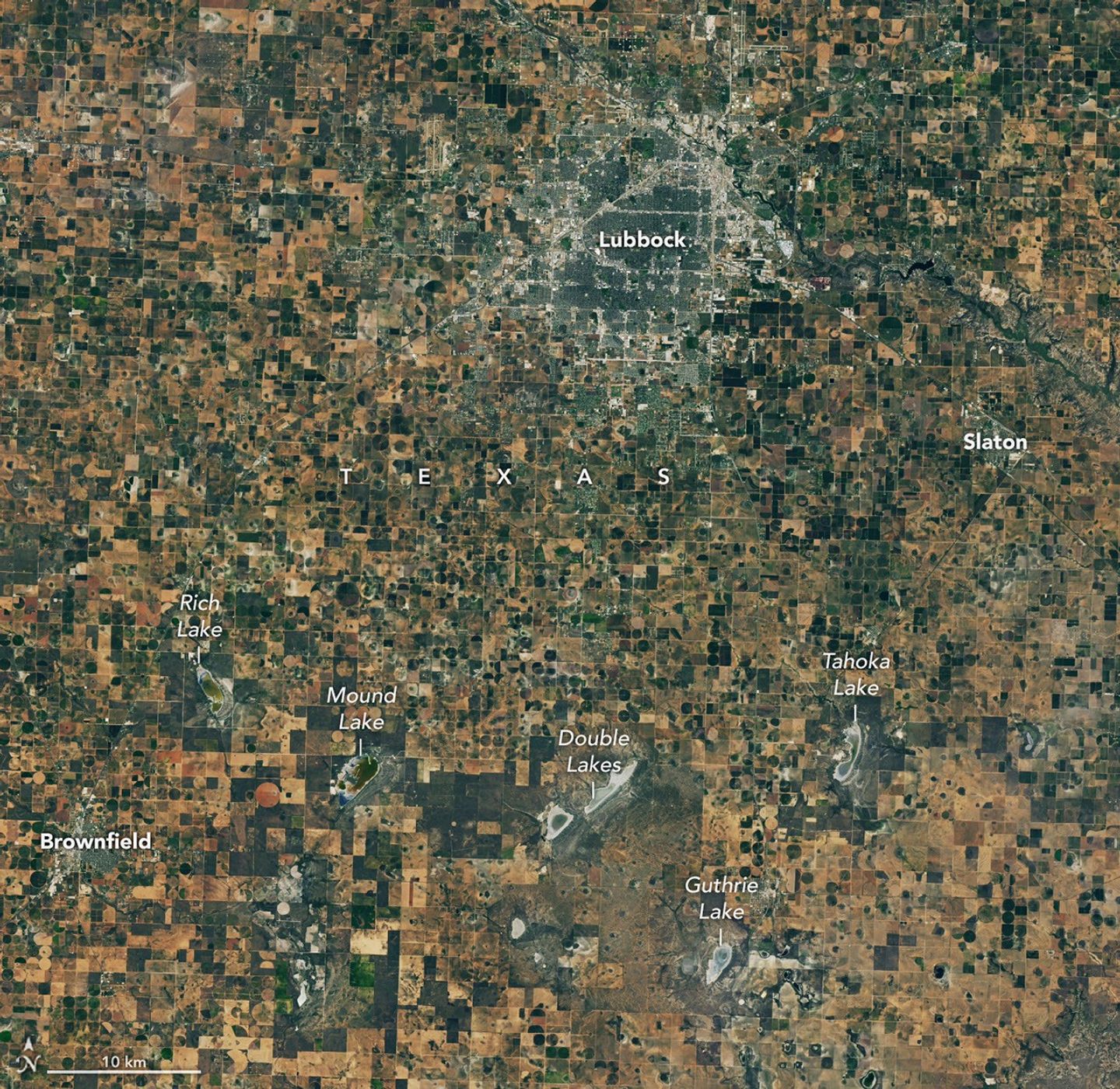
A satellite image of farmland around Lubbock, Texas, on September 22, 2025, features a patchwork of green and brown agricultural fields and several playa lakes with varying amounts of water.
NASA Earth Observatory / Lauren Dauphin
A satellite image of the same Lubbock region on September 9, 2026, appears parched, with much less green vegetation and mostly dry lakes.
NASA Earth Observatory / Lauren Dauphin
September 22, 2025
September 9, 2026
Fields were parched and brown, and playa lakes mostly dry, in Lubbock County in September 2026 (right) compared to September 2025 (left) in imagery captured by the OLI (Operational Land Imager) on the NASA/USGS Landsat 8 satellite. NASA Earth Observatory/Lauren Dauphin
For many longtime cotton farmers in the Texas High Plains, the 2026 drought sparked flashbacks to catastrophic harvests of the past. Miserably dry seasons forced farmers in America’s largest cotton-producing region to abandon massive portions of their dryland crop, including 72 percent in 2022 and 66 percent in 2011.
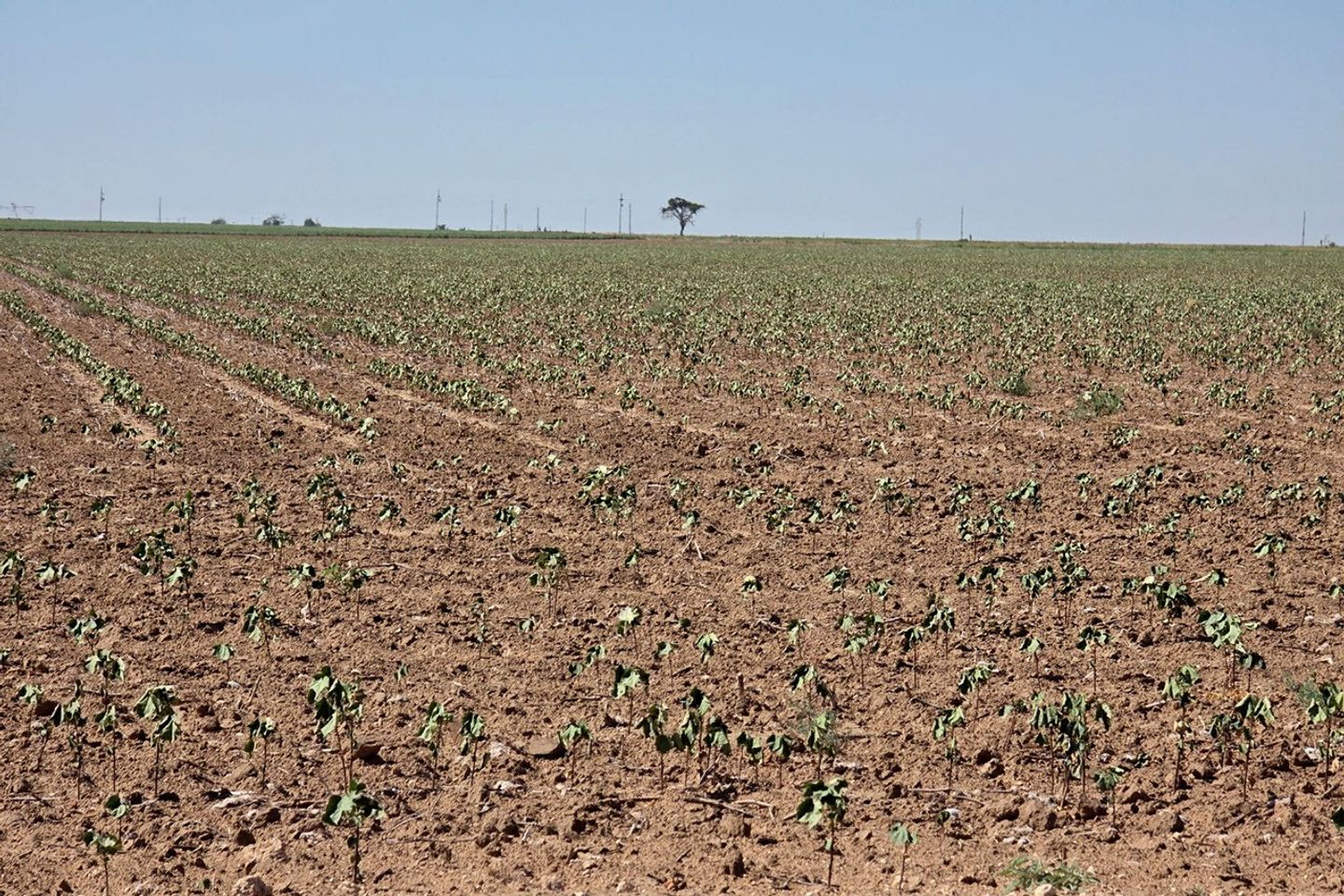
But in some ways, farmers felt the drought in 2026 entered new territory. “This is the first year that we’ve had cotton completely die,” said Lacy Cotter-Vardeman, a farmer based in Lubbock County whose family has worked the land there for several generations. “I was just talking to our insurance people, and they said they’d never seen this before,” she said, adding that roughly 90 percent of her dryland cotton was dead.
Satellite images highlight the scale of the problem in Lubbock and adjacent counties. Brown, parched crops and vacant plots dominated the landscape on September 9, 2026, when the OLI (Operational Land Imager) on Landsat 8 captured the image above (right). In contrast, much greener landscapes prevailed on September 22, 2025 (left), when the sensor captured an image of the same area during a more typical year with a relatively healthy harvest.
Rows of spindly, wilted cotton photographed in one of Cotter-Vardeman’s fields in Slaton, Texas, appear stressed and near death on August 14, 2026.
Lacy Cotter-Vardeman
Subtler signs of the drought are also visible. With groundwater growing scarce in the High Plains aquifer, many farmers in the region have started irrigating just one-half or one-third of their center-pivot fields, explained Tillery Timmons-Sims, an agricultural conservationist who owns land in Brownfield, Texas, and used to grow cotton. In the imagery, these appear as green semicircles and quarter circles.
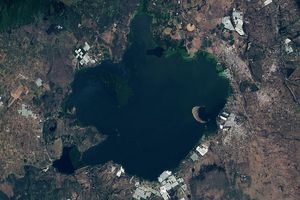
Note also the many shallow water features known as playa lakes—sometimes called mud holes, buffalo wallows, and lagoons—scattered throughout the image. Some, like Double Lakes and Mound Lake, are fairly large, but most of the more than 19,300 playa lakes in the Texas High Plains are quite small, less than 30 acres.
Many of these ephemeral lakes were dry in September 2026, unlike the previous year. Playa lakes are critical in this water-stressed region because the clay-lined features, if active, collect rainfall and provide pathways for water to seep underground and recharge the aquifer below, the region’s primary source of irrigation water. However, about 80 percent are modified by tilling or buried with sediment, and many no longer function that way.
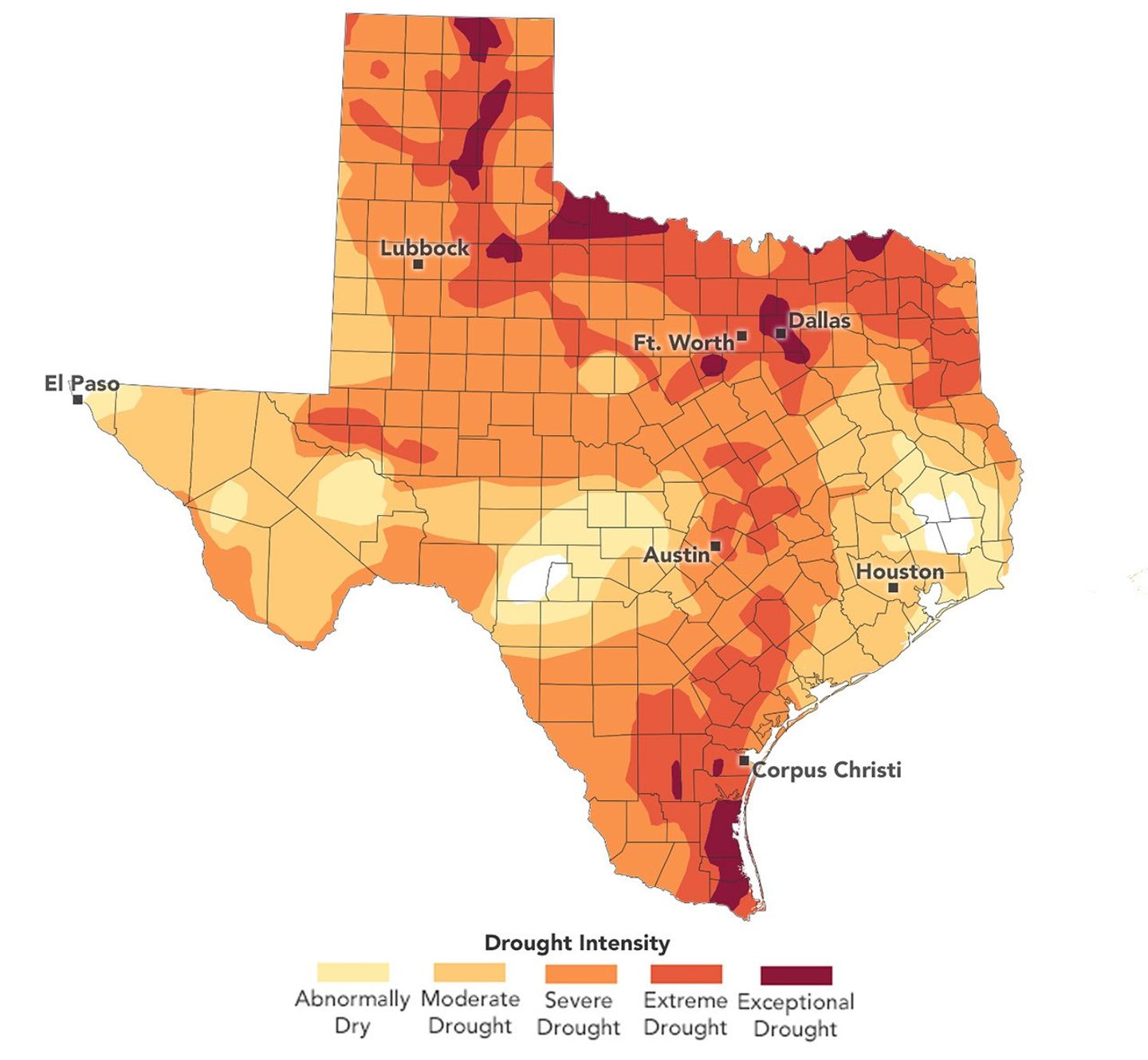
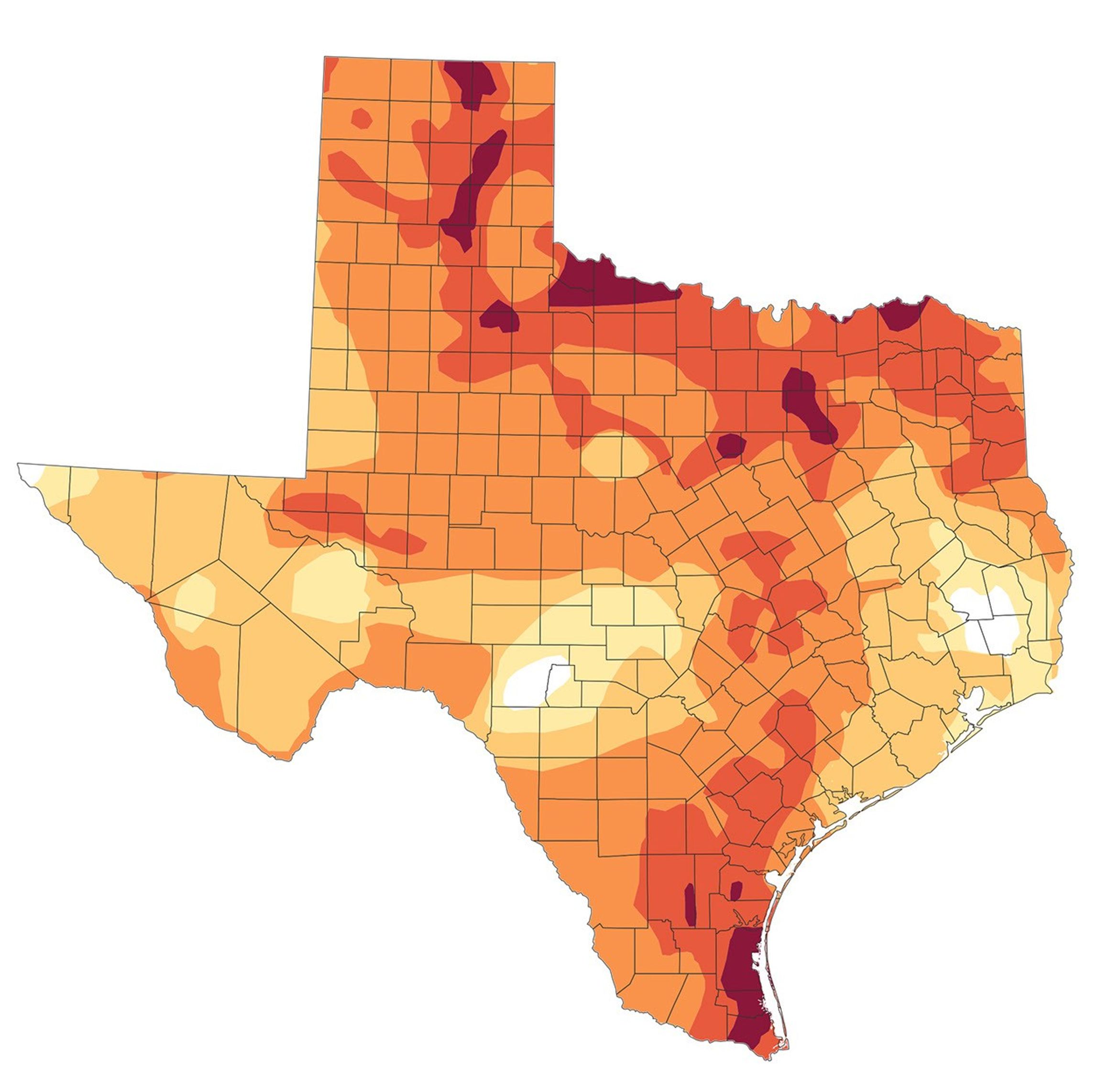
Drought remained severe across many parts of the Texas High Plains in October 2026 despite some rain falling in recent weeks. The data depicted in the map are produced by the U.S. Drought Monitor, a partnership between the National Drought Mitigation Center at the University of Nebraska-Lincoln, the U.S. Department of Agriculture (USDA), the National Oceanic and Atmospheric Administration, and NASA.
NASA Earth Observatory/Lauren Dauphin
Farmers in this region operate along the eastern margin of the aquifer, which has declined sharply in recent decades. According to U.S. Geological Survey data, the water table across much of Lubbock County has dropped by between 25 and 100 feet since 1950, around when people began drawing large volumes of water from the aquifer to irrigate. Losses have been even more extreme (150 feet or more) in counties to the north, including Parmer, Castro, Swisher, and Briscoe.
The aquifer’s long-term decline, combined with the 2026 drought, left many wells “pumping air” this summer for some of the farmers Timmons-Sims knows. “We simply don’t have groundwater to fall back on anymore,” she said. Many farmers she knows thought that water might run out during the next generation; instead, it’s “happening now,” she said. For Cotter-Vardeman, the problem couldn’t be more tangible. Many of her irrigation wells stopped working in August.
Rains in September and October, aided by a strong El Niño in the Pacific, are bringing needed moisture to the region, but they haven’t been enough, according to analysis from the U.S. Drought Monitor. “It will take about 7 inches of rain over a three-month period to ‘end’ the current drought,” said Jonathan Case, a meteorologist at NASA’s Marshall Space Flight Center and one of the Drought Monitor’s authors.
The deteriorating aquifer is one of the reasons Timmons-Sims stopped farming in 2007. She now spends most of her time searching for ways to keep farms in business, such as converting irrigated croplands to grasslands to earn water credits, developing alternative energy projects, adopting water-efficient techniques, and working with conservation organizations to plan for the long term.
Through that work, the Sandhills Area Research Association, a conservation organization she helps run, partnered with NASA Acres, a research consortium that connects farmers with NASA science to address agricultural challenges.
In August, a NASA Acres Space for Agriculture listening tour brought NASA officials to Cotter-Vardeman’s farm in Slaton, a vineyard in Meadow, and parched cotton fields in Kress (below). At each stop, the conversation returned to water: how to preserve the ailing aquifer, and how farmers could manage their land in ways that would help restore playa lakes and return billions of gallons of water to the aquifer.
Farmers and NASA scientists inspect wilted cotton in Kress, Texas, during a NASA Acres Space for Agriculture listening tour on August 25, 2026.
NASA Acres/Adam Zwerner
The playa lakes around Lubbock were among the first scientific topics researchers studied after Landsat 1 launched in 1972. One early analysis by a Texas Tech geoscientist highlighted the Double Lakes playa (shown above), estimating that monitoring lakes from space would cost just a fraction of what ground surveys would.
More recently, a team of Texas Tech University researchers used a deep learning framework to identify and track changes affecting thousands of playa lakes over three decades. Their results, published in September 2026, showed that since 1995, playa lakes declined significantly in 15 of the 45 counties analyzed, highlighting the water challenges facing farmers like Cotter-Vardeman, a member of the NASA Acres Farm Innovation Ambassador Team (FIAT).
In Texas, Timmons-Sims and FIAT are working to connect farmers and NASA scientists, making it easier for farmers to use NASA data to decide what and when to plant, how to use cover crops and irrigation, and how to manage sediment and playa lakes. “We’re simply running out of time and water,” Timmons-Sims said. “Farmers need information, innovation, optimization, and solutions—and they need it now.”
NASA Earth Observatory images by Lauren Dauphin, using Landsat data from the U.S. Geological Survey and the U.S.Drought Monitor at the University of Nebraska-Lincoln. Photos by Lacy Cotter-Vardeman and Adam Zwerner. Story by Adam Voiland.
NASA’s Curiosity Looks Back After Reaching Elevation Milestone
PIA26781
Credits: NASA/JPL-Caltech/MSSS
Downloads
NASA’s Curiosity Looks Back After Reaching Elevation Milestone
PNG (73.39 MB)
Description
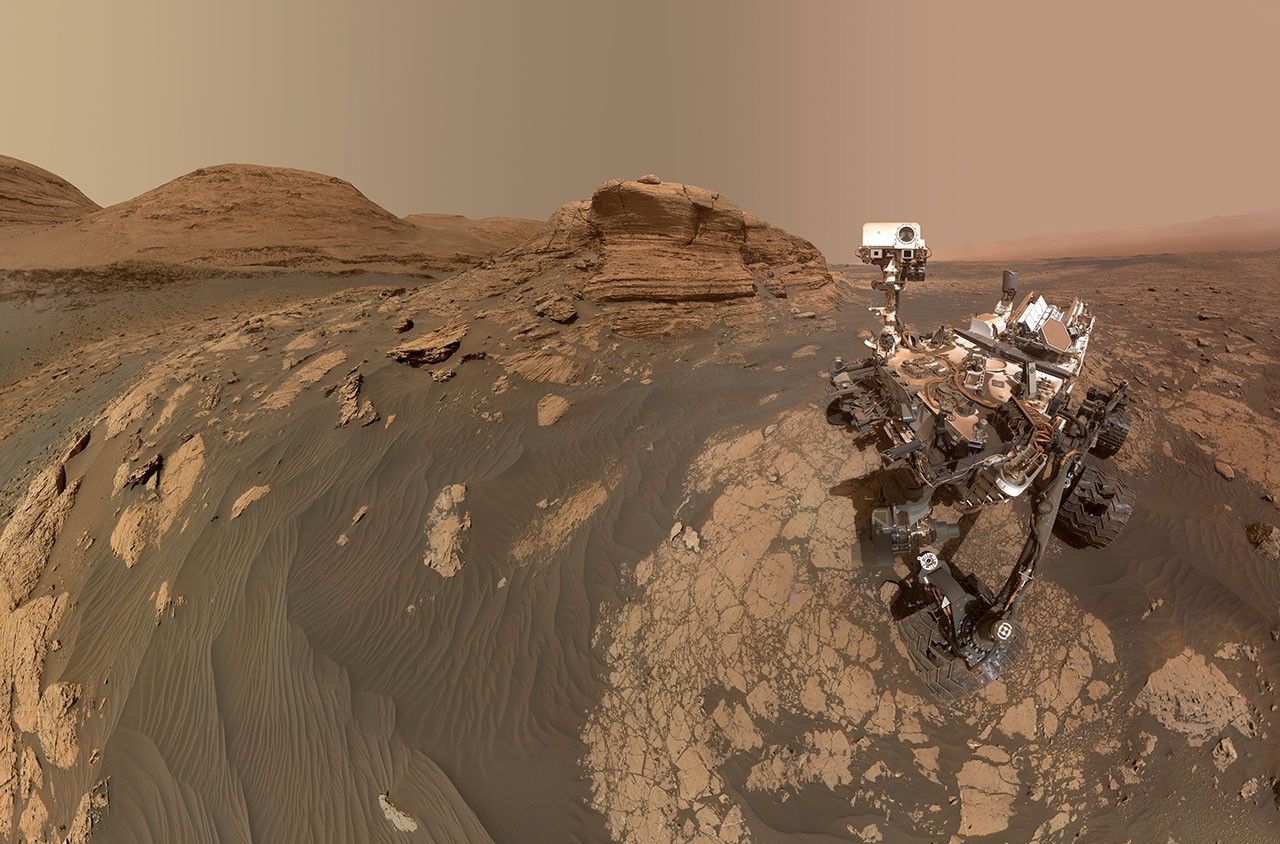
NASA’s Curiosity Mars rover captured this view looking back at the floor of Gale Crater, with the crater’s rim visible in the distance, on Sept. 5, 2026, the 5,006th Martian day, or sol, of the mission. Just nine days prior, on Aug. 26 (Sol 4,996), Curiosity set a mission milestone by reaching 1 kilometer of elevation above the crater floor. Since 2014, Curiosity has been climbing the lower foothills of Mount Sharp, a 3-mile-tall (5-kilometer-tall) mountain located within Gale Crater.
A sand ridge extends across the foreground of the image, and a trench left by the rover’s right front wheel is visible at right. Geologic layering inside the ridge, as well as the size and composition of its sand grains, will provide clues to how the feature formed.
This panorama is made up of 95 individual images taken by Curiosity’s Mast Camera, or Mastcam. The color in these images has been adjusted to match the lighting conditions as the human eye would see them on Earth.
Curiosity was built by NASA’s Jet Propulsion Laboratory, which is managed by Caltech in Pasadena, California. JPL leads the mission on behalf of NASA’s Science Mission Directorate in Washington as part of NASA’s Mars Exploration Program portfolio. Malin Space Science Systems in San Diego built and operates Mastcam.
NASA’s Curiosity Captures Dawn Breaking on Wind-Carved Cliffs
PIA25629
Credits: NASA/JPL-Caltech/MSSS
Downloads
NASA’s Curiosity Captures Dawn Breaking on Wind-Carved Cliffs
PNG (11.91 MB)
PIA25629 Figure A
PNG (2.70 MB)
Description
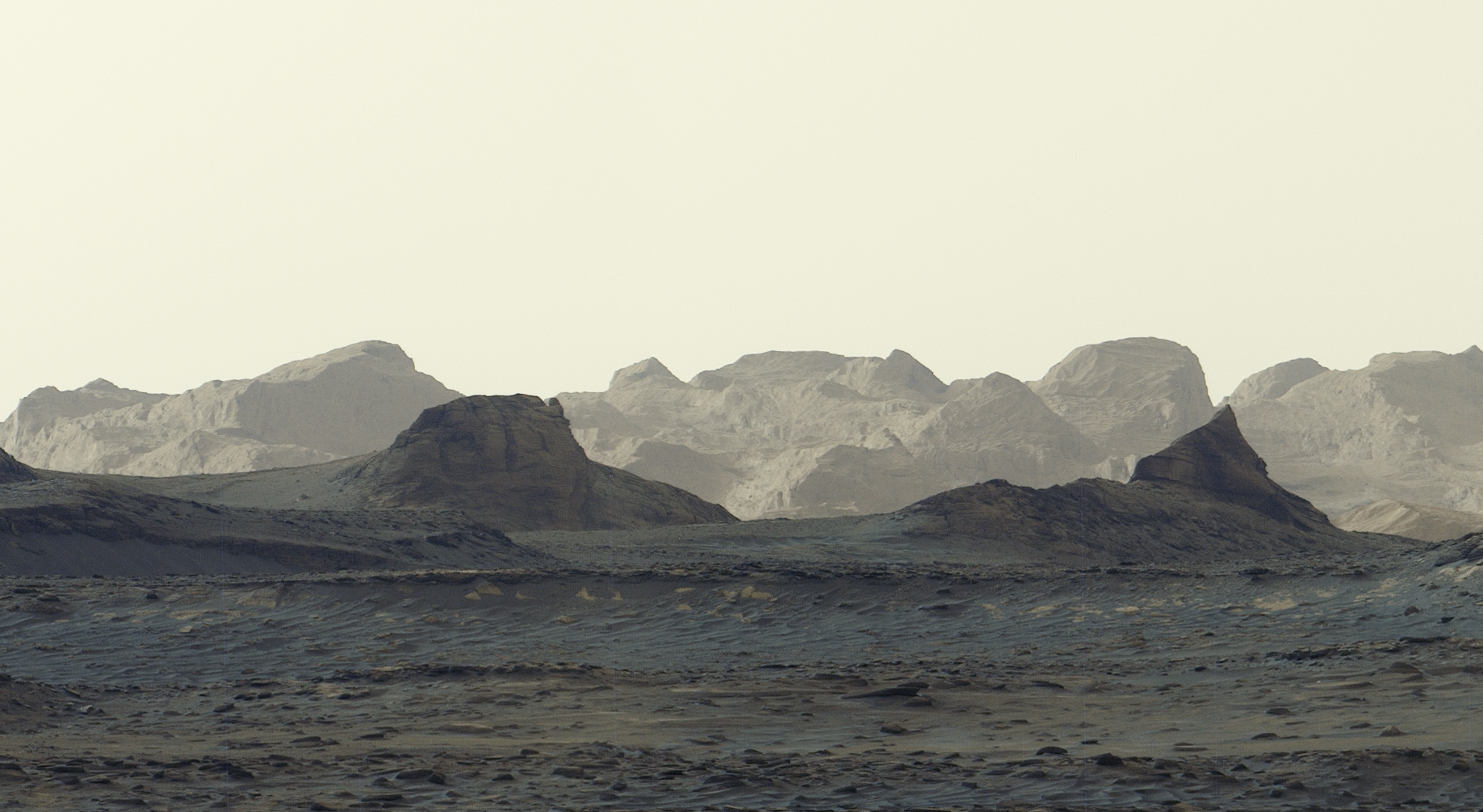
NASA’s Curiosity Mars rover captured this panorama of sunrise illuminating distant, wind-carved features called yardangs on Aug. 11, 2026, the 4,982nd Martian day, or sol, of the mission. Scientists are eager to learn more about how the yardang layer formed.
Figure A
Figure A is a crop zooming in on the distant yardangs.
Since 2014, Curiosity has been ascending 3-mile-tall (5-kilometer-tall) Mount Sharp, which is made up of a series of distinct layers that were deposited one on top of the other. In the area of the vast mountain’s shoulder where the rover is climbing, that stack of layers ends with the yardang layer. Before the yardang layer was laid down, Mount Sharp may have begun eroding, creating a gap in the otherwise continuous record of climate history that Curiosity has been reading from the layers. Scientists aren’t entirely sure how the layer formed; one theory is that it’s a pile of volcanic ash, similar to what’s seen along the Red Planet’s equator.
This panorama was captured by Curiosity’s Mastcam and is made up six individual images that were stitched together after being sent back to Earth. Unlike most of Curiosity’s Mastcam images, this one was processed without the usual white balancing, an artistic choice that preserves the early morning appearance.
Curiosity was built by NASA’s Jet Propulsion Laboratory, which is managed by Caltech in Pasadena, California. JPL leads the mission on behalf of NASA’s Science Mission Directorate in Washington as part of NASA’s Mars Exploration Program portfolio. Malin Space Science Systems in San Diego built and operates Mastcam.
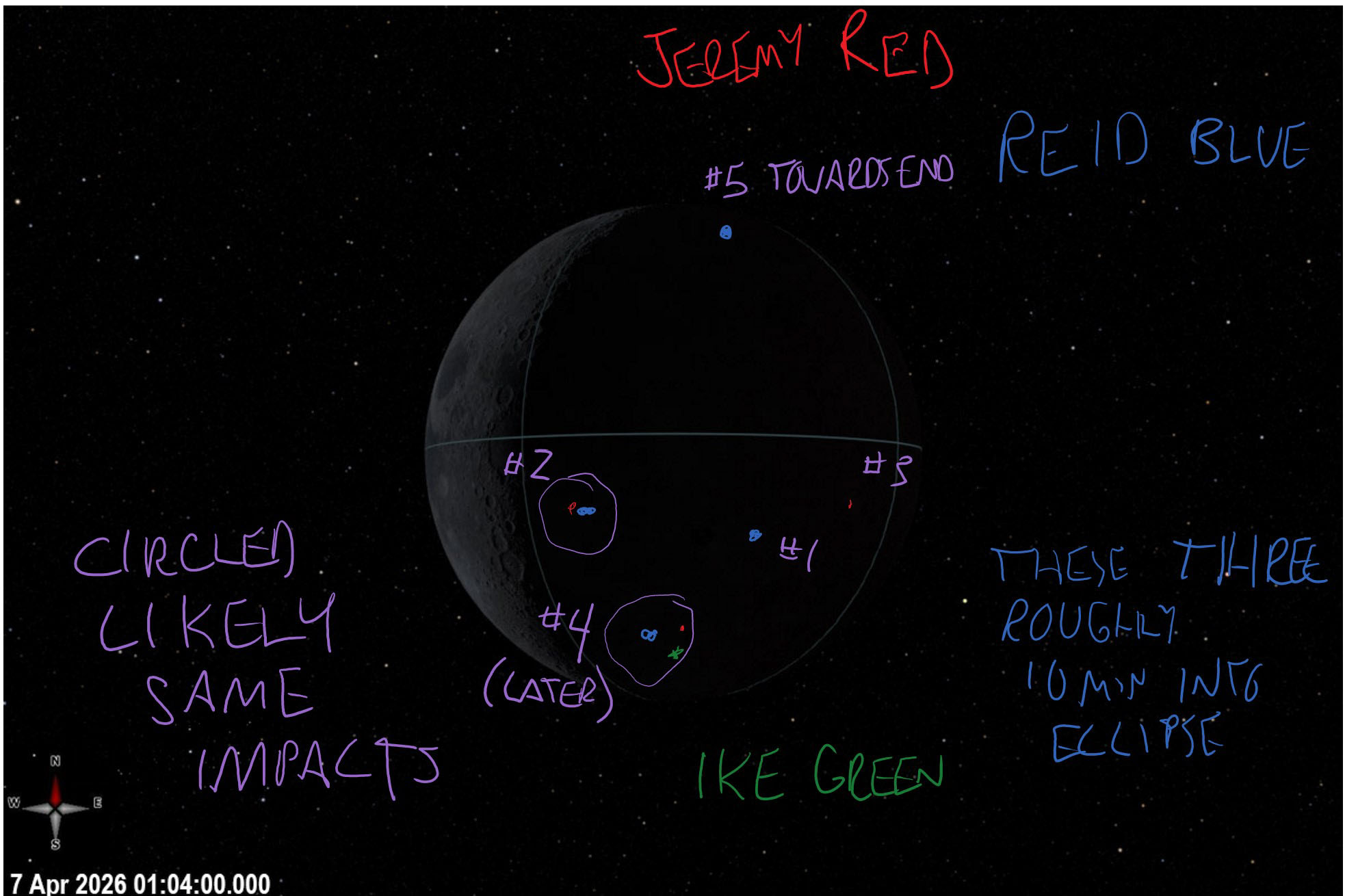
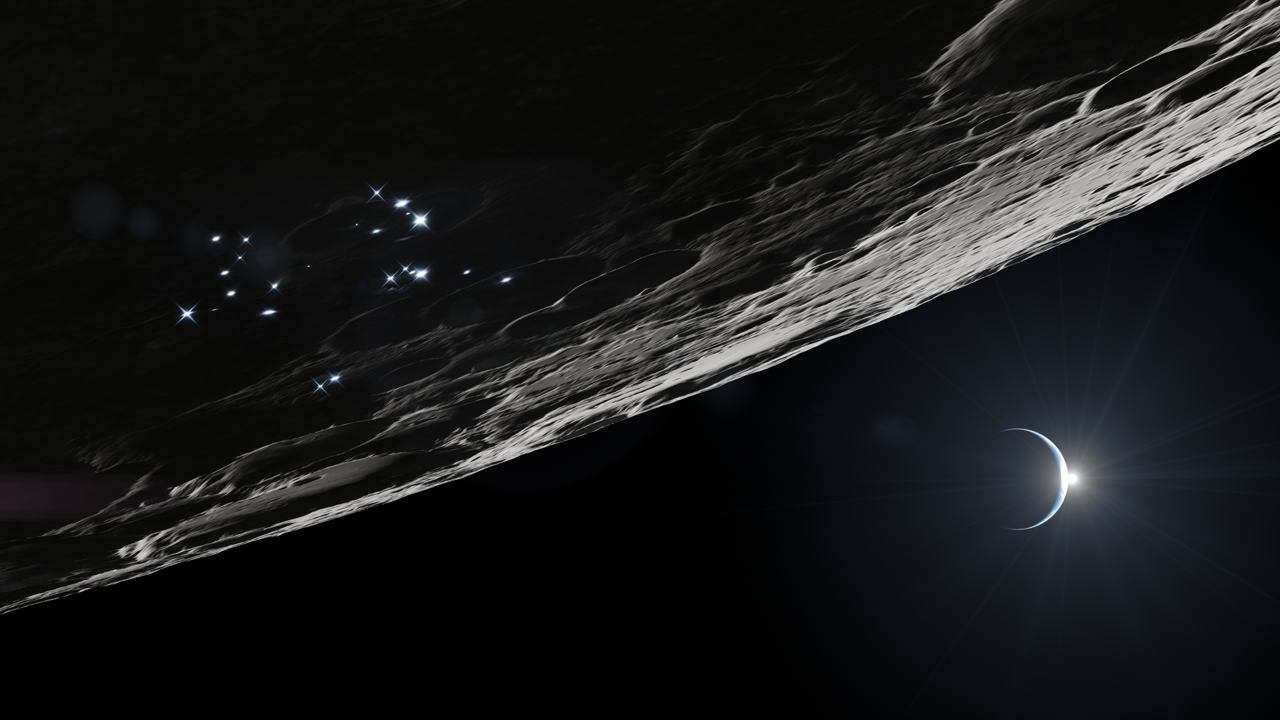
A visualization of a dark Moon eclipsing the Sun is marked with handwritten notes in this April 6, 2026, screenshot from an Artemis II crew member’s tablet.
NASA astronauts Reid Wiseman (in blue) and Victor “Ike” Glover (in green) and CSA (Canadian Space Agency) Jeremy Hansen (in red) observed impact flashes and their locations, which are noted on the image. Overall, the astronauts reported seeing five extremely faint “pinprick” bursts of light from their view aboard Orion, which was 46,000 miles away from the Moon at the time. These flashes are sparked by rocky fragments hitting the Moon.
From April 1 through April 10, 2026, NASA’s Artemis II crew traveled to the Moon and back and along the way, captured stunning imagery and scientific observations of our nearest neighbor. Now, the full lunar science dataset from their journey is available to the global science community, and to the public, for further study. Read about the report, listen to crew audio observations, and explore more.
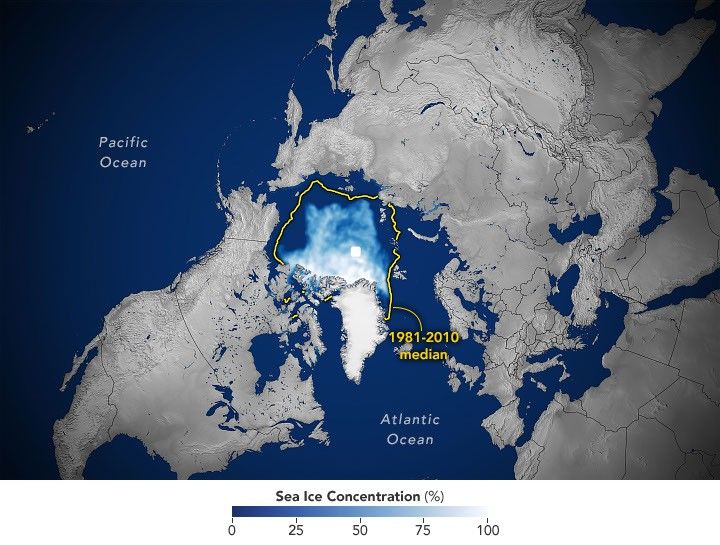
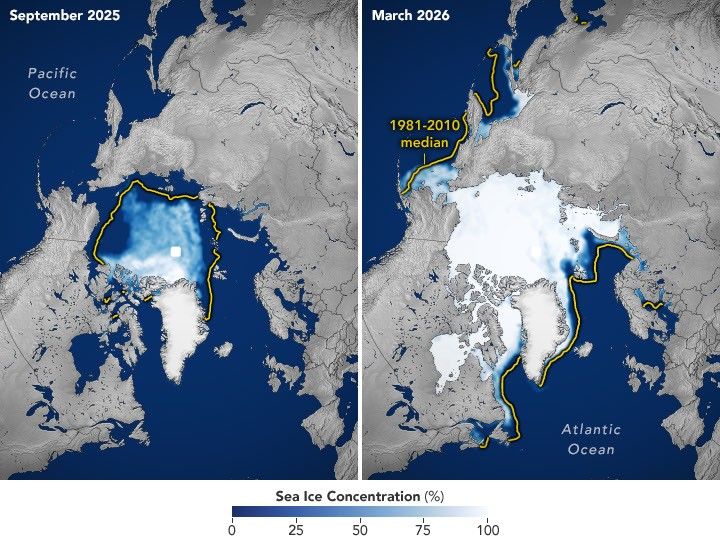
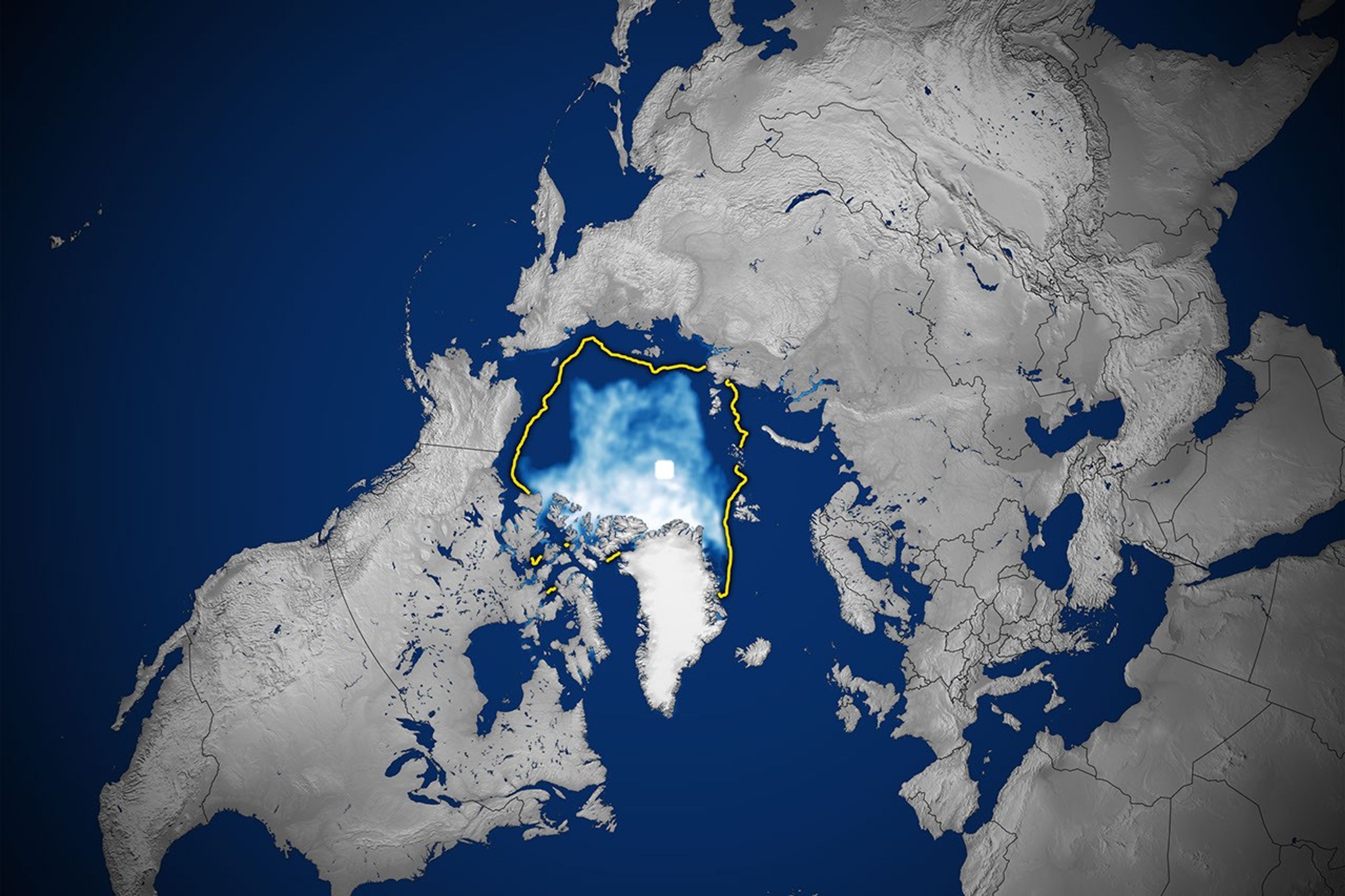
Arctic sea ice reaches its annual minimum extent on September 12, 2026, tying several past years for the 10th-lowest minimum in the satellite record. NASA Earth Observatory/Michala Garrison
This story is an update to the Arctic sea ice feature in our World of Changeseries, which tracks long-term change on Earth’s surface through satellite imagery.
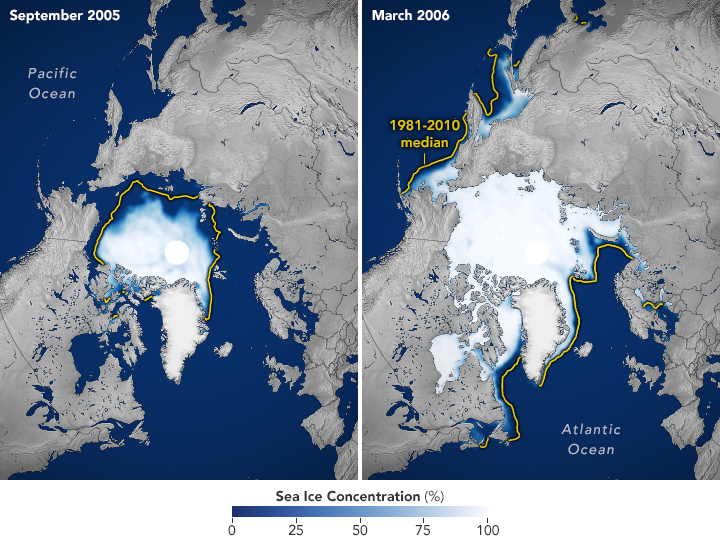
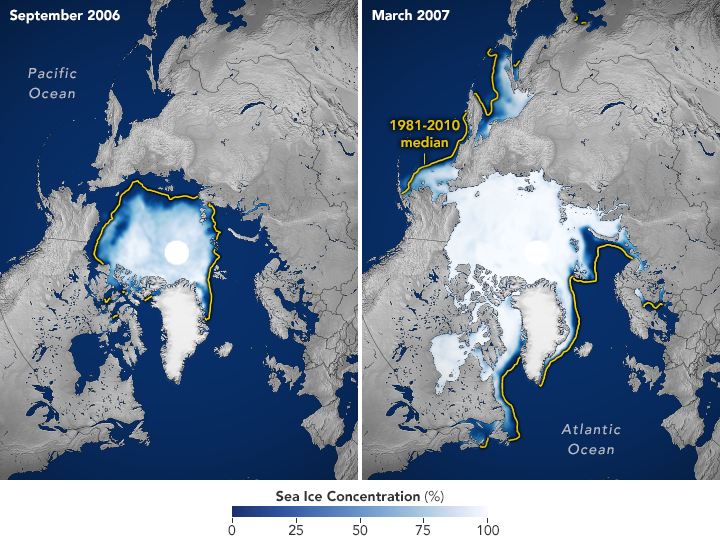
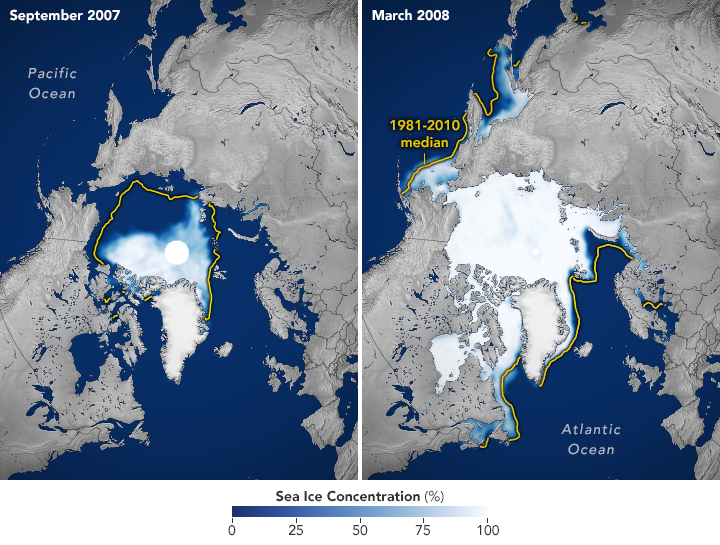
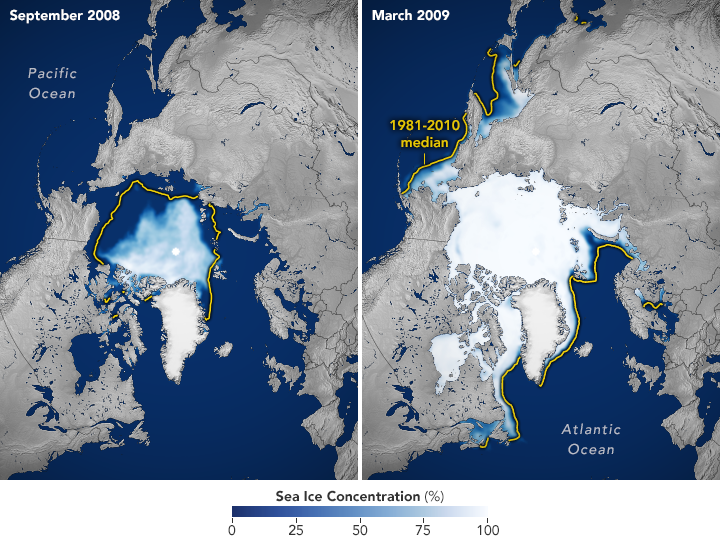
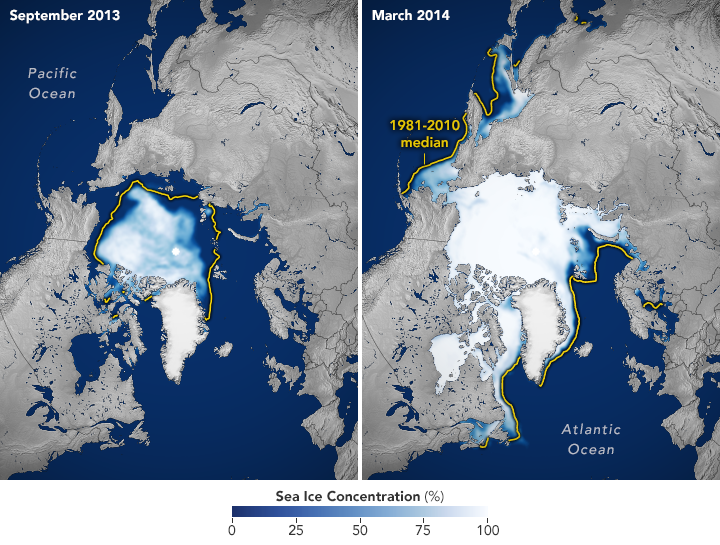
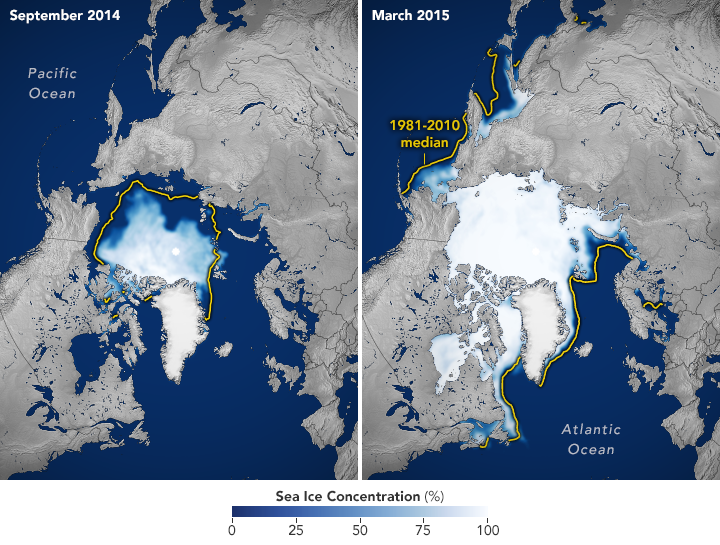
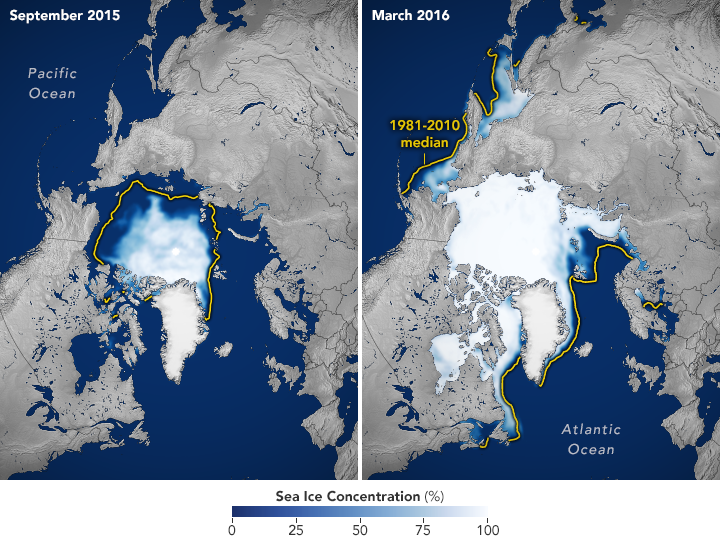
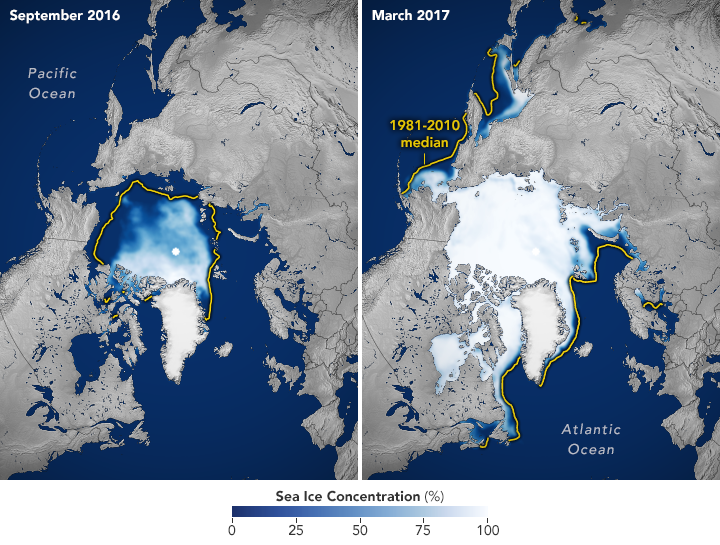
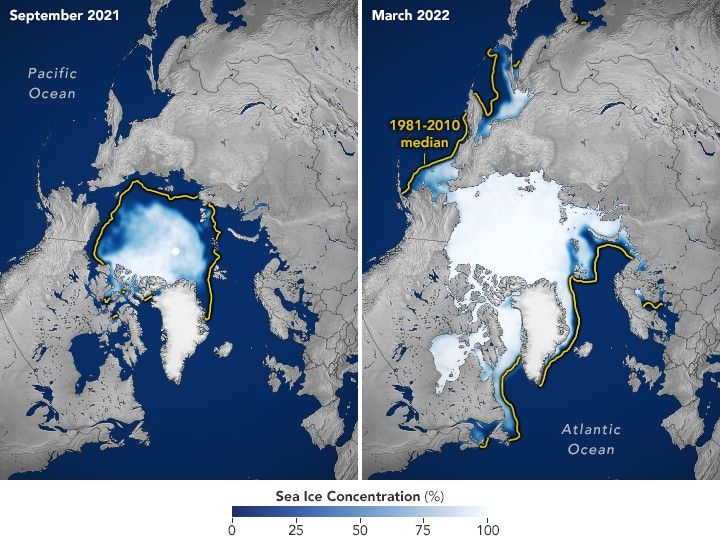
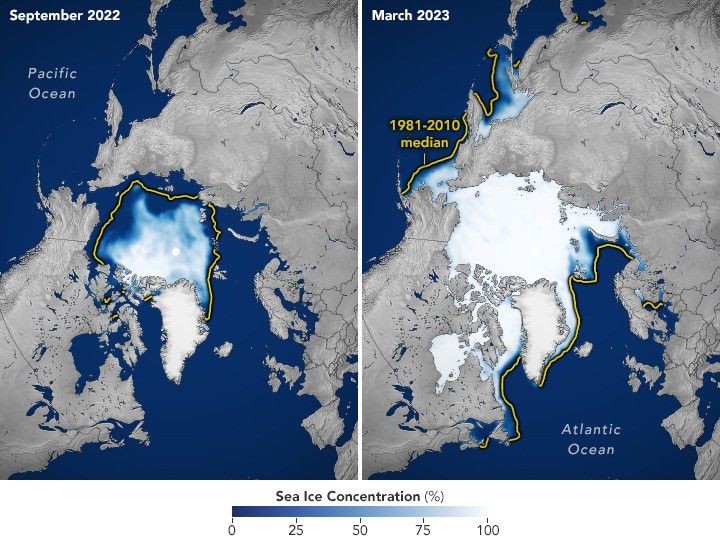
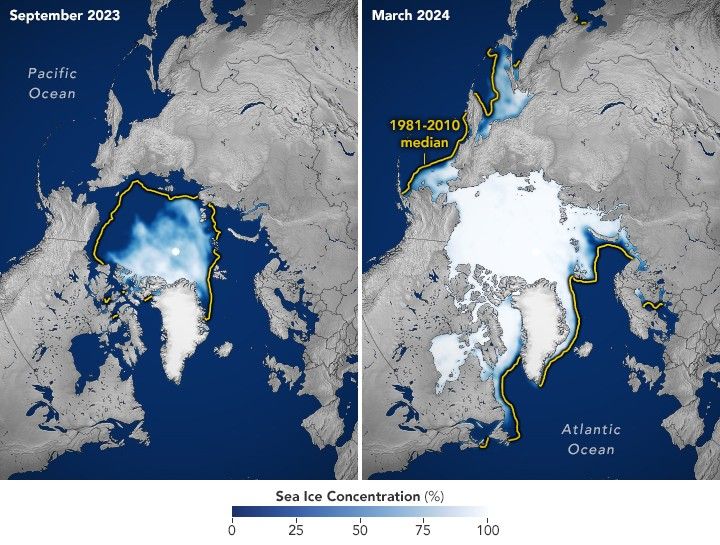
A layer of frozen seawater caps the Arctic Ocean. This sea ice grows through the long polar winter, usually peaking in March, then melts through the summer to its annual low in September. It is a natural fluctuation that has persisted for millennia. But satellite records show the ice now covers less of the Arctic Ocean at its annual maximum and minimum than it did a few decades ago.
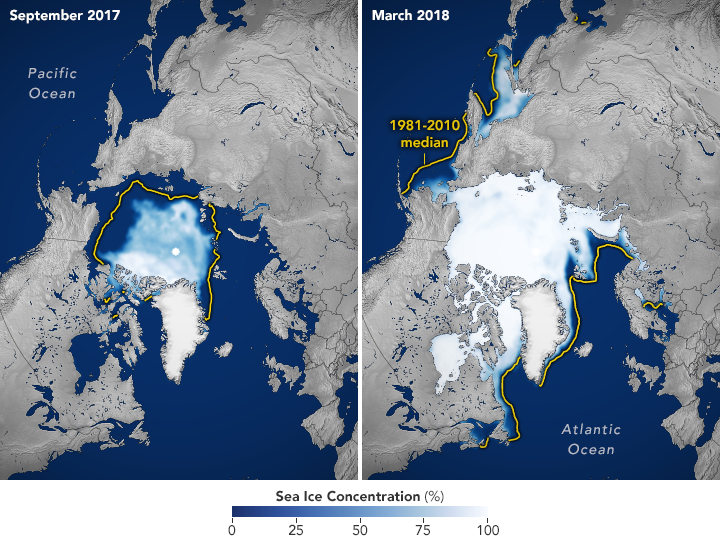
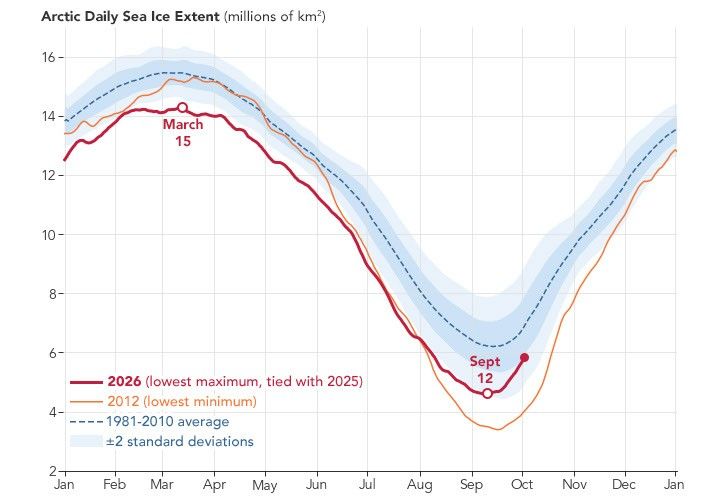
Sea ice in 2026 reached its annual minimum extent on September 12 (above), when it covered an estimated 4.6 million square kilometers (1.78 million square miles), according to NASA and the National Snow and Ice Data Center (NSIDC). That ties 2008, 2010, and 2025 for the 10th-lowest minimum in the satellite record.
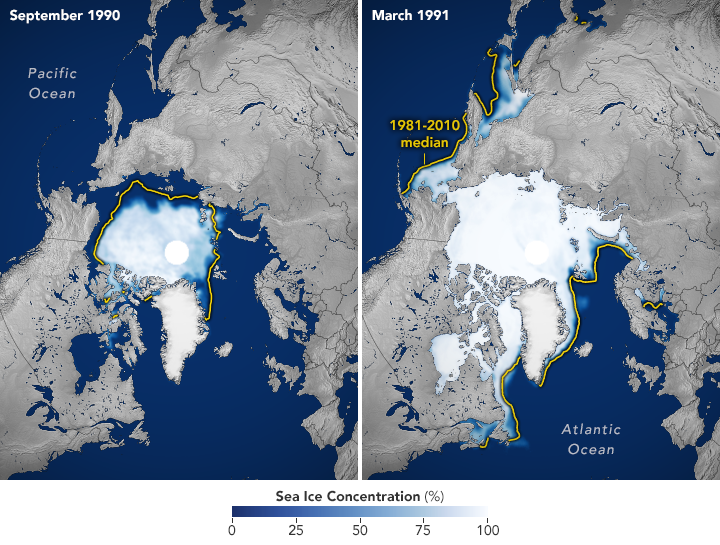
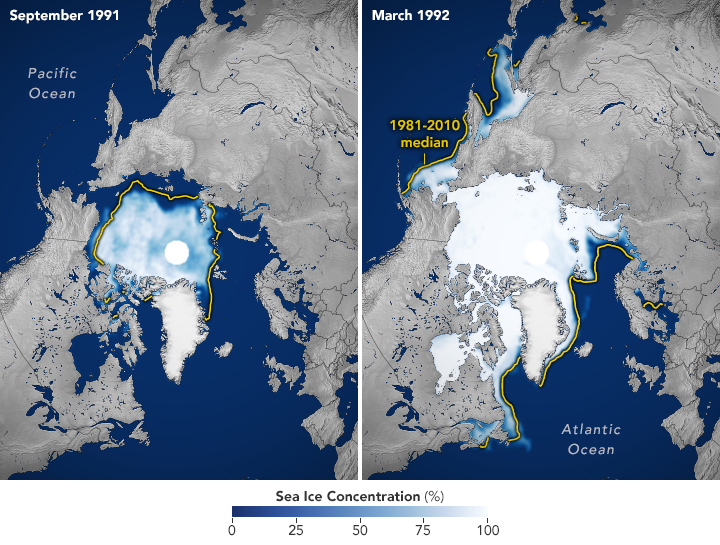
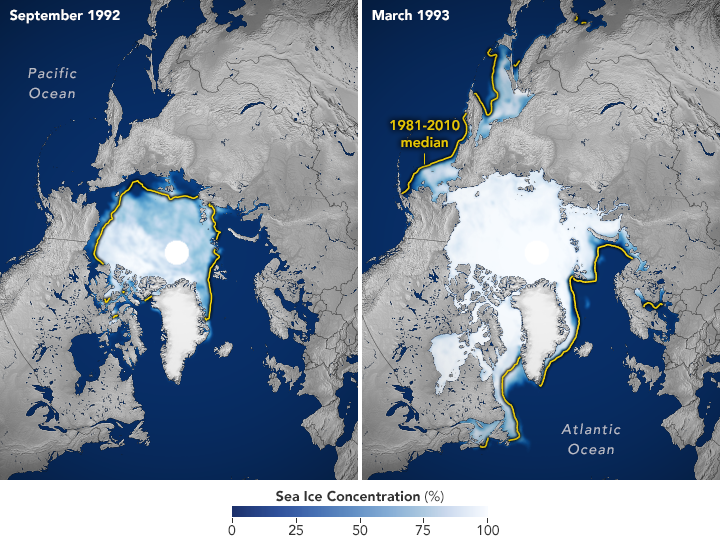
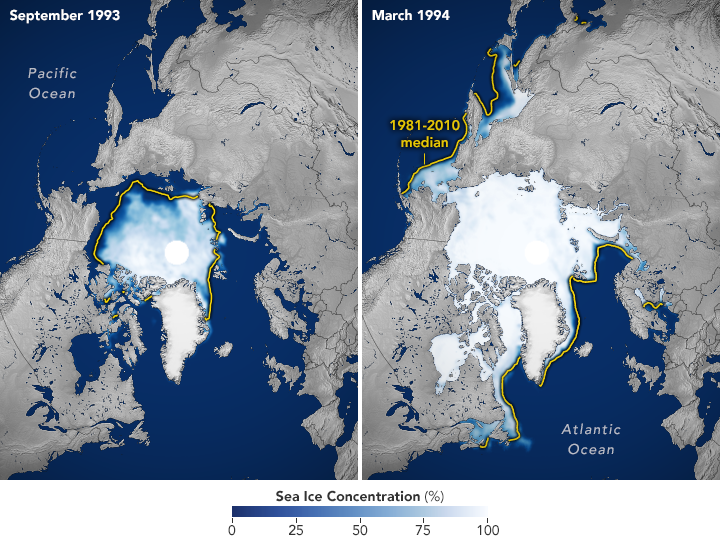
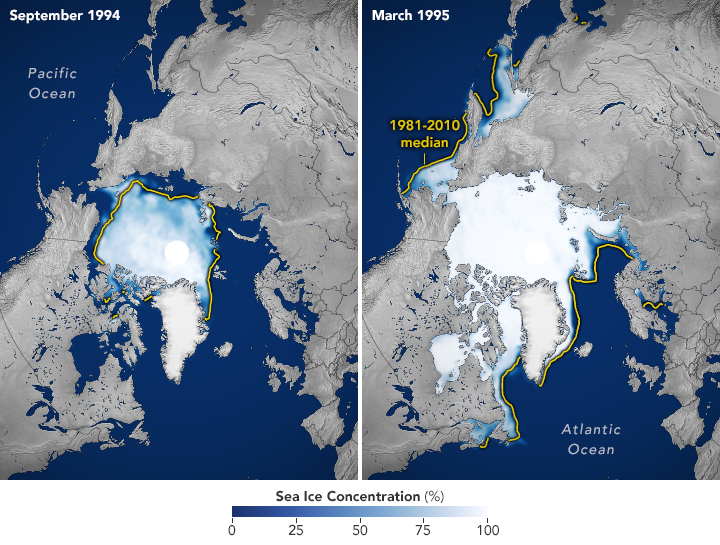
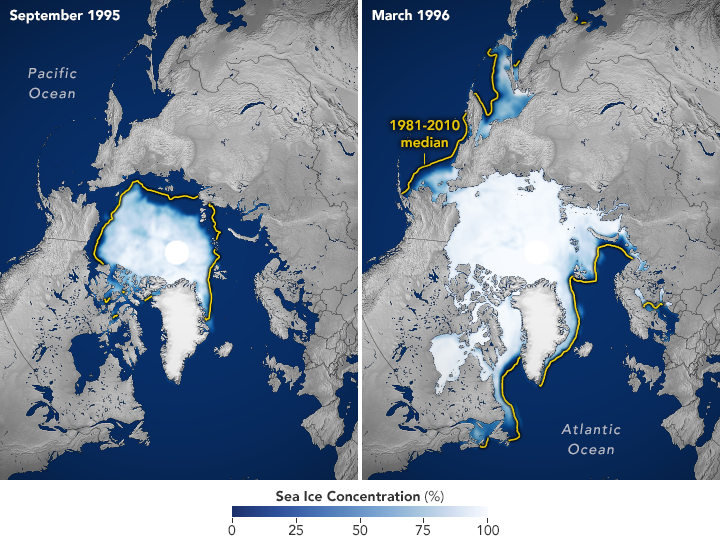
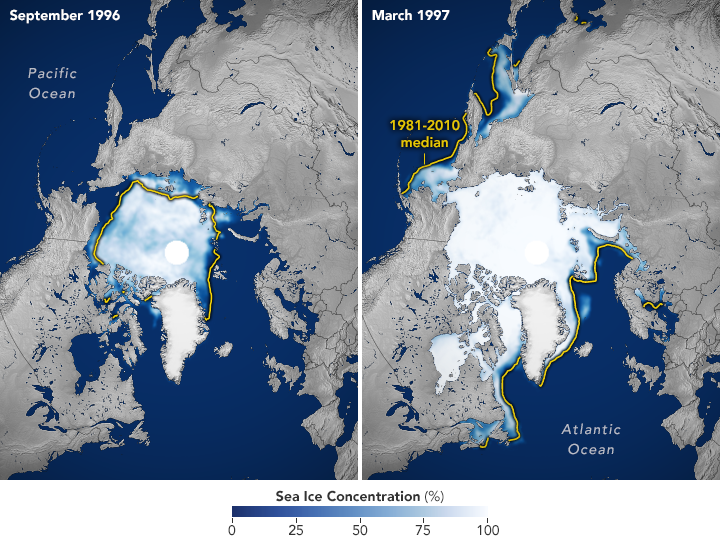
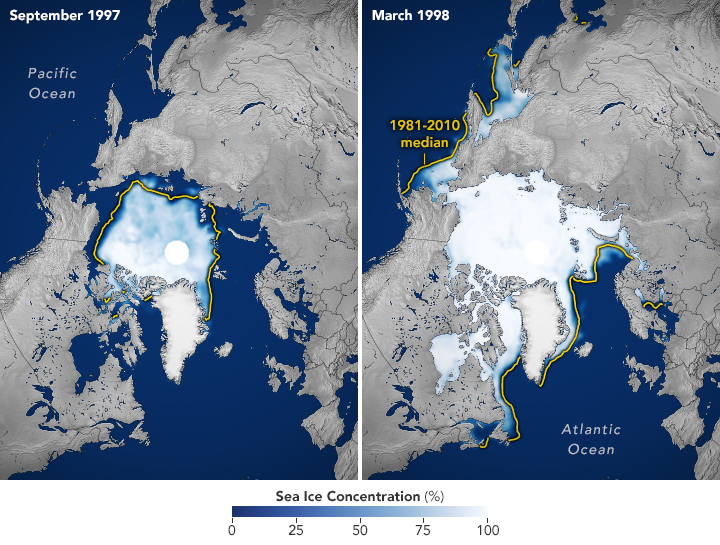
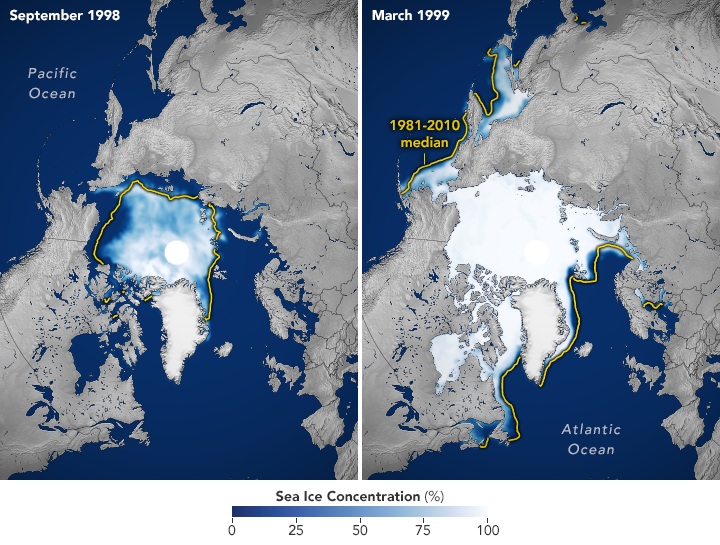
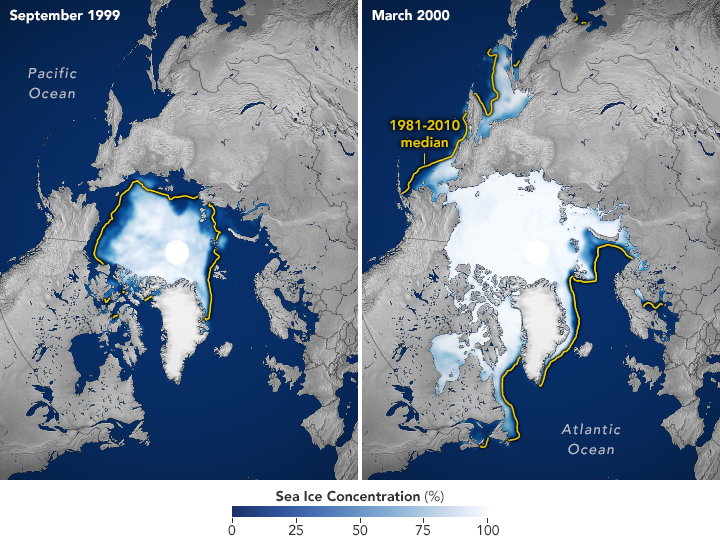
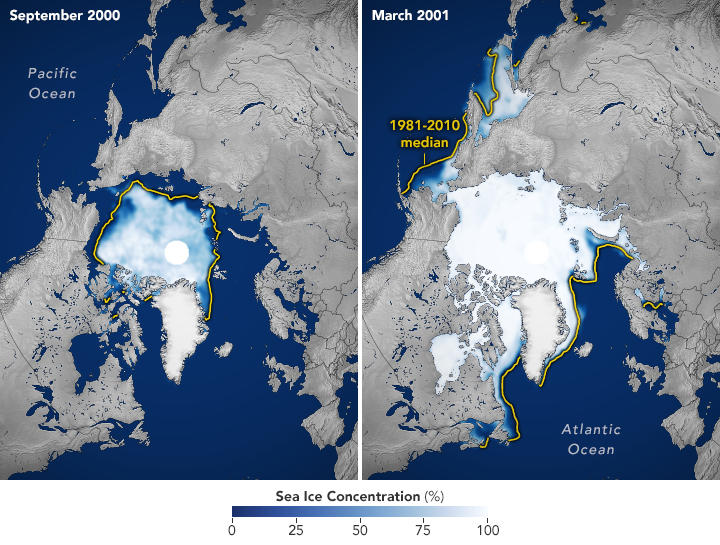
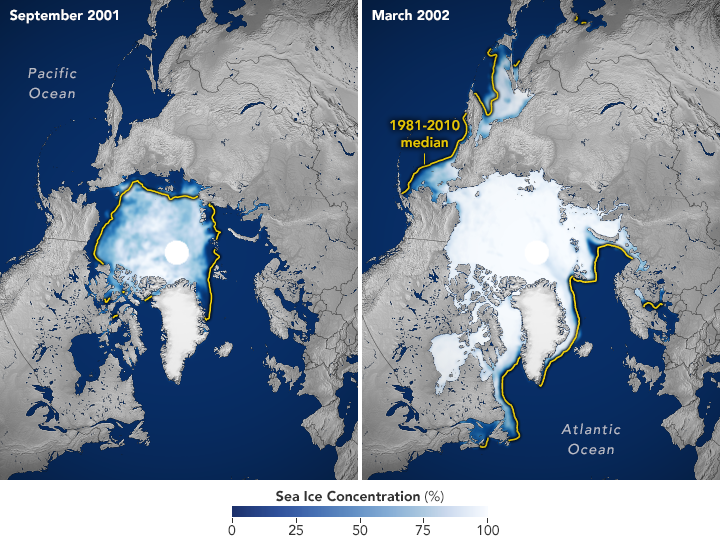
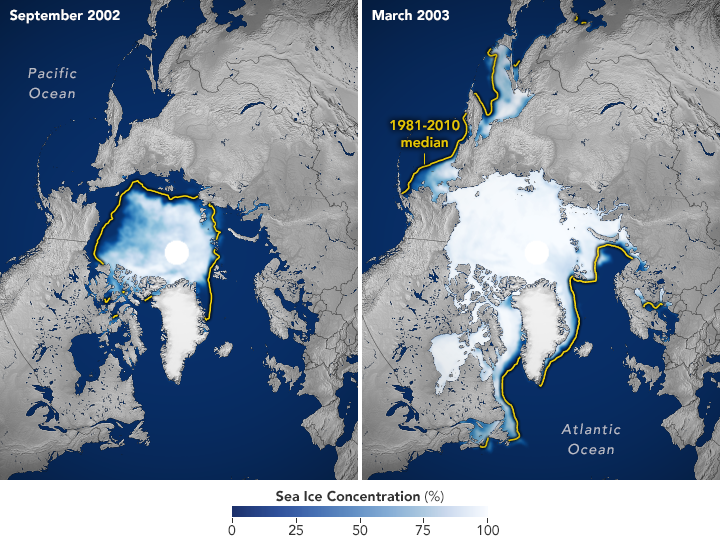
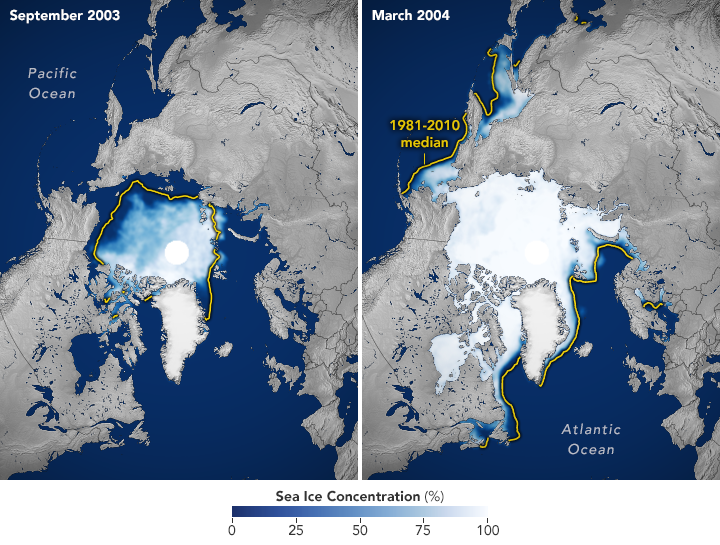
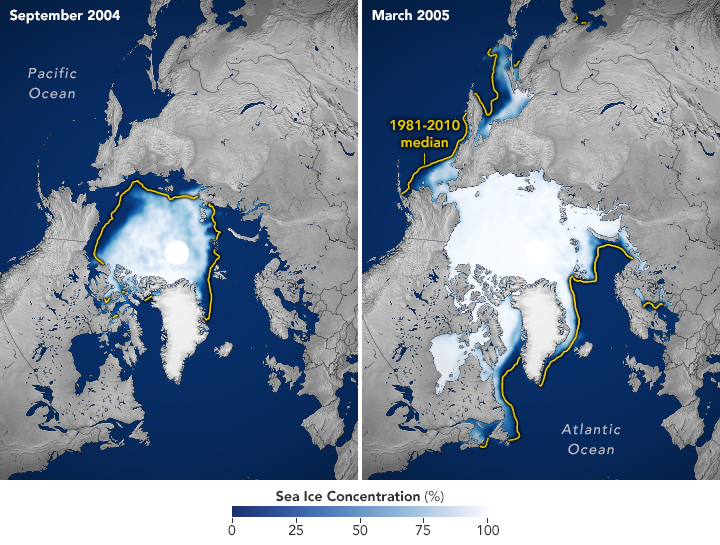
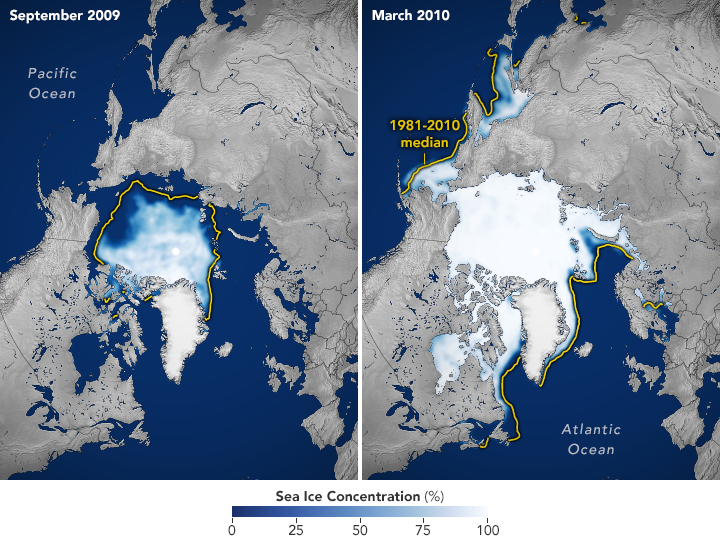
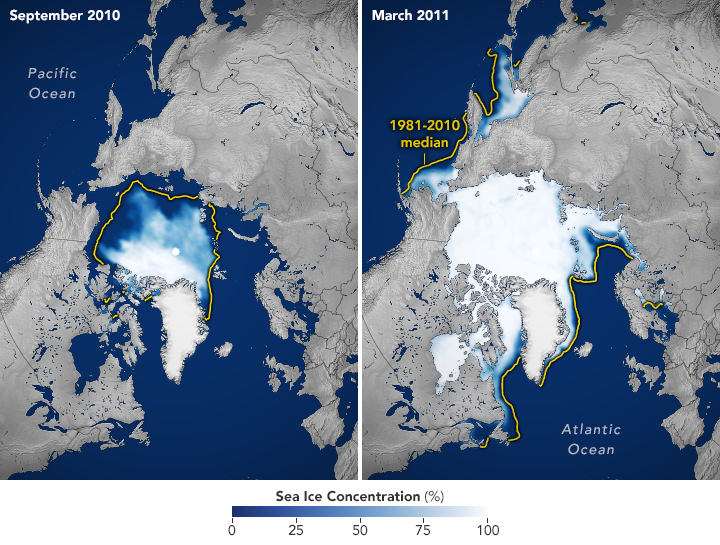
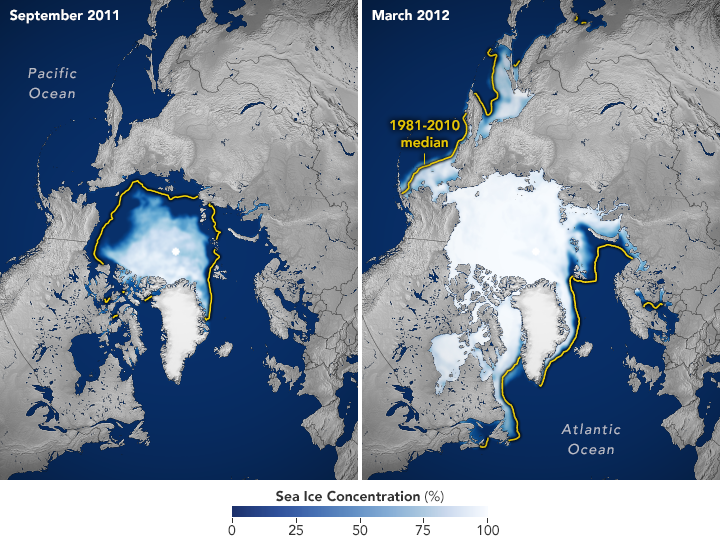
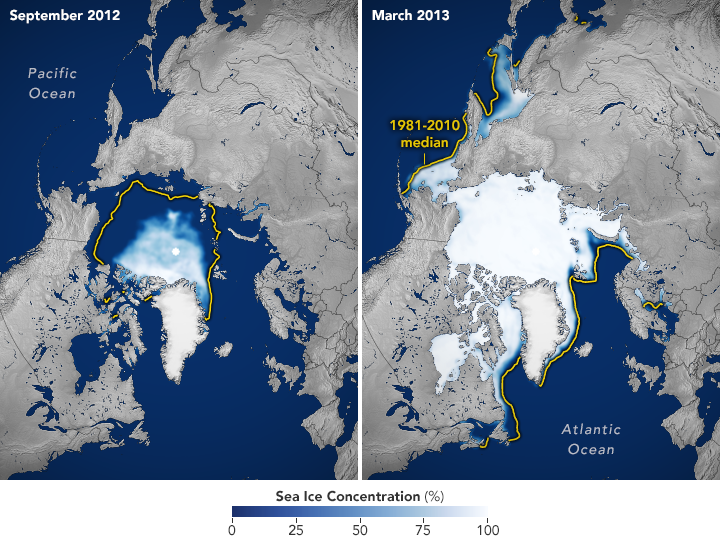
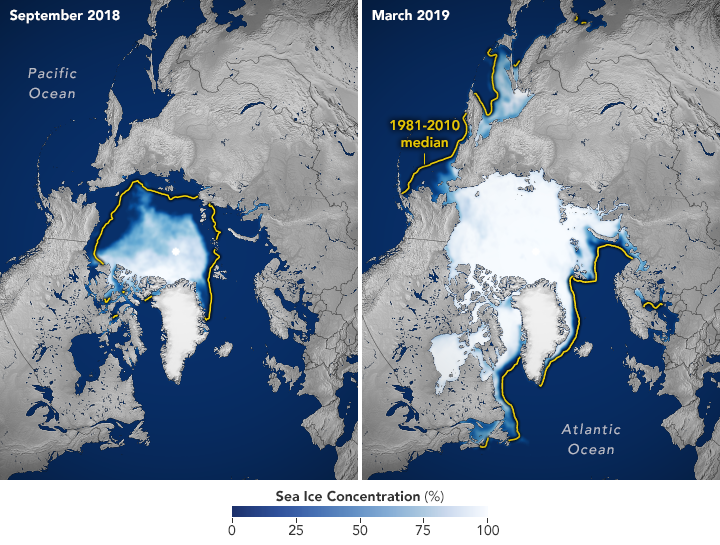
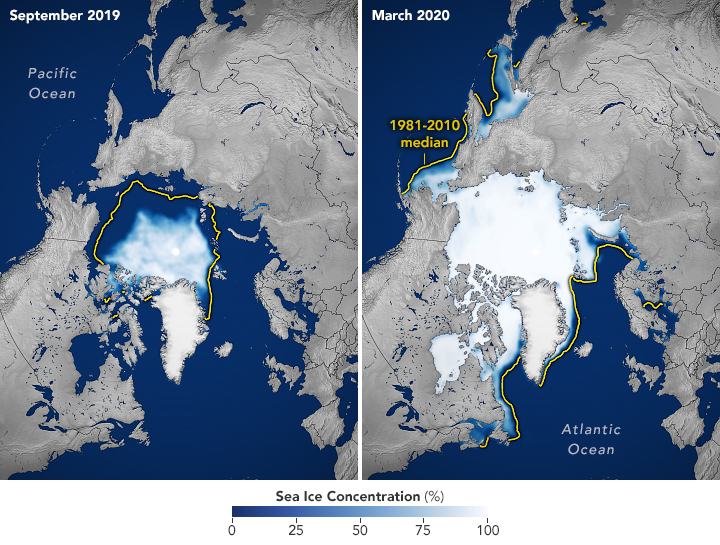
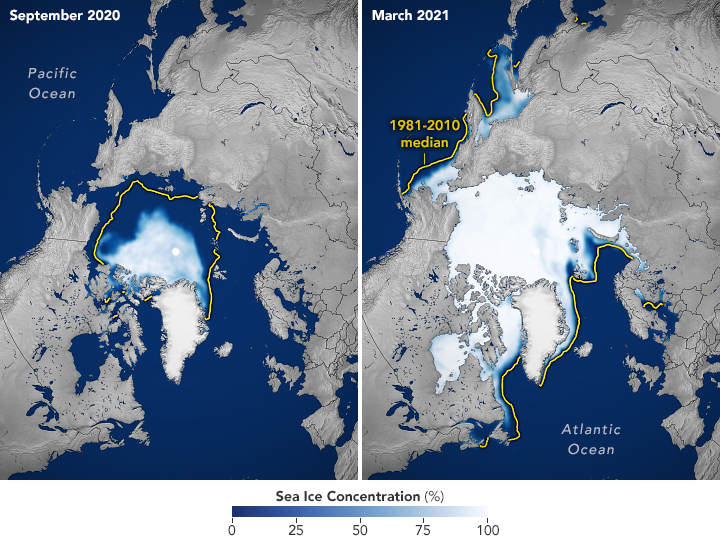
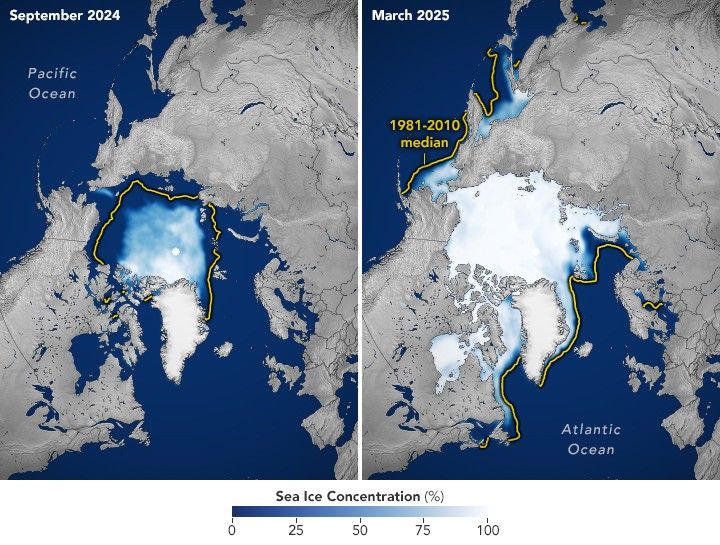
The maps below pair each September since 1990 (left), around the ice’s annual minimum, with the following March (right), near its annual maximum, through March 2026.
1990-1991
1991-1992
1992-1993
1993-1994
1994-1995
1995-1996
1996-1997
1997-1998
1998-1999
1999-2000
2000-2001
2001-2002
2002-2003
2003-2004
2004-2005
2005-2006
2006-2007
2007-2008
2008-2009
2009-2010
2010-2011
2011-2012
2012-2013
2013-2014
2014-2015
2015-2016
2016-2017
2017-2018
2018-2019
2019-2020
2020-2021
2021-2022
2022-2023
2023-2024
2024-2025
2025-2026
Lower Lows, Thinner Ice
Scientists have used satellites to observe the annual growth and retreat of Arctic sea ice continuously since late 1978. While sea ice extent has declined overall during that time, the downward trend steepened in the 2000s and set off a run of record and near-record lows. Each of the past 20 summers, from 2007 through 2026, ranks among the 20 lowest minimum extents in the satellite record. The lowest occurred in September 2012.
More recently, the September sea ice extent has been relatively steady. Weather can make a big difference in how much ice melts from one summer to the next. For example, over the past decade, increased cloud cover has prevented sunlight from accelerating the melt, according to NASA scientists. Despite this recent plateau, the summer minimum remains well below the long-term average.
Across the Arctic, the ice that remains is younger and thinner. Observations show a decline in multiyear ice—that which survives at least one melt season—leaving an Arctic dominated by thinner first-year ice. Winter ice is also shrinking. The March 2026 maximum statistically tied the 2025 maximum for the lowest in the satellite record.
Cycles of natural variability such as the Arctic Oscillation are known to play a role in Arctic sea ice extent, but the decline observed throughout the satellite record cannot be explained by natural variability alone. Natural variability and rising global temperatures have worked together to melt greater amounts of Arctic sea ice. Scientists have projected an essentially ice-free Arctic could occur at least once before the middle of the 21st century.
Seeing Through the Clouds
To determine sea ice extent, scientists rely on satellites with passive microwave sensors that measure the microwave energy Earth naturally emits. Sea ice emits more of this energy than open water, so it stands out in microwave images. Because microwaves pass through clouds, the satellites can observe sea ice regularly, regardless of weather.
The record began in 1978 with data collected by NASA’s Nimbus-7, followed by Defense Meteorological Satellite Program (DMSP) satellites starting in 1987 and NASA’s Aqua satellite between 2002 and 2011. Starting in 2025, scientists began using observations from the Japan Aerospace Exploration Agency’s GCOM-W satellite. The white circle at the center of each image is the “pole hole,” north of which satellite sensors have historically been unable to collect data. The sea ice estimates assume that this hole is ice-filled.
IPCC (2021) Summary for Policymakers. In: Climate Change 2021: The Physical Science Basis. Contribution of Working Group I to the Sixth Assessment Report of the Intergovernmental Panel on Climate Change. Accessed October 6, 2026.
NASA Earthdata (2026, October) Sea Ice. Accessed October 6, 2026.
Discover the cosmos! Each day a different image or photograph of our fascinating universe is featured, along with a brief explanation written by a professional astronomer.
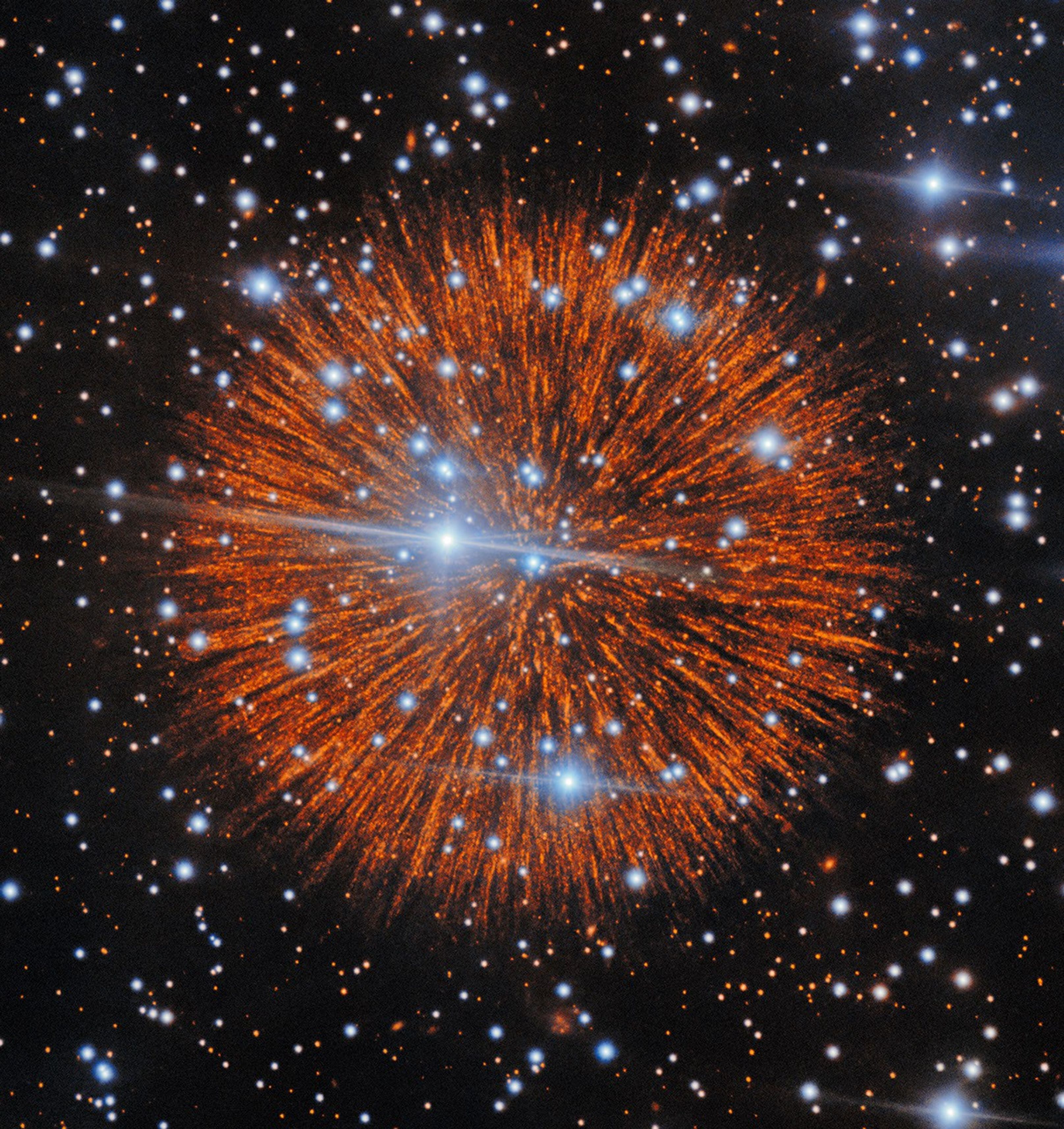
Supernova Remnant Pa 30
Explanation: “Happy New Year!” No, wait, this is not a fireworks display. This image shows Nebula Pa 30, observed with the Gemini North Telescope in Hawai’i. It is likely the remnant of an old supernova explosion: separate historical records by Chinese, Japanese and Arabic astronomers tell of a “guest star” that appeared in the sky for 185 days in the year 1181. It is believed that this bright new point of light came from the supernova that caused the fireworks in Pa 30. Astronomers don’t know exactly what happened in this unusual explosion, classified as a Type Iax supernova, but it is thought to be caused by the merger of two white dwarfs. The mysterious central star in the image is extremely hot and produces a strong wind, possibly forming the radial filaments. Look closely at them: those pearl-like knots stringing the filaments are 4 light-days in diameter. Understanding how a supernova created this amazing nebula continues an 845-year old mystery (and counting).
Preparations for Next Moonwalk Simulations Underway (and Underwater)
Artist’s rendering of the lunar South Pole region. Glowing points of light scattered across the lunar surface represent surface assets supporting sustained human and robotic operations near the South Pole.
NASA
As an astronaut traverses the lunar South Pole, tribocharging from walking on the lunar surface and plasma charging from the ambient plasma generate electric charge on the spacesuit. This problem is severely compounded when entering lunar shadows and Permanently Shadowed Regions (PSRs). In these dark zones, the spacesuit can buildup a substantial negative potential due to a lack of ambient ion flux and the absence of photoelectron emission to balance ambient electron collection.
The risk occurs when an astronaut returns to the spacecraft. Because the lunar surface lacks a natural environmental mechanism to bleed the charge accumulated on spacesuit away, the astronaut may become a walking, high voltage capacitor.
In the sunlit region, the stationary lander will hold slightly positive electrical potential. When a highly negatively-charged astronaut approaches the vehicle, the extreme voltage differential can trigger electrostatic discharge (an instantaneous electrical arc, or a spark) during physical contact. A rapid discharge from the astronaut to the lander risks degrading vital suit layers, damaging sensitive suit electronics, threatening the oxygen-rich environment inside the suit, and delivering dangerous electrical shocks to the crew.
Through the Lunar Grounding Challenge, NASA is seeking innovative designs and operational solutions to provide a lunar bringing to equilibrium capability to safely discharge a suited astronaut from high triboelectric charge buildup during lunar surface EVAs in the South Pole. This challenge seeks innovative concepts for an Electrostatic Discharge (ESD) mitigation solution to neutralize the astronaut in a safe and timely manner under this extreme charge differential before astronauts directly interact with the lander.
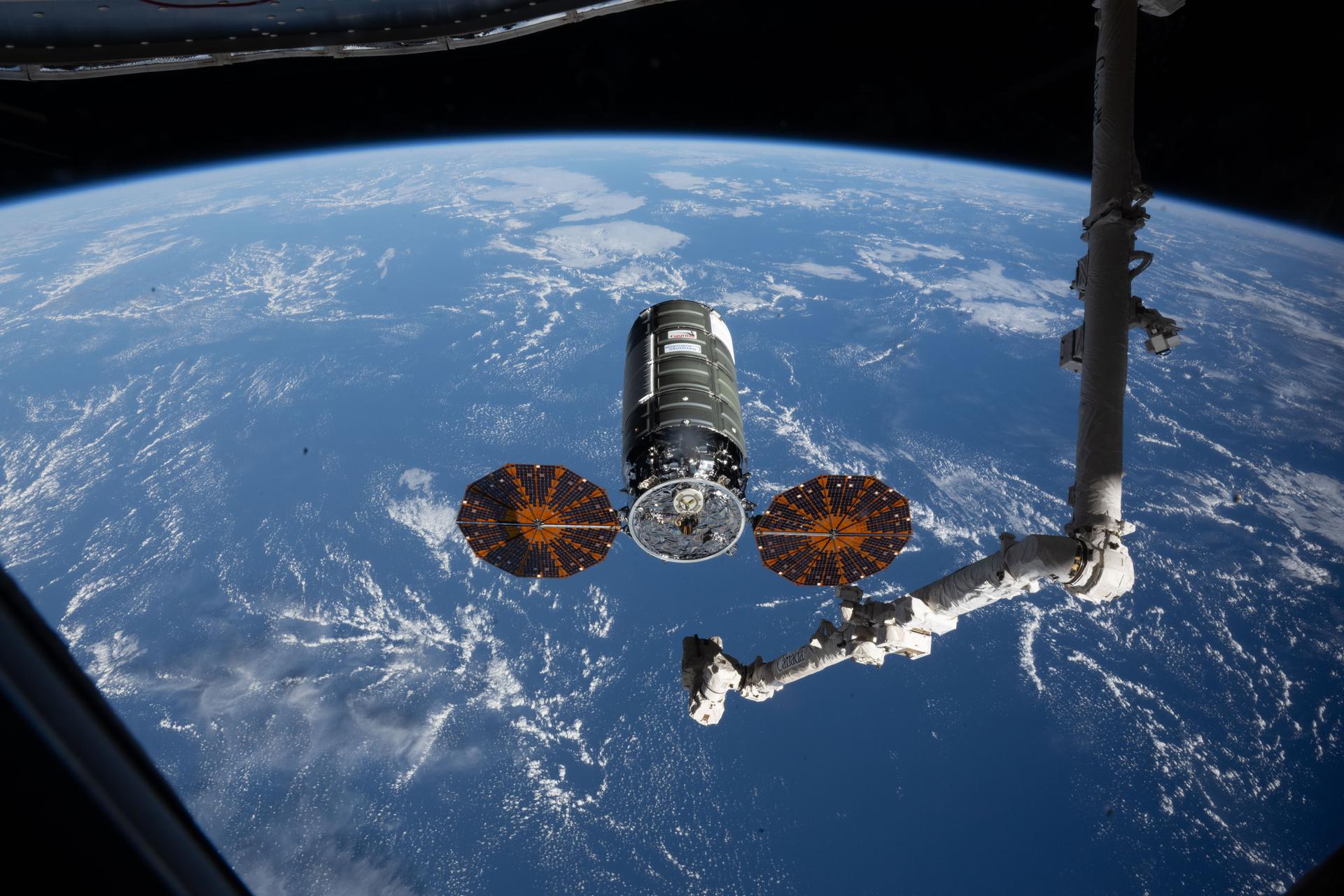
Northrop Grumman’s Cygnus XL cargo spacecraft rests at its capture point on April 13, 2026, 12 meters from the International Space Station, as the Canadarm2 robotic arm prepares to grapple the resupply ship.
Credit: NASA/Jessica Meir
After delivering more than 11,000 pounds of supplies, science experiments, and other cargo to the International Space Station for NASA, Northrop Grumman’s Cygnus XL spacecraft is scheduled to depart Friday, Oct. 9, as part of the company’s Commercial Resupply Services-24 mission, or Northrop Grumman CRS-24.
Watch NASA’s live coverage of undocking and departure beginning at 12:30 p.m. EDT through a variety of platforms. Learn where to watch online:
Flight controllers on the ground will send commands for the space station’s Canadarm2 robotic arm to detach the Cygnus XL spacecraft from the Unity module’s Earth-facing port and maneuver it into position for release at 12:45 p.m. NASA astronaut Luke Delaney will monitor the operation from aboard the orbital complex.
Loaded with thousands of pounds of disposal items and other unneeded cargo, Cygnus XL will deorbit Sunday, Oct. 11, for a destructive re-entry into Earth’s atmosphere, where it will safely burn up. NASA will not provide coverage of the spacecraft’s deorbit.
The resupply spacecraft launched on April 11 on a SpaceX Falcon 9 rocket from Space Launch Complex 40 at Cape Canaveral Space Force Station in Florida.
Learn more about this NASA commercial resupply mission at: