APOD: 2026 September 26 – Mirrored Meteor and Milky Way

APOD

Astronomy Picture of the Day

Discover the cosmos! Each day a different image or photograph of our fascinating universe is featured, along with a brief explanation written by a professional astronomer.

A large, segmented telescope mirror is seen against the night sky along with  the Milky Way and a bright meteor.

Mirrored Meteor and Milky Way

Explanation: On August 15, this perseid meteor streaked through night skies over the Observatorio del Roque de los Muchachos at La Palma, Canary Islands, Spain. The bright and colorful meteor trail was captured next to the central Milky Way, whose dark interstellar dust clouds and luminous starlight reach above the horizon. In the foreground of this tantalizing celestial scene is the 23 meter diameter mirror of the prototype Large-Sized Telescope (LST-1). LST-1 is the first telescope constructed at the northern hemisphere site of the innovative Cherenkov Telescope Array Observatory. With 198 hexagonal mirror segments and a large, high-efficiency, pixelized camera, LST-1 is designed to detect extremely brief, atmospheric visible light flashes. Lasting about a billionth of a second, the visible light flashes are triggered by energetic gamma-rays from cosmic sources such as distant active galaxies and gamma-ray bursts. Of course, on that night some individual mirror segments of LST-1 also reflected the atmospheric flash of the bright perseid meteor.

APOD’s email for image submissions has changed. Please see: APOD Submissions.
APOD’s main NASA site is moving: From apod.nasa.gov to science.nasa.gov/apod
Tomorrow’s picture: before and after

Date September 26, 2026
Credit & Copyright: Jeff Dai (TWAN)
Authors & editors: Jerry Bonnell, Cecilia Chirenti, Robert Nemiroff, Keighley Rockcliffe
A service of: ASD at NASA / GSFC,
NASA Science Activation & Michigan Tech. U.

Source: science.nasa.gov

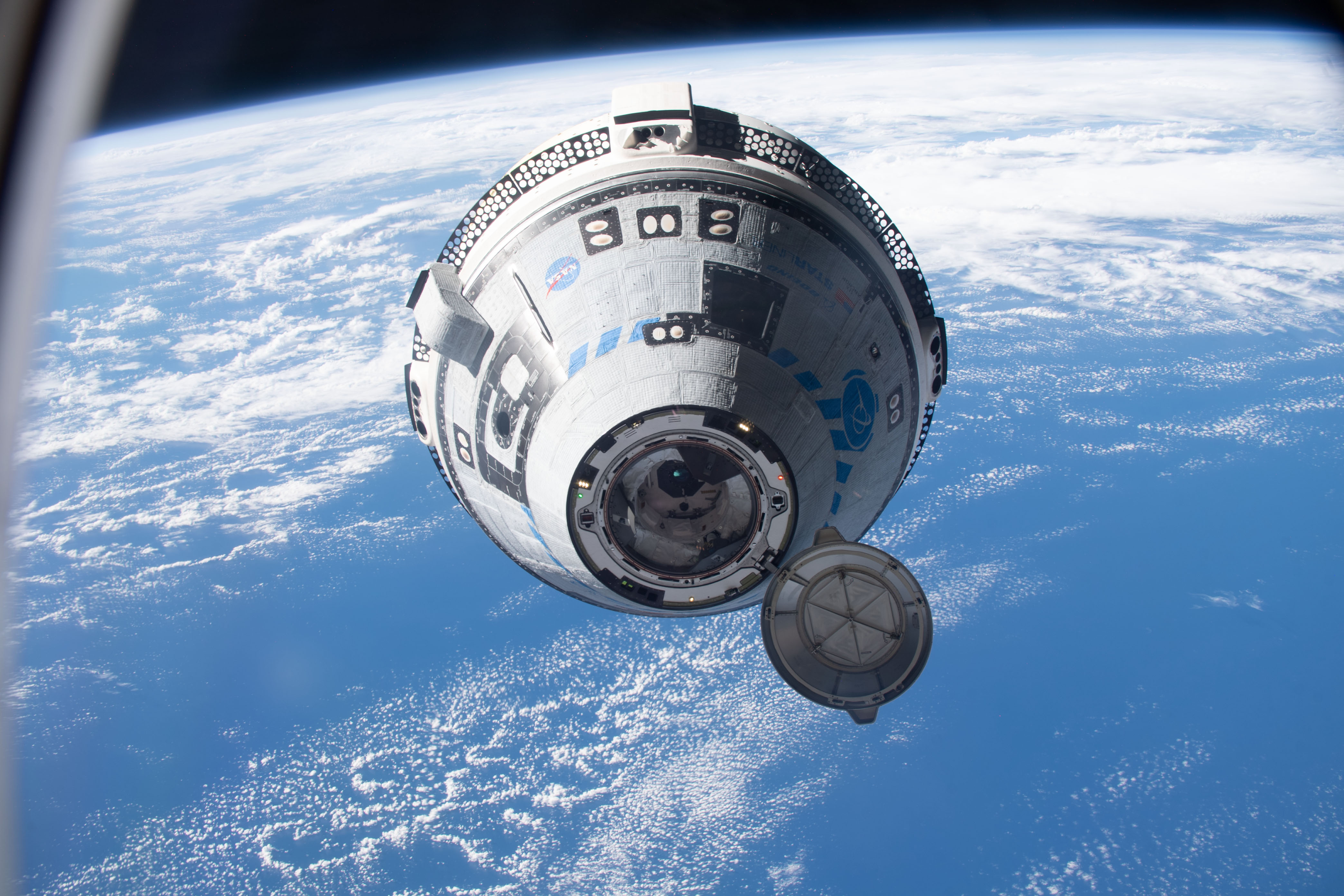
NASA, Boeing to Provide Update on Starliner Development

Boeing’s Starliner spacecraft that launched NASA’s Crew Flight Test astronauts Butch Wilmore and Suni Williams to the International Space Station is pictured docked to the Harmony module’s forward port.
Credit: NASA

During a news conference at 3 p.m. EDT on Monday, Sept. 28, NASA and Boeing leadership will discuss Starliner’s development and plans for regular crew flights to and from the International Space Station.

Learn where to watch online:

https://www.nasa.gov/live

The briefing participants include:

  • NASA Administrator Jared Isaacman
  • Dana Weigel, manager, NASA’s Low Earth Orbit Program
  • Woody Hoburg, NASA astronaut
  • John Mulholland, vice president and program manager, Boeing Commercial Crew

Media already credentialed for Crew-13 may participate in person at NASA’s Kennedy Space Center in Florida. To ask questions, media must request the dial-in number from the Kennedy newsroom by emailing: [email protected] no later than one hour prior to the start of the call. A copy of NASA’s media accreditation policy is online.

For NASA’s blog and more information about the agency’s missions, visit:

https://www.nasa.gov

-end-

George Alderman / Joshua Finch
Headquarters, Washington
202-358-1600
[email protected] / [email protected]

Source: www.nasa.gov

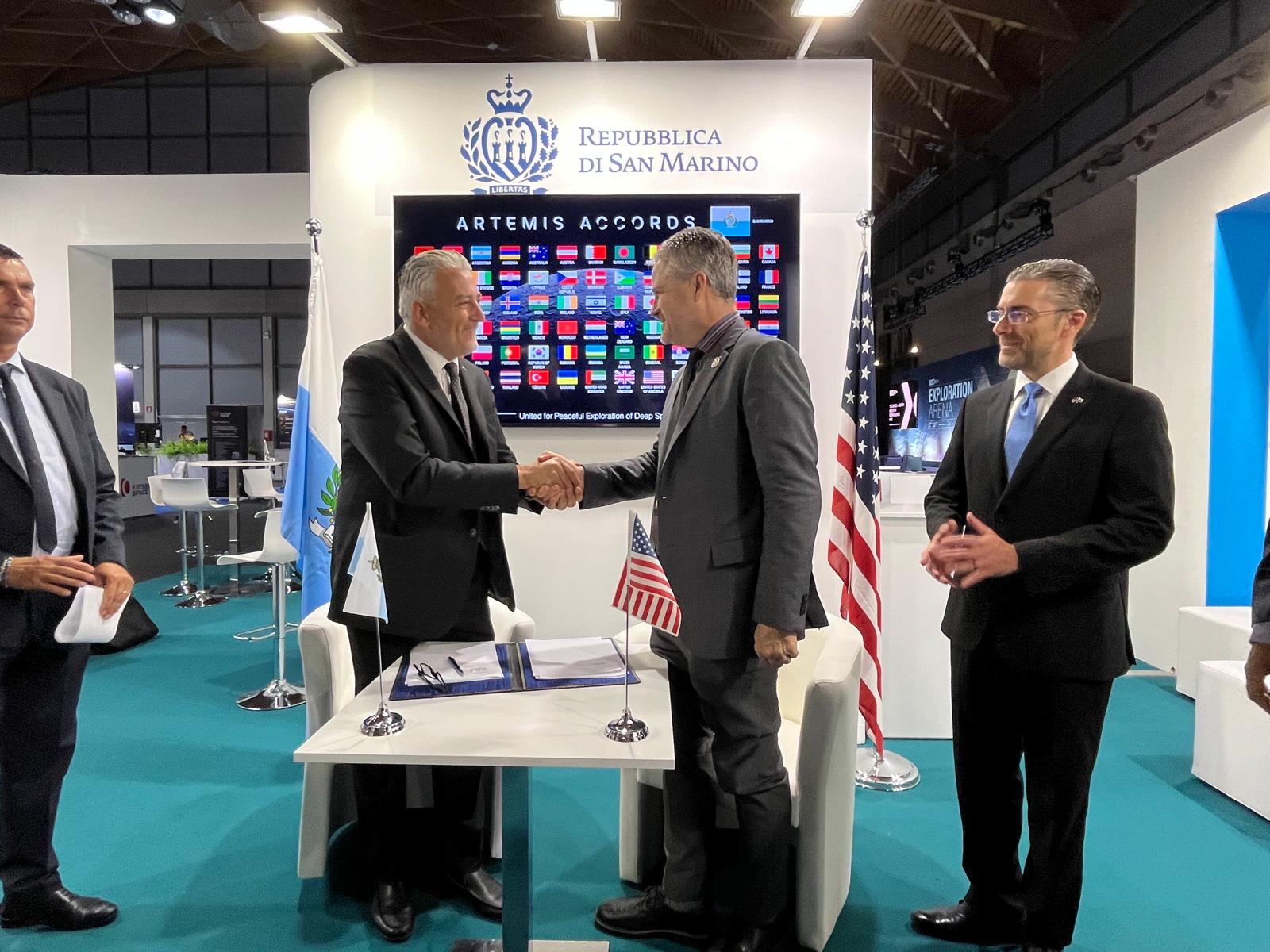
NASA Welcomes San Marino Signing the Artemis Accords  

Minister of Industry and Technological Research Rossano Fabbri signed on behalf of San Marino. Gregory Mann, NASA Europe representative, and U.S. Consul General in Florence Joseph Tordella participated in the event on Friday, Sept. 25, 2026.
Credit: U.S. Department of State

The Republic of San Marino became the 76th signatory to the Artemis Accords during a ceremony in the city of Rimini on Friday with NASA and U.S. Department of State officials present.  

“San Marino joins a growing coalition of like-minded nations committed to the peaceful, transparent, and responsible exploration of space,” said NASA Deputy Administrator Matt Anderson. “President Trump has directed NASA to build a Moon Base and establish an enduring presence on the lunar surface. As we do, we are putting the principles of the Accords into practice. NASA has invited every Artemis Accords signatory to participate in our return to the Moon through scientific payloads, technology demonstrations, CubeSats, and other capabilities. San Marino is already looking toward that future.” 

Minister of Industry and Technological Research Rossano Fabbri signed on behalf of San Marino. Gregory Mann, NASA Europe representative, participated in the ceremony with the U.S. Consul General in Florence Joseph Tordella.   

“We are pleased and honored that the Republic of San Marino has been welcomed as the 76th signatory state of the Artemis Accords,” said Fabbri. “We fully share the principles and values expressed in the Artemis Accords, and we are convinced that the signatory states united under the Accords will make a tangible contribution to promoting international cooperation in space and ensuring the use of space for peaceful purposes.” 

In 2020, NASA and the State Department joined with seven other founding nations to establish the Artemis Accords, responding to the growing interest in lunar activities by both governments and private companies. They introduced the first set of practical principles aimed at enhancing the safety and coordination between nations as they explore the Moon, Mars, and beyond, committing nations to: 

  • Explore peaceably and transparently 
  • Render aid to those in need 
  • Enable access to scientific data 
  • Ensure activities do not interfere with those of others 
  • Preserve historically significant sites and artifacts by developing best practices 

By signing the Artemis Accords, nations open the door to opportunities for future lunar exploration with NASA, advancing humanity’s return to the Moon, and shaping the Golden Age of exploration and innovation. 

Learn more about the Artemis Accords at:

https://www.nasa.gov/artemis-accords

Source: www.nasa.gov

NASA Shares SpaceX Crew-14 Assignments for Space Station Mission

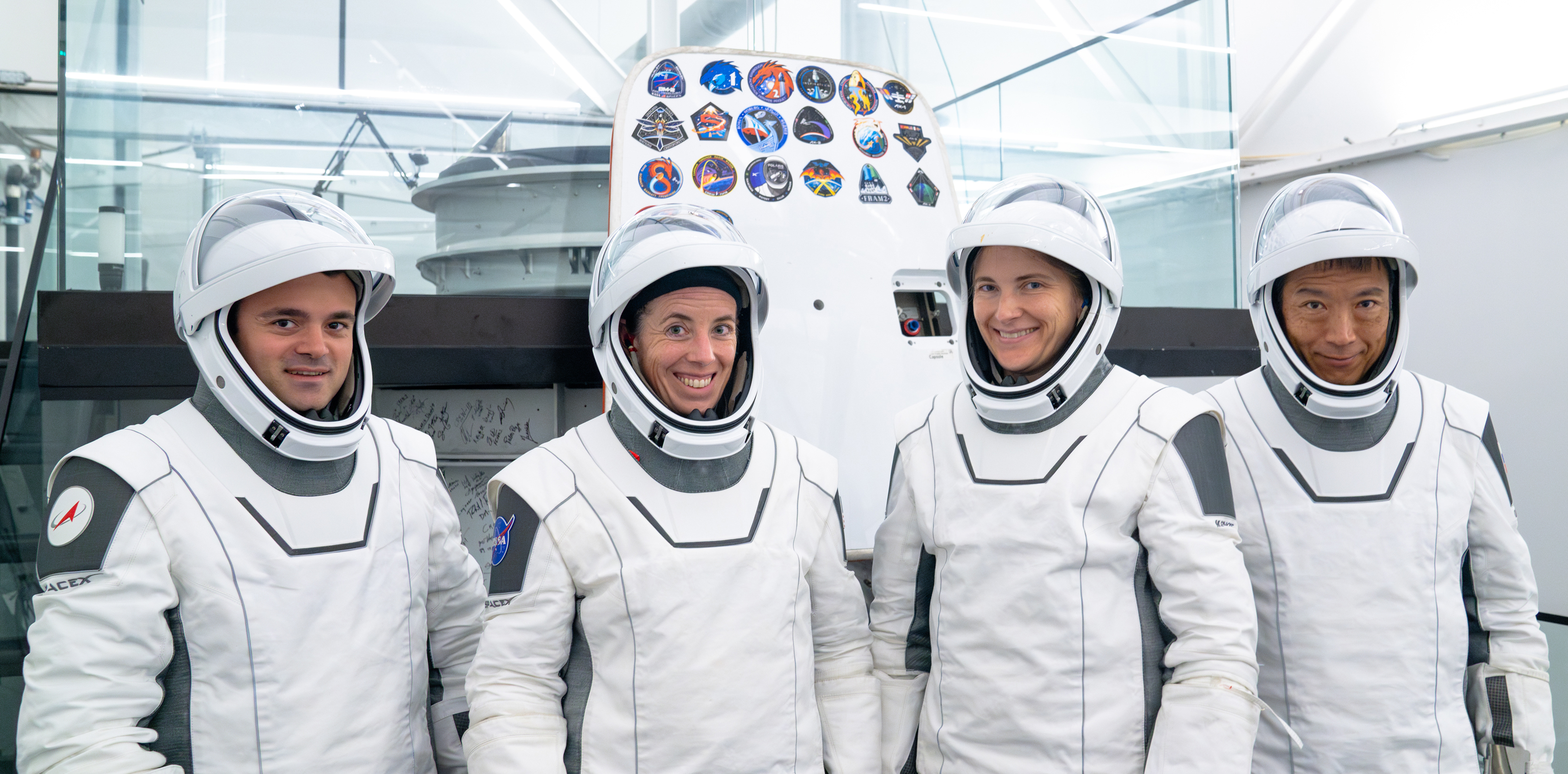
NASA’s SpaceX Crew-14 crew members during preflight training at SpaceX’s facility in Hawthorne, California (from left, Roscosmos cosmonaut Arutyun Kiviryan, NASA astronaut Chris Birch, NASA astronaut Kayla Barron, and JAXA (Japan Aerospace Exploration Agency) astronaut Makoto Suwa).
Credit: SpaceX

Four crew members from three space agencies will launch to the International Space Station no earlier than spring 2027 for a long-duration science expedition as part of NASA’s SpaceX Crew-14 mission.

NASA astronauts Kayla Barron and Chris Birch will serve as spacecraft commander and pilot, with JAXA (Japan Aerospace Exploration Agency) astronaut Makoto Suwa, and Roscosmos cosmonaut Arutyun Kiviryan as mission specialists. After docking, Crew-14 will join the space station’s Expedition 75/76.

This mission is the 14th commercial crew rotation with SpaceX under NASA’s Low Earth Orbit Program. The crew will conduct scientific investigations and technology demonstrations to help prepare humans for future exploration missions to the Moon and Mars and to benefit people on Earth.

This will be Barron’s second flight to the space station. She was selected as a NASA astronaut in 2017. Barron earned a bachelor’s degree in systems engineering from the U.S. Naval Academy in Annapolis, Maryland and a master’s degree in nuclear engineering from the University of Cambridge in England. A commander in the U.S. Navy, Barron earned her submarine warfare officer qualification, deploying three times aboard the USS Maine. She first launched to the space station in 2021 aboard NASA’s SpaceX Crew-3 mission, spending a total of 177 days in space across space station Expeditions 66/67. She completed two spacewalks and served as lead robotics operator for another. Most recently, Barron supported the development of new technologies and operational concepts for NASA’s Artemis program.

Selected as a NASA astronaut in 2021, Birch graduated from the University of Arizona in Tucson with degrees in mathematics and biochemistry and molecular biophysics. She earned a doctorate in biological engineering from the Massachusetts Institute of Technology, and later taught bioengineering at the University of California, Riverside, and scientific writing and communication at the California Institute of Technology in Pasadena. Birch competed as a decorated track cyclist on the U.S. National Team and was named to the Olympic Long Team for the 2020 Tokyo Games. She has served as a capsule communicator, supporting crews aboard the space station and during the Artemis II mission. Birch was crew lead for Expedition 72, working with flight control teams to help manage daily operations, and served as a crew representative for NASA’s Orion Program, supporting Artemis II mission development and operations. This will be her first spaceflight.

The Crew-14 mission also is the first spaceflight assignment for Suwa. Before JAXA selected him as an astronaut candidate in 2023, Suwa spent nearly a decade with the World Bank Group. Previously, he served in Rwanda as a Japan Overseas Cooperation Volunteer before joining the United Nations World Meteorological Organization. Suwa holds a doctorate in geosciences from Princeton University and completed basic training to become certified as an astronaut in 2024.

This mission will be Kiviryan’s first trip to the space station. He graduated from Saint Petersburg Suvorov Military School in 2010 and later studied at the Baltic State Technical University. He graduated in 2015 as an engineer specializing in rocket science and completed training in the operation of computer-controlled machines. Kiviryan was selected for the Gagarin Research and Test Cosmonaut Training Center Cosmonaut Corps in 2021 and has served as a test cosmonaut since 2023.  

For more than 25 years, people have lived and worked continuously aboard the International Space Station, advancing scientific knowledge and making research breakthroughs that aren’t possible on Earth. The space station helps NASA understand and overcome the challenges of human spaceflight, expand commercial opportunities in low Earth orbit, and build on the foundation for long-duration missions to the Moon, as part of the Artemis program, and to Mars.

Learn more about International Space Station research and operations at:

https://www.nasa.gov/station

-end-

Joshua Finch / Jimi Russell
Headquarters, Washington
202-358-1100
[email protected] / [email protected]

Anna Schneider / Mary Pfister
Johnson Space Center, Houston
281-483-5111
[email protected] / [email protected]

Details

Last Updated

Sep 24, 2026

Editor
Jennifer M. Dooren

Source: www.nasa.gov

APOD: 2026 September 25 – Globular Star Cluster Omega Centauri

APOD

Astronomy Picture of the Day

Discover the cosmos! Each day a different image or photograph of our fascinating universe is featured, along with a brief explanation written by a professional astronomer.

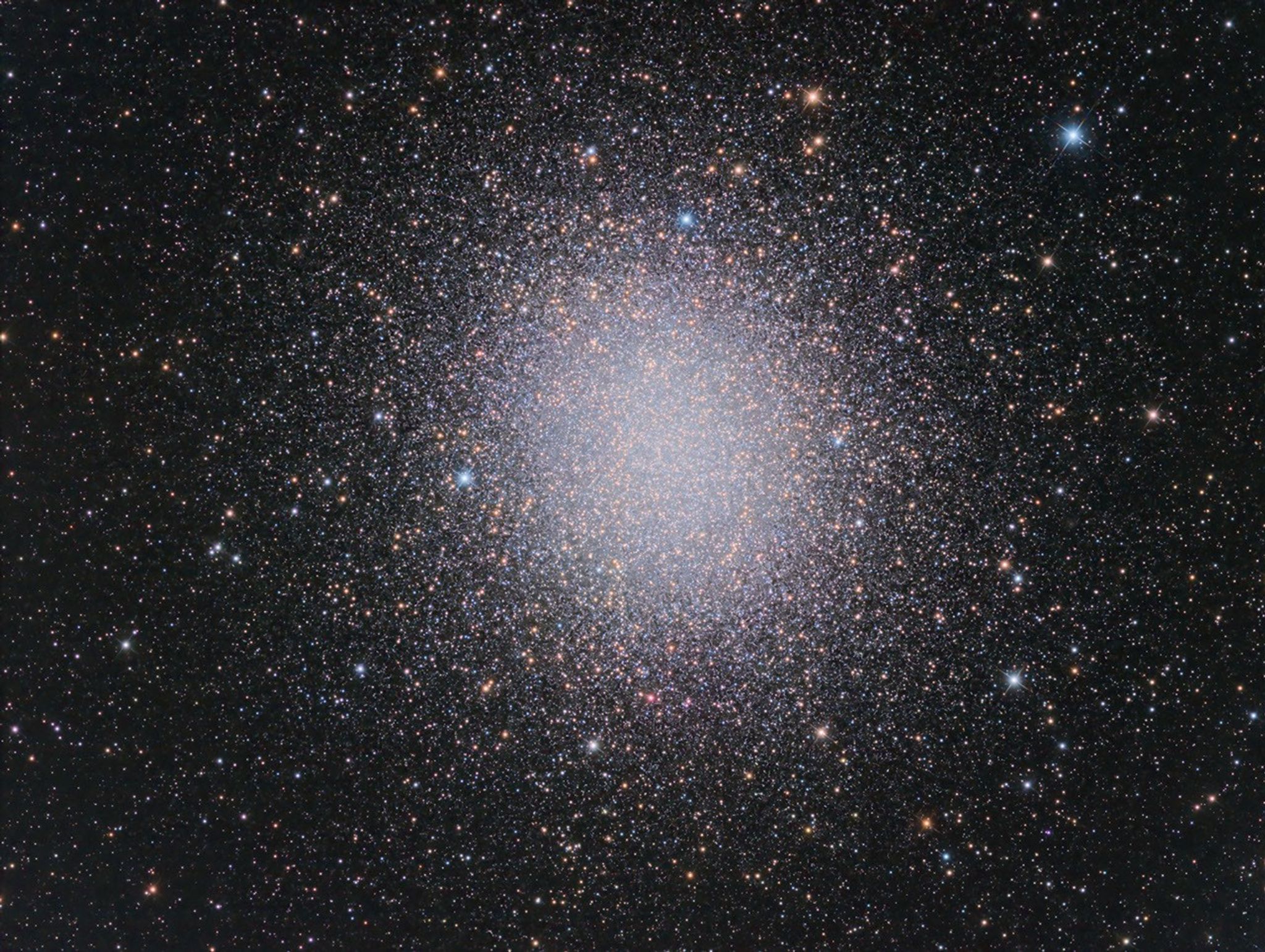
A dense globular cluster of stars.

Globular Cluster Omega Centauri

Explanation: Globular star cluster Omega Centauri packs about 10 million stars much older than the Sun into a volume some 150 light-years in diameter. Also known as NGC 5139, at a distance of 15,000 light-years it’s the largest and brightest of 200 or so known globular clusters that roam the halo of our Milky Way galaxy. Though most star clusters consist of stars with the same age and composition, the enigmatic Omega Cen exhibits the presence of different stellar populations with a spread of ages and chemical abundances. In fact, Omega Cen may be the remnant core of a small galaxy merging with the Milky Way. With a yellowish hue, Omega Centauri’s red giant stars are easy to pick out in this sharp telescopic view. A two-decade-long exploration of the dense star cluster with the Hubble Space Telescope has revealed evidence for a massive black hole near the center of Omega Centauri.

APOD’s email for image submissions has changed. Please see: APOD Submissions.
APOD’s main NASA site is moving: From apod.nasa.gov to science.nasa.gov/apod
Tomorrow’s picture: reflections on a starry night

Date September 25, 2026
Credit & Copyright: Javier O. Cadenas Parra
Authors & editors: Jerry Bonnell, Cecilia Chirenti, Robert Nemiroff, Keighley Rockcliffe
A service of: ASD at NASA / GSFC,
NASA Science Activation & Michigan Tech. U.

Source: science.nasa.gov

TB 26-07 Aluminum Alloy 2219 Material Guidance

For more information, contact Donald S. Parker, Kennedy Space Center, [email protected]

Download the PDF version

Improper casting and forging processes in the manufacture of aluminum alloy 2219 can lead to microstructural defects that result in a sub-optimal response to anodic surface treatments and an increase in corrosion susceptibility. This Technical Bulletin communicates the risks of improper casting and recommends a homogenizing step followed by multidirectional deformation after conventional direct chill casting, especially for larger castings. 09/24/26 DOC ID: 20260008373

Background
Aluminum 2219 is an age-hardenable, over-saturated, aluminum-copper alloy developed by Aluminum Company of America (Alcoa) in 1954, for service up to 600 °F. Numerous aerospace applications include launch and space vehicles including space shuttle fuel tanks, and International Space Station human-rated pressurized modules. It has excellent cryogenic properties, weldability, workability, and mechanical properties at low and high temperatures [1].

Problem/Issue Description
Casting 2219 aluminum alloy ingots is a specialized process used to manufacture large-scale structures that are subsequently forged or rolled into final product forms. The as-cast ingot internal defects may include disparate grain sizes, macrosegregation of alloying elements, and residual banded and clustered copper-rich intermetallics, which can lead to unsatisfactory mechanical and corrosion properties including low ductility, low strength, and a non-uniform distribution of material properties in the final product form. [2,11,12]

These defects can be somewhat mitigated with post-casting processes, including mechanical deformation, solution treatment, quenching, and aging. However, if ingots already possess unrecoverable discontinuities such as interdendritic segregation, banded and clustered large copper intermetallics, and disparate grain sizes, no subsequent thermos-mechanical processing will remedy the deficiencies in properties, especially for larger ingot sizes.

Homogenization as an Essential Step
Homogenization after casting greatly improves the final properties’ subsequent mechanical processing. Studies show that Fick’s laws of diffusion drive the highly concentrated copper atoms out of the interdendritic boundary zones, distributing them evenly across the aluminum matrix grains; residual phases are dissolved into the matrix, and degree of segregation of all elements reduces dramatically. Homogenization processing parameters need to be optimized for ingot cross-section thickness to ensure proper and uniform thermal response. Wang et al., who focused on homogenization, effectively used a temperature and time of 535 °C for 10 hours [3].

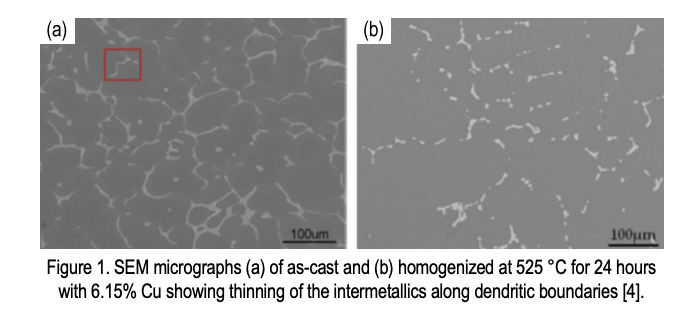
Homogenization optimization variables include the melting point, amount and dissolution rate of the eutectic phase, ingot size, grain size and copper content. Several researchers demonstrated that tools such as X-ray Diffraction (XRD) or Differential Scanning Calorimetry (DSC) are valuable tools for defining and verifying the homogenization step [3,4,5,6,7,8,9]. Improvement of microstructure and mechanical properties of homogenized aluminum 2219 is well documented. Scanning Electron Microscope (SEM) images from a study examining aluminum 2219 with varying amounts of copper show change in the morphology of grain boundaries after homogenizing in Figure 1.

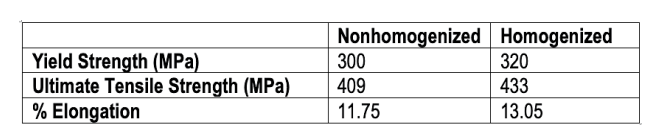
The table below lists the results of Wang et al. who examined nonhomogenized and homogenized 2219, which were forged and treated to the T6 temper. The homogenized 2219 is clearly superior [3].

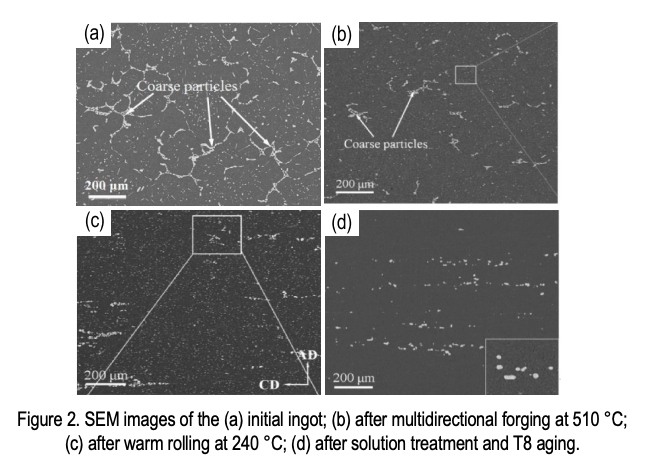
Thermomechanical Deformation Mechanical deformation such as forging — specifically, upset forging — and rolling, followed by solution treatment and aging, have been shown to drastically improve the aluminum 2219 microstructure by creating well distributed smaller-sized Al2Cu particles and significantly smaller grains leading to improved and less anisotropic mechanical properties. In one example of many studies, superior mechanical and microstructural properties were developed with a higher temperature multidirectional forging at 510 °C followed by warm rolling at 240 °C.

The upset forging and rolling followed by solution treatment and aging led to significantly reduced area fraction of coarse Al2Cu particles (5.5% to 1.0%) due to dissolution into the matrix. Grain size was reduced (230 micrometers to 58.6 micrometers) through increased storage energy and nucleation from the lower temperature rolling. Lastly, a uniformly distributed θ’ phase was increased by 118%.  These changes in microstructure led to better strength, elongation and fracture properties[10].

Recommendation/Guidance
Homogenization after conventional direct chill casting is imperative to optimize the final properties of aluminum 2219 and should be explicitly included in procurement specifications. In addition, verification of effectiveness of the homogenization step is also recommended and could include before and after micrographs, DSC or XRD measurements. The initial micrographs are useful to verify a high-quality ingot. Multi-directional deformation is also important to aid fracturing of coarse particles, distribution of the Al2Cu and intermetallic phases, recrystallization, and nucleation of new grains leading to improved mechanical properties.

References
1. NASA-CR-74545

2. NASA-CR-123777

 3. Wang et al., Materials 2018, 11, 914.

4. Chen et al., Metals 2020, 10, 197.

5. Zhang et al., Journal of Materials Research and Technology 2023, 27, 7470.

6. Gupta et al., Canadian Metallurgical Quarterly, 2006, 45, No. 3.

7. Xu et al., Metals 2021, 11, 174.

8. Zhang et al., Advanced Engineering Materials, 2024, 26.

9. Lin et al., Materials 2023, 16, 433.

10. Zhang et al., Journal of Materials Research and Technology 2023, 22, 1136.

11. NASA-TM-20230018439 12. NASA-TM-20240000329

Source: www.nasa.gov

Hubble Spots Chaotic Secret in Galaxy

A spiral galaxy viewed at an angle, with a bright central bulge and winding spiral arms. The arms form a ring around the galaxy, without appearing to reach its center. Prominent red-brown dust lanes weave through the arms, which are also dotted with bright blue and reddish regions of star formation. The galaxy is set against a dark background scattered with stars and faint distant galaxies.
ESA/Hubble & NASA, D. Thilker, the MAUVE-HST Team

A chaotic secret hides within this seemingly serene image of spiral galaxy NGC 4698 taken by NASA’s Hubble Space Telescope and released on Sept. 18, 2026. As a spiral galaxy like our own Milky Way galaxy, NGC 4698 has spiral arms that curl around within a thin disk of stars, gas, and dust. These arms are marked by opaque clumps of brown dust and dotted with small collections of bright blue stars.

Unlike many other spiral galaxies, NGC 4698’s delicate spiral arms are only prominent in the outer reaches of the disk; spiral arms often wind down to the very center of a galaxy, but NGC 4698’s spiral arms appear to shy away from its glowing center. The arms instead hover in a ring-like structure around the perimeter of the galaxy.

Read more about this unusual spiral galaxy.

Text credit: ESA/Hubble

Image credit: ESA/Hubble & NASA, D. Thilker, the MAUVE-HST Team

Source: www.nasa.gov
2026-2027 DWU: High School Engineering Challenge

9 min read

Preparations for Next Moonwalk Simulations Underway (and Underwater)

2026-2027 DWU High School Engineering Challenge artist concept illustration showing a blueprint in the background the wright brother flyer, X-59 and a BWB aircraft on top. There is also a container of LNG gas, an iPad showing fuel analysis and drawings of the BWB and wright flyer on transparent paper.

2026-2027 DWU: High School Engineering Challenge

Challenge Materials

  1. Engineering Notebook Template
  2. Scoring Rubric

Overview

The 2026-2027 challenge theme is, “Fueling Flight Design Challenge: New Energy Systems.”

As more and more aircraft are a part of the US’ National Airspace System (NAS), NASA and partners at the FAA, at universities, and in the aviation industry are searching for ways to increase safety, make flight more affordable, find new fuels for aircraft, and reduce the amount of time passengers and cargo spend in the air. This year’s Dream with Us Challenge focuses on new aircraft fuels and how even the addition of one new fuel will change both the aircraft they are used in and the airports where aircraft take off and land.  

The “Fueling Flight Design Challenge: New Energy Systems” challenge is open to middle and high school students, with a different task for middle school teams and high school teams. Teams for both categories will focus on the addition of an emerging aircraft fuel source, liquefied natural gas (LNG) into our aviation environment. This will require teams to learn more about LNG, how it might be used in aviation, the benefits of an additional fuel source, and what kind of changes would need to be made to aircraft and to airports to adapt to these new changes.  

Since the early days of aviation, commercial aircraft have relied on traditional designs and infrastructure. Aircraft have been a similar “tube-and-wing” design, with limitations that were made because of the materials aircraft were made with, along with the technology to build these aircraft. With the increasing availability of new technologies and new materials, aircraft no longer need to follow the same basic design. In addition, new research about fuel types, increasing demand for more flights and more fuel has resulted in many different options that include types of fuel, increasing electrification, and more. That also means airports are going to need to adjust. Changes in airport infrastructure will be needed to add multiple fuel types, different gateway configurations to allow for new aircraft types, and perhaps even different areas for different aircraft. What will this all look like? That partially depends on researchers and designers in the future since these are challenges the aeronautics community is starting to face now and will continue to do in the future.   

Scenario

Globally each year, over 62 million metric tons of air cargo are transported, which is more than 33% of global trade by value. This equates to about $8.3 trillion annually. With these large numbers, even a small increase in efficiency can have a large economic impact.

A major air freight company has announced that they are looking to replace some of their fleet with a new aircraft and are interested in new designs to increase efficiency and that will utilize a different type of fuel. Your team has been tasked by your aircraft company to develop a new concept cargo aircraft to present to the air freight company. Your team has been directed to focus on a design that will use liquefied natural gas, or LNG. Since LNG must be stored differently than traditional jet fuel, the aircraft design needs to adapt. These changes, however, may lead to innovative designs that are more aerodynamically efficient.

The air freight company has provided the following requirements.

  • Crew: 2 pilots. Assumed weight of 190 lb/person with a baggage weight of 30 lb
  • Takeoff Field Length (Max Takeoff Weight, Sea Level, ISA+15 deg C, over a 35 ft obstacle to a runway with dry pavement, balanced field) ≤ 12,000 ft
  • Landing Field Length (Max Landing Weight, Sea Level, ISA+15 deg C, dry pavement) ≤ 12,000 ft
  • Approach Speed (Max Landing Weight, Sea Level, ISA) ≤ 150 knots
  • Range: 3000 nmi at max payload weight
  • Cruise altitude: 35,000 ft—40,000 ft
  • Cruise speed: Mach 0.8
  • Reserve mission: Loiter for 30 min at 13,000 ft, Mach 0.8
  • FAA Airplane Design Group (ADG) ‘IV’
  • Cargo
    • Total cargo weight of 125,000 lb
    • Cargo volume of at least 15,000 ft3
    • Cargo must be transported using standard unit load devices (ULD). Selection of the specific ULD type(s) is up to the team. The weight of the ULDs is included in total cargo weight.

Teams will be provided with performance information for the jet engine.

Challenge Rules

The high school module is for students in grades 9 – 12. Students in grades 6 – 8 will use the middle school module. See the Dream with Us main webpage for details. Note: for teams that have both middle and high school students, those teams will compete in the high school challenge. 

The high school challenge is open to all participants in grades 9 – 12 who are attending public, private, parochial, and home schools in the United States of America and children of U.S. military members stationed overseas.  

The 2026/2027 Dream with Us Design Challenge for middle and high school students opens September 25, 2026. The submission period for middle school entrants begins September 25, 2026, and concludes on January 22, 2027, at 11:59 pm ET. Schools, organizations, and community groups should communicate to parents and guardians that submissions are limited to one entry per team and team registration requires someone over the age of 13 to create the account (adult team sponsors may create the registration on the team’s behalf if desired). Entries must be submitted through the submission link on the Dream with Us Design Challenge webpage: https://www.nasa.gov/dream-with-us/. Signed permission forms from parents or legal guardians are required for all participants that agree to the terms and requirements listed below and on the submission form. 

Use of AI

Use of artificial intelligence tools for challenge-related work is not permitted. Teams must not upload, process, or generate any content using AI systems, including publicly available browser‑based GenAI services, AI‑assisted code generation tools, or AI‑generated imagery. All submissions must be created solely by team members without the assistance of AI.

Engineering Design Notebook

The final product for this challenge is to prepare and submit an Engineering Design Notebook. 

Teams of judges will evaluate your work based on what you submit in your Engineering Design Notebook. Your team should look through the Scoring Rubric and begin to do research to design a system to address the requirements of the notebook; specifics about the notebook requirements can be found in the Scoring Rubric. The headings in the Scoring Rubric should be used as the headings in your Engineering Design Notebook. Fill in sections of the Engineering Design Notebook as you complete the work in each section.  

Engineering Design Template (insert) 

Scoring Rubric (insert) 

Resources

The following research resources can get you started on your work. This is not an all-inclusive list of resources publicly available but is meant to give you a strong starting point: 

AACES 2050 

Fundamental Experimental Tests and Modeling of LOX/CH4 Engines at High Pressures 

“As Jet Fuel Supplies Tighten, Can Other Fuels Meet Demand?” 

Important Dates and Deadlines

  • Sep. 25, 2026 – Challenge goes live
  • TBD (check back soon!) – Information Session
  • Dec. 08, 2026 – Registration Deadline
  • Jan. 25, 2027 – Submission Deadline
  • Mar. 19, 2027 – Finalists selected and announced
  • Apr. 2, 2027 – Finalist presentations (virtual)
  • Apr. 9, 2027 –Winners Announcement

Submitting Entries

All high school entries will be submitted through the NASA Gateway link found INSERT GATEWAY LINK HERE and on the Dream with Us Design Challenge webpage. All entries must include the following:  

  1. Signed permission form completed by parent or legal guardian of each student.   
  2. Presentations must be submitted in a PDF format. PDFs are limited to 10 MB. While each participant should sign up for the challenge in NASA Gateway, ONLY ONE STUDENT SHOULD SUBMIT THEIR TEAM’S PROJECT ON THE TEAM’S BEHALF.  
  3. Artwork must be submitted as high-resolution images of the original artwork in .jpg or .png format (minimum of 2,400 pixels on the longest edge). Note: AI-generated work will not be accepted. 
  4. The submitted Engineering Notebook must meet accessibility standards. 
    • To make your documents accessible and compliant with Section 508, it’s important to add descriptive alt tags to all images, diagrams, and graphics. Alt tags provide text descriptions that assist screen readers in conveying visual information to users with disabilities. When adding alt tags, use clear and concise language to describe the purpose and content of each image. In Microsoft Word, right-click the image, select “Edit Alt Text,” and enter your description. This simple step ensures everyone can access and understand your content, regardless of their abilities. 
    • Alt Text Sample on a PC (right click over the image and a drop down will appear, select “inspect accessibility properties and it will open the web inspector.”View Alt Text” option. If you select that option an “Alt Text” window opens with a grey box and instructions for how to create the alt tag.
    • Alt Text Sample on a Mac (right click over the image and a drop down will appear, select inspect accessibility properties and it will open the web inspector. There is a gray area that is highlighted. It is the location of the image alt tag in the code. You may need to click the gray arrow next to the word “image” in order to see the whole alt tag. To hide the properties window click on the X in the top right corner of the window.
The NASA 'meatball' logo featuring a blue planetary sphere, white stars, a red chevron vector, and the white text NASA wrapped in a white orbit wave.
Official insignia of the National Aeronautics and Space Administration.
NASA

Judging and Criteria

Entries will be evaluated by industry experts based on impact, practicality, originality, and how well the idea is communicated. Projects will go through several levels of judging. Top teams will be asked to take part in the finalist stage, where participants will be asked to join a select group of industry judges and virtually present their projects (see timeline for dates). A panel of Blue Ribbon Judges will then make award selections based to determine which projects will be recognized.  

A Scoring Rubric (see above) is available as a guide for teams. This does not need to be submitted with the team’s project. 

Mid-Point Check-In

Are you an educator who needs to know more about how to support a team or multiple teams? Are you a student wanting to know more about how to participate? Join us in October, when we will set up a mid-point check-in! Stay tuned for those dates to be released on the Dream with Us design challenge webpage.  

Questions: 

If you have any additional questions, please reach out to the NASA Aeronautics STEM team at [email protected].  

Dream With Us: High School Engineering Challenge

Dream With Us

Details

Last Updated

Sep 25, 2026

Editor
Lillian Gipson
Contact
April Lanotte

Related Terms

Source: www.nasa.gov