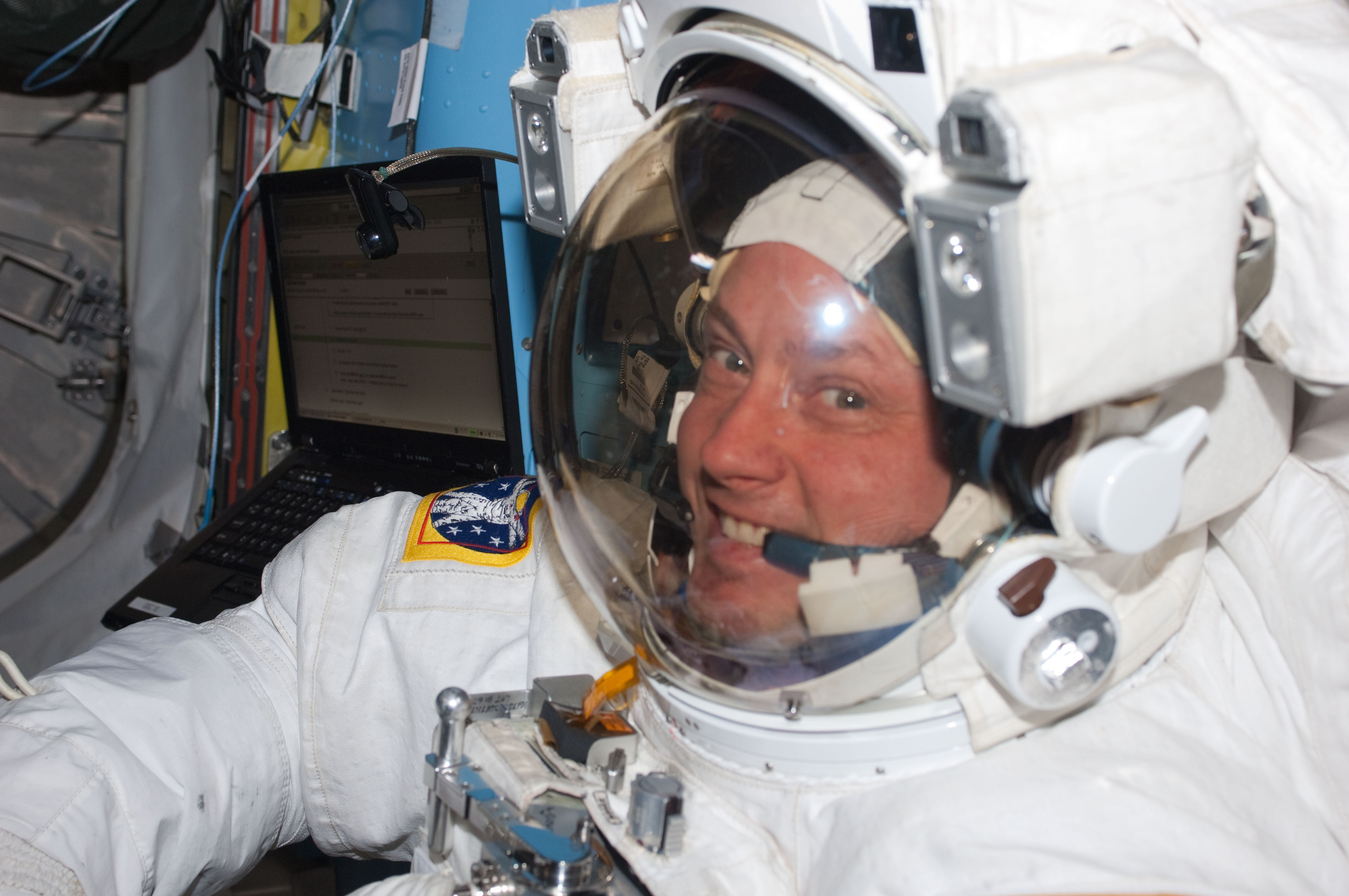
NASA astronaut Mike Fincke is pictured inside the International Space Station’s Quest airlock prior to the start of the third spacewalk for the STS-134 mission.
Credit: NASA
NASA astronaut Mike Fincke is departing the agency on Wednesday after 30 years of service. Throughout his career, he flew four missions, spent 549 days in space, and completed nine spacewalks in support of the International Space Station.
“Few people have had the opportunity to shape as many chapters of NASA’s history as Mike Fincke,” said NASA Administrator Jared Isaacman. “Over a remarkable career, Mike served our nation as a pilot, engineer, astronaut, and mentor. From long-duration missions aboard the International Space Station to helping prepare the Artemis generation, his contributions have helped position NASA for what comes next. The success we’re building on today is possible because of people like Mike, who dedicated their careers to moving our space program forward and preparing the next generation to carry the mission even further. I’d like to congratulate Mike on an incredible career and thank him for his decades of service to NASA, our nation, and the countless people who had the opportunity to learn from and fly alongside him.”
He ranks fourth among NASA astronauts in accumulated time in space, and his spacewalks total 48 hours and 37 minutes. Most recently, Fincke piloted NASA’s SpaceX Crew‑11 mission, which launched in August 2025 and returned in January. During the mission, he served as a flight engineer for International Space Station Expedition 73 and commander of Expedition 74.
Fincke joined NASA’s 16th astronaut class in 1996 and first flew to space in 2004 aboard Soyuz TMA‑4 in support of the space station’s Expedition 9. Serving as a science officer and flight engineer, he helped maintain station systems and performed four spacewalks. He returned to space in 2008 on Soyuz TMA‑13 as commander of Expedition 18, preparing the space station for its transition to six‑person crews at the time and completing two more spacewalks.
In 2011, Fincke flew on STS‑134, the final flight of space shuttle Endeavour. As mission specialist and robotic arm operator, he completed three spacewalks and helped deliver and install the Alpha Magnetic Spectrometer.
“Mike’s remarkable career reflects three decades of dedication to NASA’s mission and the advancement of human spaceflight,” said Vanessa Wyche, director of NASA’s Johnson Space Center in Houston. “From his time aboard the International Space Station to his commitment to mentoring the next generation, Mike has made an immense impact across our agency. His legacy of service, mentorship, and dedication to exploration will continue to inspire the generations to come.”
Throughout his career, Fincke bridged spacecraft development, flight testing, and mission operations. Early in the International Space Station Program, he helped test and integrate several of the station’s initial modules before launch. His flight experience spanned multiple generations of human spacecraft, including two missions aboard Soyuz, one aboard the space shuttle, and later piloting the SpaceX Dragon.
Fincke was a foundational contributor to NASA’s Commercial Crew Program. As chief of the Astronaut Office’s Commercial Crew Branch, he worked to ensure astronaut needs, crew safety, and human spaceflight experience informed development of the nation’s next generation of crewed spacecraft. He spent five years supporting Boeing’s Crew Flight Test program training as a crew member and backup pilot, contributing to flight software, systems integration, integrated testing, and spacecraft interfaces.
Fincke also supported station operations from the ground as a crew test support team member in Russia, a capsule communicator, or capcom, and crew procedures team lead. He helped translate complex engineering and operational requirements into clear instructions for crews working in orbit. His continuity across development, integration, mission support, and long‑duration flight gave him an end‑to‑end perspective on space station assembly and operation.
“Mike approached every assignment with experience, humility, and an unwavering focus on the mission,” said Scott Tingle, chief of the Astronaut Office at NASA Johnson. “Whether flying aboard the station, supporting crews from the ground, or helping shape the spacecraft that future crews will rely on, he consistently strengthened our team. His legacy is woven into the way we fly today.”
A native of Emsworth, Pennsylvania, Fincke holds bachelor’s degrees in aeronautics and astronautics and in Earth, atmospheric, and planetary sciences from the Massachusetts Institute of Technology, where he also studied in the Soviet Union through an exchange program with the Moscow Aviation Institute. He earned master’s degrees in aeronautics and astronautics from Stanford University and in planetary geology from the University of Houston, Clear Lake.
Fincke is a retired U.S. Air Force colonel and distinguished graduate of the U.S. Air Force Test Pilot School. He served as a space systems engineer and flight test engineer at Edwards and Eglin Air Force Bases and later as the U.S. flight test liaison to the Japanese‑U.S. XF‑2 fighter program at Gifu Air Base in Japan. He accumulated more than 2,000 flight hours in more than 30 aircraft types.
“After exactly 30 years, I am departing NASA, but I remain deeply committed to the work of exploration.” Fincke said. “NASA gave me the extraordinary privilege of serving alongside remarkable people, flying and helping develop spacecraft, and contributing to the International Space Station from its earliest days through command in orbit. I am profoundly grateful to my crewmates, the teams on the ground, our international partners, and the families who make this work possible. I am excited to carry those lessons forward and help prepare the next generation of engineers, explorers, and leaders. Together, we will return humanity to the Moon, travel to Mars, journey outward to the planets and moons beyond Earth, and someday reach for the stars – all while caring for Earth, the most beautiful planet in our solar system.”
To learn more about NASA’s astronauts and space exploration, visit:
NASA astronaut Adam Fuhrmann (right, in yellow) prepares for a training flight aboard NASA’s WB-57 aircraft in this July 16, 2026, photo.
These high-altitude flights train the crew to work in a tight environment and operate aircraft systems while in a pressure suit, preparing them for future missions to the International Space Station, Moon, or beyond.
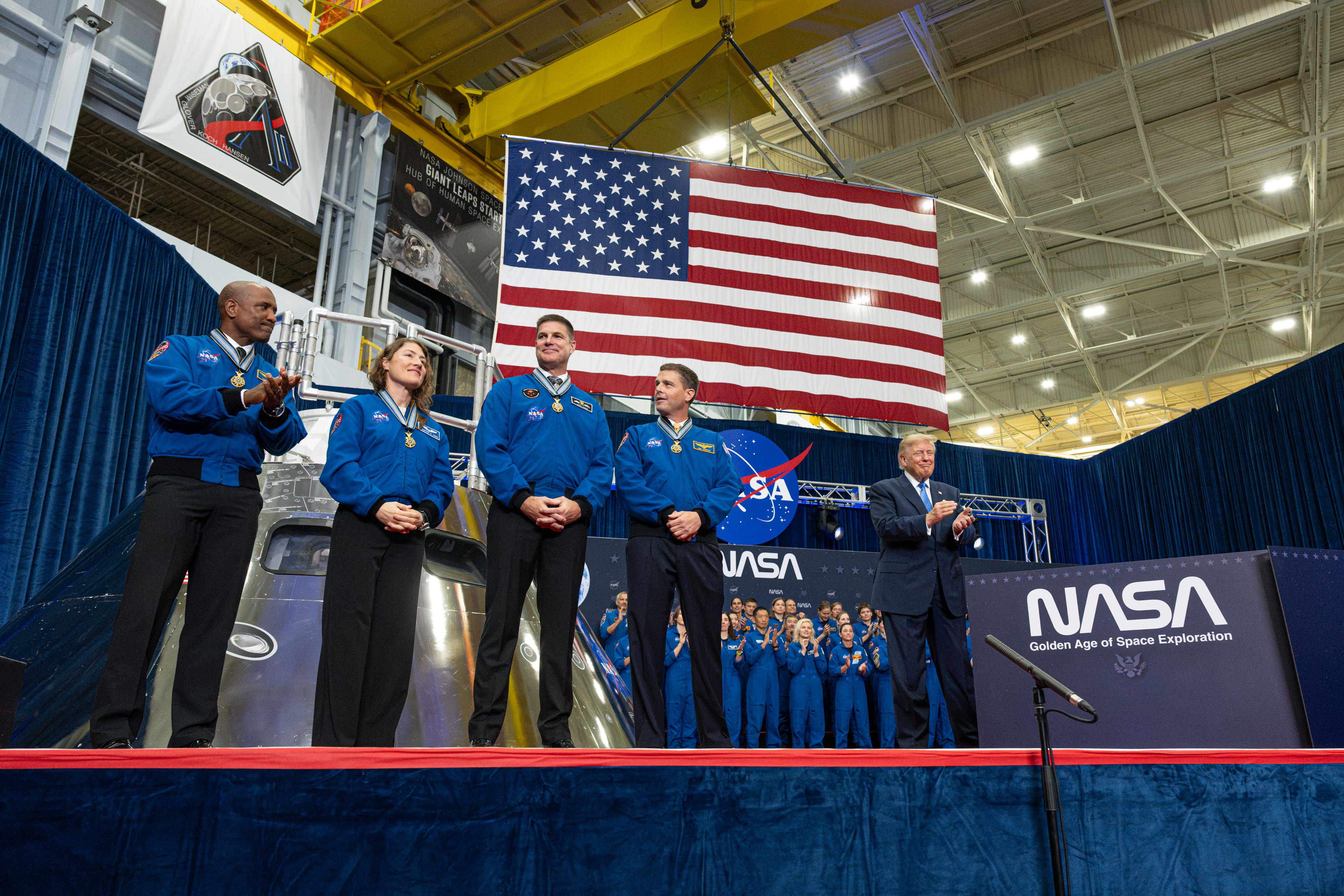
President Donald J. Trump awarded NASA astronauts Victor Glover and Christina Koch, CSA (Canadian Space Agency) astronaut Jeremy Hansen, and NASA astronaut Reid Wiseman with the Congressional Space Medal of Honor on Aug. 28, 2026, at NASA’s Johnson Space Center in Houston.
NASA/John Kraus
From left to right: NASA astronauts Victor Glover and Christina Koch, CSA (Canadian Space Agency) astronaut Jeremy Hansen, and NASA astronaut Reid Wiseman receive the Congressional Space Medal of Honor from President Donald J. Trump on Aug. 28, 2026, for their service during the Artemis II mission.
The Congressional Space Medal of Honor was authorized by Congress in 1969 to recognize an astronaut who in the performance of duties has distinguished himself or herself by exceptionally brave and meritorious efforts, and contributions to the welfare of the nation and humanity. There now are 34 recipients of the award since the beginning of the space program, including the crews of Apollo 1, Challenger, and Columbia who received the award posthumously.
The 56 delegates who signed the Declaration of Independence are all considered Founding Fathers; Massachusetts had five delegates — three of them were Elbridge Gerry, John Hancock and Robert Treat Paine.
Before a blast of shrapnel to his leg and arm changed his life forever, Marine Corps Lance Cpl. Noah Smith spent more than 100 grueling hours holding the line against a desperate sea of humanity in Kabul, Afghanistan.
Online slot machines are among the most popular casino games worldwide because they are simple to play, entertaining, and offer the chance to win significant prizes. Whether you’re playing at a traditional online casino or a crypto casino USA, understanding how slot machines work can help you make better gaming decisions and enjoy a more informed experience.
Modern online slots are far more advanced than the classic mechanical machines found in land-based casinos. Today’s games feature impressive graphics, engaging themes, interactive bonus rounds, and progressive jackpots. However, behind every colorful animation is a sophisticated system of algorithms and random number generation that determines every outcome.
If you’re searching for the best crypto casino, exploring a trusted bitcoin casino USA, or comparing different crypto gambling sites, learning how online slots operate can help you understand concepts like RTP, volatility, paylines, and bonus features before placing your bets.
This guide explains everything you need to know about online slot machines, from the technology behind every spin to the features that make these games exciting for beginners and experienced players alike.
What Are Online Slot Machines?
Online slot machines are digital casino games where players spin virtual reels in hopes of landing winning symbol combinations. Unlike traditional mechanical slot machines that relied on physical gears and reels, online slots are powered entirely by software.
Every online slot consists of several core elements:
Virtual reels
Symbols
Paylines
Betting options
Bonus features
Random Number Generator (RNG)
Instead of pulling a physical lever, players simply click or tap the spin button. Within milliseconds, the software generates a completely random result and displays the symbols on the screen.
Today, thousands of slot games are available across crypto gambling sites, offering everything from classic fruit machines to branded adventure-themed games with immersive gameplay and massive jackpot potential.
The Technology Behind Online Slot Machines
The biggest difference between traditional slot machines and online slots is the technology that powers them.
Online slots use advanced computer software developed by licensed gaming companies. Every game is designed using mathematical models that determine:
Winning combinations
Bonus features
Jackpot frequency
RTP percentage
Volatility level
These calculations are programmed before the game is released and are regularly tested by independent auditing organizations to ensure fairness.
When you play at a reputable crypto casino USA, the game software operates exactly as intended without manual interference from the casino. Licensed operators cannot change the outcome of individual spins or manipulate results during gameplay.
What Is a Random Number Generator (RNG)?
The most important technology behind every online slot machine is the Random Number Generator, commonly known as the RNG.
An RNG is a computer program that continuously generates thousands of random numbers every second—even when nobody is playing the game.
The moment you press the spin button, the RNG selects a random number that corresponds to a specific reel position. The software instantly displays those symbols, creating your final result.
This entire process happens in a fraction of a second.
Because every spin is generated independently:
Previous spins have no influence on future spins.
Winning streaks do not increase or decrease future chances.
Losing streaks do not make a jackpot more likely.
Every spin starts with completely fresh odds.
This randomness is what makes online slots fair and unpredictable.
How Does a Slot Spin Actually Work?
Although spinning a slot appears simple, several processes occur almost instantly behind the scenes.
Step 1: You Place Your Bet
First, you choose your wager amount.
Most online slots allow flexible betting options, making them suitable for both casual players and high rollers at the best bitcoin casino.
Step 2: The RNG Generates Numbers
As soon as you hit Spin, the Random Number Generator instantly selects random values.
These values determine where every reel will stop.
Step 3: The Reels Stop
The software converts the random numbers into visible symbols.
You might see:
Wilds
Scatter symbols
Free Spin icons
Bonus symbols
Regular paying symbols
Step 4: Winning Combinations Are Checked
The game immediately compares the symbols against the paytable.
If your symbols match an eligible winning combination, the software calculates your payout automatically.
Step 5: Winnings Are Credited
Any winnings are instantly added to your balance.
If bonus symbols appear, the game may also trigger:
Free Spins
Bonus rounds
Multipliers
Jackpot features
Pick-and-click games
The entire process usually takes less than three seconds.
Understanding Slot Reels and Symbols
Every online slot contains reels filled with various symbols.
Traditional slots usually feature:
Three reels
One payline
Modern online slots often include:
Five reels
Six reels
Seven reels
Hundreds or even thousands of winning ways
Common symbols include:
Standard Symbols
These provide regular payouts based on the paytable.
Wild Symbols
Wilds substitute for other symbols to help complete winning combinations.
Many Wilds also include:
Expanding Wilds
Sticky Wilds
Walking Wilds
Multiplying Wilds
Scatter Symbols
Scatter symbols usually activate bonus features regardless of their position on the reels.
Landing three or more Scatter symbols often awards:
Free Spins
Bonus games
Instant prizes
Bonus Symbols
These unlock interactive bonus rounds where players can win additional prizes.
Many high-quality games at a crypto casino USA feature creative bonus mechanics that significantly increase entertainment value.
What Are Paylines?
A payline is the pattern that determines whether symbols form a winning combination.
Classic slot machines often featured just one horizontal payline.
Modern online slots may offer:
10 paylines
20 paylines
50 paylines
100 paylines
243 winning ways
1,024 ways to win
Megaways systems with over 100,000 winning combinations
The more paylines or winning ways a slot offers, the greater the number of potential winning combinations on each spin.
However, more paylines don’t necessarily increase your chances of making a profit—they simply create more possible winning patterns.
Fixed vs Adjustable Paylines
Some slot games allow players to choose how many paylines they want to activate.
Others automatically activate every payline with each spin.
Fixed paylines are common on modern crypto gambling sites because they simplify gameplay and ensure players never accidentally miss a winning combination.
What Is RTP in Slot Machines?
RTP stands for Return to Player and represents the theoretical percentage of wagered money that a slot machine returns to players over millions of spins.
For example:
RTP: 96%
This means that over an extremely long period, the game is designed to return approximately $96 for every $100 wagered collectively by players.
It’s important to remember that RTP is a long-term mathematical average and does not predict individual results.
A player could:
Win a jackpot after five spins.
Lose several sessions consecutively.
Break even over hundreds of spins.
This randomness is completely normal.
Many players searching for the best crypto casino compare RTP percentages before choosing which slot games to play, as higher RTP games generally provide better long-term value.
What Is Slot Volatility?
Volatility, also called variance, describes how often and how much a slot machine pays.
Low Volatility
Low-volatility slots offer:
Frequent wins
Smaller payouts
Longer playing sessions
These games are ideal for beginners.
Medium Volatility
Medium-volatility slots balance payout frequency with prize size, making them suitable for most players.
High Volatility
High-volatility slots offer:
Less frequent wins
Larger payouts
Bigger jackpot potential
These games appeal to players willing to accept greater risk for the chance of substantial rewards.
Understanding volatility helps players choose games that match their bankroll and playing style.
Bonus Features in Online Slot Machines
One of the biggest reasons online slots are so popular is the wide variety of bonus features they offer. Unlike traditional slot machines, modern games include interactive elements that can increase excitement and winning potential.
Free Spins
Free Spins are one of the most common slot features. They are usually triggered by landing three or more Scatter symbols. During the Free Spins round, you can continue spinning without using your own balance while still having the chance to win real prizes.
Some games also include:
Expanding Wilds
Sticky Wilds
Increasing multipliers
Retriggerable Free Spins
These features can significantly boost your total winnings during a bonus round.
Wild Symbols
Wild symbols substitute for other regular symbols to help complete winning combinations. Depending on the game, Wilds may come with additional enhancements, such as:
Expanding across entire reels
Staying in place for several spins
Moving between reels
Applying payout multipliers
These special Wild features are commonly found in games offered by the best crypto casino platforms.
Multipliers
A multiplier increases the value of your winnings by a specific amount.
Examples include:
2x multiplier
5x multiplier
10x multiplier
50x multiplier
Some bonus rounds allow multipliers to stack, resulting in much larger payouts.
Bonus Games
Many online slots include interactive mini-games that are activated by Bonus symbols. These rounds may involve picking treasure chests, opening mystery boxes, spinning a prize wheel, or selecting hidden rewards.
Bonus games not only add variety but also offer additional opportunities to win.
What Are Progressive Jackpot Slots?
Progressive jackpot slots are designed to offer extremely large prizes that continue growing until one lucky player wins.
Every eligible wager contributes a small portion to the jackpot pool. As thousands of players spin the reels across different casinos, the jackpot keeps increasing.
There are several types of jackpots:
Fixed Jackpot
A fixed jackpot always pays the same amount regardless of how many people are playing.
Local Progressive Jackpot
The jackpot grows using wagers from a single casino or a specific group of games.
Network Progressive Jackpot
A network jackpot is shared across multiple casinos and thousands of players, allowing prize pools to reach millions of dollars.
Many crypto gambling sites feature progressive jackpot slots where players can win substantial prizes using cryptocurrencies such as Bitcoin, Ethereum, or Litecoin.
Are Online Slot Machines Fair?
A common question among new players is whether online slots are fair.
The answer depends on where you play.
Licensed online casinos use certified software developed by reputable gaming providers. Their games are regularly tested by independent auditing organizations to ensure they operate according to their advertised RTP and Random Number Generator (RNG).
When you play at a trusted crypto casino USA or a reputable bitcoin casino USA, every spin is generated independently, and neither the casino nor the player can predict or manipulate the outcome.
Some cryptocurrency casinos also offer Provably Fair technology. This system allows players to verify that each game result was generated honestly using cryptographic methods, providing an extra level of transparency compared to many traditional online casinos.
Can Casinos Control Slot Outcomes?
One of the biggest misconceptions about online gambling is that casinos can change the outcome of individual spins whenever they want.
In reality, licensed casinos do not control the result of each spin. The game software is created by independent developers, and outcomes are determined by the RNG.
Reputable casinos cannot:
Choose when players win
Force players to lose
Change the result after the spin button is pressed
Adjust individual payouts during gameplay
Their role is simply to provide access to certified games and process player transactions.
This is why choosing licensed and trustworthy crypto gambling sites is essential for a safe gaming experience.
Common Myths About Online Slot Machines
There are many myths surrounding online slots. Understanding the facts can help you make smarter decisions.
Myth 1: A Machine Is “Due” for a Win
Every spin is independent. A slot that hasn’t paid recently is no more likely to pay on the next spin than any other.
Myth 2: Playing Longer Increases Your Chances
Your odds remain the same on every spin. Playing for a longer period does not improve the probability of hitting a jackpot.
Myth 3: Casinos Can Predict the Next Spin
The Random Number Generator continuously creates random outcomes. Neither players nor casino staff know what the next result will be.
Myth 4: Higher Bets Always Trigger Bigger Wins
Increasing your wager may qualify you for larger payouts or jackpots on certain games, but it does not guarantee a winning spin.
Myth 5: Slots Have Winning Times
There is no evidence that online slots pay more during specific hours of the day. Every spin is generated randomly regardless of when you play.
Tips for Choosing the Best Online Slot Games
With thousands of games available, selecting the right slot can improve both your entertainment and long-term value.
Check the RTP
Look for games with an RTP of 96% or higher whenever possible.
Understand the Volatility
Choose low-volatility slots for longer play sessions or high-volatility slots if you’re comfortable chasing larger payouts.
Review the Paytable
The paytable explains symbol values, bonus features, and jackpot rules. Reading it before playing helps you understand how the game works.
Play Licensed Games
Stick to games from reputable software developers available at the best bitcoin casino or trusted crypto casino USA platforms.
Take Advantage of Bonuses
Many casinos offer free spins and welcome bonuses that allow you to try new slot games while extending your bankroll.
Responsible Slot Gaming
Online slots are designed to provide entertainment, and responsible gambling should always be a priority.
To enjoy a safe gaming experience:
Set a spending limit before you start.
Never chase losses.
Take regular breaks during long sessions.
Play only with money you can afford to lose.
Use responsible gambling tools such as deposit limits and session reminders if available.
Responsible gaming helps ensure that slot machines remain an enjoyable form of entertainment rather than a source of financial stress.
Conclusion
Understanding how online slot machines work gives you a better appreciation of the technology and mathematics behind every spin. Modern slots rely on Random Number Generators (RNGs), certified software, RTP calculations, and innovative bonus features to deliver a fair and exciting gaming experience.
Whether you’re exploring a crypto casino USA, searching for the best crypto casino, or comparing a trusted bitcoin casino USA, knowing how reels, paylines, volatility, RTP, and bonus features work can help you make more informed choices.
Remember that no slot machine can guarantee consistent wins. Every spin is random, and outcomes are independent of previous results. Choosing licensed crypto gambling sites, understanding game mechanics, and practicing responsible bankroll management will help you enjoy online slots with greater confidence and realistic expectations.
Frequently Asked Questions
Are online slot machines completely random?
Yes. Licensed online slot machines use Random Number Generators (RNGs) that produce independent and unpredictable outcomes for every spin.
Can I improve my chances of winning online slots?
You cannot influence random outcomes, but choosing games with higher RTP, understanding volatility, and managing your bankroll wisely can improve your overall playing experience.
What is the difference between RTP and volatility?
RTP is the theoretical percentage of money returned to players over the long term, while volatility measures how often and how much a slot machine pays.
Do crypto casinos offer the same slot games as traditional casinos?
Many crypto gambling sites feature games from leading software providers, offering the same popular slots found at traditional online casinos, along with exclusive cryptocurrency-focused titles and Provably Fair games.
Are progressive jackpot slots worth playing?
Progressive jackpot slots can offer life-changing prizes, but they usually have higher volatility. They’re a good option for players who enjoy chasing large jackpots while accepting less frequent wins.
How do I choose the best crypto casino for slot games?
Look for a licensed platform with a strong game selection, high-RTP slots, secure cryptocurrency payments, fast withdrawals, responsive customer support, and positive player reviews. These features help ensure a safe and enjoyable gaming experience.
Practical work-life balance in the Square Mile: lunchtime resets, green spaces, walking commutes and evening boundaries for City of London workers.
The Square Mile has a reputation, and it is not for balance. The City of London conjures images of early trains, late nights and lunches eaten one-handed over a keyboard. Some of that reputation is earned. But here is what the cliché misses: the City is also one of the easiest places in Britain to build a genuinely good working day — if you use it properly. Nowhere else packs so many restorative things into so few streets: gardens hidden in churchyards, a river with a promenade, world-class culture a footbridge away, and two thousand years of history to walk through on your lunch break.
Having worked in and written about the Ludgate quarter — the western corner of the City around St Paul’s — for years, we’ve come to believe work-life balance here is less about grand lifestyle changes and more about small, repeatable habits that use what the district already offers. This is our practical playbook: morning, midday, evening, and the boundaries that hold it all together.
Rethinking Balance When You Work in the City
Let’s define terms honestly. Work-life balance in a demanding job is not a fifty-fifty split of hours; it’s the sense that your day contains more than work — that your body moved, your mind changed gear at least once, and your evening belonged to you. Research on workplace wellbeing consistently points to a few reliable levers: daylight, movement, time in green space, real breaks, and clean boundaries between working and not-working. The good news is that the Square Mile, for all its intensity, supplies four of those five within a ten-minute walk of almost any desk. The fifth — boundaries — is on you, and we’ll get to it.
Win the Morning Without Waking at Five
Make the Commute Do Double Duty
The single easiest upgrade to a City working day is turning part of the commute into movement. The quarter around Ludgate is unusually good for this: if you arrive at Blackfriars, you can walk the riverside before climbing to your desk; if you live south of the river, the Millennium Bridge delivers you across the Thames with St Paul’s dead ahead — a walk to work so good that tourists queue to do it on holiday. Cyclists have a protected route along the embankment. Even Underground arrivals can get off one stop early and walk the last ten minutes through streets that predate the Great Fire. Movement plus daylight before nine o’clock is half the wellbeing literature in one habit; our guide to commuting to Ludgate maps every option.
Shift Twenty Minutes and Claim the Difference
The City’s rush peaks are narrow. Travelling twenty or thirty minutes off-peak transforms the journey from an endurance event into transit — and the time you would have spent compressed on a platform becomes yours. Arrive early and the quarter is at its best: quiet lanes, empty churchyards, coffee without a queue. Bank the calm; it compounds through the day.
The Lunchtime Reset: The City’s Best-Kept Secret
If we could legislate one change to City working culture, it would be this: the desk lunch dies today. The midday break is the highest-leverage hour of the working day, and the Square Mile is almost comically well equipped for it. The trick is having a repertoire — a set of fifteen-to-sixty-minute resets you can deploy without planning.
Green Space: The Churchyard Network
The City’s secret garden network is its churchyards — dozens of former burial grounds reborn as pocket parks, each a bench, some planting and near-total quiet one street from the noise. Around the Ludgate quarter alone you can sit in the gardens beside St Paul’s, find the small courts off Carter Lane, or walk a few minutes further to Postman’s Park with its extraordinary Victorian memorial to everyday heroes. Time in green space measurably lowers stress; the City hides more of it than almost any visitor would believe. Our local’s guide to the Ludgate area lists our favourites.
The River and the Bridge
Water resets the mind in a way streets cannot. From the quarter, the Thames path is five minutes downhill; the full lunchtime circuit — down Peter’s Hill, across the Millennium Bridge, along Bankside, back over Blackfriars Bridge — takes well under an hour at a stroll and delivers river, skyline and a change of bank. On harder days, the short version works too: stand mid-bridge, look at the dome, breathe, return. We are not being poetic; try it during a difficult week and see.
Culture in Small Doses
The district’s cultural assets work brilliantly at lunchtime scale. Tate Modern’s free collection displays are twelve minutes’ walk away over the bridge — one room, one artist, back by two. City churches host free or low-cost lunchtime recitals through the week; St Paul’s and St Bride’s both carry musical traditions centuries deep. Even the Old Bailey’s public gallery offers an hour of real-world drama no streaming service can match. A lunch hour that includes one work of art or one piece of live music is a different day from one that didn’t.
Build your own rotation from the fifteen-minute tier upward:
Time You Have
Reset Options from the Ludgate Quarter
15 minutes
Churchyard bench by St Paul’s; a loop of Carter Lane’s medieval lanes; coffee taken outside, phone in pocket
30 minutes
Down to the Thames path and back; Postman’s Park and the Watts Memorial; a lunchtime recital in a Wren church
60 minutes
The full bridge circuit via Bankside; one room at Tate Modern; a proper sit-down lunch with a colleague, work talk banned
Boundaries: The Part the District Can’t Do for You
Everything above is geography; this section is discipline. The City’s density means work can colonise every hour if you let it — the same streets that offer churchyard calm also offer breakfast meetings, lunch meetings and “quick drinks” that end at ten. Balance here is less about finding time than defending it.
The boundary habits we’ve seen work, in ourselves and colleagues:
Give the workday a hard edge. Book the departure the way you’d book a meeting — a class, a train, a person waiting. Open-ended evenings drift; committed ones don’t.
Build a shutdown ritual. Last email review, tomorrow’s list, laptop closed. Two minutes that tell your brain the day is over — especially vital on home-working days.
Separate phone from work after hours. Whatever your tooling allows: notifications off, work apps in a folder, or the old-fashioned discipline of simply not looking. The inbox will be identical at nine tomorrow.
Choose your evenings deliberately. The after-work social scene is a genuine pleasure of City life — historic pubs off Fleet Street included — but two intentional evenings beat four accidental ones. Go because you chose to, leave when you planned to.
Protect one lunchtime anchor per week. A standing walk, recital or gallery visit that survives busy weeks. One kept ritual holds the whole structure up.
Hybrid Rhythms: Making Office Days Count
For most City workers the week is now split between home and office, and balance looks different on each side. Our observation: the happiest hybrid workers treat the two day-types as different instruments rather than interchangeable ones. Office days are for density — collaboration, mentoring, the conversations that don’t survive video — and for using the district: the walk over the bridge, the good coffee, the lunchtime recital, the deliberate evening. Home days are for depth and for reclaiming the commute hours as actual life. What ruins hybrid work is smearing: office days spent on video calls you could have taken at home, home days that bleed into the evening because no train forced an ending. A workplace worth travelling to helps enormously — we’ve written about what that looks like in what makes a great modern office space — but the rhythm is yours to set.
A Balanced Day in the Life
Put together, a good Square Mile day might look like this. Arrive slightly off-peak, on foot for the final stretch — over the bridge or along the river if geography allows. Work the morning in focused blocks, coffee taken standing somewhere with daylight. At midday, deploy the reset that matches the day’s weather and your energy: churchyard on the gentle days, the full bridge circuit when the head needs clearing, one room of a gallery when it needs filling. Work the afternoon. Then end the day on purpose — the pre-booked class, the chosen pint in a three-hundred-year-old pub, or simply the walk back over the river as the dome catches the last light. None of it requires heroics. All of it requires deciding.
Frequently Asked Questions
Is work-life balance realistic in a demanding City job?
Yes, if you define it as day-quality rather than hour-counting. Long days are a reality in many City roles; days that contain zero daylight, zero movement and zero non-work input are a choice — and usually a bad one, since breaks reliably improve the work itself. The district makes micro-recovery unusually easy; the job is to actually take it.
What are the best green spaces near the Ludgate quarter?
The gardens flanking St Paul’s are the flagship, with benches and dome views. The lanes off Carter Lane hide smaller churchyard courts, and Postman’s Park — with its moving Watts Memorial — is a short walk beyond the cathedral. Add the Thames path at Blackfriars for open sky, and you have five distinct settings within a ten-minute radius of Ludgate Hill.
How do I actually stop eating lunch at my desk?
Make the alternative easier than the default. Pick one standing lunchtime commitment per week and put it in the calendar like a meeting. Recruit a colleague — mutual accountability doubles survival rates. And lower the bar: the goal isn’t a perfect hour, it’s fifteen minutes outside with your phone in your pocket. Streaks build from there.
Does the walking commute really make a difference?
In our experience, more than any other single habit. Twenty minutes of walking bracketing the workday delivers movement, daylight and a psychological buffer between roles — commute as decompression chamber. In this quarter it also happens to be beautiful, which keeps the habit alive through winter. Start with one walked leg per day and protect it.
Any advice for new starters in the City?
Three things. Learn the quarter in your first month — lunch spots, churchyards, the river route — because habits form early and geography you know gets used. Say yes to the social scene selectively rather than universally; reputation survives missed drinks. And set your boundaries in week one, gently and consistently, because they are far easier to establish than to retrofit.
Final Thoughts
The Square Mile will take everything you offer it — that has been true since the Romans built the wall. But it also gives more back, per square metre, than any working district we know: gardens, river, music, art, history and some of the best short walks in Britain, all within the radius of a lunch hour. The balance question in the City is rarely “is it possible?” It is “will you claim it?”
So claim it in small ways, daily. Walk one leg of the commute. Eat one lunch a week somewhere with sky. Stand on the bridge for ninety seconds when the day tightens. End work at a time you chose. None of these will appear on your CV — but stack them for a year and they are the difference between surviving the City and actually living in it. The quarter is ready when you are.
What makes a great modern office space? Light, air, amenities, location and flexibility — lessons drawn from the City of London’s best workplaces.
The office was supposed to be finished. For a strange year or two, plenty of commentators declared the workplace a relic — and then something interesting happened. The best offices filled back up, while the mediocre ones stayed empty. The lesson of the past few years is not that people won’t come to an office; it’s that they won’t come to a bad one. Nowhere is that clearer than in the City of London, where centuries of workplace evolution are compressed into a single square mile, and where the gap between a great building and a merely adequate one has never been more visible.
Working in and around the Ludgate quarter, we watch this experiment run daily. The Square Mile has Victorian banking halls converted into collaborative campuses, glass towers with winter gardens in the sky, and mid-rise buildings whose roof terraces look straight at St Paul’s Cathedral. Some hum with life; others echo. This article distils what separates the two — the qualities that make a modern office genuinely great, drawn from the place that has been refining the office longer than almost anywhere on earth.
The Office Has a New Job Description
For most of the twentieth century, the office had one function: to be the place where the work physically happened, because the files, the phones and the typewriters were there. That justification is gone. Laptops and cloud software mean the work itself can happen almost anywhere, so the office has had to discover a new purpose — and the buildings that thrive are the ones that understand what that purpose is.
The new job description looks something like this: the office is where culture is transmitted, where juniors learn by osmosis, where trust is built faster than any video call allows, and where the accidental conversation — the one that solves the problem nobody scheduled a meeting about — actually happens. A great modern office is designed for those things deliberately. It earns the commute rather than assuming it. Every quality we discuss below flows from that single shift.
Light, Air and the Fabric of the Building
Natural Light Is Non-Negotiable
Ask people what they remember about the best office they ever worked in and the answer, more often than not, involves light. Daylight regulates mood and alertness in ways artificial lighting has never fully replicated, and the difference between a desk by a window and a desk under fluorescent panels is the difference between a workday that flows and one that drags. The best modern buildings are designed around this: floorplates shallow enough that daylight reaches the middle, floor-to-ceiling glazing, atriums that pull brightness into the core of the building.
Air, Temperature and the Things You Only Notice When They’re Wrong
Nobody ever praised an office’s ventilation on a first visit, but everyone has suffered a stuffy meeting room at three in the afternoon. Air quality became a mainstream concern in recent years, and it has stayed one: modern buildings advertise their fresh-air rates and filtration the way they once advertised marble lobbies. Alongside air comes acoustic comfort — the unglamorous science of making an open floor quiet enough to think in — and reliable temperature control that doesn’t split the floor into arctic and tropical zones. These fundamentals are invisible when right and corrosive when wrong, which is precisely why great buildings obsess over them.
Sustainability as a Baseline, Not a Badge
The City’s newest and best-refurbished buildings treat energy efficiency, green roofs, rainwater systems and responsible materials as entry requirements rather than marketing flourishes. This matters for the planet, obviously, but it also matters commercially: companies increasingly carry their own environmental commitments and cannot house themselves in buildings that undermine them. A genuinely modern office can tell you where its energy comes from and where its waste goes — and the good ones are proud to.
Space That Matches How Work Actually Happens
Variety Beats Uniformity
The great insight of the past decade of workplace design is that a knowledge worker’s day is not one activity but many: focused solo work, quick huddles, long collaborative sessions, video calls, confidential conversations, and the social connective tissue between all of them. A floor of identical desks serves exactly one of those modes. The best modern offices offer a landscape instead — quiet zones and library rules in one area, collaboration tables and writable walls in another, phone booths for calls, generous kitchens that double as casual meeting space.
The checklist we’d apply to any floorplan, whether you’re leasing space or redesigning it:
Focus space: genuinely quiet areas where deep work is protected, not just tolerated.
Collaboration space: rooms and open settings sized for real teams, with technology that starts working in seconds.
Call privacy: enough booths and small rooms that video calls don’t colonise the open floor.
Social gravity: a kitchen, café or commons good enough that people linger — this is where the accidental conversations live.
Flex and growth: the ability to reshape the space as the team changes, without a construction project.
Technology That Disappears
Hybrid work made every meeting a broadcast, and the buildings that handle this well share a trait: their technology is invisible. Screens wake when you walk in, cameras frame the room sensibly, connectivity is fast everywhere including the lift lobby, and nobody spends the first seven minutes of any meeting hunting for the right cable. The measure of good workplace technology is how rarely anyone talks about it.
Amenities: What Actually Matters
Somewhere along the way, office amenities became an arms race — climbing walls, cinema rooms, slides between floors. The City’s experience suggests most of that is noise. The amenities that genuinely change daily behaviour are humbler and almost boringly practical.
Top of the list: end-of-trip facilities. Secure bike storage, good showers and lockers turn cycling and running commutes from a heroic gesture into a routine, and in a district as well served by protected cycle routes as the western City, they get used daily. Close behind come outdoor spaces — terraces, balconies and roof gardens. In a dense urban quarter, ten minutes outside at height, with a view towards the cathedral or the river, does more for an afternoon than any games room ever has. Add a genuinely good coffee offer at or near the building, decent food options within a short walk, and quality meeting and event space for the moments a team needs to gather at scale — and you have covered what people actually use.
Here’s how we’d rank common amenities by real-world impact:
Amenity
Daily Impact
Honest Verdict
Showers, lockers & bike storage
High
Changes how people commute; used every single day
Terraces and roof gardens
High
The most-loved perk in dense districts; genuine wellbeing value
Great coffee & food nearby
High
Small pleasure, compounding daily; underrated in leasing decisions
Quality meeting & event space
Medium
Matters enormously, episodically
Gyms and fitness studios
Medium
Valued by a committed minority; location nearby often suffices
Cinema rooms, games zones
Low
Photographs well; used rarely after month one
Location: The Amenity No Building Can Fake
A building can renovate everything except where it stands. Location remains the amenity that outranks all others, and the City of London illustrates why with unusual clarity. A workplace near multiple stations effectively shortens every employee’s day. A workplace surrounded by good lunch options, green churchyards and things worth seeing turns the working day porous in the best way — errands, walks and small pleasures slot into its gaps. The Ludgate quarter is a textbook case: main line and Underground stations within minutes, the river walk and Millennium Bridge to the south, and St Paul’s Cathedral as the daily backdrop. We’ve mapped all of it in our local’s guide to the Ludgate area and the practical routes in our guide to commuting to Ludgate.
There’s a subtler location effect, too. People bring more energy to a place they’re mildly proud of. “Our office is by the cathedral” lands differently than an anonymous address — with clients, with recruits, and with the person saying it. Great districts confer a small identity on the organisations within them, and that identity compounds.
Character: Why the Best Offices Feel Like Somewhere
The City’s most interesting workplaces share one more quality that resists the spreadsheet: character. Some of it comes from heritage — a converted warehouse’s brick and beams, a former banking hall’s ceiling height, a lane that follows a medieval street line. Some comes from newness done well: daring atriums, sky gardens, glass that reflects the dome of St Paul’s. Either way, the effect is the same. The space feels specific, like it could only be here. In a working world where the alternative to the office is a laptop at the kitchen table, that sense of somewhere-ness is not decoration; it is the product. People do not cross a city for a beige floorplate. They will cross it for a place with a view, a story and a bit of soul — a truth the Square Mile, with two thousand years of practice, has learned better than anywhere. That heritage runs deep in our quarter especially; the layers are all still visible if you know where to look, as we explore in the history of Ludgate.
The Human Test: Does the Office Support a Good Day?
Strip away the specification sheets and one question remains: does this office help the people in it have a good day? That means arriving without stress, working without friction, eating something decent, getting outside at lunchtime, and leaving with energy still in the tank. Buildings influence every one of those moments — through their location, their light, their air, their spaces and their surroundings. The office that passes this test gets filled; the one that fails it gets discussed in leasing meetings as a mystery underperformer. It’s rarely a mystery. For the employee’s side of this equation — how to actually use a district like this to work well and live well — see our companion piece on work-life balance in the Square Mile.
Frequently Asked Questions
What is the single most important feature of a modern office?
If forced to choose one, we’d say natural light, because it affects every person, every hour, every day, and no amenity compensates for its absence. But the honest answer is that the top tier is a bundle: light, air, location and a variety of well-designed spaces. Weakness in any one of those four drags down everything else a building offers.
Do office amenities really affect whether people come in?
Yes, but not the amenities that get the press coverage. The daily-use practical ones — showers and bike storage, outdoor space, good coffee and food — measurably shape behaviour because they remove friction from real routines. Novelty amenities generate a burst of enthusiasm and then gather dust. The test is simple: will a normal person use it in a normal week?
Is the City of London still a good place to base an office?
The Square Mile’s fundamentals are hard to argue with: extraordinary transport density, a deep talent pool, walkable amenities and a setting layered with history and character. Its districts each have distinct personalities — the western quarter around Ludgate and St Paul’s, for instance, pairs main line connectivity with riverside walks and cathedral views. As with any location decision, the right answer depends on where your people live and who you need to be near.
How much does building character actually matter?
More than most specifications suggest. Character — heritage fabric, views, a distinctive setting — is what makes people feel something about their workplace, and feeling is what drives the discretionary decision to come in. It also shows up externally: clients remember visiting a memorable building, and candidates weigh it when choosing between offers. It is genuinely hard to retrofit, which is why it commands a premium.
What should a small business prioritise when choosing office space?
Transport access first — your team’s commute is a tax on everything else. Then natural light and air quality, because they set the daily experience. Then flexibility of terms and layout, because small businesses change shape quickly. Amenities can be borrowed from the neighbourhood: in a district with good cafés, parks and gyms nearby, the street provides what the building lacks — one more reason location earns its price.
Final Thoughts
The great modern office is not a trend package — it is an old idea rediscovered: a place worth travelling to, in a location that gives as much as it takes, filled with light and air, shaped around the many ways people actually work, and possessed of enough character to feel like somewhere. The City of London proves the point in both directions daily, in buildings that hum and buildings that echo.
Whether you’re choosing space, designing it, or simply deciding how often to use the office you have, the same test applies: does this place help people do their best work and still hand them back a good day? Around the Ludgate quarter, with the cathedral above the rooftops and the river five minutes’ walk away, we’re lucky — the district does half the work. The buildings only have to do the rest.