APOD: 2026 October 24 – Rosetta’s Selfie

APOD

Astronomy Picture of the Day

Discover the cosmos! Each day a different image or photograph of our fascinating universe is featured, along with a brief explanation written by a professional astronomer.

Image of a Rosetta spacecraft solar array in foreground and the nucleus of comet 67P in background.

Rosetta’s Selfie

Explanation: This Rosetta spacecraft selfie was snapped on October 7th, 2014. At the time the comet-chasing spacecraft was about 472 million kilometers from planet Earth, but only 16 kilometers from the surface of comet 67P/Churyumov-Gerasimenko. Looming beyond the spacecraft near the top of the frame, dust and gas stream away from the comet’s curious double-lobed nucleus. Bright sunlight glints off one of Rosetta’s 14 meter long solar arrays. In fact, two exposures, one short and one long, were combined to record the dramatic high contrast scene using the CIVA camera system on Rosetta’s still-attached Philae lander. Its chosen primary landing site was on the visible hemisphere of the smaller lobe of the nucleus. This was the last image from Philae’s camera before the lander separated from Rosetta on November 12. Shortly after separation Philae took another image looking back toward the orbiter and began its descent to the nucleus of the comet.

Tomorrow’s picture: dark matters

Date October 24, 2026
Credit: ESA/Rosetta/Philae/CIVA
Authors & editors: Jerry Bonnell, Cecilia Chirenti, Robert Nemiroff, Keighley Rockcliffe
A service of: ASD at NASA / GSFC,
NASA Science Activation & Michigan Tech. U.

Source: science.nasa.gov

NASA, Partners Accelerate Lander Development for 2028 Moon Missions

7 Min Read

NASA, Partners Accelerate Lander Development for 2028 Moon Missions

015B0749.NEF

As NASA returns humans to the lunar surface and establishes a long-term presence on our closest celestial neighbor, the agency and commercial human landing system providers Blue Origin and SpaceX have streamlined the designs and changed both concepts of operations for its future crewed landers.

Since NASA established initial contracts with Blue Origin and SpaceX for crewed missions to the Moon, the agency has redefined Artemis III to demonstrate rendezvous and docking capabilities between test versions of landers from each provider and the agency’s Orion spacecraft in low Earth orbit next year. In parallel, the companies are also developing crew and cargo versions of their landers for near-term Artemis missions.

“We are executing President Trump’s National Space Policy to complete the long-awaited return of American astronauts to the lunar surface in 2028 and establish a Moon Base,” said NASA Administrator Jared Isaacman. “We have a proven foundation in SLS and Orion, along with two lunar landers in development with Blue Origin and SpaceX. But NASA has no intention of sitting idly by as all the pieces come together. That is not how Apollo succeeded, and it is not how the near-impossible is achieved. NASA is energized, our core capabilities are being rebuilt, our machine shops are running 24/7, and our experts are in the field attacking the critical path. We are building a Super Bowl-caliber team to safely achieve these objectives and everything that comes next.”

NASA is energized, our core capabilities are being rebuilt, our machine shops are running 24/7, and our experts are in the field attacking the critical path. We are building a Super Bowl-caliber team to safely achieve these objectives and everything that comes next.

Jared Isaacman

Jared Isaacman

NASA Administrator

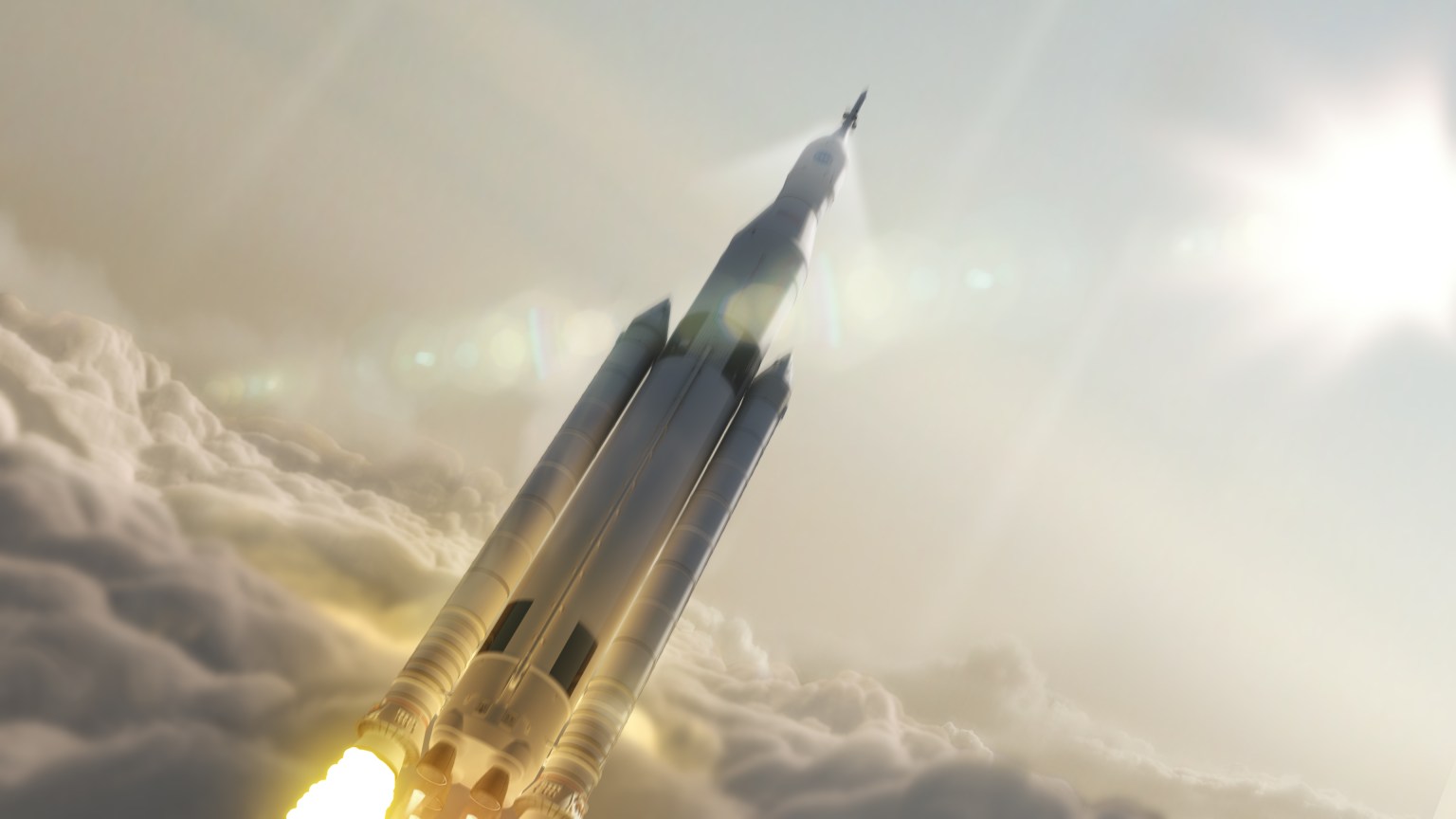
For the initial crewed missions to the Moon, Artemis astronauts will launch in the agency’s Orion spacecraft on top of the SLS (Space Launch System) rocket from NASA’s Kennedy Space Center in Florida. During each Artemis mission, a commercial human landings system will link up with Orion before taking two crew members to the lunar surface while two remain aboard Orion. To accelerate development toward a 2028 landing, the Artemis landers and Orion will no longer rendezvous in a near-rectilinear halo orbit around the Moon and instead meet up in an orbit that differs for each partner, informed by their systems.

Both companies are required to perform an uncrewed demonstration mission with their crewed landers prior to the near-term Artemis crewed missions to the Moon. NASA will certify lander systems prior to the crewed missions to ensure safety and mission success.

Starship lander concept of operations

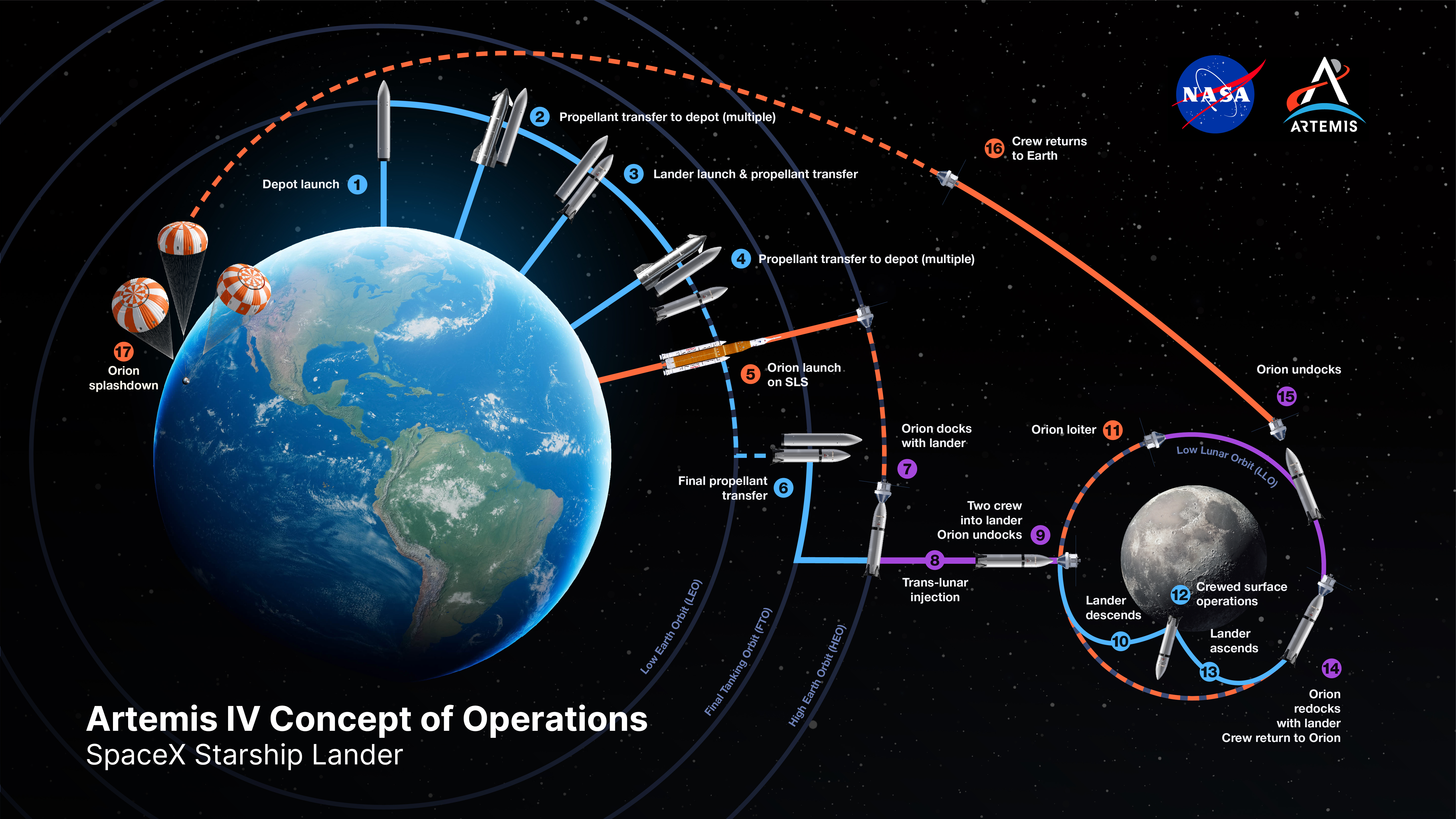
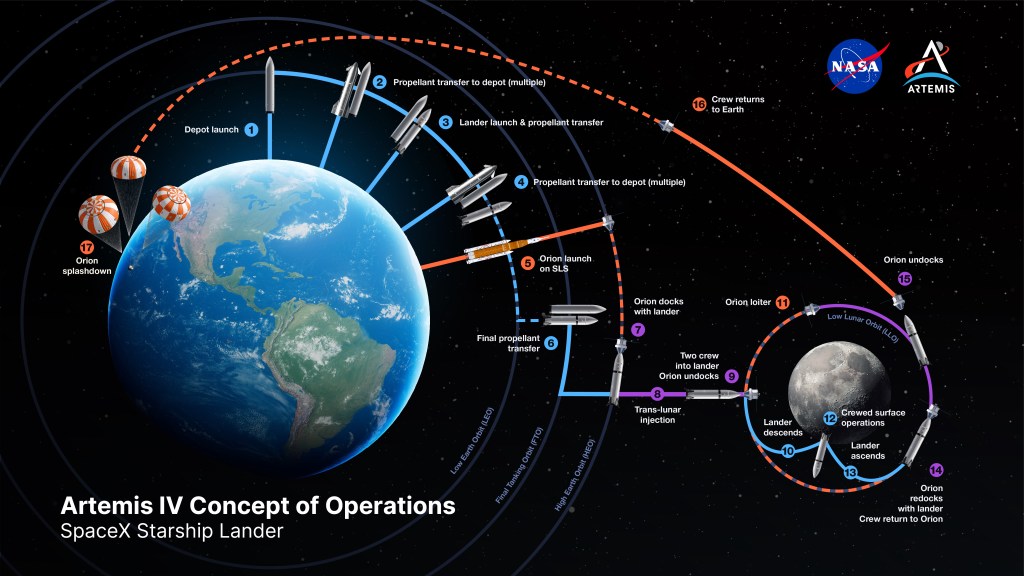
Artemis IV Concept of Operations (SpaceX Starship Lander) infographic.

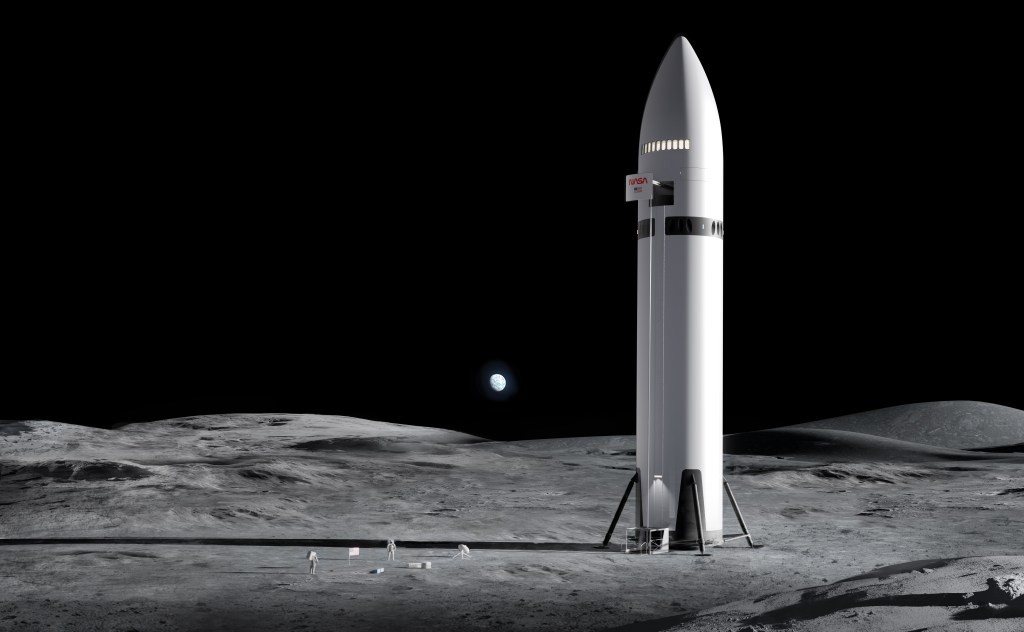
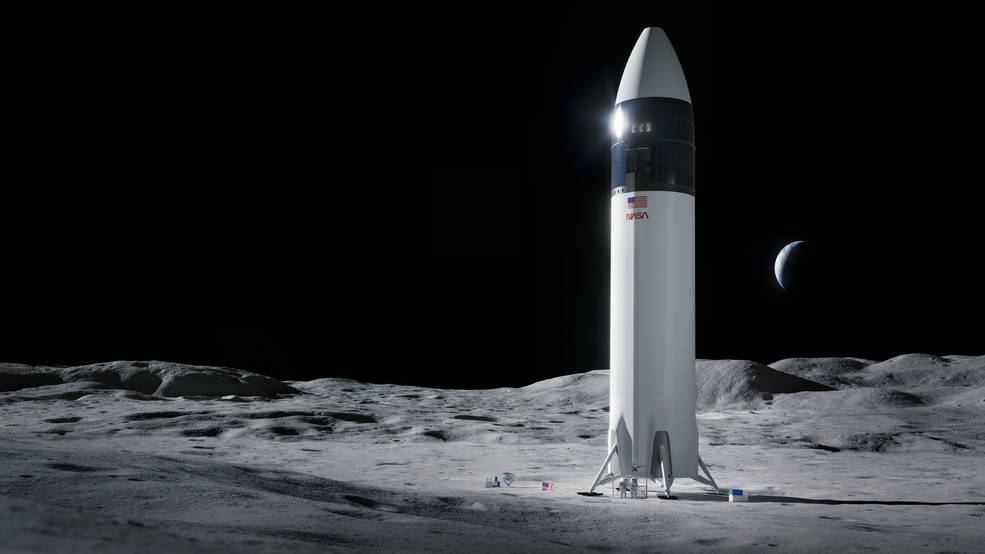
SpaceX continues to plan for an in-space propellant aggregation approach to transfer super cold, or cryogenic, liquid propellant in space. The company will launch multiple versions of Starship to low Earth orbit prior to the launch of the Starship Human Landing System (HLS) from Florida. Similar to a gas station on Earth, the series of propellant “tanker” Starships in low Earth orbit will transfer propellant to the waiting “depot” Starship. The depot Starship will ultimately fuel the Starship lander for its journey to the Moon.

Under the revised operations, Starship HLS will await Orion and its crew in Earth orbit. The lander and Orion will rendezvous and dock in Earth orbit, then the Starship lander will perform a trans-lunar injection burn to send the combined lander and Orion stack to low lunar orbit. NASA is working to modify Orion to enable Starship to push it to the Moon. The lander will bring two crew members to the lunar surface for several days before delivering them back to Orion for the ride back to Earth.

Propellant aggregation in low Earth orbit allows for flexibility in the crew launch timing on SLS, while a trans-lunar injection burn performed by the Starship lander will enable direct access to low lunar orbit. This new concept of operations using low lunar orbit will significantly lower the amount of propellant Starship needs to aggregate in space while reducing the amount of time it can take for astronauts leaving the Moon’s surface in Starship to link back up with Orion. SpaceX will demonstrate the propellant aggregation approach during the uncrewed demonstration mission.

Blue Moon lander concept of operations

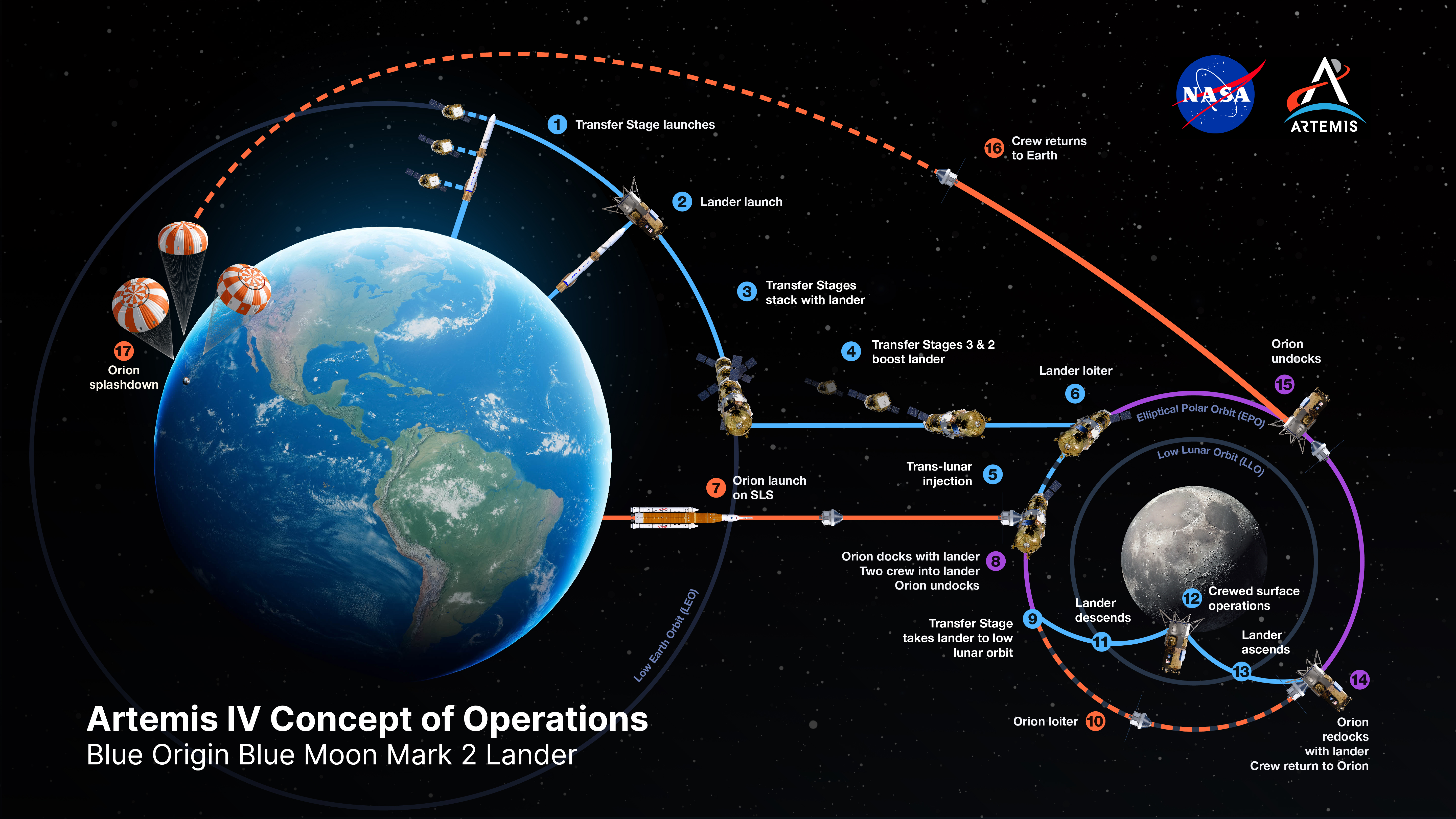
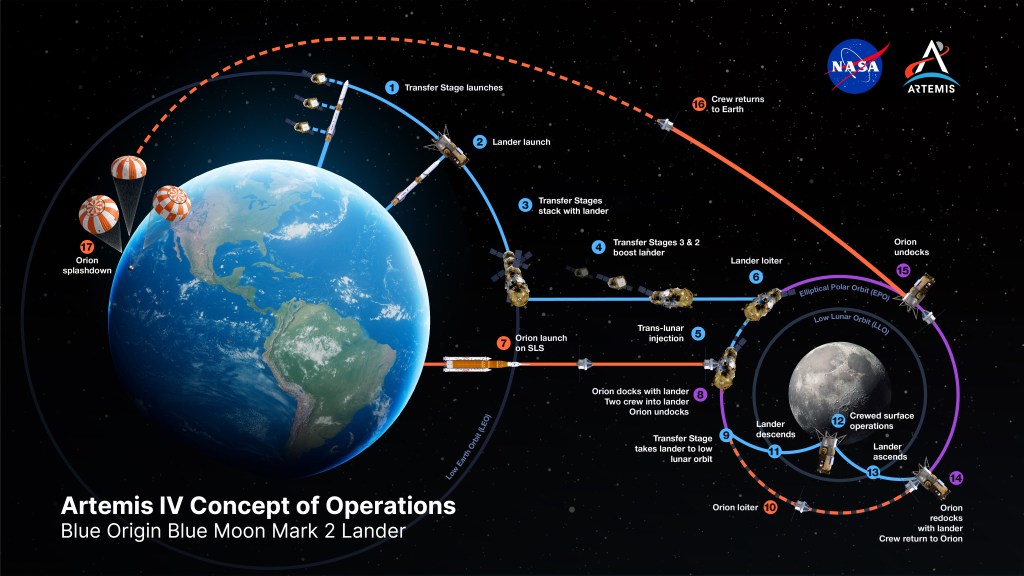
Artemis IV Concept of Operations (Blue Origin Moon Mark 2 Lander) infographic.

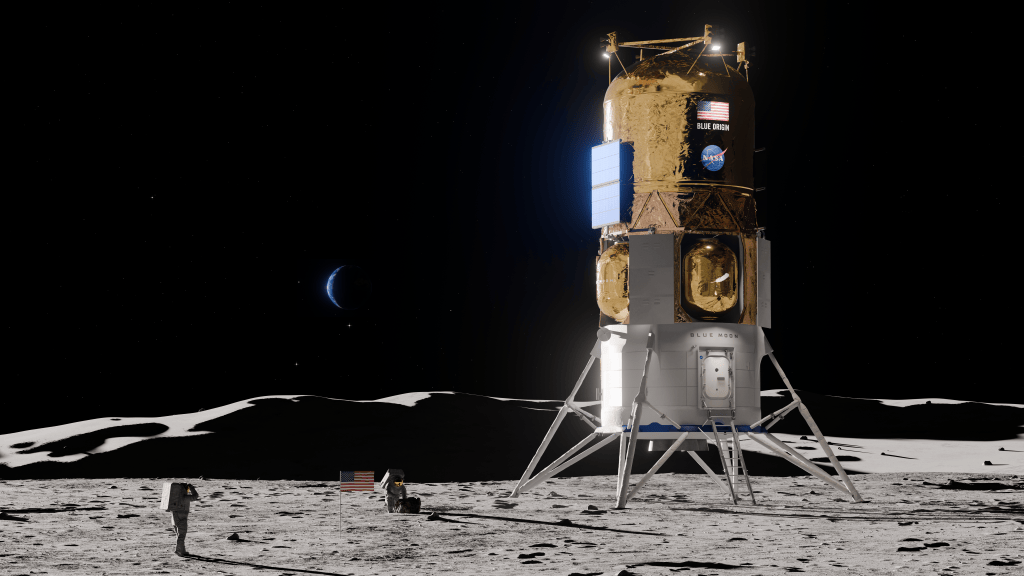
For its accelerated 2028 crewed lunar landing mission, Blue Origin will defer propellant transfer and use three transfer stages to send the Blue Moon Mark 2 Alpha Lander to the Moon. Based on existing Mark 1 and Mark 2 hardware, the stages operate like a multistage rocket. They launch into low Earth orbit, followed by the Mark 2 lander. Once docked, the stack departs for an elliptical polar orbit around the Moon, with each transfer stage separating as its propellant depletes. Compared with the previously planned near-rectilinear halo orbit, the elliptical polar orbit offers faster returns from the lunar surface to Orion, reduces Blue Moon lander propellant requirements, and maximizes the performance available by SLS.

This architecture provides multiple opportunities for SLS and Orion to launch the crew to elliptical polar orbit and dock with the Blue Moon Mark 2 lander. Two crew members then transfer to the lander and descend to the Moon’s South Pole. After surface operations, the lander returns to Orion, where the crew transfers for their journey back to Earth.

Blue Origin will incorporate lessons from earlier robotic Mark 1 missions supporting the agency’s Moon Base Program and demonstrate the full mission profile in an uncrewed lander transfer stage demonstration mission.

Returning American astronauts to the Moon

Ultimately, based on lander readiness, NASA will determine which company will be first selected to safely deliver astronauts to the Moon’s surface and back to lunar orbit in 2028. A second crewed landing opportunity will follow.

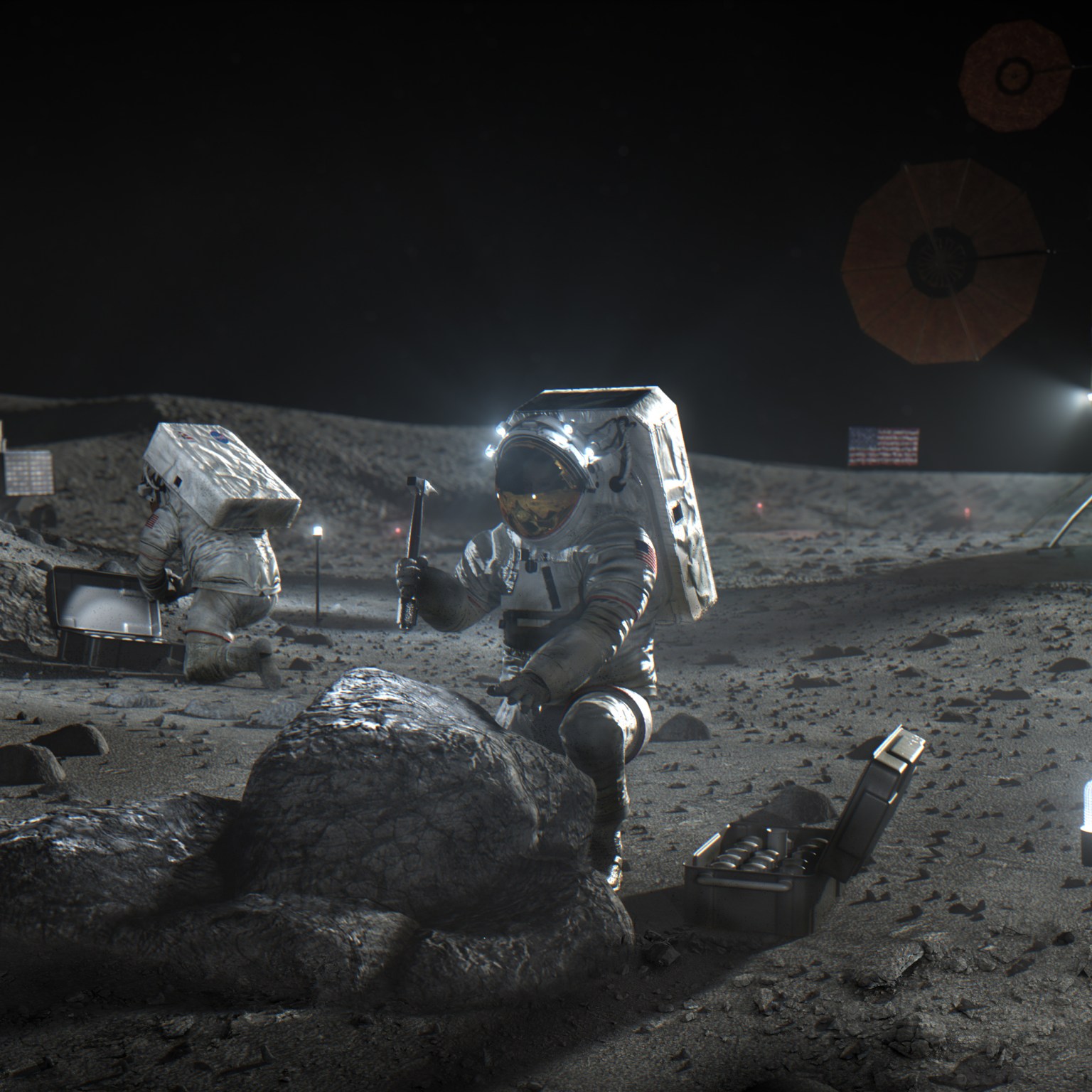
NASA is targeting two, approximately two-hour long lunar surface Moonwalks during initial surface missions. Astronauts will use the Moonwalks to collection lunar samples and test capabilities of the spacesuit provided by Axiom Space.

Earlier this year, NASA updated its contracts with Blue Origin and SpaceX for human landing systems and large cargo deliveries to the Moon. The updates align the agency’s human landing system requirements with acceleration efforts announced earlier this year to streamline Artemis mission architecture, expedite a lunar return, and support an increased mission cadence to the Moon.

Under the original HLS contracts, SpaceX’s Starship human landing system was assigned to the Artemis III and IV missions, while Blue Origin would use its Blue Moon Mark 2 human landing system for Artemis V. Under the contract realignments, both providers are participating in the Artemis III mission in low Earth orbit and neither lander provider has been assigned to a specific Artemis lunar landing mission.

“NASA and our lunar lander providers Blue Origin and SpaceX have been working hand in hand to ensure we can return American astronauts to the Moon by 2028,” said Jeremy Parsons, NASA’s Artemis program manager.“While work to realign with our partners in support of architecture updates announced at Ignition Day in March has been underway since then, updating the contracts ensures NASA and its partners are on the same page with requirements and other milestones to ensure continued insight into lander development to support mission success and the safety of our Moon crews.”

Both Blue Origin and SpaceX have added development milestones to provide NASA with more insight into lander development efforts, reducing risk and enhancing astronaut safety in preparation for crewed Moon landings. SpaceX is adding two demonstrations of its crew cabin, called Cabin 1, for its Starship lander. Blue Origin is adding new human-in-the-loop testing and hardware readiness milestones to streamline training development as well as ground and flight operations.

As part of a Golden Age of innovation and exploration, NASA will send Artemis astronauts on increasingly difficult missions near the lunar South Pole to explore more of the Moon than ever before. In addition to providing economic benefits and advancing scientific discovery though its Moon missions, NASA will establish an enduring human presence on the lunar surface and build on the agency’s foundation for the first crewed mission to Mars. 

About the Author

Corinne Beckinger

Public Affairs Official

Details

Last Updated

Oct 23, 2026

Editor
Lee Mohon
Contact
Corinne Beckinger

Source: www.nasa.gov

NASA’s Artemis III Mission to Test Future Moon Lander Operations

Before astronauts return to the lunar surface, NASA will first conduct one of the most ambitious and complex test missions in the agency’s history. 

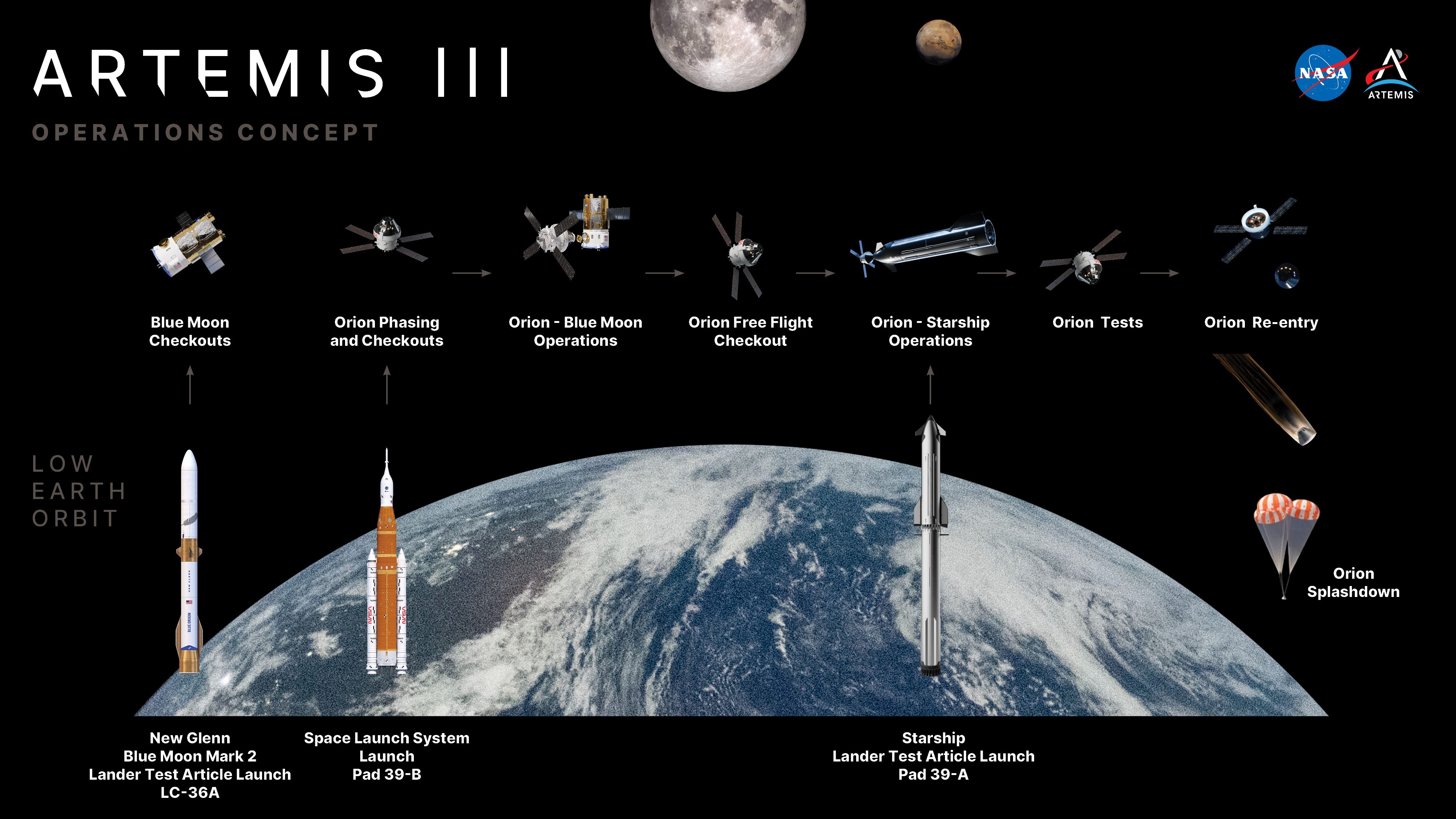
Launching in 2027, Artemis III will send NASA astronauts Randy Bresnik, Frank Rubio, Andre Douglas, and ESA (European Space Agency) astronaut Luca Parmitano aboard the Orion spacecraft into low Earth orbit to perform a series of demonstrations with test versions, or test articles, of human landing systems being developed by industry partners Blue Origin and SpaceX. During the planned 14-day mission, crews and flight controllers will practice the rendezvous, docking, habitation, and operational procedures that will be essential when Artemis astronauts begin landing near the Moon’s South Pole in 2028. The mission is designed to reduce risk, validate hardware, and gain operational experience before NASA attempts a crewed lunar landing.  

“Every piece of this mission in Earth orbit is designed to reduce risk before we put astronauts back on the Moon,” said Jeremy Parsons, NASA’s Artemis program manager. “We’re launching three spacecraft on three different rockets and testing how they operate together — something NASA has never attempted. Every lesson we learn here gets us closer to landing on the Moon in 2028.” 

This graphic shows NASA’s concept of operations for Artemis III. The mission will send four astronauts to low Earth orbit next year to test critical systems needed for future lunar landings.
NASA

First stop: Blue Origin’s lunar lander test article 

Earlier Artemis missions used only NASA’s SLS (Space Launch System) rocket and Orion spacecraft. Artemis III will involve three separate spacecraft launched on three different heavy-lift rockets within a relatively short period of time. 

The mission begins with Blue Origin launching a test version of its Blue Moon Mark 2 lander into a circular low Earth orbit approximately 273 miles (237 nautical miles) above Earth. The spacecraft can remain on orbit for up to 30 days providing schedule flexibility. Artemis III is designed as a tightly choreographed campaign, with NASA planning to launch Orion on top of SLS from the agency’s Kennedy Space Center in Florida only days after the Blue Moon test article launch and confirmation the vehicle is healthy and ready for joint operations. 

Following launch, Orion will initially enter an elliptical Earth orbit of 18 x 1122 miles (16 x 975 nautical miles). It will use its service module to perform a series of maneuvers to transition to a circular orbit at about 345 miles (300 nautical miles) for thermal stabilization before then gradually setting up its rendezvous with the waiting Blue Moon lander test article. Because each spacecraft operates in slightly different orbital regimes optimized for its mission requirements, Artemis III requires a carefully choreographed sequence of orbital maneuvers and rendezvous operations throughout the flight. 

During the first two days of flight, the crew will check out Orion’s systems, prepare for proximity operations, and gradually position themselves for the mission’s first major objective: rendezvous and docking with the Blue Moon test vehicle. 

The operation represents NASA’s first opportunity to evaluate how Orion and a commercial lunar lander work together in space. Engineers will assess how software aboard both spacecraft, guidance systems, communications systems, and operational procedures perform in real-world conditions, while flight controllers gain experience coordinating activities across multiple teams and organizations. 

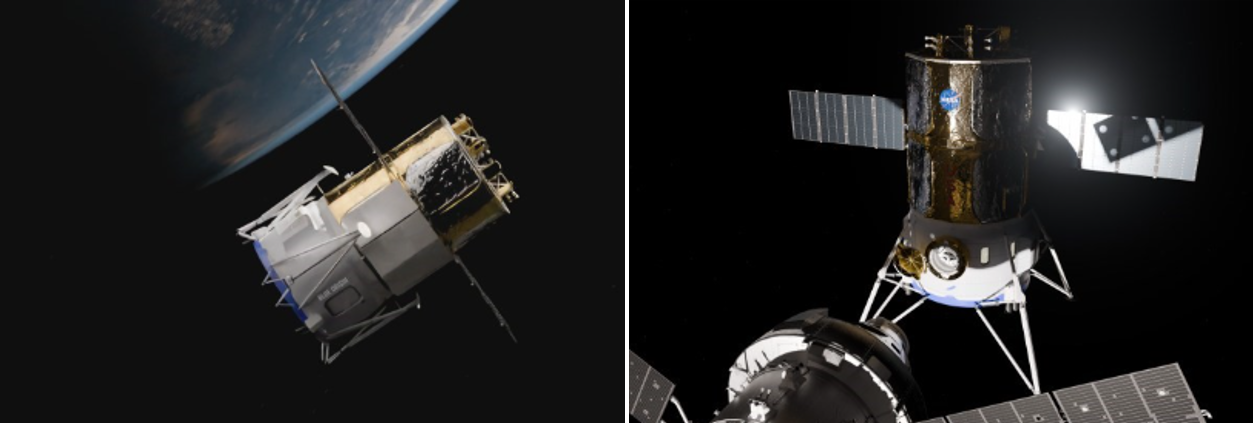
These artist’s concepts depict Blue Origin’s Blue Moon Mark 2 human landing system test article in Earth orbit and docked with NASA’s Orion spacecraft as part of NASA’s upcoming Artemis III demonstration mission in low Earth orbit.
Blue Origin

Once docked, astronauts will spend approximately two days conducting evaluations aboard the Blue Moon test article. Crew members will open the hatch and enter the spacecraft, allowing them to assess the cabin environment, controls, and life-support systems firsthand. Teams will verify the spacecraft’s ability to maintain the proper atmosphere and pressure. 

The Blue Moon test article incorporates many of the avionics, software, flight-control systems, crew-cabin technologies, and life-support functions planned for future lunar missions. Testing those systems in orbit will provide the first opportunity to evaluate how many of the lander’s flight systems perform in space as an integrated vehicle. 

By the time Orion undocks, NASA will have completed its first evaluation of a commercial lunar lander with crew, gathering data on spacecraft systems, crew operations, and spacecraft interoperability not possible on the ground. 

Starship docking demonstration  

After completing operations with Blue Origin’s lander, Orion will undock and reposition to support the next phase of the mission: a second rendezvous operation. 

SpaceX will launch a Starship Version 3 test article from Florida. Because Starship is designed for a much shorter on-orbit lifetime than Blue Origin’s lander, launch occurs later in the mission, allowing NASA to efficiently sequence the two docking demonstrations. Starship will enter a lower orbit at 206 nautical miles, optimized for communications coverage, and will carry an added docking system mounted at the forward end. 

These artist’s concepts depict NASA’s Orion spacecraft and SpaceX’s Starship human landing system test article during docking operations as part of NASA’s upcoming Artemis III demonstration mission in low Earth orbit.
SpaceX

Orion will rendezvous and dock with the spacecraft during a test expected to last up to two hours. Crew will not enter Starship during this test. The demonstration is focused on validating how Orion and Starship interact as a docked system in space. NASA and SpaceX plan to evaluate spacecraft controllability, communications, integrated software performance, and the dynamics associated with docking and undocking operations. 

The docking itself also presents a unique test, using different docking geometries. Orion will connect to a port beside Blue Moon’s crew cabin, then later align its forward docking system with the one at Starship’s nose. Testing both approaches during a single mission gives NASA an opportunity to assess different operational concepts while gathering valuable engineering data.  

Together, the two docking campaigns will demonstrate how Orion interfaces with two very different commercial lander architectures during a single mission. 

Testing Orion for future exploration 

Even after docking activities are complete, Artemis III will continue generating data that supports future missions. 

Once the Starship demonstration is complete, Orion and its crew will have up to five additional days available in orbit before beginning preparations for the journey home. NASA plans to use this time to complete a variety of test objectives that support future Artemis missions, including additional evaluations of the Orion Crew Survival System suits, docking sensor tests, acoustic and thermal measurements, human-factors assessments, and a range of science and technology demonstrations. 

Several investigations led by NASA will build on studies conducted during Artemis II, collecting additional data that will help inform future deep-space missions. The crew also will conduct a proof-of-concept study examining how astronauts could perform health-related assessments when they are unable to communicate directly with mission control, an important capability for future lunar surface expeditions and other missions farther from Earth. 

NASA also plans to fly a cellular biology experiment during the mission while researchers use the flight to test concepts for returning lunar samples to Earth. Teams will evaluate how future samples could be transported, received, and moved into curation facilities after landing, while also conducting assessments of Orion’s environment to better understand potential contamination considerations for future lunar missions. 

The mission also will include Earth and solar observations that help astronauts continue developing critical observation skills while taking advantage of the spacecraft’s unique orbital vantage point. Plant seeds will fly aboard Orion as well, providing opportunities for scientific study and educational engagement following the mission. 

Mission planners have also built flexibility into the flight timeline, providing additional opportunities to complete test objectives depending on how operations unfold in real time. 

When ready, Orion will begin phasing for return, and the crew will configure the cabin for reentry and splashdown, which will occur in the Pacific Ocean, off the coast of California. Orion and its crew will be recovered by NASA personnel and the United States Navy. 

Practicing for Moon missions 

Every activity performed during Artemis III supports a larger goal: reducing risk before astronauts return to the lunar surface. 

The mission will provide NASA with experience operating alongside multiple commercial partners while managing complex rendezvous and docking operations involving three different spacecraft. Engineers will gain insight into spacecraft interoperability, mission-control coordination, communications architecture, crew operations, and hardware performance. 

By the time Artemis III concludes with Orion’s splashdown on Earth, NASA will have demonstrated technologies and operational concepts that future lunar crews will rely on as they travel to and from the Moon.  

Most importantly, Artemis III will provide the operational experience needed to transform plans for future lunar landings into proven flight procedures. The lessons learned throughout the mission will help refine future exploration plans, strengthen partnerships with industry, and ensure astronauts are prepared for humanity’s next giant leap at the Moon. 

As part of a Golden Age of innovation and exploration, NASA will send Artemis astronauts on increasingly difficult missions near the lunar South Pole to explore more of the Moon than ever before. In addition to providing economic benefits and advancing scientific discovery through its Moon missions, NASA will establish an enduring human presence on the lunar surface and build on the agency’s foundation for the first crewed mission to Mars. 

To learn more about Artemis, visit: 

www.nasa.gov/artemis 

Source: www.nasa.gov

Fighting to Stay: Army Combatives Team Builds Camaraderie, Retention

At Fort Campbell, Kentucky, the Screaming Eagles Combatives Team and the 3rd Brigade Combat Team’s fight night events do more than teach soldiers how to fight. They’re building camaraderie, developing confidence and giving soldiers a reason to stay in the Army.

Source: www.war.gov

RS-25 Engine Tests at NASA Stennis

A massive cloud of white vapor billows out from a structure where an RS-25 engine is firing. The flames are just barely visible through the structure. In the foreground is a body of water.
NASA/Danny Nowlin

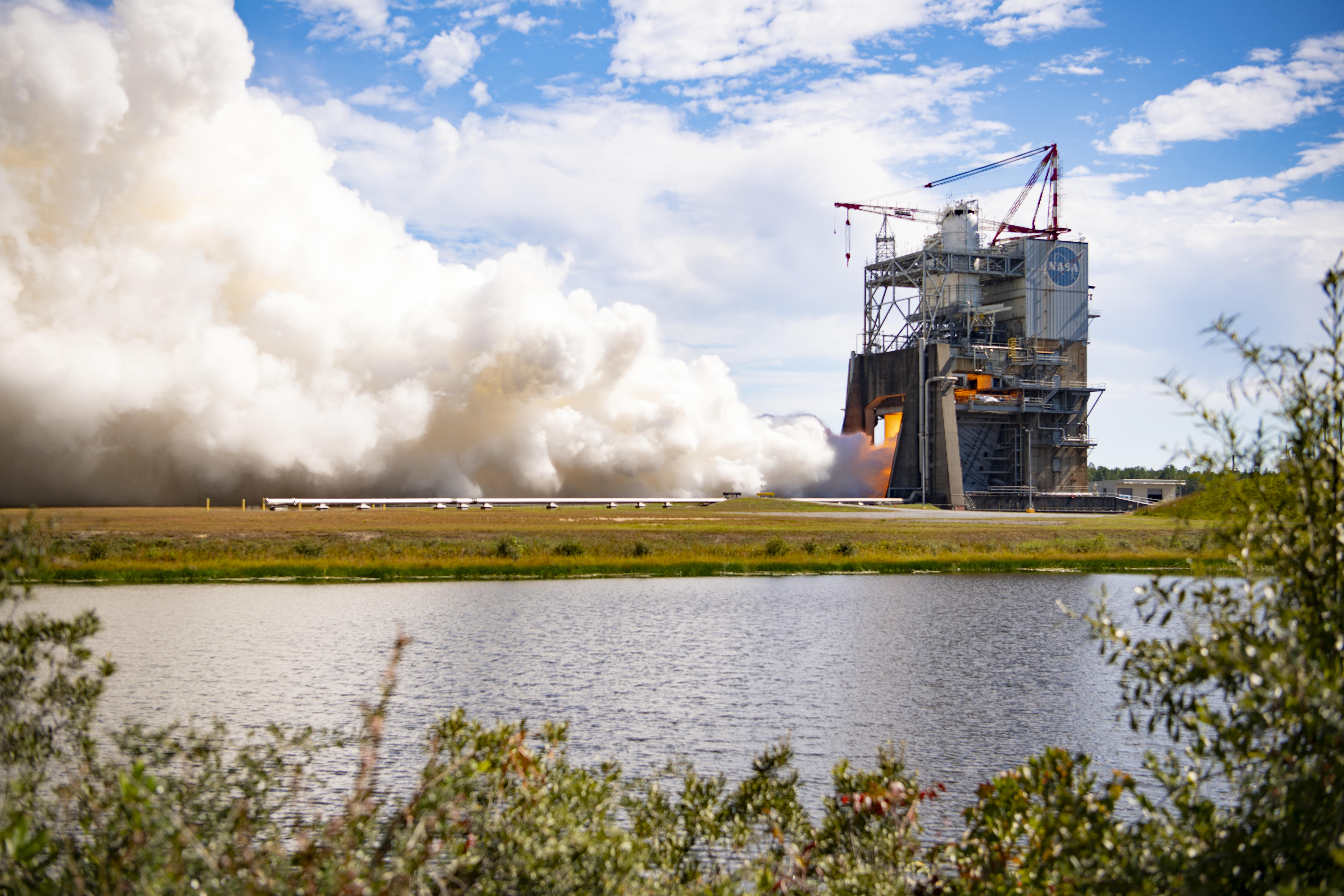
Teams at NASA’s Stennis Space Center near Bay St. Louis, Mississippi tested RS-25 engine No. 10001 on Oct. 21, 2026. The hot fire test lasted for almost eight-and-a-half minutes (500 seconds), the same amount of time RS-25 engines fire during launch of NASA’s SLS (Space Launch System) rocket, with a 111% power level. For each Artemis mission, four RS-25 engines produce up to 2 million pounds of combined thrust to help launch the SLS rocket.

Prior to use, all RS-25 engines are proven flightworthy at NASA Stennis. While this developmental engine will not be used in flight, the hot fire test provides NASA and NASA’s prime engine contractor L3Harris Technologies with the capability to capture critical data to improve engine performance and reliability.

Image credit: NASA/Danny Nowlin

Source: www.nasa.gov

NASA, Virginia Launch Power Partnership for Energy Security

3 min read

Preparations for Next Moonwalk Simulations Underway (and Underwater)

NASA is helping to foster long-term energy security in Virginia. 

NASA’s Langley Research Center in Hampton, Virginia, is partnering with the Virginia Department of Energy to support informed decisions for effective energy generation, delivery and use by providing solar, meteorological, and future weather risk datasets for energy system modeling and planning purposes.

Under a new Space Act Agreement announced during a ceremony Friday, the partnership will use NASA expertise in atmospheric sciences to assist Virginia Energy in support of resiliency studies, resource analysis, and long-term energy planning.

“NASA Langley relishes the opportunity to put our unique science data into the hands of those who want to improve people’s lives,” said NASA Langley Deputy Director Allen Kilgore. “This collaboration with Virginia Energy will benefit the citizens of Virginia and provide stronger energy security for the Commonwealth.”

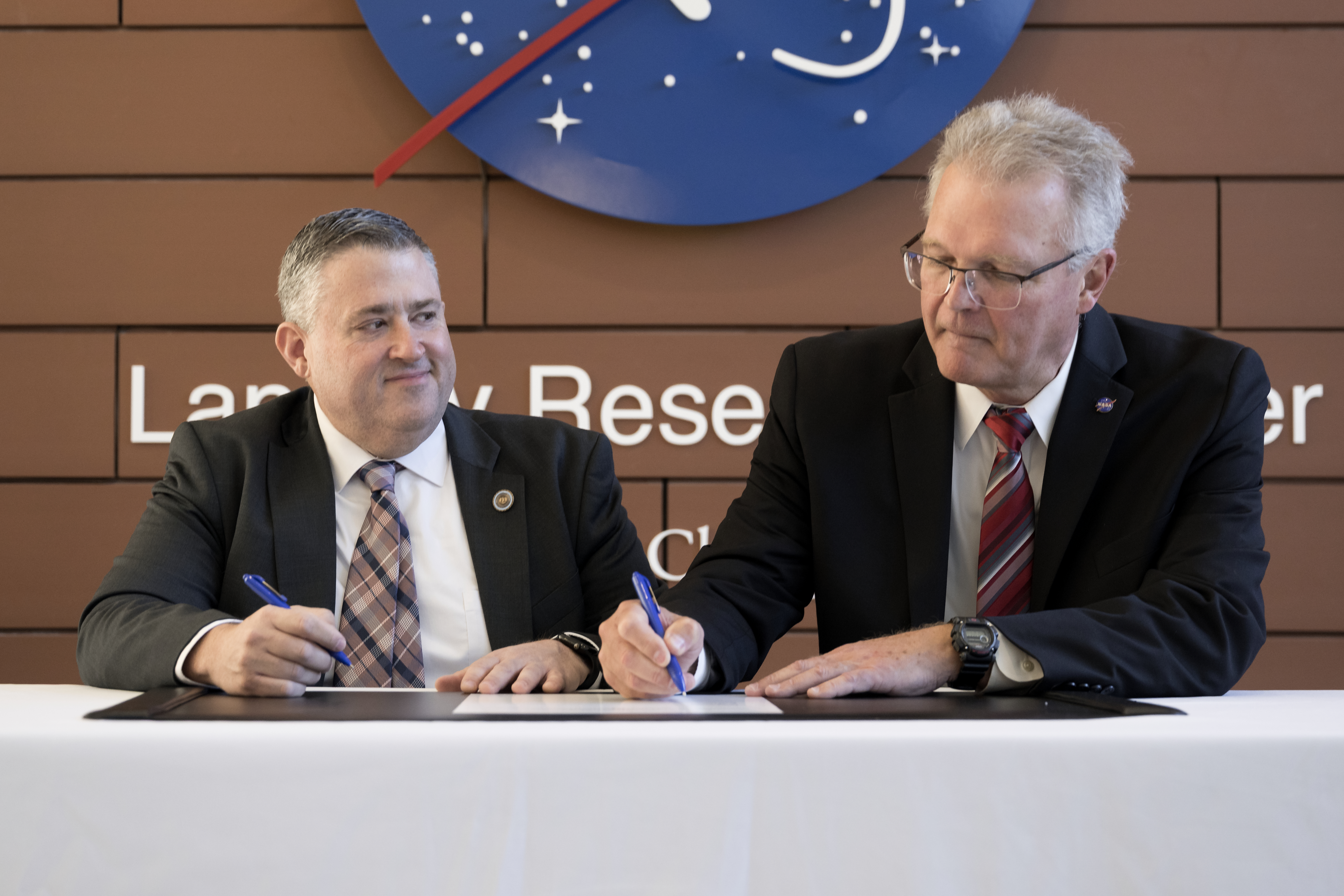
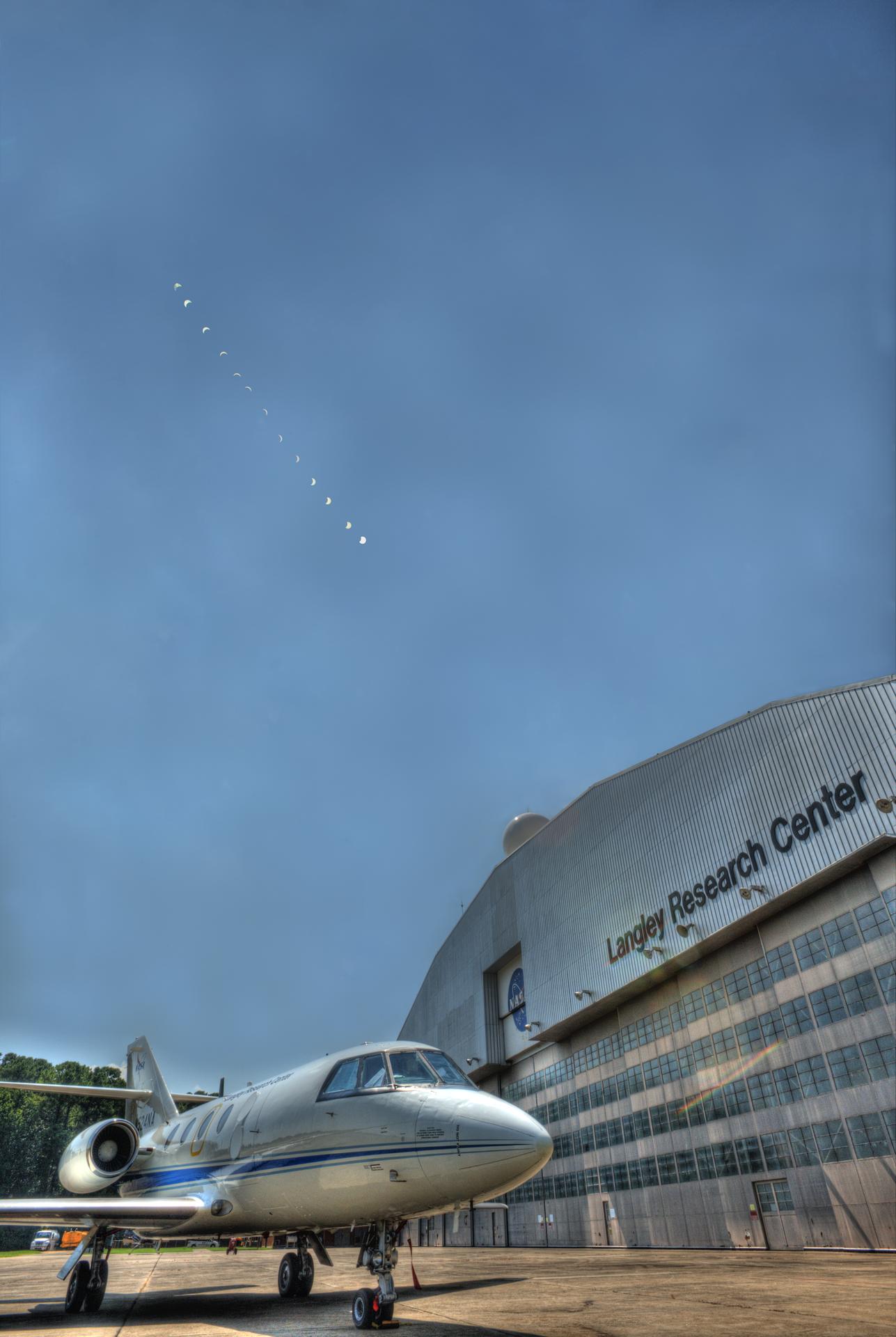
The image shows two men in suits looking down and signing a document on a table. The background wall shows the NASA logo and lettering that spells Langley Research Center.
NASA Langley Deputy Director Allen Kilgore and Virginia Energy Director Vince Maiden sign a new Space Act Agreement during a ceremony announcing the partnership at NASA Langley in Hampton, VA. NASA will provide atmospheric science information to Virginia Energy in support of long-term energy planning.
NASA/Mark Knopp

This agreement will help state officials plan for current and potential extreme weather conditions in Virginia and assess implications for electricity demand, energy generation, and system stress. Information can be directly incorporated into energy policy, planning, and operational decisions.

By helping Virginians better anticipate energy demands, prepare for extreme weather, and understand factors affecting electricity generation, this partnership will support a more reliable and resilient energy system.

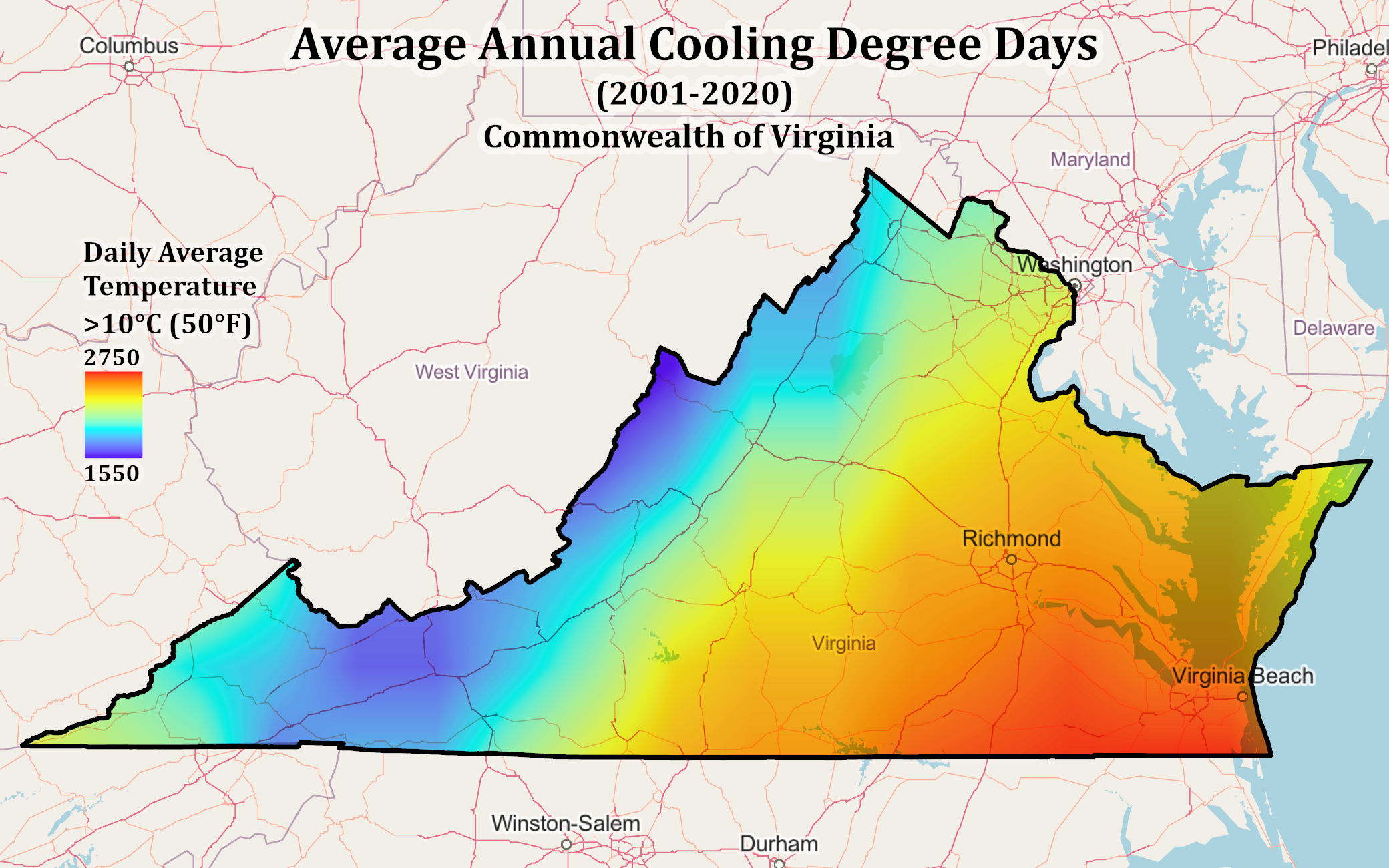
The image shows a graphic map of the state of Virginia with a spectrum of colors across the state that symbolize daily average temperatures from 2001-2020.
NASA POWER data show where cooling demand is highest across Virginia. The map uses cooling degree days, a measure of how often daily average temperatures exceed 50°F (10°C), averaged from 2001 to 2020. These customized energy metrics will help Virginia Energy better understand energy demand and inform future energy planning across the state.
NASA/POWER

“Sound energy planning depends on models that reflect real-world conditions,” said Virginia Energy Director Vince Maiden. “This collaboration will help us better understand how weather affects electricity supply and demand, identify vulnerabilities, and weigh resource tradeoffs with greater confidence.”

The partnership will infuse relevant NASA Prediction of Worldwide Energy Resources (POWER) data products into Virginia Energy’s modeling and analysis system. The POWER information supports energy generation system designs and prediction of energy production using validated data products from NASA’s Earth Science to Action program. Those key NASA products represent research and development across NASA including Langley, Goddard Space Flight Center in Greenbelt, Maryland, and Ames Research Center in California’s Silicon Valley.

Through a digital pipeline, Virginia Energy can connect to Langley’s POWER web platform to download specific datasets and put them directly into their modeling tools. NASA’s POWER team members will work with Virginia Energy researchers to streamline the exchange, adjust formats, and evaluate the need for additional data.

This new partnership was fostered through NASA Langley’s Strategic Partnerships Office that connects industry, academia, and other government agencies with center facilities, capabilities, specialized test environments, and technical expertise to bring ideas to life.

For more information on strategic partnerships at NASA Langley, visit:

https://www.nasa.gov/centers-and-facilities/langley/explore-langley-partnerships/

Details

Last Updated

Oct 23, 2026

Related Terms

Source: www.nasa.gov
APOD: 2026 October 23 – Andromeda in Southern Spring

APOD

Astronomy Picture of the Day

Discover the cosmos! Each day a different image or photograph of our fascinating universe is featured, along with a brief explanation written by a professional astronomer.

The Andromeda galaxy above rolling hills.

Andromeda in Southern Spring

Explanation: Looking toward the north from Mullion, New South Wales, Australia, the Andromeda Galaxy never gets more than a few degrees above the horizon. During the southern hemisphere spring, Andromeda is highest in the sky around midnight though. And in this telephoto scene from October 10/11, multiple exposures were used to reveal the spiral galaxy in tantalizing detail as it climbed above rolling Australian hills. Also known as M31, the Andromeda Galaxy is one of the brightest objects in the Messier catalog, but is only visible to the unaided eye as a small, faint, fuzzy patch. Digitally tracked and stacked frames were combined with a foreground shot in the deep astro-image composite to reveal the galaxy’s greater extent in planet Earth’s night. In the springtime night skyscape,the closest large spiral galaxy spans nearly 6 full moons.

Tomorrow’s picture: pixels in space

Date October 23, 2026
Credit & Copyright: Lucy Yunxi Hu
Authors & editors: Jerry Bonnell, Cecilia Chirenti, Robert Nemiroff, Keighley Rockcliffe
A service of: ASD at NASA / GSFC,
NASA Science Activation & Michigan Tech. U.

Source: science.nasa.gov

El Niño Then and Now


october 13, 1997
october 12, 2026

Side-by-side maps of the Pacific Ocean compare sea surface height anomalies in October 1997 (left) and October 2026 (right). In both, red areas of higher-than-normal sea surface height stretch across the central and eastern Pacific and reach South America.
Sea levels are higher than normal across the central and eastern equatorial Pacific in October 2026 (right), a hallmark of El Niño. The pattern closely resembles October 1997 (left), during another one of the strongest El Niño events in the satellite altimetry record.
NASA Earth Observatory / Lauren Dauphin


october 13, 1997

october 12, 2026

October 13, 1997 – October 12, 2026


Sea levels are higher than normal across the central and eastern equatorial Pacific in October 2026 (right), a hallmark of El Niño. The pattern closely resembles October 1997 (left), during another one of the strongest El Niño events in the satellite altimetry record. Maps by NASA Earth Observatory/Lauren Dauphin using altimetry data provided by NASA/JPL-Caltech.

El Niño is part of a natural climate pattern that occurs roughly every two to seven years, bringing warmer-than-normal water to parts of the equatorial Pacific. The most recent very strong El Niño events, in 1997-98 and 2015-16, upended weather patterns. Impacts spanned the planet, from fires in Indonesia and the Amazon, to crop failures due to drought in southern Africa, to heavy rain and coastal flooding in Southern California. The current El Niño rivals these past heavyweights.

Every El Niño grows from a feedback loop between the atmosphere and the ocean. Trade winds normally keep warm water piled up in the western Pacific, where it stands higher than in the east. When those winds weaken, that warm water begins to pulse eastward, which further weakens and sometimes reverses the winds, allowing even more warm water to move east. The cycle intensifies as waters continue to warm and pile up in the central and eastern Pacific.

But each El Niño has its own character, shaped by where in the Pacific the warmth builds and how the atmosphere responds. “The search for the ‘typical’ El Niño is very elusive,” said Josh Willis, project scientist for sea level missions at NASA’s Jet Propulsion Laboratory (JPL). “They’re all different in terms of where they land and how their impacts play out.”

Altimetry satellites can track those differences by measuring the height of the sea surface. Because water expands as it warms, higher-than-normal sea levels in the central and eastern equatorial Pacific signal the buildup of heat associated with El Niño. The maps above depict sea surface height anomalies across the Pacific Ocean on October 13, 1997 (left), and on October 12, 2026 (right). Data are from the TOPEX/Poseidon satellite and the Sentinel-6 Michael Freilich satellite, respectively, and were processed by scientists at JPL.

Shades of red indicate where sea levels were higher than average. Normal sea level conditions appear white, and lower areas are blue. Signals related to seasonal cycles and long-term trends have been removed to highlight sea level anomalies associated with El Niño and other short-term natural phenomena.

“What’s unique about altimetry is that we have a 35-year record from nearly identical satellites flying almost the same ground track, with each mission overlapping the next,” Willis said. “That lets us look back in time and compare this El Niño to what happened in 1997. And right now, this one is on track to be even bigger.”

Compared with the 1997-98 event, El Niño in 2026 came on much more suddenly. But as of October, the two events appear similar in character—the tilt of sea level (low in the west and high in the east) and high, warm water extending all the way to South America—so Willis thinks the impacts could be similar as well. In 1997-98, that meant, for instance, lots of rain in California and across the southern tier of the U.S.

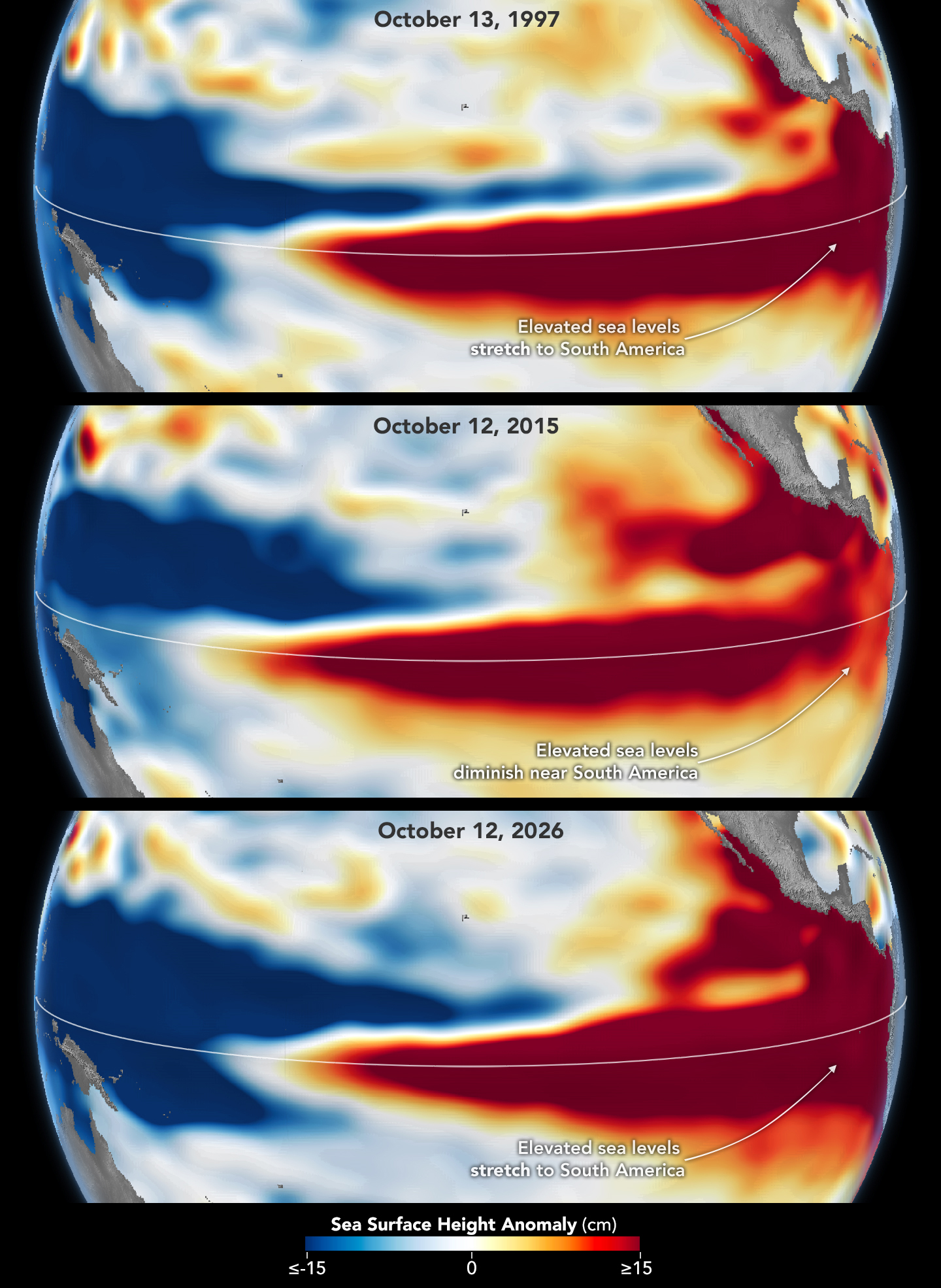
Three stacked maps of the Pacific Ocean compare sea surface height anomalies in October 1997 (top), October 2015 (middle), and October 2026 (bottom). In 1997 and 2026, dark red areas of exceptionally high sea surface height extend across the eastern Pacific and pile up against the coast of South America. In 2015, the dark red stays farther offshore and does not reach the coast.
The 2015-16 El Niño was also very strong, as elevated sea levels in October 2015 (middle) show. But its pattern differed from those in October 1997 (top) and October 2026 (bottom): less of the elevated water reached the coast of South America, which contributed to different weather patterns that year.

The 2015-16 El Niño was another heavy hitter but differed in its character. Sea surface height anomalies on October 12, 2015, based on altimetry data from the Jason-2 satellite, are shown above in context with maps from around the same time in 1997 and 2026. In 2015, the exceptionally warm, high water along the equator didn’t push up against South America to the extent it did in the other years. Rainfall impacts that winter concentrated more over Central America and the southeastern U.S., with significant flooding in Mexico.

NOAA’s El Niño outlook on October 8, 2026, called for an 83 percent chance of a strong-to-very strong El Niño through the first three months of 2027. But exactly how the impacts will play out in winter 2026-27 and beyond remains to be seen. Willis noted that El Niño’s influence propagates through a chaotic atmosphere, and the signal can get muddled as it extends beyond the tropics. “There’s always a bit of a dice roll here,” Willis said. “Just because this El Niño looks like 1997 doesn’t mean it will be exactly the same—it’s just our best guess at the moment.”

NASA Earth Observatory maps by Lauren Dauphin, using NASA-SSH altimetry data provided by Josh Willis, Severine Fournier, and Kevin Marlis, NASA/JPL-Caltech. Story by Kathryn Hansen.

References & Resources

You may also be interested in:

Stay up-to-date with the latest content from NASA as we explore the universe and discover more about our home planet.

El Niño Is Underway

4 min read

Satellite observations of sea surface height indicated that the 2026 event continued to strengthen in early June.

Article

How the Tide Turns at the Mouth of the Elbe

4 min read

The ocean’s ebbs and flows reveal dynamic tidal flats and a well-traveled shipping route along the coast of Germany.

Article

El Niño Alters Marine Life in the Pacific

5 min read

Satellite measurements of chlorophyll at the sea surface signal shifts in the ocean’s nutrient supplies in mid-2026.

Article

Source: science.nasa.gov