Fire Cloud with a Pileus on Top


natural color
swir

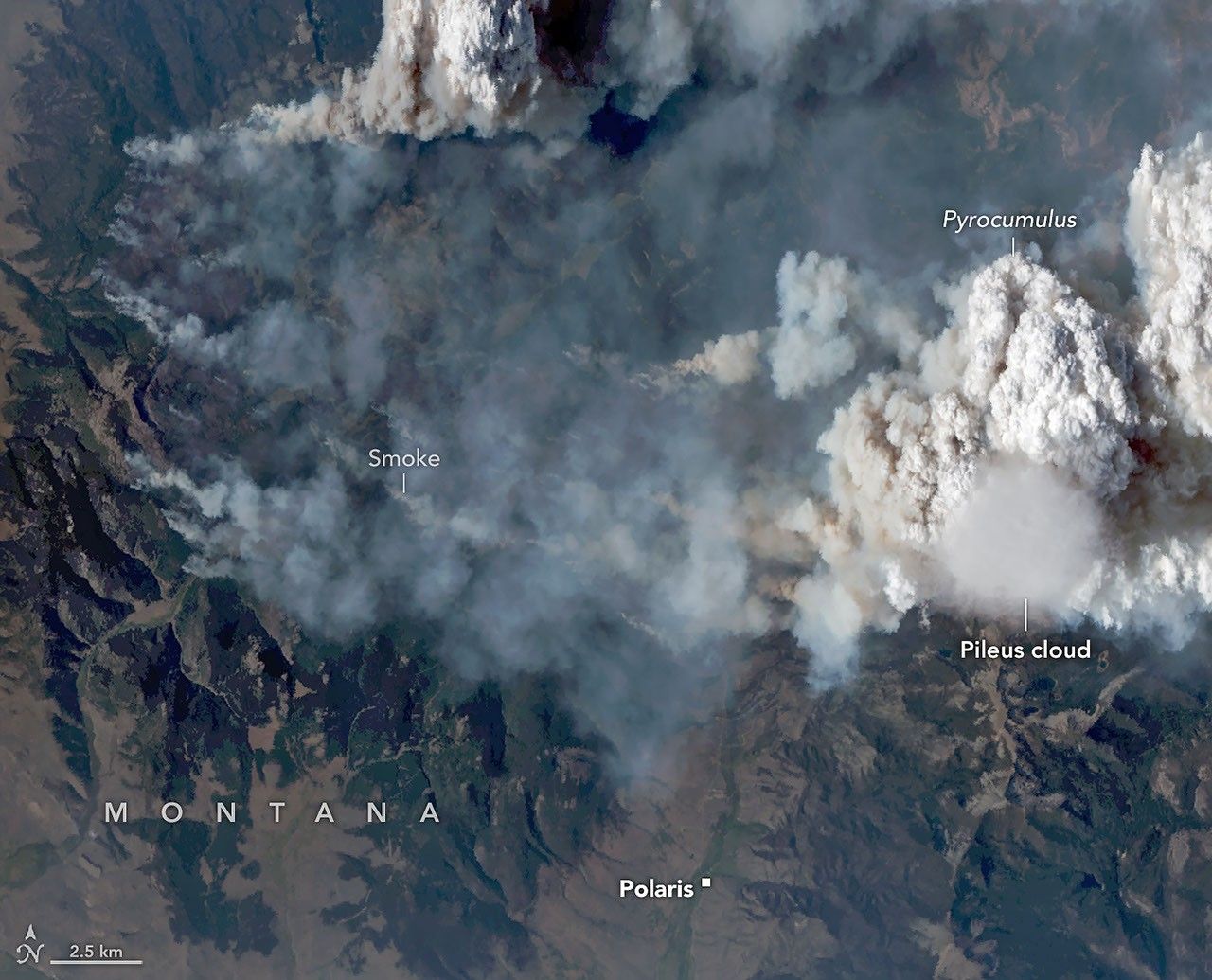
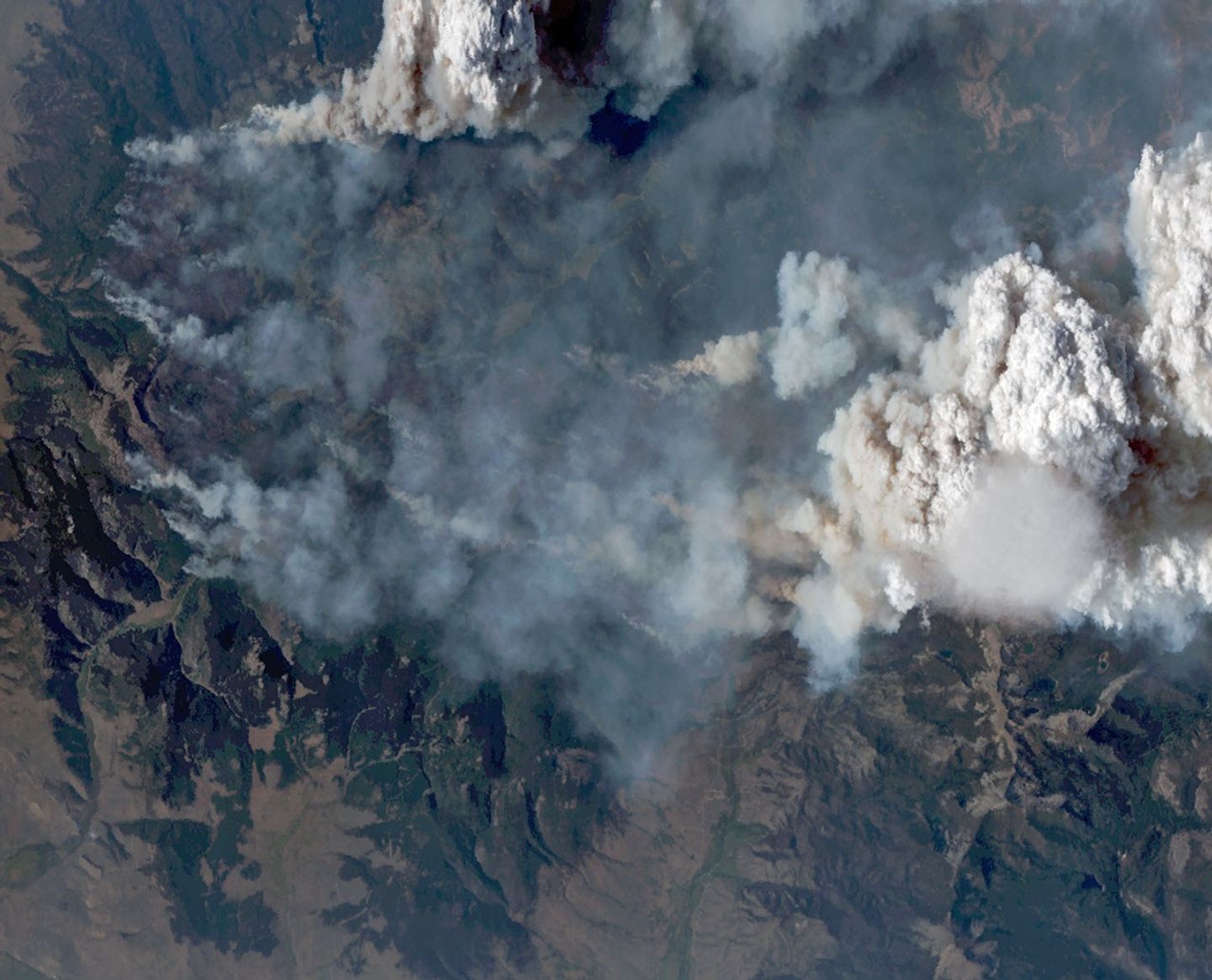
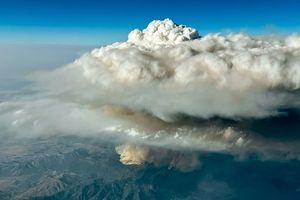
Natural-color aerial image of a wildfire in mountainous terrain. Thick gray and brown smoke spreads across much of the landscape, while a towering white pyrocumulus cloud rises at right. A smooth, thin pileus cloud hovers just below the main convective cloud.
NASA Earth Observatory/Michala Garrison

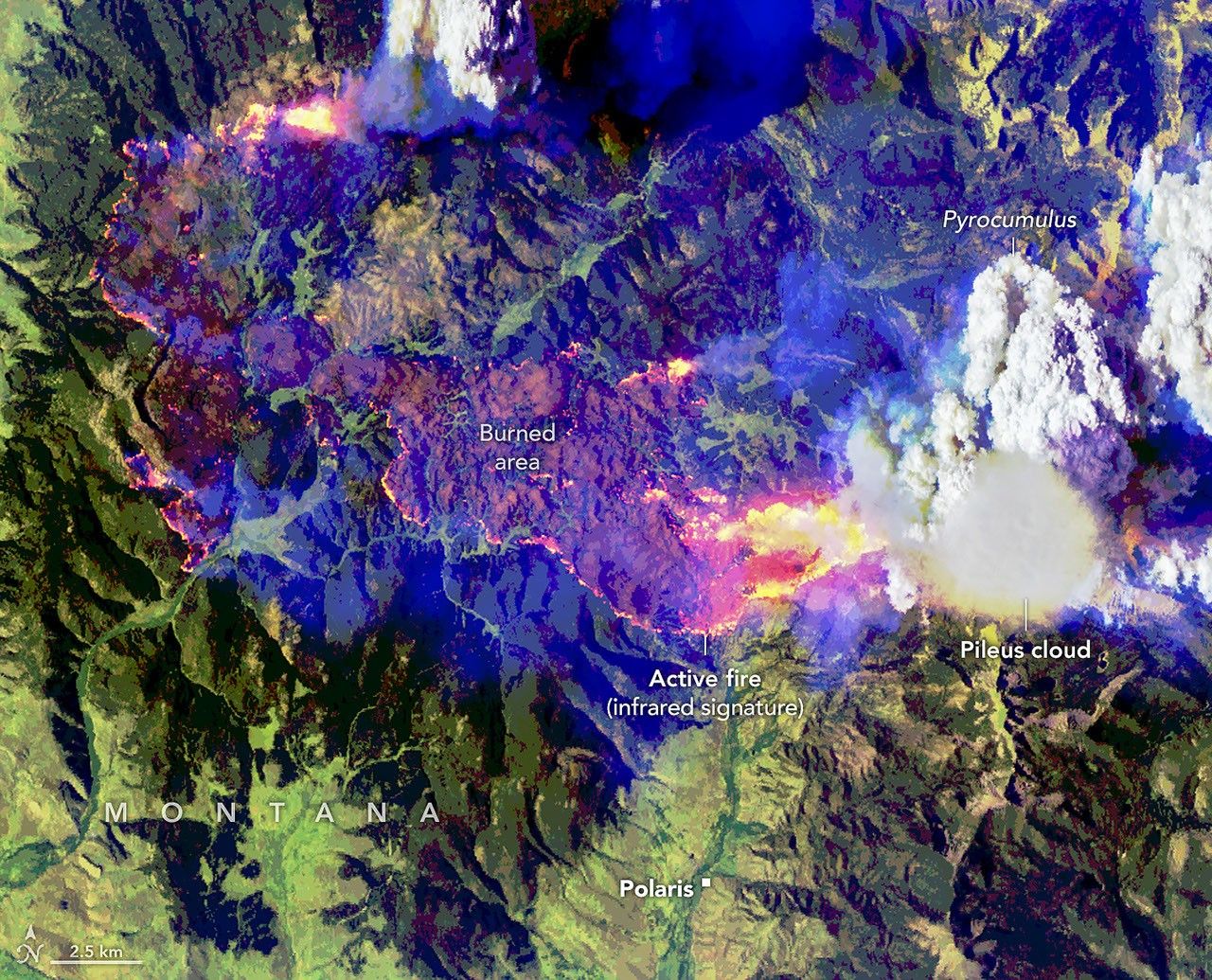
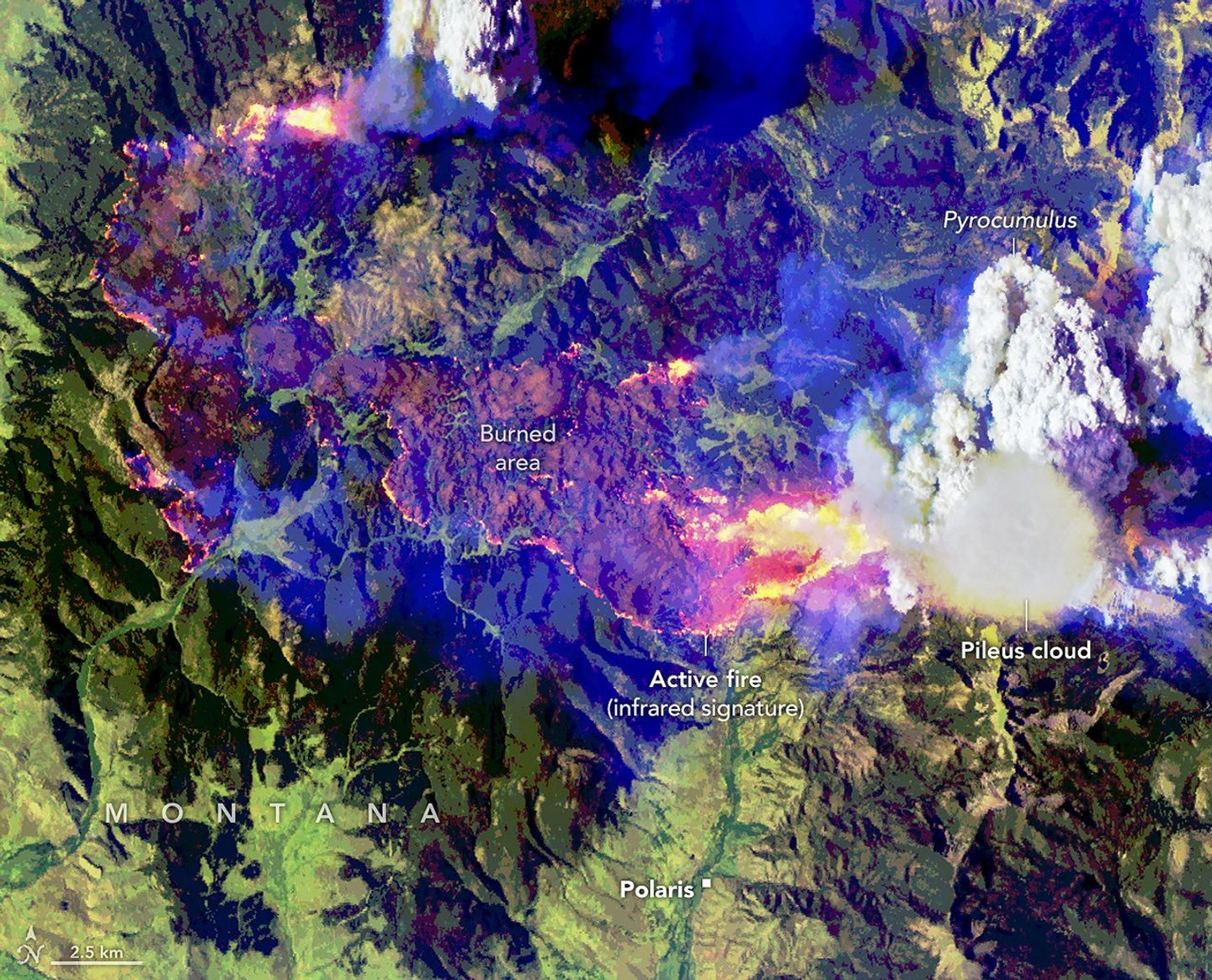
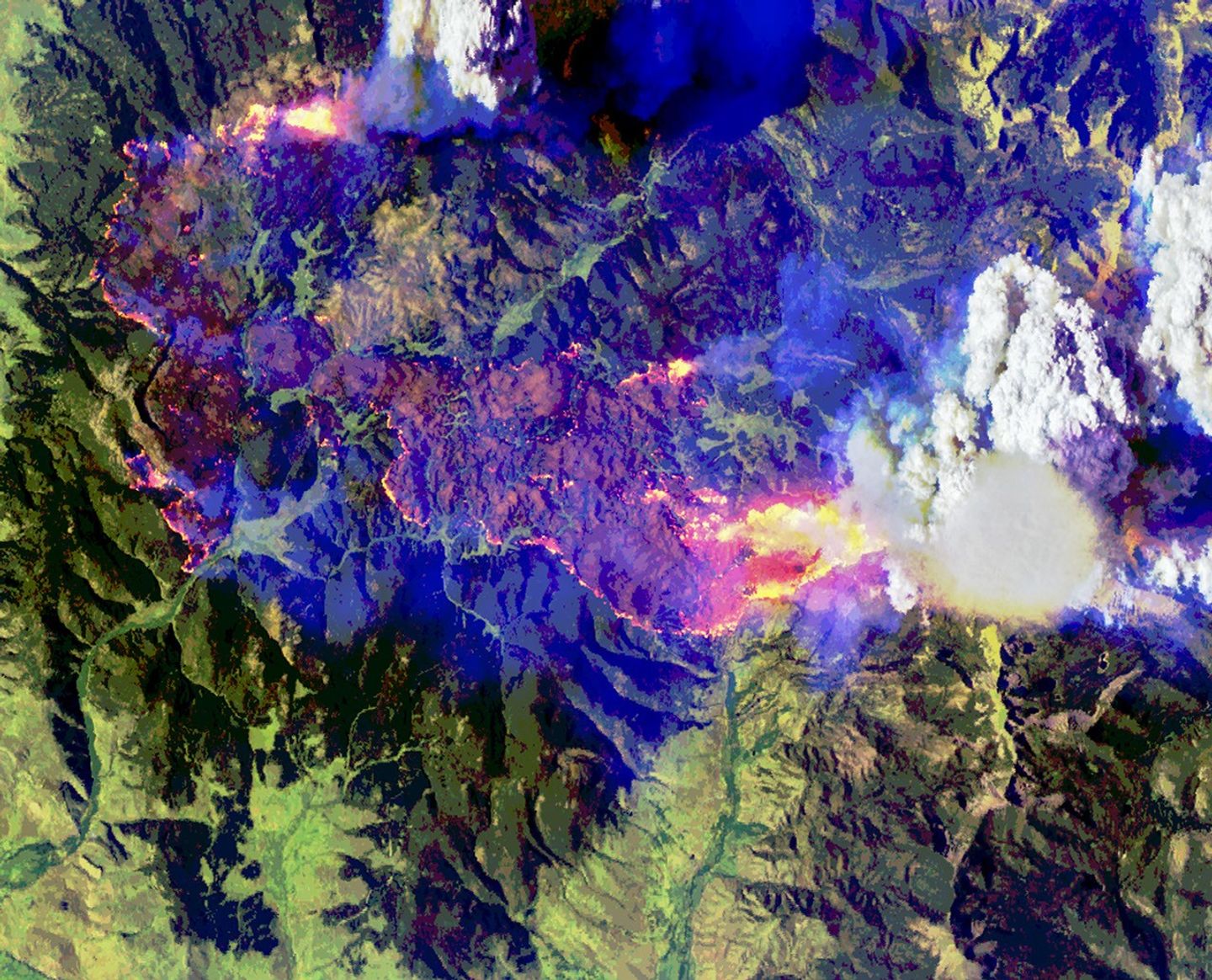
False-color aerial image of the same wildfire. Active fire fronts appear bright pink, magenta, and yellow around a large brown burned area. A towering white pyrocumulus cloud rises from the fire at right. A smooth, thin pileus cloud obscures part of its top.

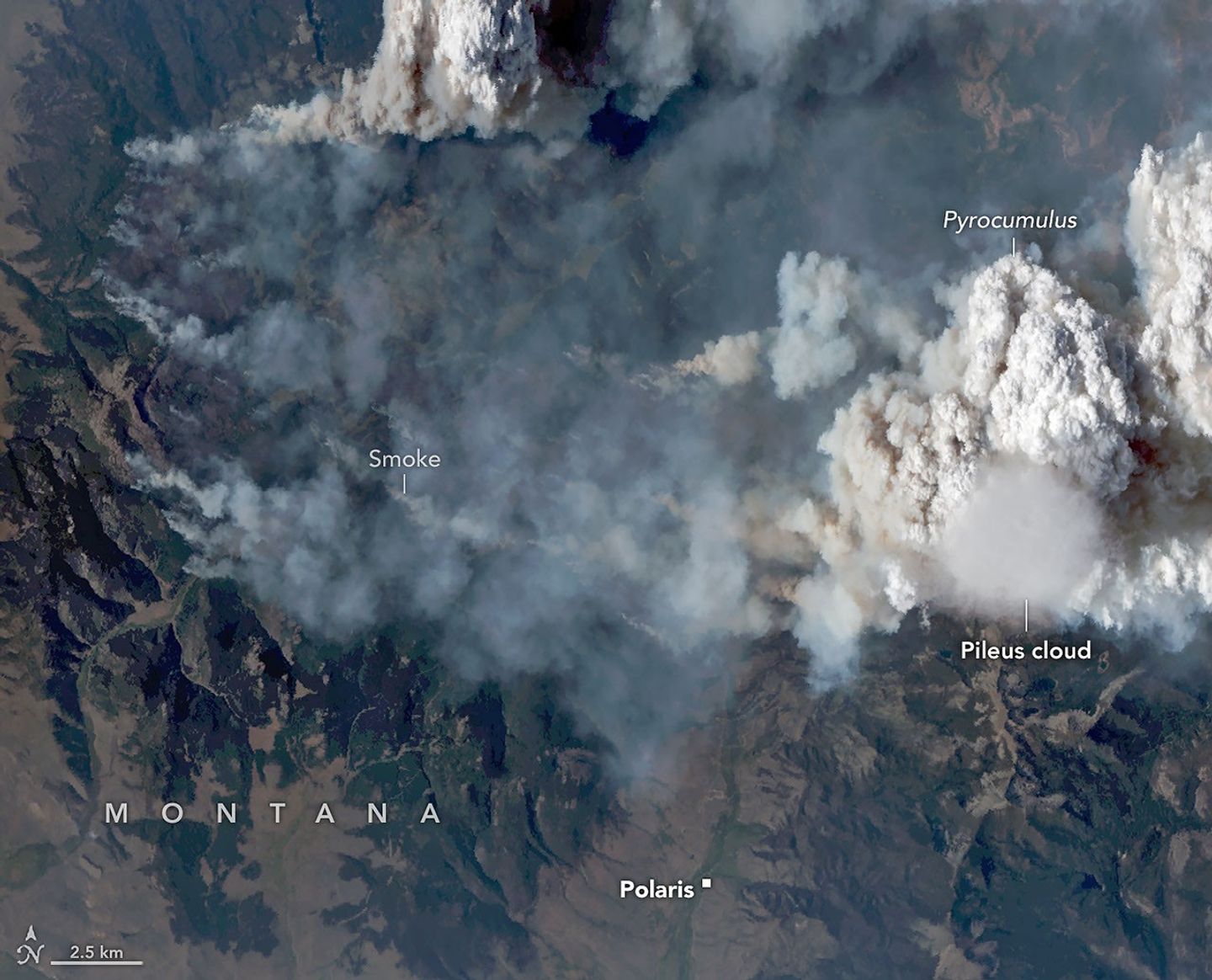
Natural-color aerial image of a wildfire in mountainous terrain. Thick gray and brown smoke spreads across much of the landscape, while a towering white pyrocumulus cloud rises at right. A smooth, thin pileus cloud hovers just below the main convective cloud.
NASA Earth Observatory/Michala Garrison

False-color aerial image of the same wildfire. Active fire fronts appear bright pink, magenta, and yellow around a large brown burned area. A towering white pyrocumulus cloud rises from the fire at right. A smooth, thin pileus cloud obscures part of its top.

natural color

swir


A pileus cloud veils part of a pyrocumulus rising from the Sand Creek fire in Montana on August 11, 2026, in images captured by the MASTER (MODIS/ASTER Airborne Simulator) on NASA’s ER-2. In the false-color image (right) active fires appear pink and yellow, burned areas brown, clouds white, and smoke blue-purple. MASTER images by RoseAnne Dominguez, annotated by Michala Garrison.

In summer 2026, scientists took to the air to intercept and study the towering, smoke-infused clouds that wildland fires sometimes create. But during an August 11 flight over the Sand Creek fire in Montana, they came back with a bonus—observations of an ephemeral pileus cloud hovering atop one of the towering fire clouds.

Smooth, veil-like pileus clouds are well-known to atmospheric scientists and cloud lovers and regarded as signs of especially vigorous convection. But researchers rarely observe a pileus cloud interacting with a fire cloud—known as a pyrocumulus (pyroCu)—in as much detail as they did on this flight, part of NASA’s INSPYRE (Injected Smoke and Pyrocumulonimbus Experiment) campaign.

Named after the Latin for “cap,” pileus clouds typically form when rising columns of air collide with a sufficiently moist layer of air aloft. Over the Sand Creek fire, a fast-rising updraft heated by the fire displaced air vertically and forced a horizontal layer of moister air sitting above it upward. The process is similar to how air forced over a mountain can produce clouds, explained Neil Lareau, INSPYRE’s deputy project investigator. “But in this case, the pyrocumulus itself was the ‘mountain,’” he said. As the displaced air was pushed upward, it cooled, and its water vapor condensed into a pileus cloud.

The pair of images above was captured at 5:40 p.m. local time (23:40 UTC) by the MASTER (MODIS/ASTER Airborne Simulator) on one of NASA’s ER-2s, a type of high-flying research aircraft. The natural-color image on the left shows the thin, circular pileus atop the turret of smoke and water rising from the spreading wildfire. The image on the right shows the same moment but includes shortwave-infrared (SWIR) observations, which reveal the burned area and actively burning spots along the fire’s perimeter.   
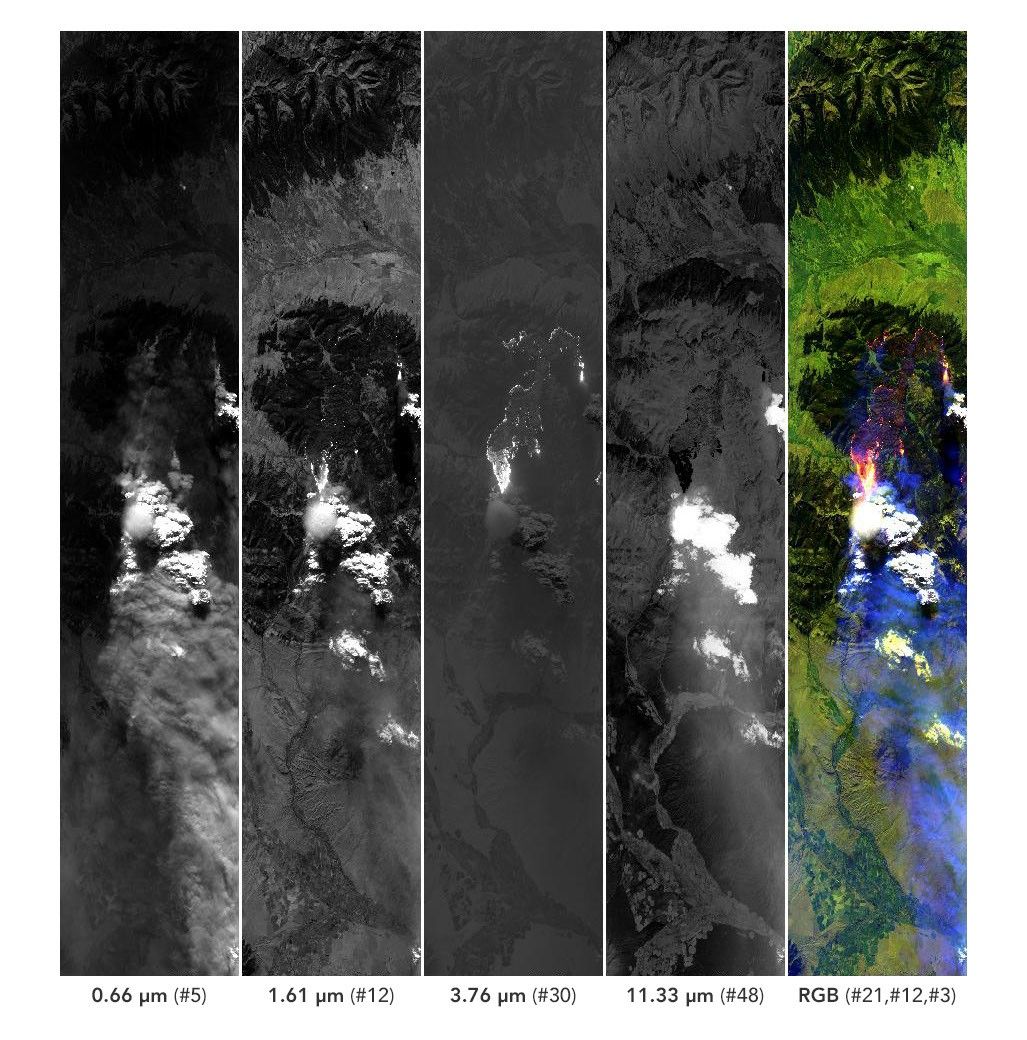
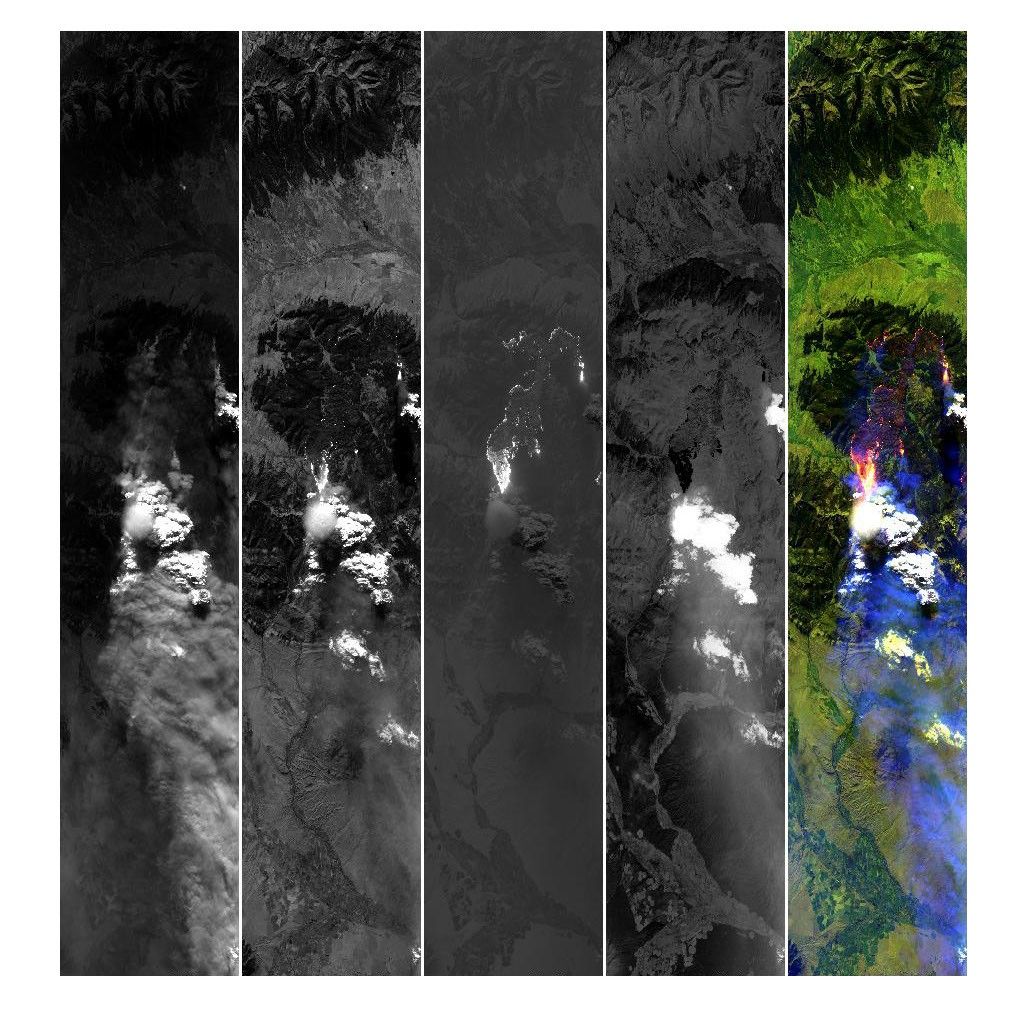
Five side-by-side panels from the MASTER instrument show a wildfire and its smoke plume. The four left panels are grayscale views of the scene at progressively longer wavelengths. The rightmost panel is a false-color composite in which active fires appear pink and yellow, burned areas in purple, smoke in purple, and clouds in white.
MASTER captures data at 50 different spectral bands, including at wavelengths of 0.66, 1.61, 3.76, and 11.33 micrometers. The strip on the far right combines information from three spectral bands.
MASTER/RoseAnne Dominguez.

Pileus clouds are usually quite short-lived, often persisting for only a few minutes before being overtaken by the underlying convection. During this flight, the scientists collected MASTER imagery of the plume roughly every 30 minutes, and the pileus was clearly visible in just one scene. The presence of the cloud hints at what Lareau described as the “extreme updraft dynamics” within the fire plume and pyrocumulus. At the time of the image, he explained, the fire was making a rapid run up the western side of Mount Comet as winds aligned with the drainage channels leading up the mountain.

“The whole scene is amazing,” he said, noting that the science team was fortunate that MASTER’s visible channels captured the rapidly developing pyrocumulus and pileus cloud, its infrared channels captured the fire’s extreme surface behavior, and downward-pointing radars on the airplane studied the cloud structure. “This scene is in many ways the core of what we’re after with INSPYRE,” he said. “We were able to connect and map the surface fire dynamics to the convective plume to the cloud processes.” The image above shows the cloud in four of the 50 channels, or bands, measured by MASTER. The false-color panel on the far right of the image is a combination of shortwave-infrared and visible observations, similar to the right image at the top of the page.

Fires are just one driver of convection that can produce pileus clouds. Vigorous updrafts associated with severe thunderstorms can also produce these wispy clouds. Researchers who participated in NASA’s CRYSTAL-FACE (Cirrus Regional Study of Tropical Anvils and Cirrus Layers-Florida Area Cirrus Experiment) in Honduras in 2002 reported the presence of thin cirrus clouds in the tropopause above thunderstorms that were likely the products of pileus clouds.

Volcanic eruptions can produce pileus clouds as well. One of the more stunning images captured by astronauts and published by NASA Earth Observatory is this photograph of a pileus cloud cloaking the top of a volcanic plume rising from the Sarychev volcano after an eruption in 2009.

MASTER images by RoseAnne Dominguez (Airborne Sensor Facility), annotated by Michala Garrison. Story by Adam Voiland.
References & Resources

You may also be interested in:

Stay up-to-date with the latest content from NASA as we explore the universe and discover more about our home planet.
Chasing Fire Clouds in Utah

6 min read

NASA aircraft are sampling smoke lofted high into the atmosphere by one of the most formidable cloud types in the…

Article

Smoke Streams Across Eastern Washington

3 min read

Wildland fires in early August 2026 pushed air quality to unhealthy levels, destroyed hundreds of structures, and triggered mandatory evacuations…
Article

Cottonwood Fire Chars Utah

5 min read

The blaze burned more than 150 square miles and swept through parts of a ski resort.

Article

Source: science.nasa.gov

APOD: 2026 September 29 – Sh2-188: The Shrimp Nebula

APOD

Astronomy Picture of the Day

Discover the cosmos! Each day a different image or photograph of our fascinating universe is featured, along with a brief explanation written by a professional astronomer.

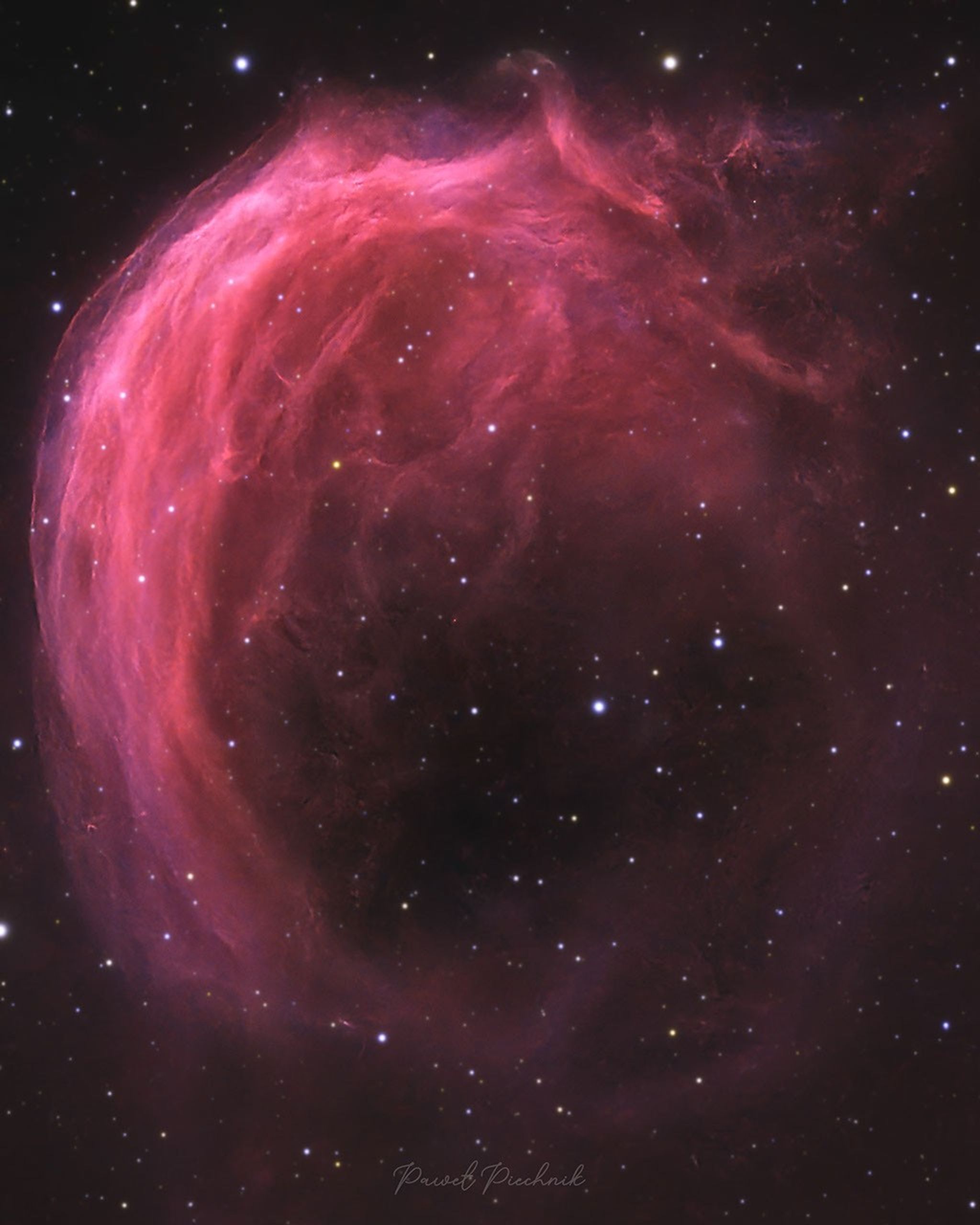
A starfield has a bright pink swirling nebula  in it. The top part of the nebula shows much detail, while the bottom part is mostly open.

Sh2-188: The Shrimp Nebula

Explanation: What causes the swirl in the Shrimp Nebula? Its high speed is likely. What is sure is that Sh2-188 is one of the larger planetary nebulas on the night sky, by angular size, spanning about half the diameter of the Moon. Moreover, the white-dwarf core — leftover from the Sun-like star that shed its outer atmosphere — is moving unusually fast through interstellar space, creating a bow shock most visible on the upper left that is similar to a boat plowing through water. Although faint, the Shrimp Nebula glows also by compressing and brightening gas on its leading edge. The featured image was taken in the light of hydrogen, sulfur, and oxygen by a backyard telescope in Krakow, Poland and then digitally adjusted to approximate the nebula‘s true colors.

APOD’s email for image submissions has changed. Please see: APOD Submissions
APOD’s main NASA site has moved: From apod.nasa.gov to science.nasa.gov/apod
Tomorrow’s picture: open space

Date September 29, 2026
Credit & Copyright Pawel Piechnik
Authors & editors: Robert Nemiroff, Jerry Bonnell, Cecilia Chirenti, Keighley Rockcliffe
A service of: ASD at NASA / GSFC,
NASA Science Activation & Michigan Tech. U.

Source: science.nasa.gov
Under the Microscope: NASA-Made Material for Moon Manufacturing

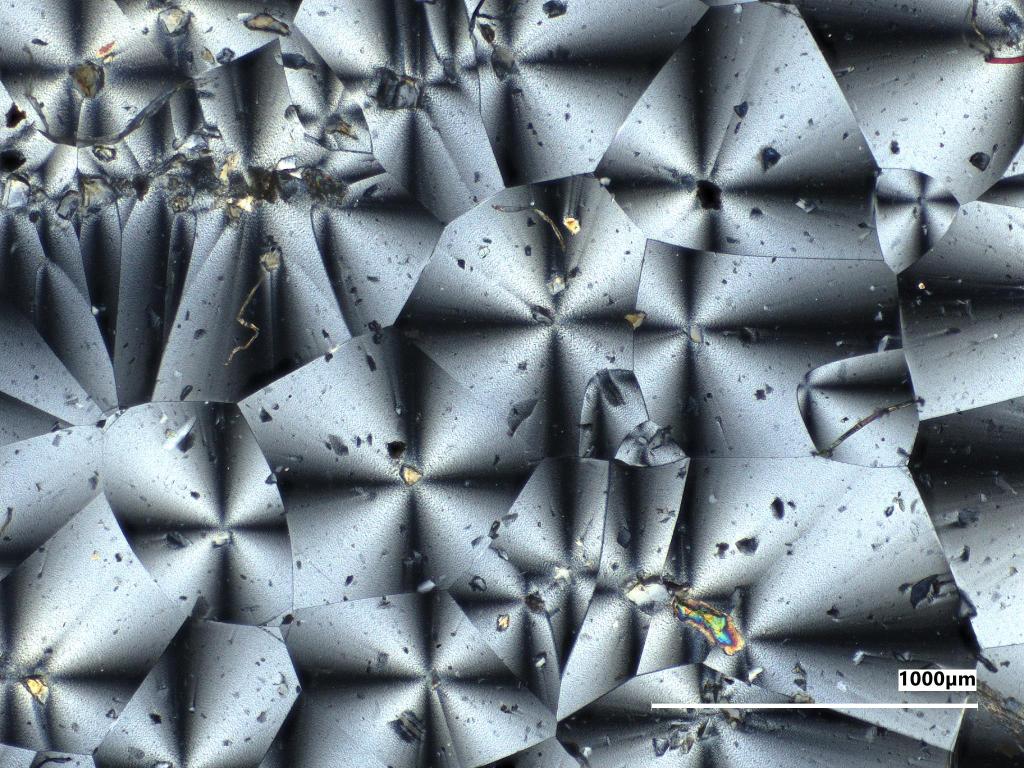
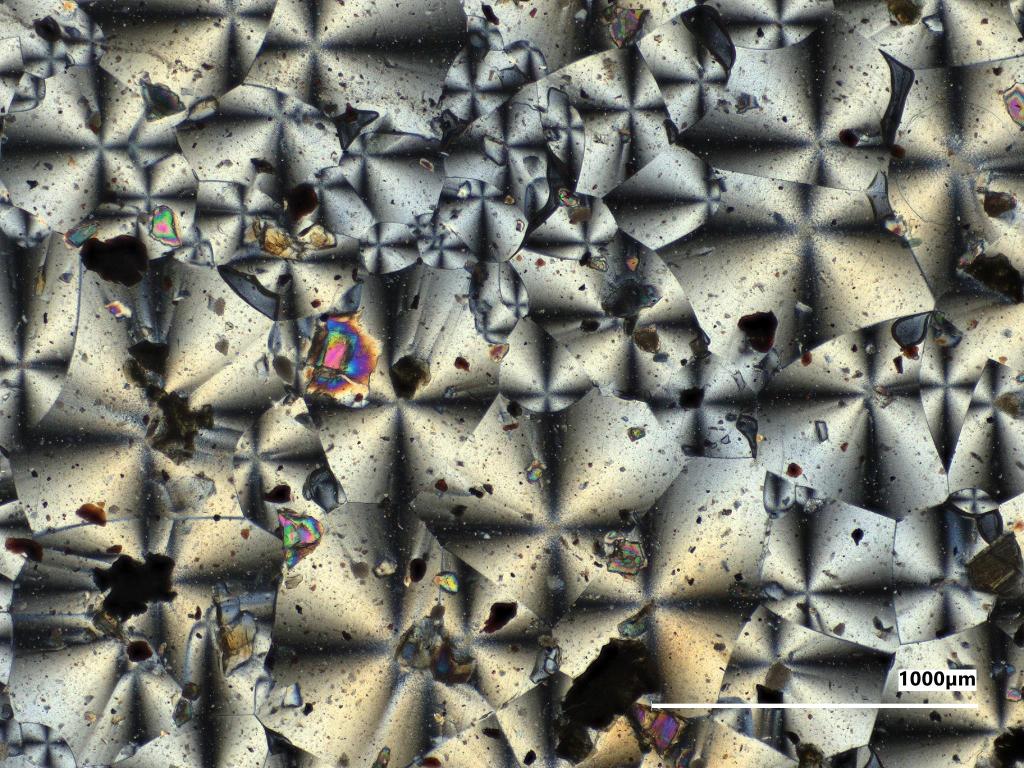
Photos taken using a microscope reveal the colorful, kaleidoscope-like crystal structure of a new NASA-made material that could be used for manufacturing during future space missions. Developed at NASA’s Glenn Research Center in Cleveland, the material could be created directly on the Moon or Mars, allowing NASA to pack fewer supplies — saving weight and reducing launch costs. 

To make the material, research chemical engineer Allison Christy and her team of summer interns at NASA Glenn — Tyler Klinchuch, Ethan Bilodeau, and Emma Levenson — mixed a special plastic with simulated Moon and Mars dust. This plastic is biodegradable and could be produced by bacteria fed with crew waste or carbon dioxide. 

“The plastic literally grows within the bacteria’s little bodies,” Christy said. “It’s really cool.” 

The team found that incorporating simulated lunar and Martian dust particles into this plastic made it stronger and easier to process. Adding different types and amounts of dust allowed them to adjust the material’s properties. The gray image shows sample material manufactured using mock Moon dust, while the reddish image shows material made with mock Mars dust.  

The material could be used to manufacture equipment used inside future Moon or Mars habitats, like structural brackets, wrenches, or chairs. By potentially enabling on‑demand, fully recyclable fabrication with lunar surface material, this could help advance NASA’s objective of a permanent Moon Base by reducing resupply needs and empowering crews to build and repair essential equipment on-site. 

“You can’t just bring everything with you to the Moon or Mars,” Christy said. “If something breaks, you have to find a way to fix it with what you have. This is a very versatile material, which is a huge benefit.” 

Going forward, the team hopes to analyze whether this material could also be used outside in the harsh environments of the lunar or Martian surfaces.  

The material is now undergoing testing in Glenn’s Lunar Environment Structural Test Rig to see how it holds up in extreme temperatures. Several samples are also slated to launch aboard the upcoming Materials International Space Station Experiment 23 (MISSE-23) mission and will be exposed to intense conditions outside the station. 

This research is funded through NASA Glenn’s 2026 Center Innovation Fund, which is managed by the agency’s Research and Technology Mission Directorate.  

Learn more about the program:

https://www.nasa.gov/center-innovation-fund/ 

Source: www.nasa.gov

NSTGRO 2026

NSTGRO Homepage

Omar Alyousef
University Of Memphis
Polycatenated Architected Materials (PAM) for Origami-Inspired Space Docking Ports

Cade Armstrong
University Of Texas at Austin
Intelligent Multi-Agent Constellations for Cooperative Cislunar Operations

Laurel Barnett
Harvard University
Photonic SNSPD Readout and Feed Forward System for Improved Optical Communication Capabilities

Katie Barcak
William Marsh Rice University
Compact magnetic heat switch for thermal management of long duration low power exploration missions

Austin Bodin
University Of Colorado, Boulder
Rapid Robust Trajectory Design via Motion Funnels in Multi-Body Systems

William Bodnar
North Carolina State University
Near-field Thermophotovoltaics for Extraterrestrial Surface Power Generation

Diana Bolanos
University of California, Berkeley
Origami-inspired lattice architectures for robotic assembly and reconfiguration of modular space structures

Annalise Cabra
University Of Colorado, Boulder
Development of RF Hydrogen Plasma for Ion-Assisted Metal Processing of Lunar Regolith

William Callahan Eshleman
University of Illinois at Urbana-Champaign
Plume-Surface Interaction Experiments for Physics-Informed Ejecta Modeling

Alexander Chin
University of Washington
Adaptive Wire-Bent Compliant Attachment Aids for Small Satellite Docking and ISAM Applications

Eric Comstock
Georgia Institute of Technology
Vlasov Simulation Methods for Air Breathing Electric Propulsion

Rachel Constantin
University Of Tennessee
High-Speed Tomographic Background-Oriented Schlieren for Supersonic Retropropulsion Characterization

Andrew Dean
University Of Central Florida
Power and Mass Determination for Scalable Molten Salt Powered Lunar Outposts

Lars Erickson
University Of Minnesota
Embedded Normal Form Algorithms for Low-Cost Cislunar Navigation

Elsa Forberger
University Of Southern California
Capability-Aware Planning and Control of Multi-Robot Teams for Resilient Lunar Cargo Transport

Abigail Glover
Colorado School Of Mines
Standardizing Regolith Terramechanics Properties via Multi-Modal Characterization for Risk-Aware Navigation in Rovers

Emily Gokie
University Of Colorado, Boulder
A low-SWaP timing system for distributed in-orbit and planetary surface platforms

Elan Graupe
University Of Minnesota
Model-Driven Navigation for Robust Spacecraft Atmospheric Entry and Descent

Nikki Hart
William Marsh Rice University
Lifelong Plan Adaptation for Robot Manipulation Starting from One Example

Elizabeth Hoerber
Georgia Institute of Technology
High-Precision Landing Using Visual-Inertial Odometry

Theodore Houser
University Of Chicago
ECLiPSe: ElectroChemical Liquid Propellant Synthesis

Hannah Hutton
University of Michigan
RESIST: Radiation-Enabled Structural Improvement in Space Materials

Joseph Hwang
Purdue University
Experimental and Computational Study of Spray Cooling for Propellant Tank Thermal Management

John Lance
North Carolina State University
Predicting RDRE Thermal Loads and Performance through Accurate Detonation Modeling

Madison Lin
University of Colorado, Boulder
Autonomous Trajectory Anomaly Detection and Replanning in Cislunar Space

Breno Macarenhas Pontes
University Of Colorado, Boulder
Development of a Compact, Wide-Field X-ray Navigation Sensor for Simultaneous Multi-Pulsar Tracking

Emilia Mann
William Marsh Rice University
Advanced, 3D Knit Autonomous and Reconfigurable Soft Robots for Sustainable Planetary Surface Logistics

Alanis Matias-Perez
Colorado School Of Mines
Linking Thermophysical Properties and Electrochemical Behavior in Molten Regolith Electrolysis

Connor McCleery
Yale University
Ultrafast, High-Temperature Sintering of Mechanically Robust, Spectrally Selective Coatings for Cryogenic Propellant Storage

Eleni Mowery
University of Michigan
Multiphysics Simulation of Vapor Core Nuclear Reactors with MHD Power Conversion

Dillon Mulrooney
University of Illinois at Urbana-Champaign
Internal Pressure in Pyrolyzing Ablators for Atmospheric Entry

Robert Muldrow
University of Florida
Enabling Autonomous SmallSat Robotic Docking via Novel Electrical & Data Interface

Ari Nadelson
University of Illinois at Urbana-Champaign
Designing Solid State Batteries & Electrolytes for Low Temperature Applications

Karl Pederson
University Of Minnesota
Lightweight Metamaterial Smart Windows for Human Space Exploration

Abbey Piatt Price
Columbia University
Leveraging Protonic Solid-Oxide Electrochemical Cells for Process Intensification of H2 Recycling and In-Situ Resource Production

Rithvik Ramesh
California Institute of Technology
Integrated Opto-Electronically Mode-Locked Laser for Space Applications

Alexander Roush
Colorado School Of Mines
Adaptive Autonomy for Lunar Regolith Construction through Graph-Based Planning and Physics-Informed Surrogate Modeling

Samuel Russell
Johns Hopkins University
Particle concentration and surface topography during plume-surface interaction

Jamie Santos
Oregon State University
Dynamic Multi-Objective Prioritization for Autonomous Robot Teams on the Moon and Mars

Liam Smego
Georgia Institute of Technology
A Differential Geometric Approach to Autonomous Navigation

Truman Stoller
University Of Nebraska, Lincoln
Proposing an Advanced Heat Pipe: an Innovative Pumpless Flow Boiling Device

Tetiana Tymoshevska
University of Michigan
Liquid Droplet Radiator Enabled by an Electrospray Array

James Wall
Massachusetts Institute of Technology
A new model for cavitation in rocket engine turbopump inducers

Adam Zheng
Texas A&M University
Coupled Thermal-Structural Design of Self-Deploying Reflectors for Solar Energy Distribution to Lunar Surface Assets

Albert Zhou
California Institute of Technology
Master-Equation-Informed Reduced-Order Model for Non-Equilibrium Thermochemistry of Air in Planetary Entry

Eleanor Zimmermann
Michigan Technological University
Radiative Passive Processing Technology for Offworld Resource Separation (RaPPTORS)

Details

Last Updated

Sep 29, 2026

Editor
Loura Hall

Source: www.nasa.gov

NASA Opens Applications for Second Season of ORBIT Student Challenge

2 Min Read

NASA Opens Applications for Second Season of ORBIT Student Challenge

Following a successful inaugural year of ingenuity and career building, NASA ORBIT (Opportunities in Research, Business, Innovation, and Technology) has officially returned for a second season to bring university and college student innovation to the forefront of Earth technology development and deep-space exploration.

Registration for the 2026–2027 challenge is open through Monday, Nov. 16, 2026, through the NASA STEM Gateway.

Expanded for its second season with up to $500,000 in total prize funding, NASA’s ORBIT invites student teams to explore their boldest ideas and invent their brightest solutions. Through the competition, students must conduct targeted research, conceptualize early models, and perform feasibility analyses to refine their proposals. Top-performing teams earn a spot at the in-person Pitch Showcase to present their solutions to a panel of expert judges, who select award recipients based on their presentations and interactive Q&A sessions.

ORBIT has two challenge tracks for teams to choose from. Participants in the ORBIT Earth track must select a NASA-owned patent and develop novel commercial or nonprofit applications addressing critical terrestrial problems. Whether reimagining drones for reduced noise pollution or designing improved medical technology for better patient care, students must demonstrate clear pathways to public benefit.

The ORBIT Space focuses on next-generation space exploration technology designed to support NASA’s Artemis program and future initiatives to establish a sustainable human presence on the Moon, Mars, and beyond. Teams competing in this track develop viable concepts for power, communications, navigation, living solutions, astronaut health and well-being, and more.

Projects that successfully unite the goals of both the Earth and Space tracks can also qualify for a special Integration Bonus, but this season also introduces two new specialty recognitions: the Faculty Advisors’ Choice Award, celebrating professionalism and cross-team communications, and the Next Steps Award, recognizing teams with the strongest roadmaps to continuing their project development after the conclusion of the challenge.

Together with core prizes, ORBIT celebrates student excellence and drives key technical solutions while building a pipeline of interdisciplinary talent. The challenge provides students with immersive experience in NASA’s core missions, direct access to agency mentors, and industry-ready skills that bridge academia and aerospace careers.

For complete competition details, eligibility requirements, and official rules, visit: https://nasaorbit.org/

Registration is open until Nov.16, 2026, through the NASA STEM Gateway.

Source: www.nasa.gov

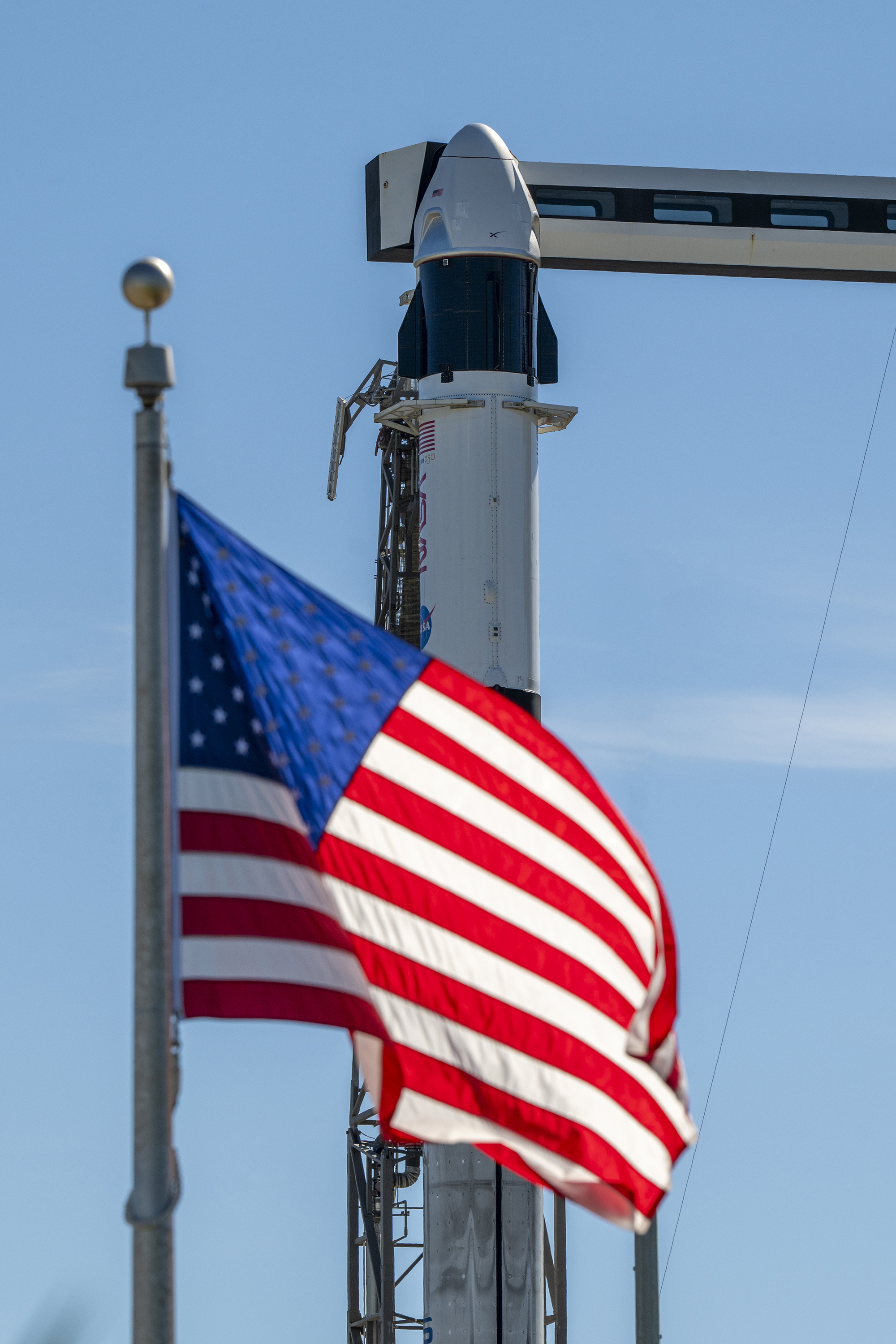
Crew-13 Rocket and Spacecraft at Launch Pad

A close-up view of a SpaceX Crew Dragon spacecraft mounted atop a Falcon 9 rocket on the launch pad. The capsule and trunk are connected to ground support hardware, with NASA and mission insignia visible on the rocket’s exterior against a bright blue sky. in the foreground in the American flag.
SpaceX

Ahead of NASA’s SpaceX Crew-13 mission launch, a SpaceX Falcon 9 rocket and Dragon spacecraft are vertical at the launch pad of Space Launch Complex 40 at Cape Canaveral Space Force Station in Florida in this Sept. 27, 2026, photo.

NASA astronauts Jessica Watkins and Luke Delaney, CSA (Canadian Space Agency) astronaut Joshua Kutryk, and Roscosmos cosmonaut Sergey Teteryatnikov are scheduled to launch to the International Space Station for a long-duration science mission on Oct. 1.

Image credit: SpaceX

Source: www.nasa.gov

NASA Sets Crew-13 Launch, Docking Coverage

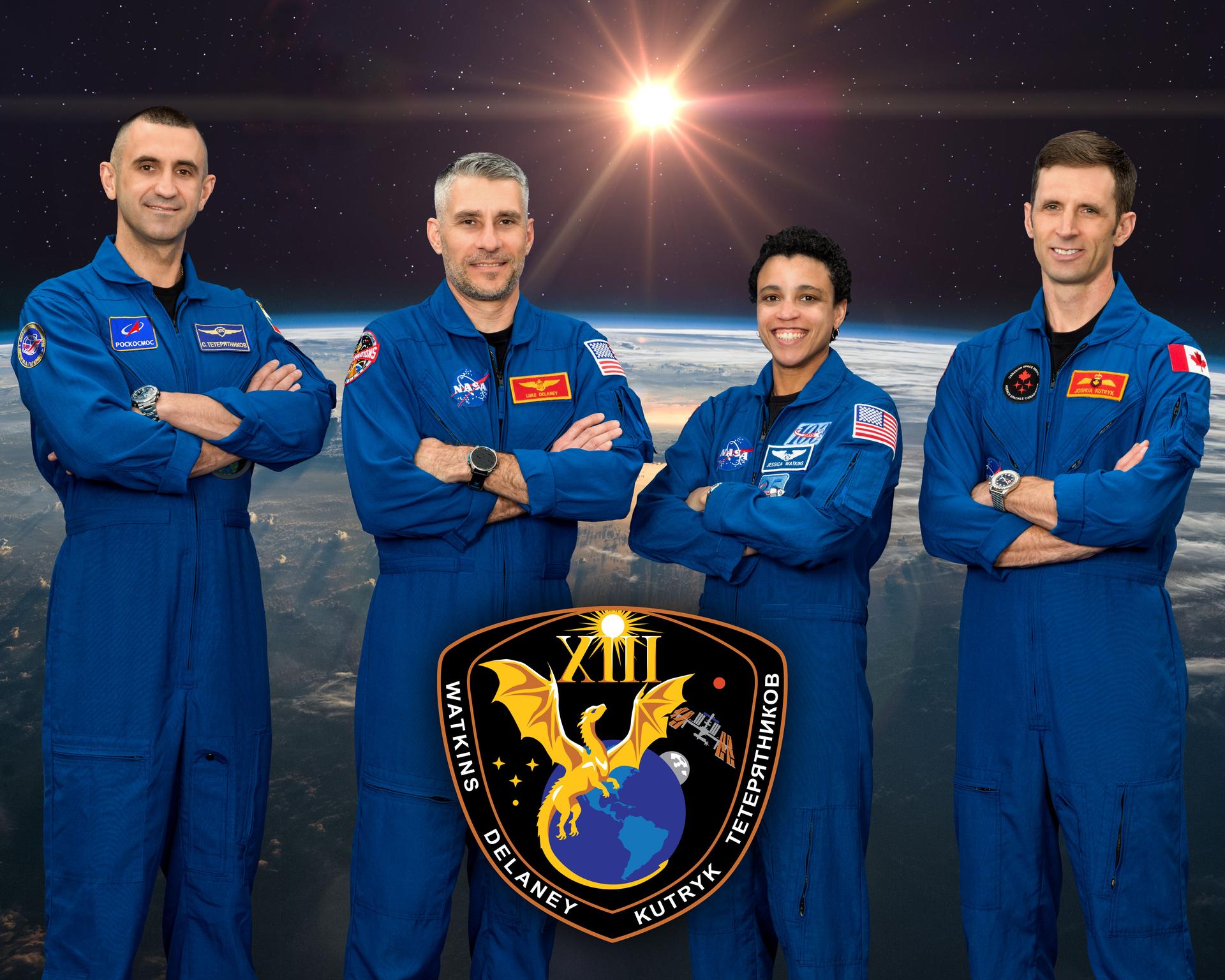
The four members of NASA's SpaceX Crew-13 mission to the International Space Station pose together for an official crew portrait. From left are, Roscosmos cosmonaut and Mission Specialist Sergey Teteryatnikov, NASA astronauts Luke Delaney and Jessica Watkins, Pilot and Commander respectively, and CSA (Canadian Space Agency) astronaut and Mision Specialist Joshua Kutryk.
The four members of NASA’s SpaceX Crew-13 mission to the International Space Station pose together for an official crew portrait. From left are Roscosmos cosmonaut Sergey Teteryatnikov, NASA astronauts Luke Delaney and Jessica Watkins, and CSA (Canadian Space Agency) astronaut Joshua Kutryk.
Credit: NASA/Bill Stafford

NASA will provide live coverage of prelaunch, launch, and docking activities for the agency’s SpaceX Crew‑13 mission to the International Space Station.

Live coverage will stream through a variety of platforms. Learn where to watch online:

https://www.nasa.gov/live

Crew‑13 is scheduled to launch at 11:10 a.m. EDT, Thursday, Oct. 1, from Space Launch Complex 40 at Cape Canaveral Space Force Station in Florida, with docking planned for about 7 p.m. The SpaceX Dragon spacecraft will carry NASA astronauts Jessica Watkins and Luke Delaney, CSA (Canadian Space Agency) astronaut Joshua Kutryk, and Roscosmos cosmonaut Sergey Teteryatnikov to the International Space Station for a long-duration science mission.

Any events in person are only open to previously credentialed media. Call details are available to media upon request.

NASA’s Crew-13 mission coverage is as follows (all times Eastern and subject to change based on real-time operations):

Wednesday, Sept. 30

5 p.m.: Prelaunch news conference with the following participants:

  • Dr. Lori Glaze, associate administrator, Human Spaceflight Mission Directorate, NASA Headquarters
  • Dana Weigel, manager, Low Earth Orbit Program, NASA’s Johnson Space Center in Houston
  • Mathieu Caron, director, Astronauts, Life Sciences, and Space Medicine, CSA
  • William Gerstenmaier, vice president, Build and Flight Reliability, SpaceX
  • Arlena Moses, launch weather officer, Cape Canaveral Space Force Station’s 45th Weather Squadron

Media may ask questions in person and via phone. Limited auditorium space will be available for in-person participation. For the dial-in number and passcode, please contact the NASA Kennedy newsroom no later than one hour prior to the beginning of the news conference at: [email protected].

Thursday, Oct. 1

9:20 a.m.: Launch coverage begins

11:10 a.m.: Launch

Following the conclusion of launch coverage, NASA will provide audio-only discussions between Crew-13, the space station, and flight controllers during Dragon’s transit to the orbital complex.

12:45 p.m.: Postlaunch news conference with the following participants:

  • NASA Administrator Jared Isaacman
  • Dr. Lori Glaze, associate administrator, Human Spaceflight Mission Directorate, NASA Headquarters
  • Dana Weigel, manager, Low Earth Orbit Program, NASA Johnson
  • Mathieu Caron, director, Astronauts, Life Sciences, and Space Medicine, CSA
  • Julianna Scheiman, director, NASA Science and Dragon Programs, SpaceX

Media may ask questions in person and via phone. Limited auditorium space will be available for in-person participation. For the dial-in number and passcode, please contact the NASA Kennedy newsroom no later than one hour prior to the beginning of the news conference at: [email protected].

NASA’s live Crew-13 coverage returns with rendezvous and docking streaming on a variety of platforms. The planned 7-hour, 50-minute trip from launch to docking on Oct. 1 will be the fastest by a U.S. spacecraft in space station history.

5:20 p.m.: Arrival coverage begins

7 p.m.: Targeted docking to the forward-facing port of the station’s Harmony module

8:45 p.m.: Hatch opening followed by welcome remarks

All times are estimates and could be adjusted based on real-time operations after launch. Follow the space station blog for the most up-to-date operational information.

Once aboard the station, the crew members will conduct a brief handover with the agency’s SpaceX Crew-12 mission, which is expected to begin its return to Earth no earlier than Monday, Oct. 5. NASA will share additional details on Crew-12’s return after Crew-13’s arrival.

Media accreditation

The deadline for media accreditation for in-person coverage of this launch has passed. The agency’s media credentialing policy is available online. For questions about media accreditation, please email: [email protected].

Live launch video coverage

NASA will provide a live video feed of Space Launch Complex 40 approximately six hours prior to the planned liftoff of the Crew-13 mission. Pending unlikely technical issues, the feed will be uninterrupted until the prelaunch broadcast begins on NASA+, approximately two hours prior to launch. Once the feed is live, find it online at: http://youtube.com/kscnewsroom.

Media who need access to NASA live video feeds may subscribe to the agency’s media resources distribution list to receive daily updates and links.

Audio-only coverage

Launch audio also will be available on Launch Information Service and Amateur Television System’s VHF radio frequency 146.940 MHz and KSC Amateur Radio Club’s UHF radio frequency 444.925 MHz, FM mode, heard within Brevard County on the Space Coast.

Attend launch virtually

Members of the public may register to attend this launch virtually. NASA’s virtual guest program for this mission also includes curated launch resources, notifications about related opportunities or changes, and a stamp for the NASA virtual guest passport following launch.

NASA website launch coverage

Launch day coverage of the mission will be available on the NASA website. Coverage will include live streaming at 9:10 a.m. on Oct. 1, and blog updates as the countdown milestones occur.

On-demand streaming video and photos of the launch will be available shortly after liftoff. For questions about countdown coverage, contact the NASA Kennedy newsroom at 321-867-2468. Follow countdown coverage on the commercial crew blog.

Watch, engage on social media

Follow the Crew-13 mission on X, Facebook, and Instagram by following and tagging these accounts:

X: @NASA, @NASAKennedy, @Space_Station, @ISS National Lab, @SpaceX

Facebook: NASA, NASAKennedy, ISS, ISS National Lab

Instagram: @NASA, @NASAKennedy, @ISS, @ISSNationalLab, @SpaceX

NASA has delivered on its goal of safe, reliable, and cost-effective transportation to and from the International Space Station from the United States through a partnership with American private industry. This partnership is opening access to low Earth orbit and the International Space Station to more people, more science, and more commercial opportunities. For more than 25 years, people have continuously lived and worked aboard the space station, advancing scientific knowledge and demonstrating new technologies that enable us to prepare for human exploration of the Moon as we prepare for Mars.

For more information about the Crew-13 mission, visit:

https://www.nasa.gov/mission/nasas-spacex-crew-13/

-end-

Joshua Finch / Jimi Russell
Headquarters, Washington
202-358-1100
[email protected] / [email protected]

Steven Siceloff
Kennedy Space Center, Fla.
321-867-2468
[email protected]

Sandra Jones / Joseph Zakrzewski
Johnson Space Center, Houston
281-483-5111
[email protected] / [email protected]

Details

Last Updated

Sep 29, 2026

Editor
Jessica Taveau

Source: www.nasa.gov

October’s Night Sky Notes: Spooky Stargazing

2 Min Read

October’s Night Sky Notes: Spooky Stargazing

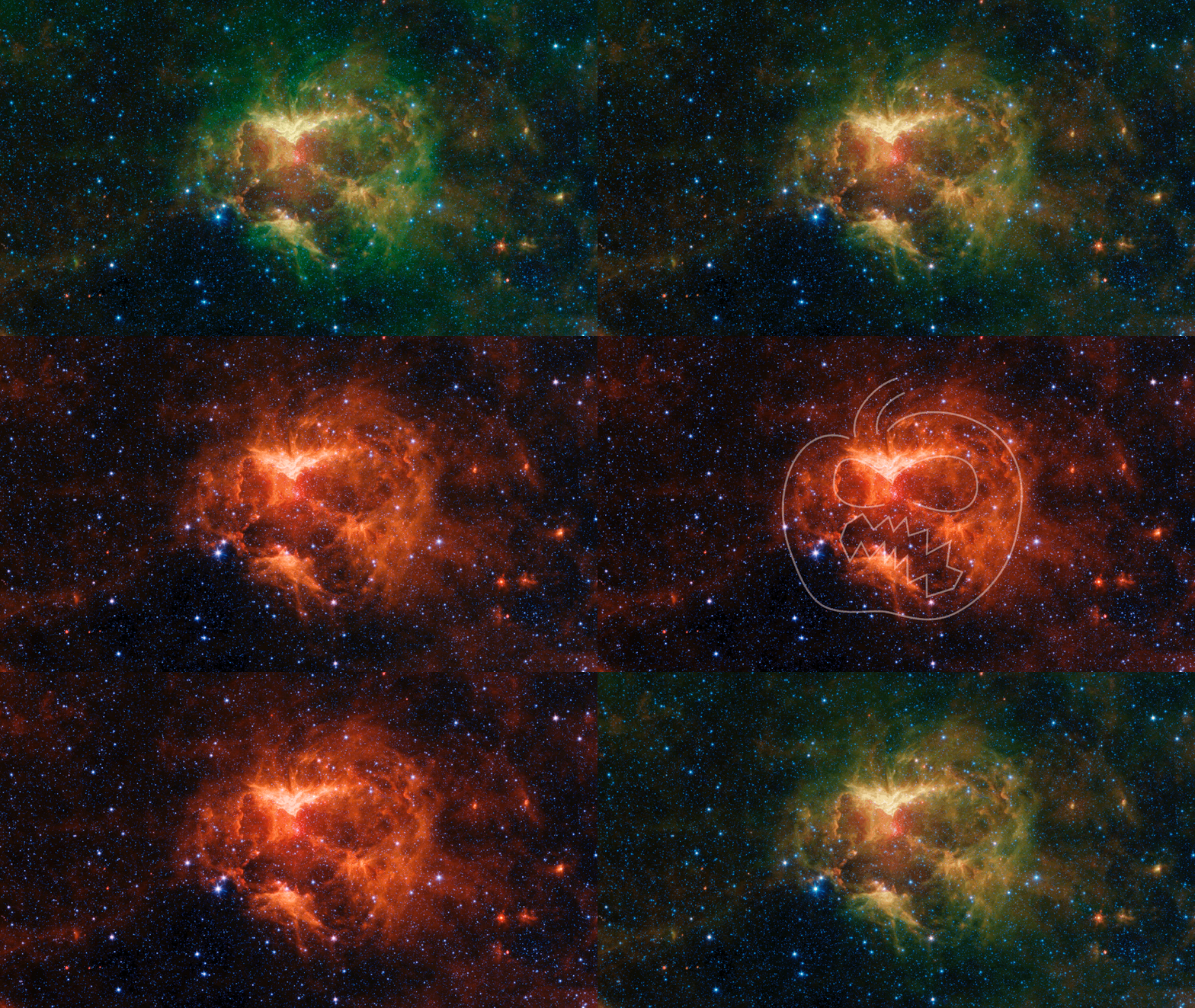
This infrared image from NASA's Spitzer Space telescope shows a cloud of gas and dust carved out by a massive star. A drawing overlaid on the image reveals why researchers nicknamed this region the Jack-o-lantern Nebula.

This infrared image from NASA’s Spitzer Space telescope shows a cloud of gas and dust carved out by a massive star. A drawing overlaid on the image reveals why researchers nicknamed this region the “Jack-o’-lantern Nebula.” Credit: NASA/JPL-Caltech

Credits:
NASA/JPL-Caltech

The Ghoul

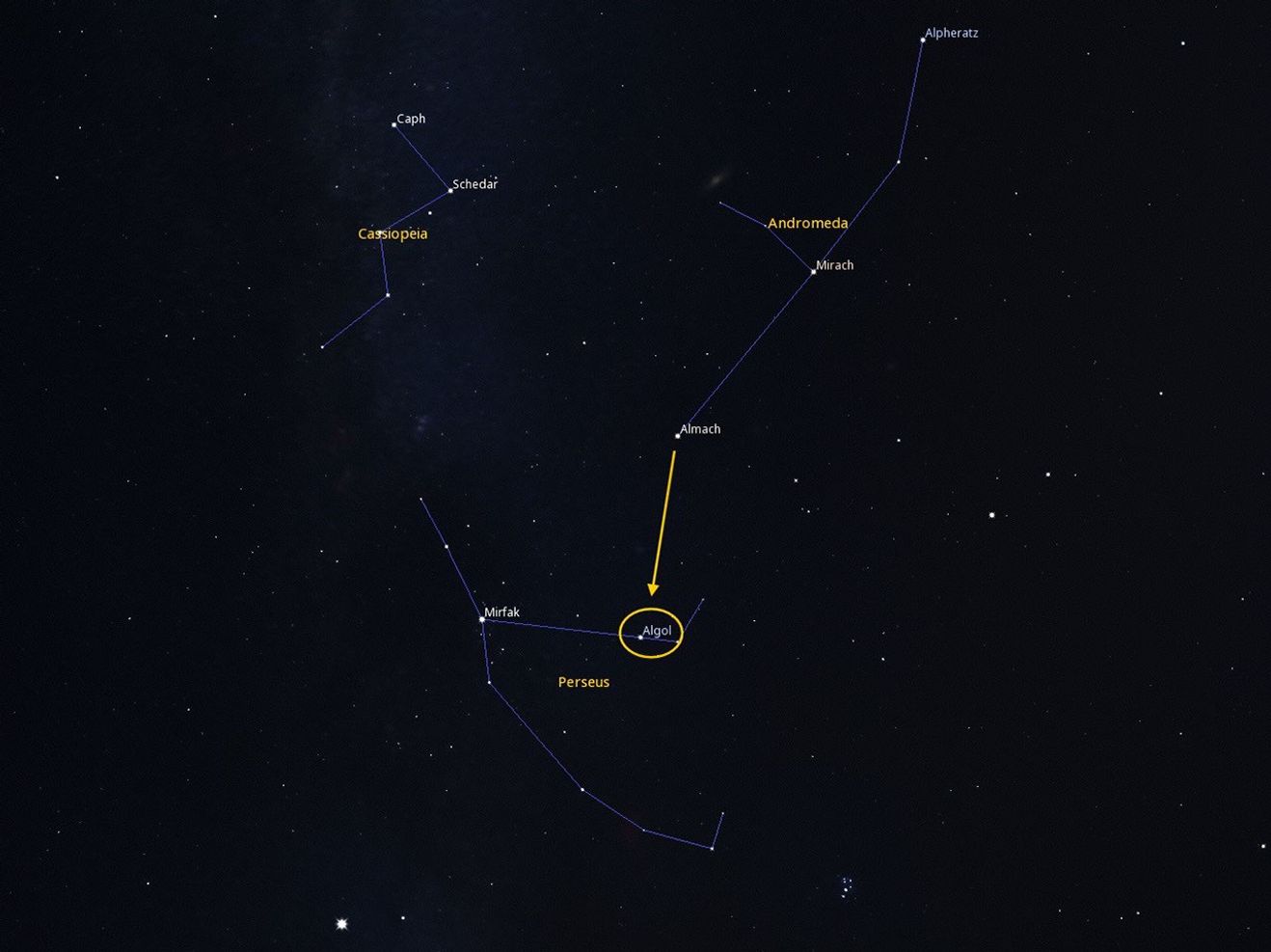
Located within the constellation Perseus lies a star called Algol, also known as ‘Demon Star’ or ‘The Ghoul’. You can spot this star during the autumn months, along with Cassiopeia and Andromeda in the northeastern sky, beginning after 9 PM. In Greek mythology, this star represents the ‘blinking eye’ of the gorgon Medusa. But how can a star blink?

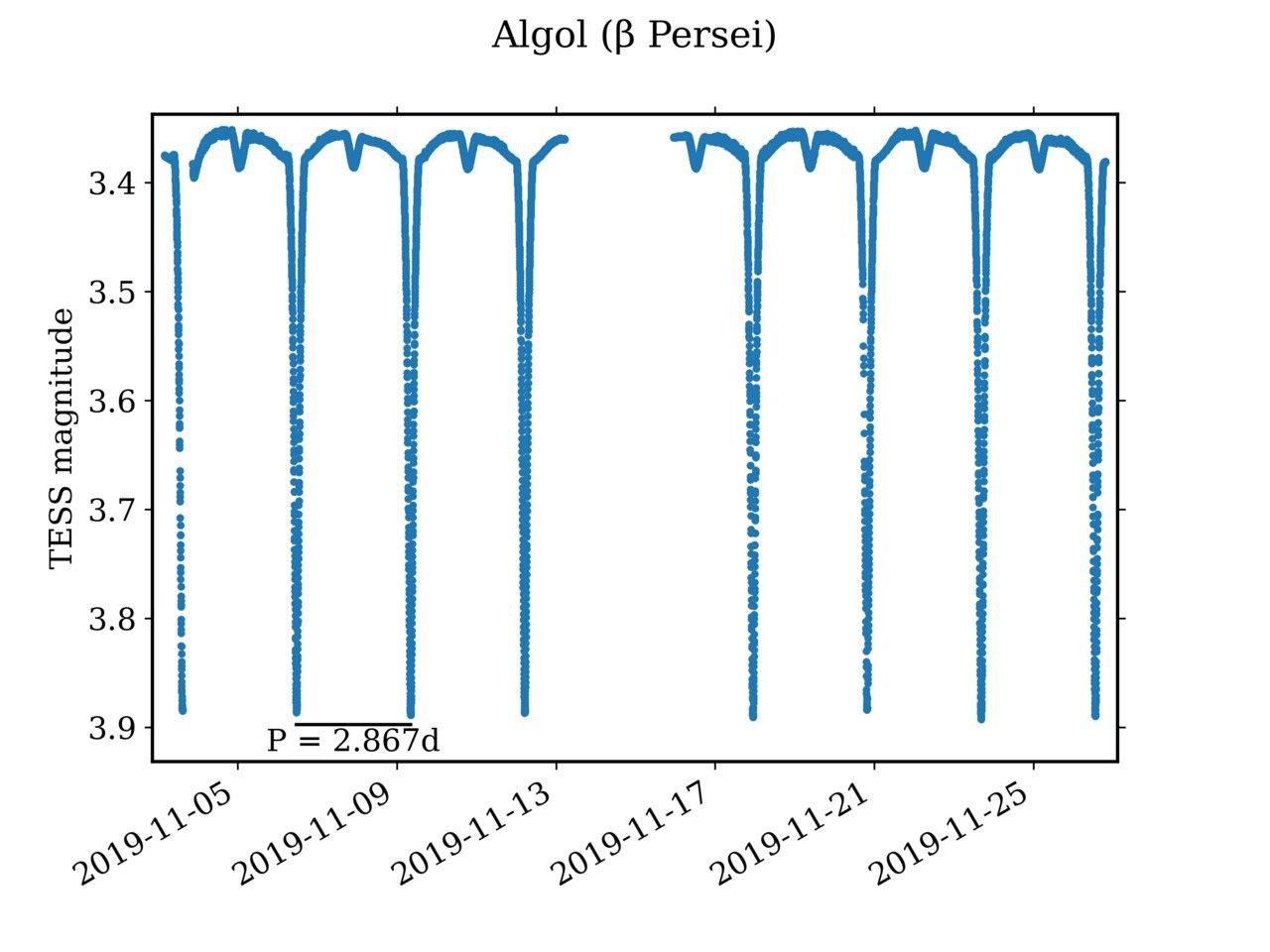
A graph of blue lines trailing down into dips, representing how starlight from Algol dims when the two stars eclipse each other.
Light curve of the eclipsing binary star Algol recorded by NASA’s Transiting Exoplanet Survey Satellite (TESS), stored on NASA’s Mikulski Archive for Space Telescopes (MAST).
NASA/Wikipedia Commons

Algol is a triple-star system, with two of the three stars orbiting one another. This eclipsing binary causes the system to go from a bright +2.1 magnitude to a slightly dimmer +3.4 magnitude about every three days. Using data from NASA’s Transiting Exoplanet Survey Satellite (TESS) mission, this light curve shows the regular dimming, or Medusa’s ‘blinking eye’!

An image of the Cassiopeia, Andromeda and Perseus constellations, with a yellow arrow pointing from star Almach in Andromeda to Algol in Perseus.
Using the constellations Cassiopeia and Andromeda, locate Perseus. You can find Algol by using the star Almach as a guide.
Stellarium

There is no shortage of resources on how to calculate the dimming – or minima – of Algol, from interactive charts to data plots. Find the one that works best for you. Because it has a similar magnitude of brightness, you can compare Algol’s brightness to the nearby star Almach (Gamma Andromedae) in Andromeda using a small telescope or binoculars.

Witch Head Nebula

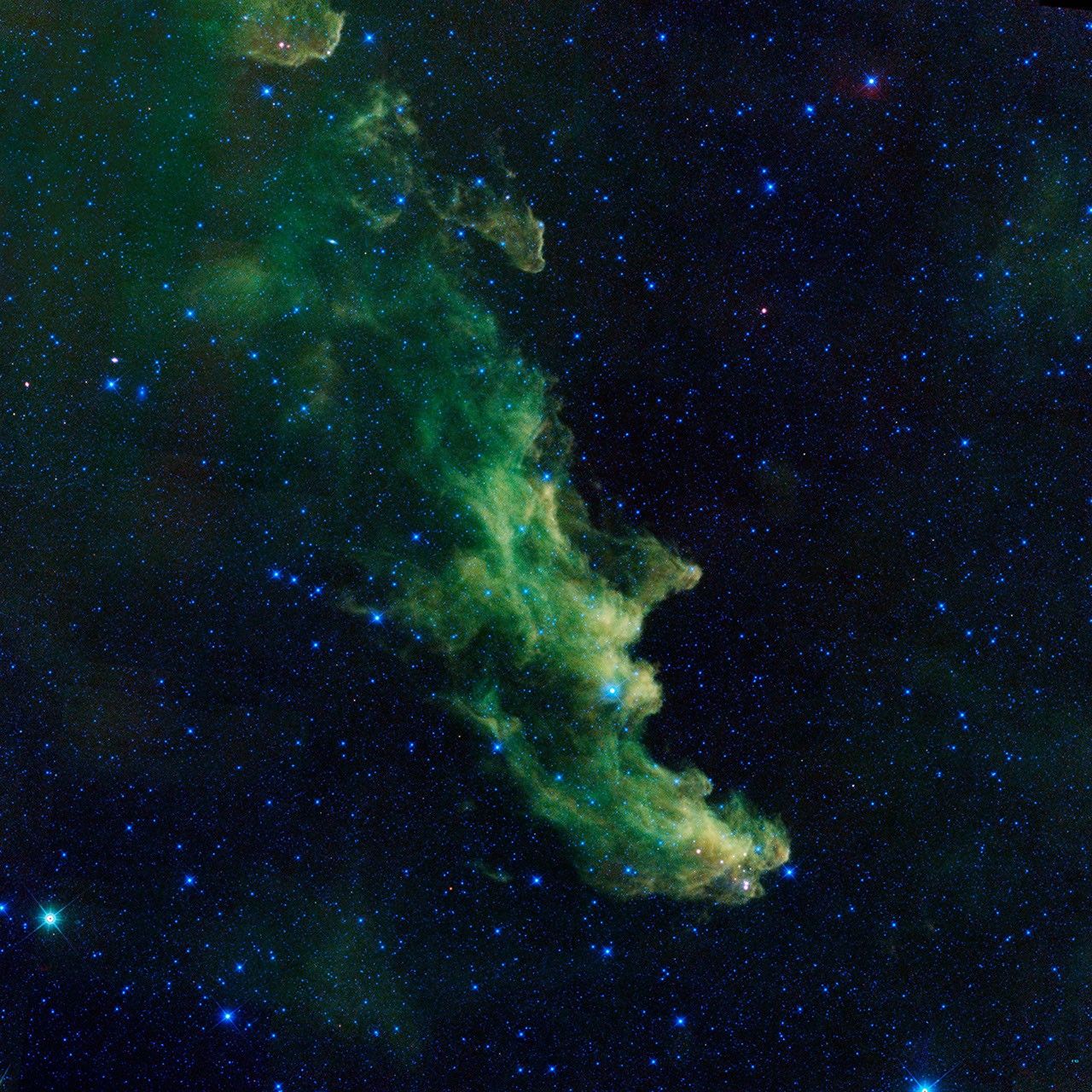
Between the Eridanus and Orion constellations lies a spooky silhouette, illuminated by the star Rigel. IC 2118, or the Witch Head Nebula, is a reflection nebula about 900 light-years away from Earth. Because reflection nebulae rely on nearby starlight to appear visible, they can be difficult to see with the naked eye, especially if they are as far away as this one. While the Witch Head Nebula can’t be seen with the naked eye, telescopes with very large apertures and low magnification make it easier to catch under dark skies. Astrophotographers, with or without smart telescopes, can image this haunting outline within a few hours, depending on equipment and sky quality. And what is a witch without their broom! You can find the Witch’s Broom in the Western Veil Nebula, located in the constellation Cygnus.

An infrared portrait of the Witch Head nebula from NASA's Wide-field Infrared Survey Explorer, or WISE, shows billowy clouds where new stars are brewing.
An infrared portrait of the Witch Head nebula from NASA’s Wide-field Infrared Survey Explorer, or WISE, shows billowy clouds where new stars are brewing.
NASA/JPL-Caltech

Want more tips for getting into the season? Read our article on how you can make some spooky sidewalk astronomy fun for your community with Trick or Treat: Sidewalk Astronomy!

Source: science.nasa.gov
Reliable Robots: Meet Johnson’s Dexterous Robotics Team

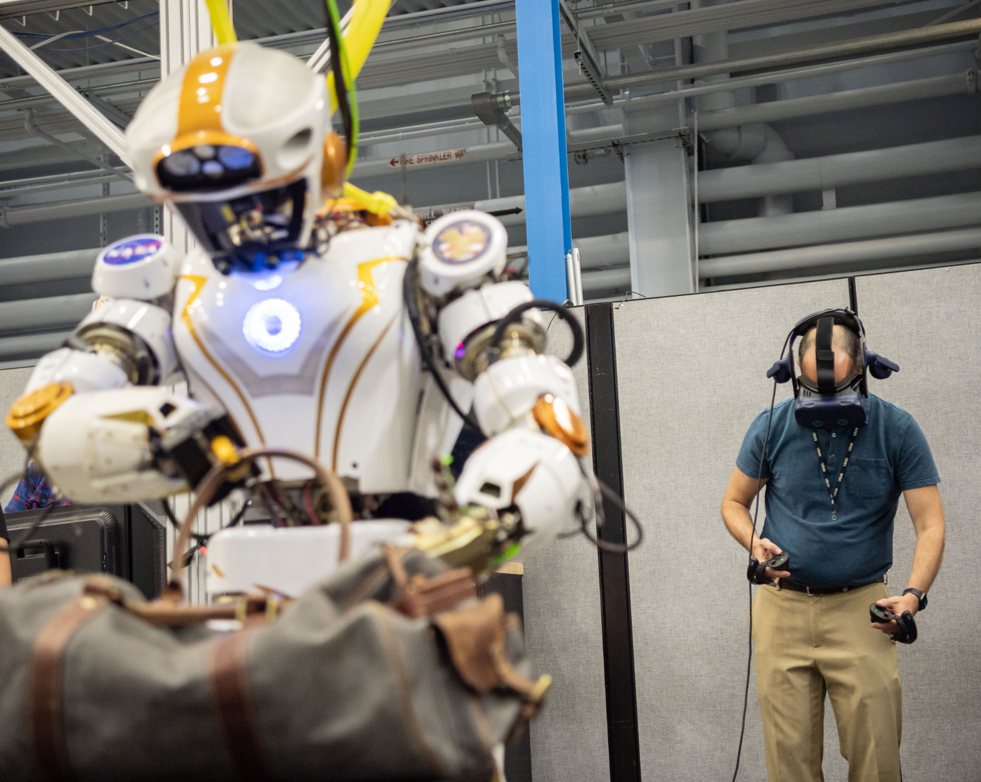
A humanoid robot stands in the foreground, lifting a duffel bag. A man in the background wears a VR headset and holds hand controllers, apparently controlling the robot's movements.
Dexterous Robotics Team lead Shaun Azimi conducts a demonstration with NASA’s Valkyrie humanoid robot.
NASA

The idea of humans and robots working side-by-side in space was once the stuff of science fiction, but with NASA launching increasingly complex missions deeper into space, human-robot collaboration could become reality.

Advanced robotic systems are critical for human spaceflight because they can enhance a crew’s performance and productivity while reducing risk and expanding the capabilities for space exploration. The Dexterous Robotics Team at NASA’s Johnson Space Center in Houston plays a key role in developing robotic hardware and software to support NASA’s bold vision for the future, with a focus on robots that can complete tasks humans do with their hands. 

“Our team is not trying to replace human explorers with robots but instead make human exploration safer and more sustainable by developing highly capable, reliable, and trustworthy robots to work in extreme environments,” said Shaun Azimi, Dexterous Robotics Team lead. “If we can send more capable robots, we can reduce the risk and make people more effective in doing the things that people do best.”

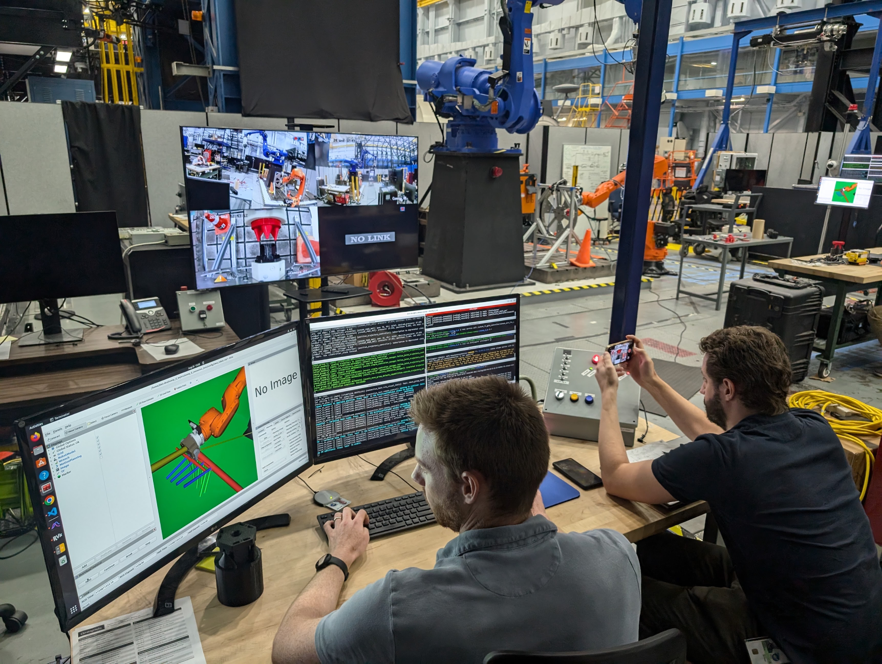
Two men sit at a wooden table with two large computer monitors displaying data and imagery from a robotic arm test. They sit in a large, open facility with additional computer monitors and robotic equipment in the background.
Dexterous Robotics Team members Nathan Dunkelberger (left) and Connor Rainen test the use of a robotic arm.
NASA

The 16-member team is part of NASA’s Robotic System Technology Branch, which also develops mobility systems like unmanned planetary rovers. Azimi is one of several engineers who work on both dexterity and mobility projects. There is also crossover within the Dexterous Robotics Team. While the group is generally organized into two subgroups, mechatronics and software, most team members have experience in electronics or mechanics as well as writing software for simulations or analyses.

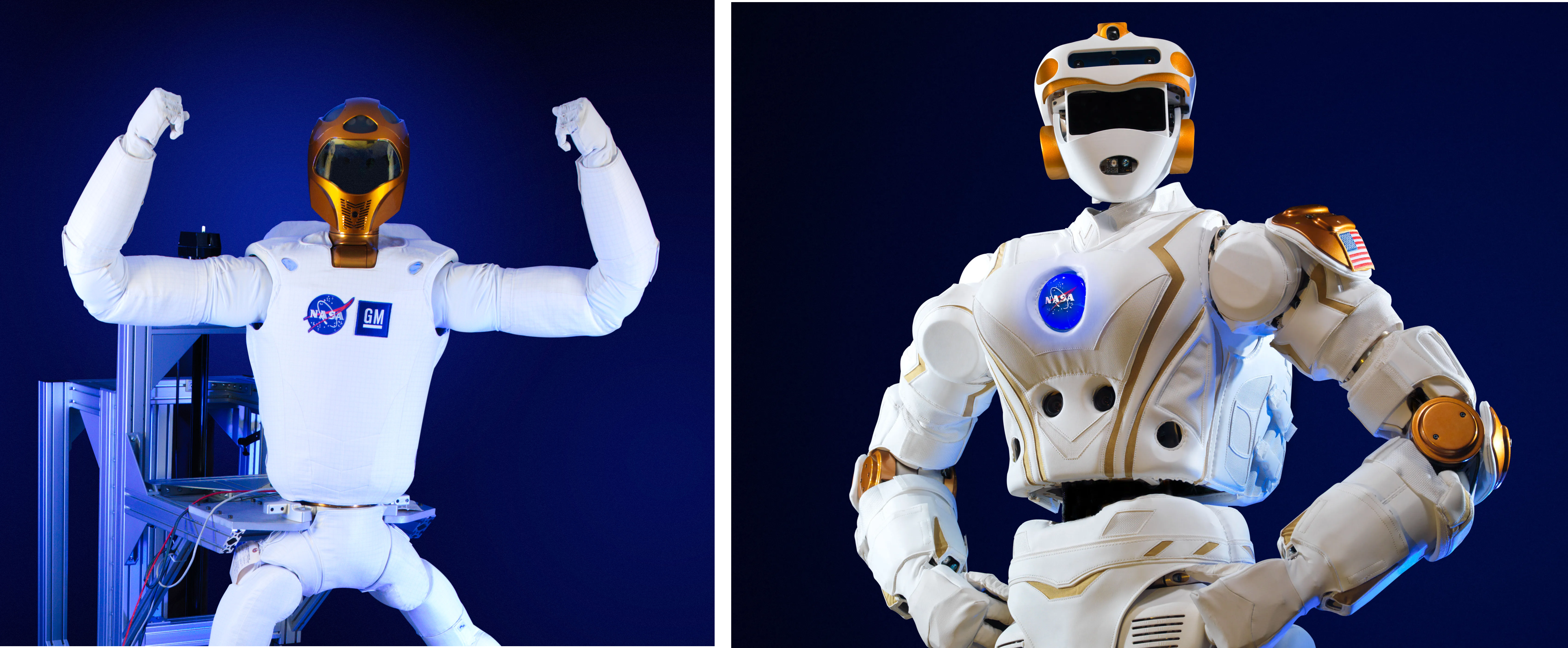
Much of that experience was gained by working on two well-known humanoid robots – the Robonaut 2, which participated in robotics technology demonstrations aboard the International Space Station for seven years, and Valkyrie, NASA’s first bipedal humanoid robot. Many of the employees who worked on those projects now make up the Dexterous Robotics Team and continue to build upon the robots’ legacy.

Pictures of two humanoid robots are displayed side-by-side.
NASA’s Robonaut 2 (left) and Valkyrie humanoid robots.
NASA

Today the team supports a variety of agency projects and programs, some of which are exploring connections to building the Moon Base, humanity’s first lunar outpost. “Our work is a combination of technology research and development, and applied technology on the operational side,” Azimi said. The team also collaborates with private industry and other external partners that face similar challenges in their work, such as an oil and gas company seeking to leverage robotic technologies in harsh environments and for riskier tasks.

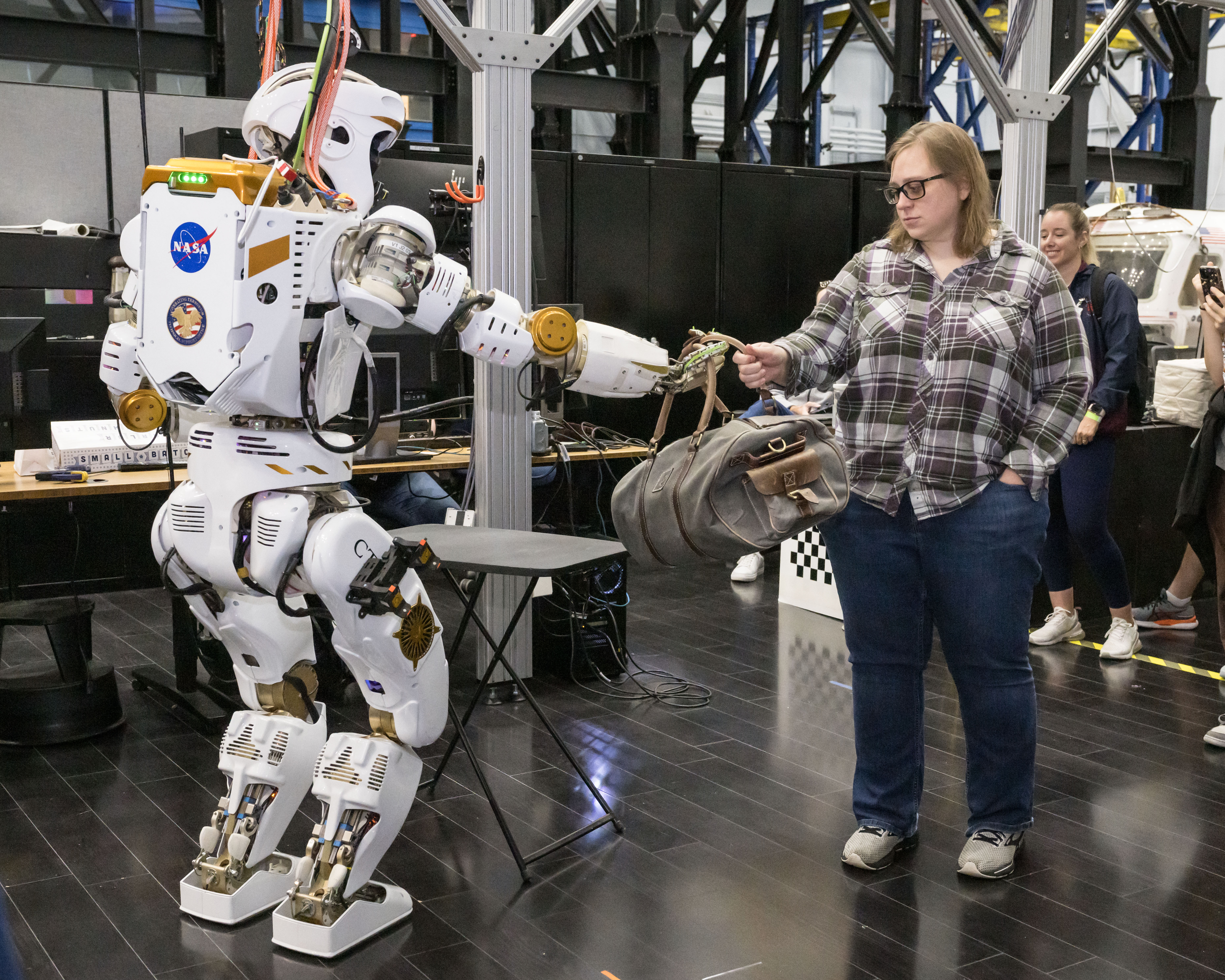
A humanoid robot hands a duffel bag to a woman wearing casual clothes.
During a demonstration, Valkyrie hands Dexterous Robotics Team member Emma Zemler a packed duffel bag.
NASA/Helen Arase Vargas

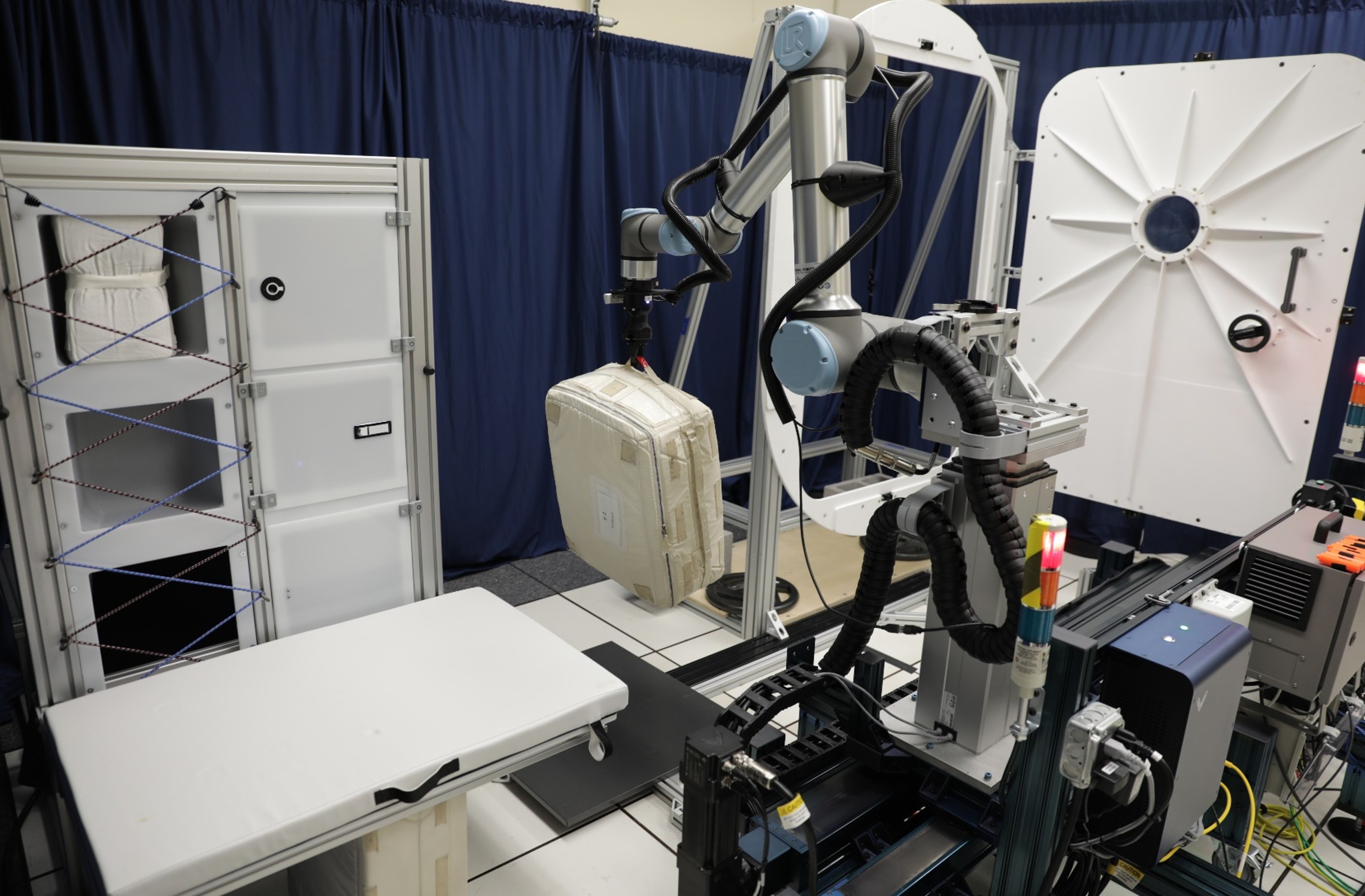
A major focus for the team has been development of the Integrated Mobile Evaluation Testbed for Robotics Operations (iMETRO) facility at Johnson. Available to NASA programs and external partners, iMETRO is designed to support the adaptation of terrestrial robotic technologies for human-supervised space exploration applications such as logistics, maintenance, and scientific research. The facility comprises open-source software and simulation assets, as well as space vehicle and habitat mockups, a selection of “house robots,” and an outdoor rock yard. Offering digital and physical facilities gives iMETRO users the flexibility to test a whole robot or a single hardware or software component.

Azimi said iMETRO helps remove the guesswork from NASA’s collaboration with external partners. “It shows them the things we actually need done so they don’t have to speculate,” he said. “We can also bring together the people who are developing the robotic technologies – hardware, software, or both – with the people who are actually designing a lunar surface habitat or rover.” This enables different teams to learn from each other: The technology providers gain a better understanding of the habitat, while the habitat designers learn what features are needed to accommodate a robot. “They can learn about how robots perceive the world and interact with objects, and what is difficult for a robot compared to a human,” Azimi said. “It’s not necessarily a totally different interface, and something like a bigger handle or better lighting might make things easier for a person as well.”

In one case, a team from PickNik Inc. used iMETRO to test software enabling a robotic arm to recognize a spacecraft hatch, then turn the latch, grasp the handle, and open the door. The arm was then able to transfer cargo bags between the hatch and a bin. The facility also supported a NASA intern’s development and testing of software that used a common commercial robotic arm and camera to inspect and maintain a cold stowage freezer like those aboard the space station.  

Robotic system components are shown in a lab setting, with blue drapery in the background.
Components of the Dexterous Robotics Team’s iMETRO facility.
NASA

Azimi acknowledged the team’s near-term emphasis on technologies that can support a sustained human presence on the lunar surface but noted those technologies also have applications for future missions to Mars. In fact, the team is collaborating with other agency organizations on a forthcoming NASA challenge that will invite the public to share their ideas for technology solutions for Mars exploration.

Azimi said he is often asked why there is a robotics team at Johnson. “It’s really about the human elements – either working in environments designed for humans or working alongside humans. That’s our niche,” he said. “We’re uniquely positioned to bring in folks who are designing the human environments.”

Source: www.nasa.gov