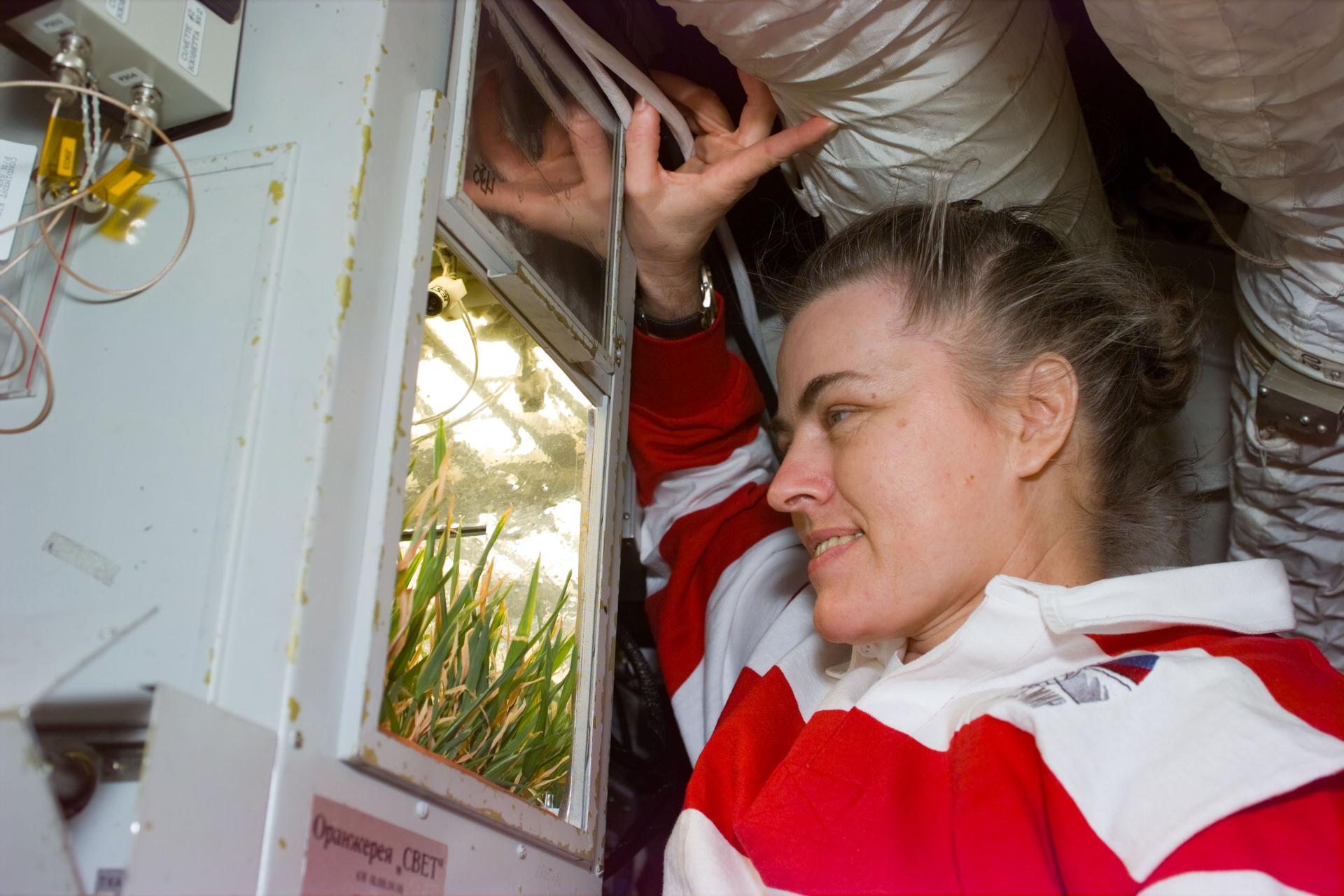
Astronaut Shannon W. Lucid checked on wheat plants aboard Russia’s Mir Space Station on Sept. 23, 1996. Lucid left Mir later that day along with the rest of the STS-79 crew except for John E. Blaha, who was beginning a four-month stay aboard the station.
NASA
Shannon Lucid’s Record-Setting Mission Aboard Mir
Three days before returning to Earth, Shannon W. Lucid—who joined NASA in 1978 as one of its first six female astronauts—checked in on wheat growing in the Svet greenhouse aboard the Russian space station Mir. For six months, Lucid lived and worked alongside two Russian cosmonauts conducting life science studies and other experiments in microgravity.
Lucid returned to Earth aboard space shuttle Atlantis on Sept. 26, 1996, completing a 188-day mission—a new record for both a woman and for an American. Lessons from her time on Mir helped NASA prepare for the psychological and cultural challenges of long-duration missions on the International Space Station.
In December 1996, President Bill Clinton awarded Shannon Lucid the Congressional Space Medal of Honor for her achievement. She was the tenth person and the first woman to receive this award.
After her mission on Mir, Lucid continued to serve NASA in key roles on the ground. She worked as a CAPCOM in Mission Control, where she was the primary voice communicating with astronauts in orbit. Later, she served as NASA’s Chief Scientist, helping guide the agency’s science priorities. Lucid retired from NASA in 2012 after a career that spanned more than three decades.
Daily images of ice cover in the Arctic Ocean show sea ice melting around the pole from March 15, 2026 to Sept. 12, 2026.
Trent Schindler/NASA’s Scientific Visualization Studio
Arctic sea ice reached its annual minimum extent on Sept. 12, according to NASA and the National Snow and Ice Data Center (NSIDC) at the University of Colorado Boulder. The ice covered an estimated 1.78 million square miles (4.6 million square kilometers), tying 2008, 2010, and 2025 for the 10th-lowest minimum in the satellite record.
The 2026 minimum is consistent with patterns observed in the satellite record. The past 20 years, from 2007 through 2026, have produced the 20 lowest annual Arctic sea ice minimum extents observed since continuous satellite measurements began in late 1978.
Arctic sea ice grows during the dark, cold autumn and winter and retreats as temperatures rise during spring and summer, typically reaching its lowest extent in September. Weather conditions can cause substantial differences in the amount of ice that melts from one summer to another.
Over the last decade, for example, increased cloud cover has prevented solar radiation from further accelerating the melt of sea ice, according to Linette Boisvert, a sea ice scientist at NASA’s Goddard Space Flight Center in Greenbelt, Maryland.
That has contributed to relatively stable September sea ice extent in recent years. “We’ve plateaued, but we’re still low relative to the earlier part of the record,” said Walt Meier, a senior research scientist at NSIDC.
Antarctic sea ice extent approaches annual maximum
At the opposite end of the planet, Antarctic sea ice is approaching its annual maximum following a fluctuation during August.
Sea ice around Antarctica declined by roughly 116,000 square miles (300,000 square kilometers) over a six-day period before resuming its seasonal growth. Meier said the decline appeared to be associated with weather conditions that pushed and compacted the thin, mobile ice near its outer edge.
“Those types of things happen all the time,” Meier said. “But the magnitude of it certainly is unusual.”
Antarctic sea ice varies more from year to year than Arctic sea ice because, in contrast to the Arctic, it is not surrounded by land and can respond more freely to changing wind and weather conditions. But Antarctic sea ice extent at its annual maximum has generally been lower in recent years. Because of this large year-to-year variability, Boisvert and Meier remain cautious about characterizing the change as a long-term trend.
Scientists have tracked polar sea ice from space for nearly five decades. During that time, NASA and the National Oceanic and Atmospheric Administration (NOAA) used a series of satellite instruments to maintain a continuous sea ice record, beginning with NASA’s Nimbus-7 satellite, which began observations in October 1978. The record continued with instruments aboard Defense Meteorological Satellite Program satellites beginning in 1987 and NASA’s Aqua satellite from 2002 to 2011. Today, scientists continue the record using data from the Advanced Microwave Scanning Radiometer 2 (AMSR2), launched in 2012 aboard JAXA’s (Japan Aerospace Exploration Agency) GCOM-W satellite.
Antarctic sea ice typically reaches its annual maximum in late September or early October. NASA and NSIDC will announce the 2026 maximum after scientists confirm that seasonal ice growth has ended.
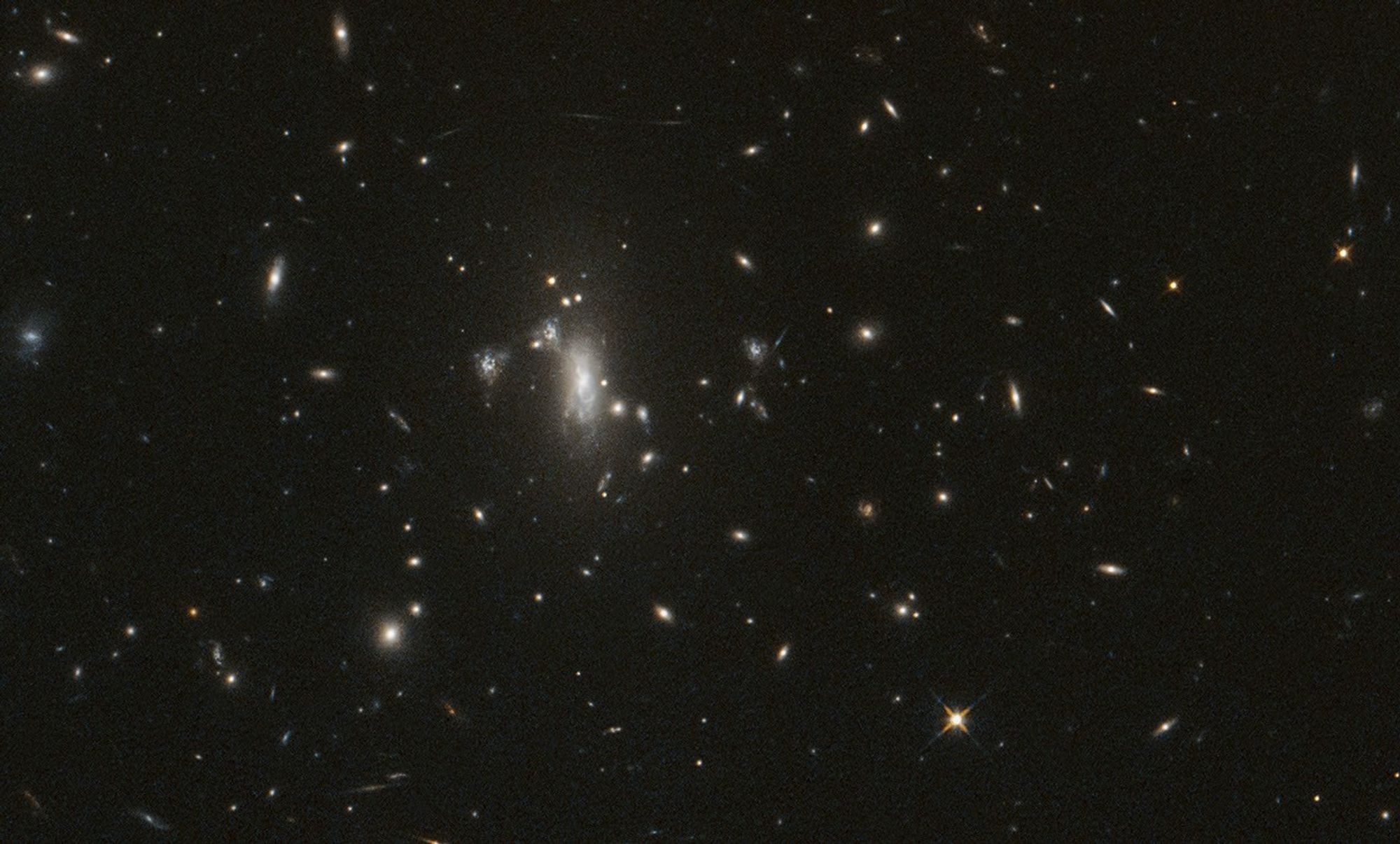
An image from NASA’s Hubble Space Telescope of galaxy cluster MACS J0417 is part of repeated observations to monitor for the reappearance of supernova Athena, which can help astronomers measure the expansion rate of the universe.
NASA, ESA, STScI, M. Pascale (UCLA); Image Processing: J. DePasquale (STScI)
NASA’s Hubble Space Telescope captured this image of massive galaxy cluster MACS J0417 (left of center) on Sept. 19, 2026. This galaxy cluster acts as a gravitational lens, bending and magnifying light from objects far behind it. Supernova Athena, discovered by NASA’s James Webb Space Telescope in 2025, is predicted to reappear between now and early March 2027. Measuring the timing of Athena’s reappearances can help researchers map the mass of MACS J0417, which acts as a magnifying, foreground lens for distant objects, and refine our understanding of the expansion rate of the universe.
Hubble also completed its 200,000th orbit around Earth on Sept. 19, marking another new milestone for an observatory that continues to transform our understanding of the universe.
A photo of the Dynamic Aviation A200 aircraft, which will conduct low-flying research flights over farmland near Greeley, Colorado, to measure emissions in October 2026.
Dynamic Aviation
Agricultural emissions represent an important and understudied part of Earth’s land and atmosphere systems. The FarmFlux mission will deploy more than a dozen sensors to measure ozone, methane, ammonia, particulates, and other pollutants rising from agricultural lands and animal farms and the interaction with the Earth’s atmosphere. The mission is jointly led by NASA’s Goddard Space Flight Center in Greenbelt, Maryland; Colorado State University; and Boston University.
The Colorado deployment is the first series of flights for the FarmFlux mission. Additional low-altitude research flights are scheduled over farmland in Amarillo, Texas, from late October to early November. For the March to July 2027 growing season, research flights with a NASA P-3 Orion aircraft are scheduled in the Midwest and California’s Central Valley with a focus on croplands.
For more information about the FarmFlux mission, visit:
Discover the cosmos! Each day a different image or photograph of our fascinating universe is featured, along with a brief explanation written by a professional astronomer.
Chance Triple Alignment: Plane, Space Station, Sun
Explanation: This shot captured an unexpected silhouette. Which is it? It isn’t the sunspots, the small dark regions caused by concentrated magnetic fields visible around the Sun’s bright disk. Sunspots typically last for weeks and were expected, since these spots were seen previously. It isn’t the International Space Station (ISS), the small dark structure on the middle left. This is because the featured picture was planned with sub-second timing to record the iconic structure passing before the Sun. It is the airplane. Just as this exposure was taking place in June, from Prasek in the Czech Republic, an airplane began its own miniature partial eclipse. The result is this triply aligned image of our Sun. The photographer estimates that the chance of any random Sun image containing silhouettes of both a space station and an airplane, from that location, is about 30 million to one.
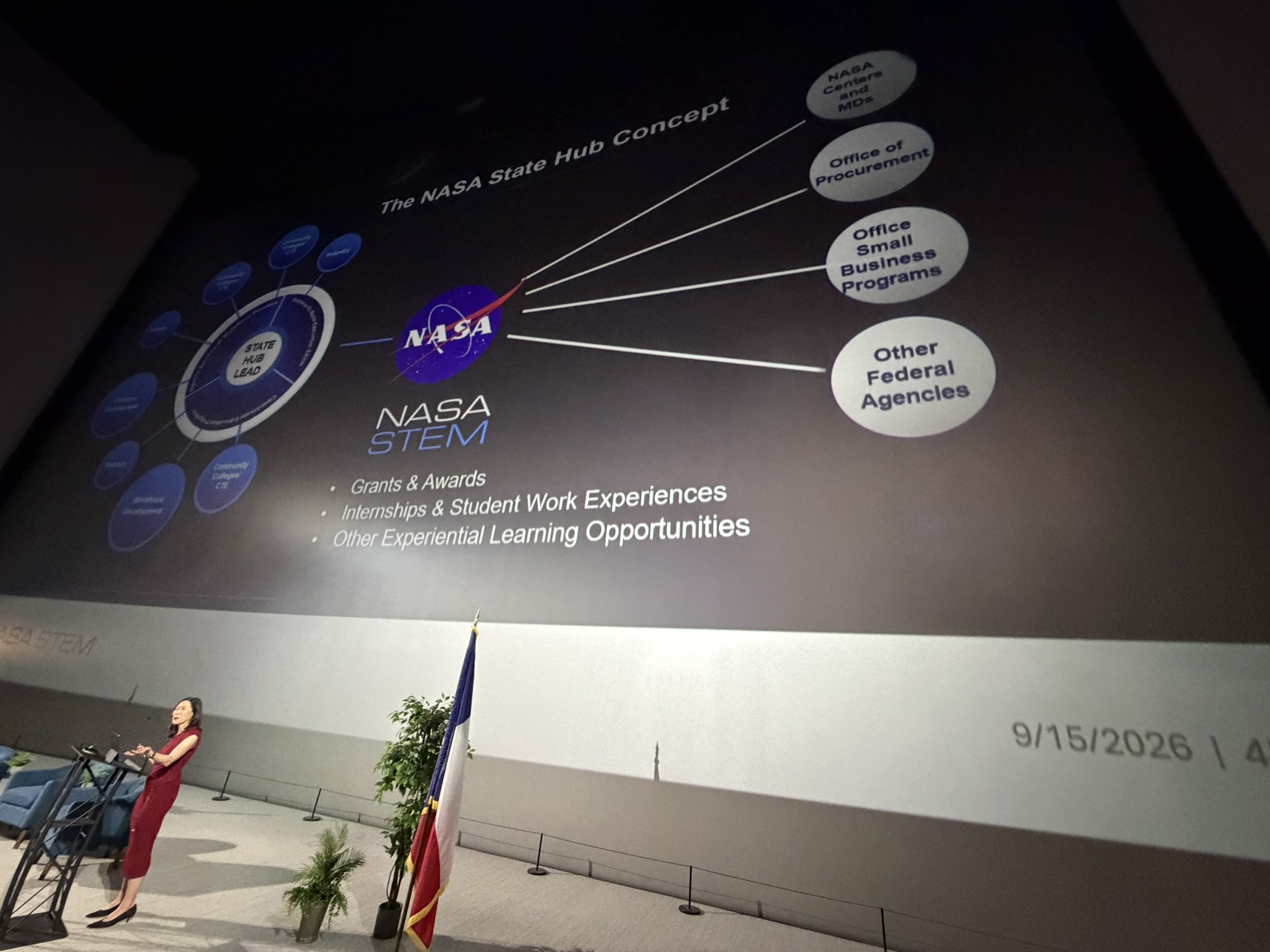
NASA kicked off its State Hubs for Skilled Technical Workforce initiative Sept. 15, 2026 with awardees at Space Center Houston. Agency leadership convened State Hub partners to align strategy and build momentum while focusing on partnerships, small business engagement, and next steps.
Elaine Ho, associate administrator for NASA’s Office of STEM Engagement in Washington, addresses NASA State Hubs project leaders and agency, state, and federal partners at Space Center Houston on Sept. 15, 2026
Credit: NASA
“The NASA State Hubs initiative is a top priority for the agency, because we know the space economy is really accelerating across the country,” said Elaine Ho, associate administrator for NASA’s Office of STEM Engagement at NASA Headquarters in Washington. “It’s energizing to watch our partners come together to put real plans into action to help students advance into well paying, rewarding technical jobs. I am excited about what’s ahead.”
NASA State Hubs project leaders and agency, state, and federal partners gathered in Houston to connect with peers, hear presentations from each State Hub, and explore workforce needs, skillsets, credentials, and hiring trends.
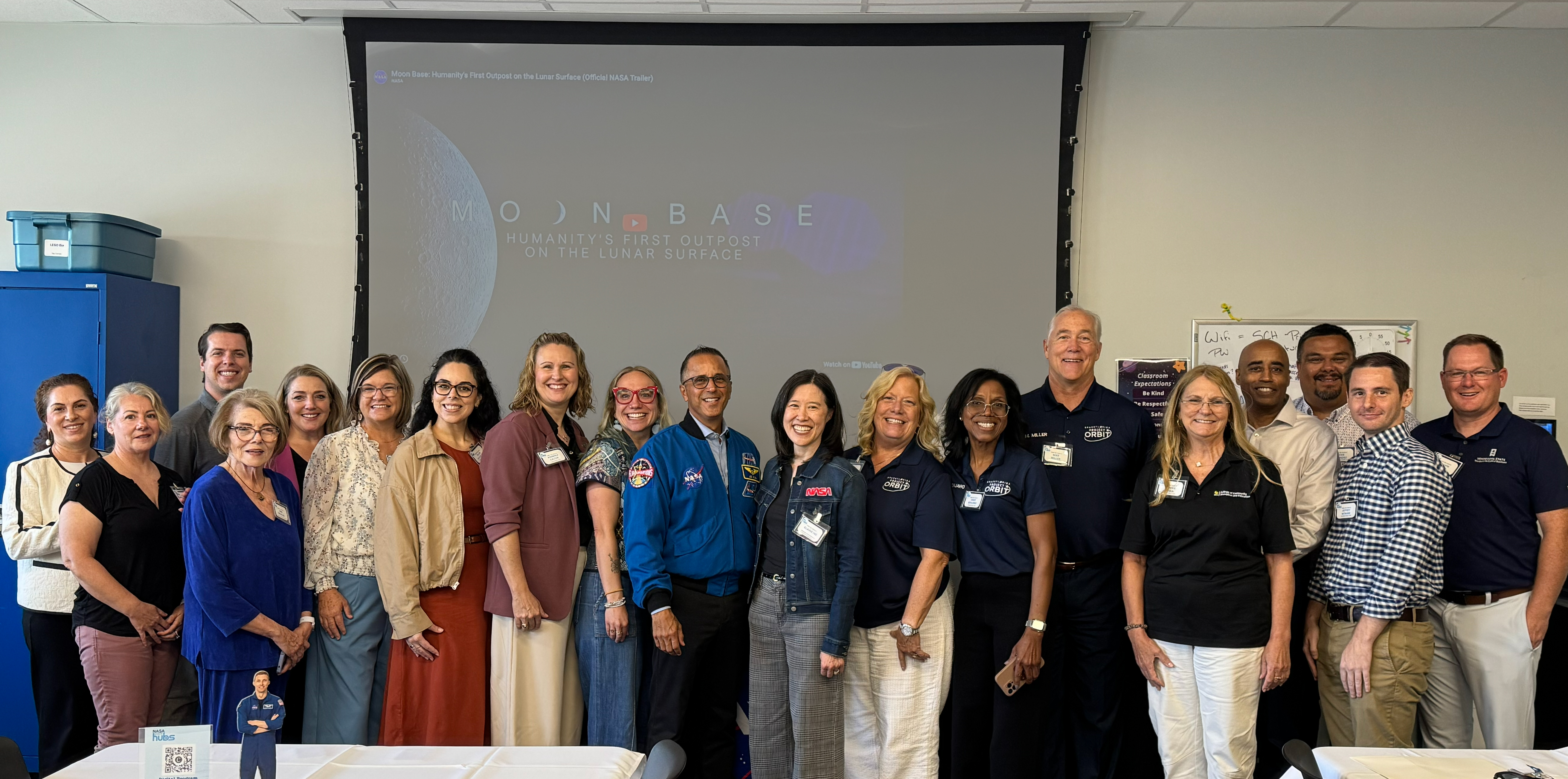
NASA State Hubs project leaders pause for a photo with Joe Acaba, center left, NASA astronaut and associate director for Mission and Strategy at Johnson Space Center in Houston, and Elaine Ho, associate administrator for NASA’s Office of STEM Engagement, center right.
Credit: NASA
In August, the agency selected seven projects representing states across the country: California, Colorado, Florida, Georgia, Minnesota, Texas, and Utah. Each Hub will offer programs tailored to its state’s unique aerospace industry and workforce priorities, ensuring students get opportunities that meet those needs.
During the meeting, NASA leadership and awardees discussed challenges impacting the STEM workforce pipeline, including limited coordination between industry, community colleges, and state economic development entities, difficulty scaling job programs, and misconceptions about manufacturing jobs.
In the coming months, NASA State Hub awardees will finalize approaches and begin delivering programming, tools, and resources that connect students across their state with the technical skills and hands-on experiences that prepare them to join the aerospace workforce.
Together, NASA and its State Hubs partners are mapping out the path to a future aerospace landscape powered by career ready workers who can build what comes next, advance NASA’s missions, and sustain America’s leadership in space.
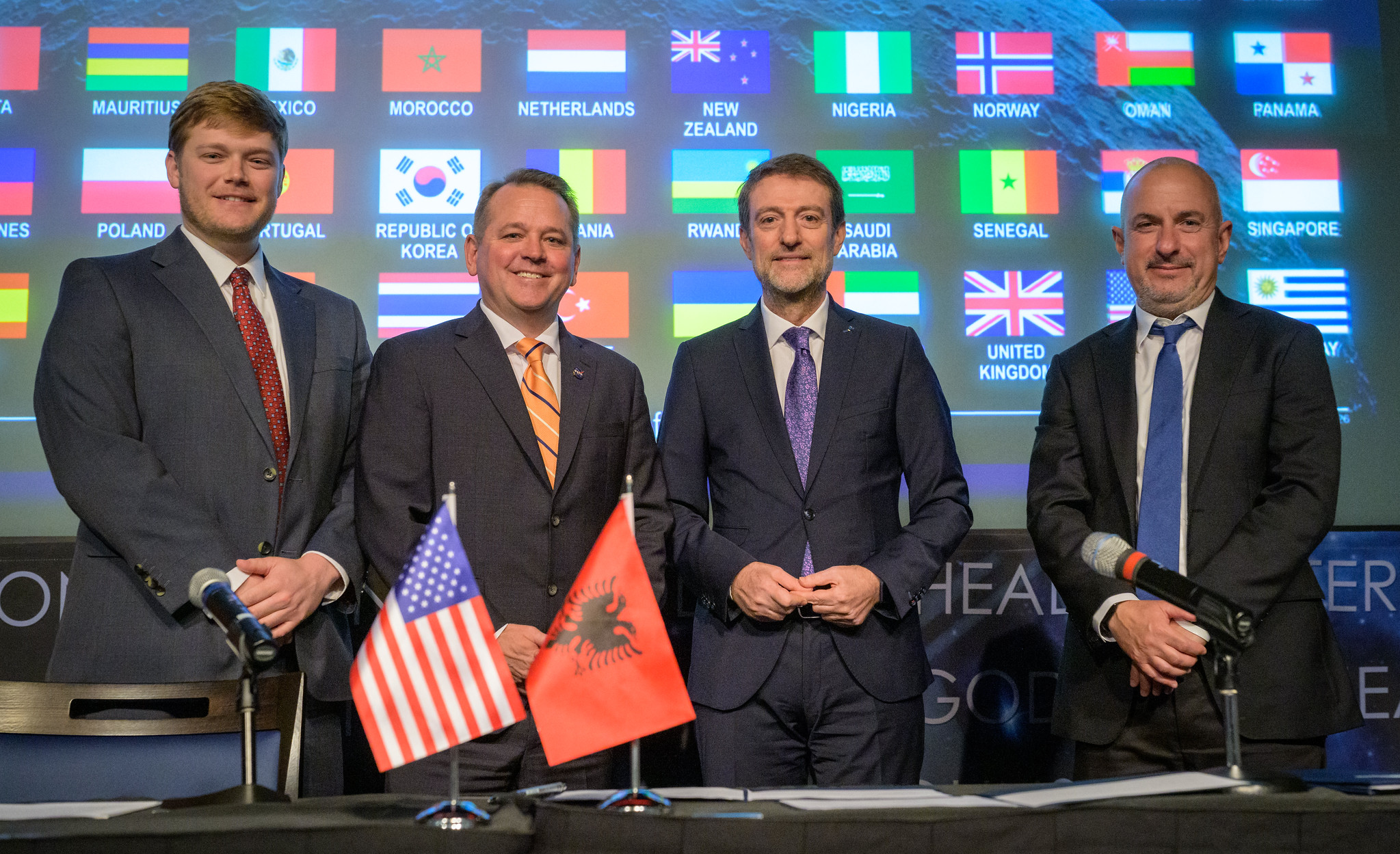
U.S. Deputy Assistant Secretary of State for Space and Environment Connor Tomlinson, left, NASA Deputy Administrator Matt Anderson, Albania’s Minister for Europe and Foreign Affairs Ferit Hoxha, and Ambassador of the Republic of Albania to the United States Ervin Bushati, right, are seen at the conclusion of an Artemis Accords signing ceremony Monday, September 21, 2026, at the Mary W. Jackson NASA Headquarters building in Washington.
NASA/Bill Ingalls
The Republic of Albania signed the Artemis Accords Monday during a ceremony hosted by NASA at the agency’s headquarters in Washington, joining the coalition of like‑minded nations committed to the responsible and transparent exploration of space.
“It is my privilege to welcome the Republic of Albania as the 73rd signatory of the Artemis Accords,” said NASA Deputy Administrator Matt Anderson. “The relationship between our nations goes back more than a century. Today, we extend that partnership into space.”
Albania’s Minister for Europe and Foreign Affairs Ferit Hoxha signed on behalf of the country. Ambassador of the Republic of Albania to the United States Ervin Bushati and the U.S. Deputy Assistant Secretary of State for Space and Environment Connor Tomlinson also participated in the event.
“It is a great honor for Albania to join the growing community of nations that have signed these important Artemis Accords,” said Hoxha in remarks during the ceremony. “By taking this step, Albania affirms its commitment to peaceful, transparent, sustainable, and cooperative exploration of space. We do so as a country deeply committed to international law, multilateral cooperation, and the belief that humanity’s greatest achievements are realized not in isolation, but through partnerships.”
Marking a significant step in Albania’s efforts to strengthen its use of space‑based data, Albania launched two dedicated Earth‑observation satellites, Albania‑1 and Albania‑2, in January 2023 aboard a SpaceX Falcon 9 rocket from NASA’s Kennedy Space Center in Florida, an example of how the United States is supporting Albania’s capabilities in space.
Albania also has played an active role in NASA’s Space Apps Challenge, hosting local events that connected students, technologists, and innovators with NASA’s openly available Earth and space science data. NASA Space Apps is the world’s largest annual global hackathon, mobilizing participants in more than 150 countries to develop creative solutions to real-world challenges using open data from NASA and partner space agencies to advance exploration for the benefit of all.
In 2020, NASA and the State Department joined with seven other founding nations to establish the Artemis Accords, responding to the growing interest in lunar activities by both governments and private companies. They introduced the first set of practical principles aimed at enhancing the safety and coordination between nations as they explore the Moon, Mars, and beyond, committing nations to:
Explore peaceably and transparently
Render aid to those in need
Enable access to scientific data
Ensure activities do not interfere with those of others
Preserve historically significant sites and artifacts by developing best practices
By signing the Artemis Accords, nations open the door to opportunities for future lunar exploration with NASA, advancing humanity’s return to the Moon, and shaping the Golden Age of space exploration and innovation.
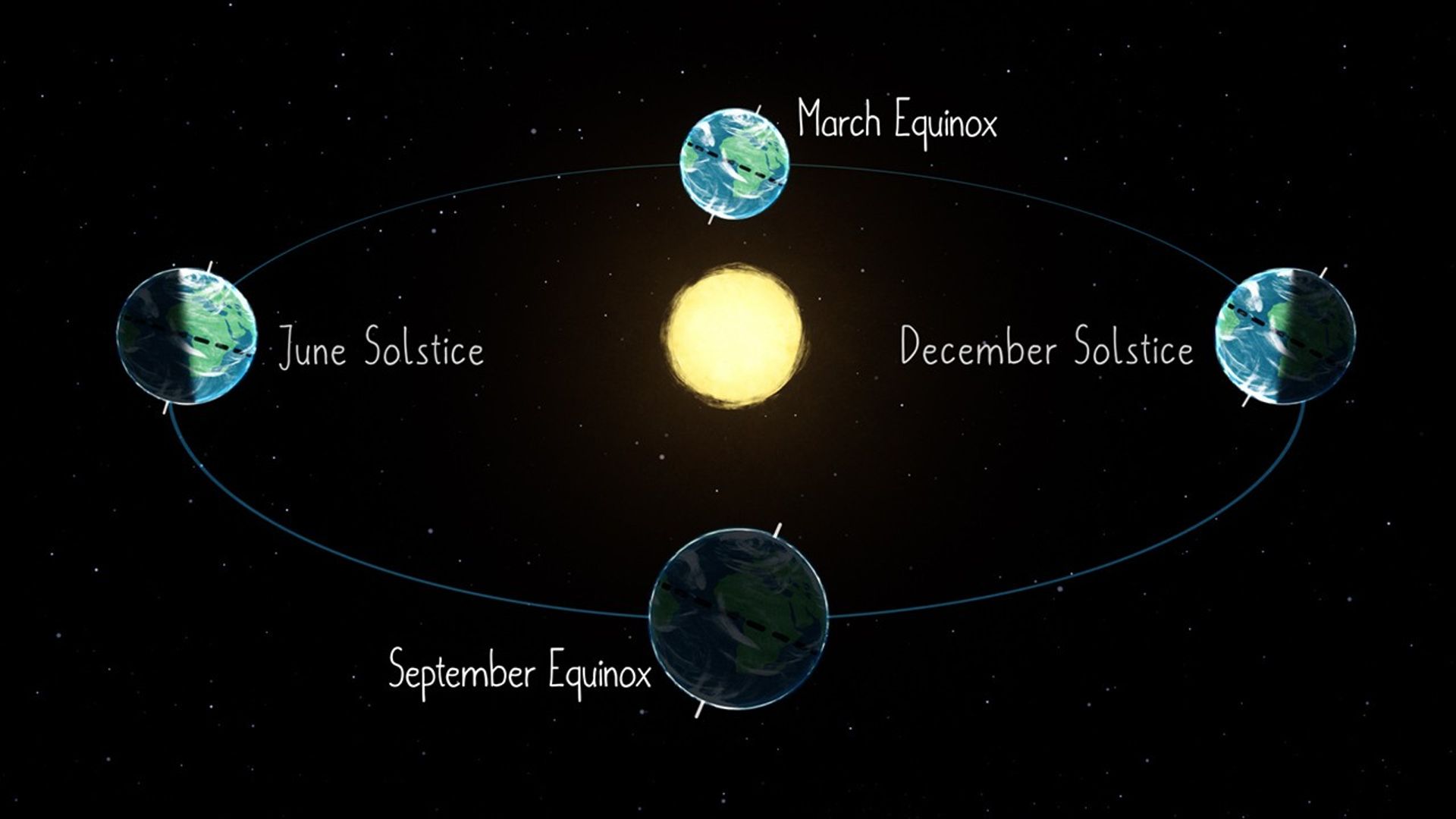
Illustration showing how Earth’s tilt leads to the Northern and Southern Hemispheres receiving changing amounts of sunlight over the course of the year. At the equinoxes, neither hemisphere is more tilted toward the Sun, so both hemispheres receive the same amount of sunlight.
Credits: NASA/JPL-Caltech
Depending on your locale, equinoxes can be seen as harbingers of longer nights and gloomy weather, or promising beacons of nicer temperatures and more sunlight. Observing and predicting equinoxes is one of the earliest skills in humanity’s astronomical toolkit. Many ancient observatories around the world observed equinoxes along with the more pronounced solstices. These days, you don’t need your own observatory to know when an equinox occurs, since you’ll see it marked on your calendar twice a year! The word “equinox” originates from Latin, and translates to equal (equi-) night (-nox). But what exactly is an equinox?
An equinox occurs twice every year, in March and September. In 2026, the equinoxes will occur on March 20, at exactly 14:46 UTC (or 7:46 AM EDT), and again on September 23, at 00:05 UTC (or September 22, 2026, at 5:05 PM PDT). The equinox marks the exact moment when the center of the Sun crosses the plane of our planet’s equator. The day of an equinox, observers at the equator will see the Sun directly overhead at noon. After the March equinox, observers anywhere on Earth will see the Sun’s path in the sky continue its movement further north every day until the June solstice, after which it begins traveling south. The Sun crosses the equatorial plane again during the September equinox, and continues traveling south until the December solstice, when it heads back north once again. This movement is why some refer to the March equinox as the northward equinox and the September equinox as the southward equinox.
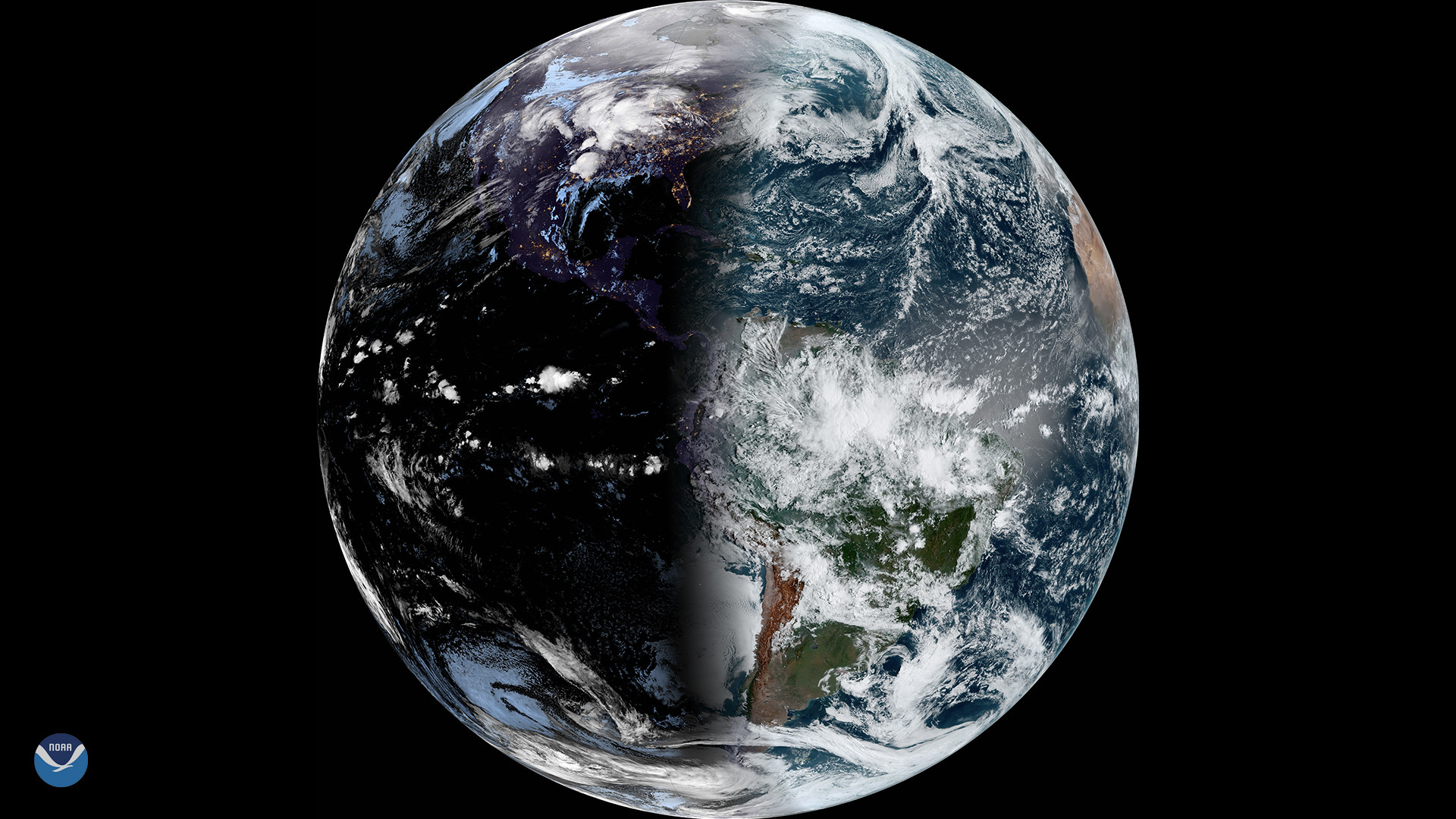
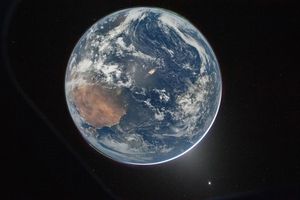
A full disk view of the earth from GOES 16, GOES East on the vernal Equinox.
NOAA/NASA
Our Sun shines equally on both the Northern and Southern Hemispheres during equinoxes, which is why they are the only times of the year when the Earth’s North and South Poles are simultaneously lit by sunlight. Notably, the length of day and night on the equinox isn’t precisely equal; the date for that split depends on your latitude, and may occur a few days earlier or later than the equinox itself. The complicating factors? Our Sun and atmosphere! The Sun itself is a sphere and not a point light source, so its edge is refracted by our atmosphere as it rises and sets, which adds several minutes of light to every day. The Sun doesn’t neatly wink on and off at sunrise and sunset like a light bulb, and so there isn’t a perfect split of day and night on the equinox – but it’s very close.
Equinoxes are associated with the changing seasons. In March, Northern Hemisphere observers welcome the longer, warmer days heralded by their vernal, or spring, equinox, but Southern Hemisphere observers note the shorter days – and longer, cooler nights – signaled by their autumnal, or fall, equinox. Come September, the reverse is true.
Images from NASA’s EPIC (Earth Polychromatic Imaging Camera) aboard the NOAA mission DSCOVR (Deep Space Climate Observatory) show Earth on the December and June solstices and the March and September equinoxes, illustrating how the tilt of Earth’s axis shifts the continent’s apparent positions through the year.
NASA Earth Observatory/Michala Garrison
Most kids learn in elementary school that the seasons are caused by Earth rotating on a tilted axis during its yearly orbit around the Sun. The substantial tilt, about 23.5 degrees, is thought to be the result of an ancient planetary body, Theia, smashing into Earth about 4.5 billion years ago, in the same cataclysmic collision that formed the Moon.
To visualize why Earth has seasons, imagine the planet as a spinning top tilted to one side. Around the June solstice, the Northern Hemisphere leans toward the Sun, bringing more direct sunlight and longer days. Around the December solstice, the Southern Hemisphere does the same. That’s why June ushers in summer and warm weather in the Northern Hemisphere, while December does so in the Southern Hemisphere.
The March and September equinoxes serve as the midpoints between these two seasonal extremes. On those days, the terminator—the boundary between the sunlit and dark sides of Earth—runs directly through both poles. As a result, the Northern and Southern Hemispheres receive almost the same amount of sunlight, and day and night are nearly equal in length.
What do the seasons look like from about one million miles away? That’s the view provided by NASA’s EPIC (Earth Polychromatic Imaging Camera) aboard the NOAA mission DSCOVR (Deep Space Climate Observatory). By maintaining an orbit that puts the spacecraft between the Sun and Earth roughly 1.6 million kilometers (1 million miles) from Earth, the camera has a nearly continuous view of the sunlit hemisphere. As Earth spins during the course of a day, EPIC captures a full-disk image of the planet’s sunlit face every few hours.
The four images above, taken at roughly the same time of day, show how EPIC’s view of the Western Hemisphere changes over the year, from the December solstice (upper left) to the March equinox (upper right), June solstice (lower left), and September equinox (lower right). The most striking difference is between the two solstices. In December, South America lies near the center of the disk and much of Antarctica is visible, while North America is partially out of view. In June, Earth’s tilt means the situation is reversed: the Northern Hemisphere and North America are more centered, Arctic sea ice comes into view, South America is offset, and Antarctica is completely out of view.
There are other notable differences among the four images. Earth looks slightly smaller during the March and September equinoxes, for instance. That’s because DSCOVR was tens of thousands of miles farther away from Earth on those dates than on the solstices. On December 21, 2023, DSCOVR was 1,447,327 kilometers (899,327 miles) from Earth compared with 1,561,901 kilometers (970,520 miles) on September 22, 2024.
The slight difference in Earth’s apparent size has nothing to do with Earth’s tilt. Instead, it occurs because DSCOVR follows a looping, three-dimensional path called a Lissajous orbit to keep the spacecraft near Lagrange point 1, where the combined gravitational pull of the Sun and Earth and the centrifugal pull of the satellite balance out, making it easier for engineers to maintain the spacecraft’s position without using much fuel. DSCOVR’s distance from Earth swings between its maximum and minimum roughly every three months, and the timing drifts throughout the year because of lunar influences and orbital maneuvers. In 2024, the orbit happened to put the spacecraft slightly farther from Earth at both equinoxes, but that is not always the case.
There’s one other notable way the images differ. Because of DSCOVR’s Lissajous orbit, the angle between the Sun, Earth, and satellite varies between 2 and 12 degrees, explained Alexander Marshak, the deputy project scientist for the DSCOVR mission. Earth appears as a fully illuminated disk at smaller angles and less rounded at larger angles, like a “bite” has been taken out, similar to a gibbous phase of the Moon. For this set of images, the September 22 image has a slightly lower angle (8.1°) than the December 21 image (10.3°), making it appear slightly rounder and fuller. The angle between the Sun, Earth, and satellite in the other two images is between 9° and 10°.
“You can see the subtle influence of the changing orbital geometry in these images,” Marshak said. “But the most obvious changes—the apparent location of the continents—are due to Earth’s tilt.”
EPIC’s vantage point offers a perspective that makes it easier to understand and visualize why Earth has seasons, but after more than a decade in space, the mission has also opened up new approaches to understanding and observing how daily and seasonal cycles play out on a planetary scale. It has collected more than a decade of diurnal and seasonal data on many key features on Earth, including vegetation, clouds, ice, snow, UV radiation, ocean color, and aerosols.
NASA Earth Observatory image by Michala Garrison, using data from DSCOVR EPIC.Story by Adam Voiland.
Downloads
December 21, 2023 March 19, 2024 June 20, 2024 September 22, 2024
JPEG (3.07 MB)
<a aria-label="Download December 21, 2023 March 19, 2024 June 20, 2024 September 22, 2024″ href=”https://assets.science.nasa.gov/content/dam/science/esd/eo/images/iotd/2026/an-epic-view-of-the-seasons/equinox_epic_20240922_lrg.jpg” target=”_blank” download>