NASA Astronaut to Answer Questions from New Hampshire Students

2 min read

Preparations for Next Moonwalk Simulations Underway (and Underwater)

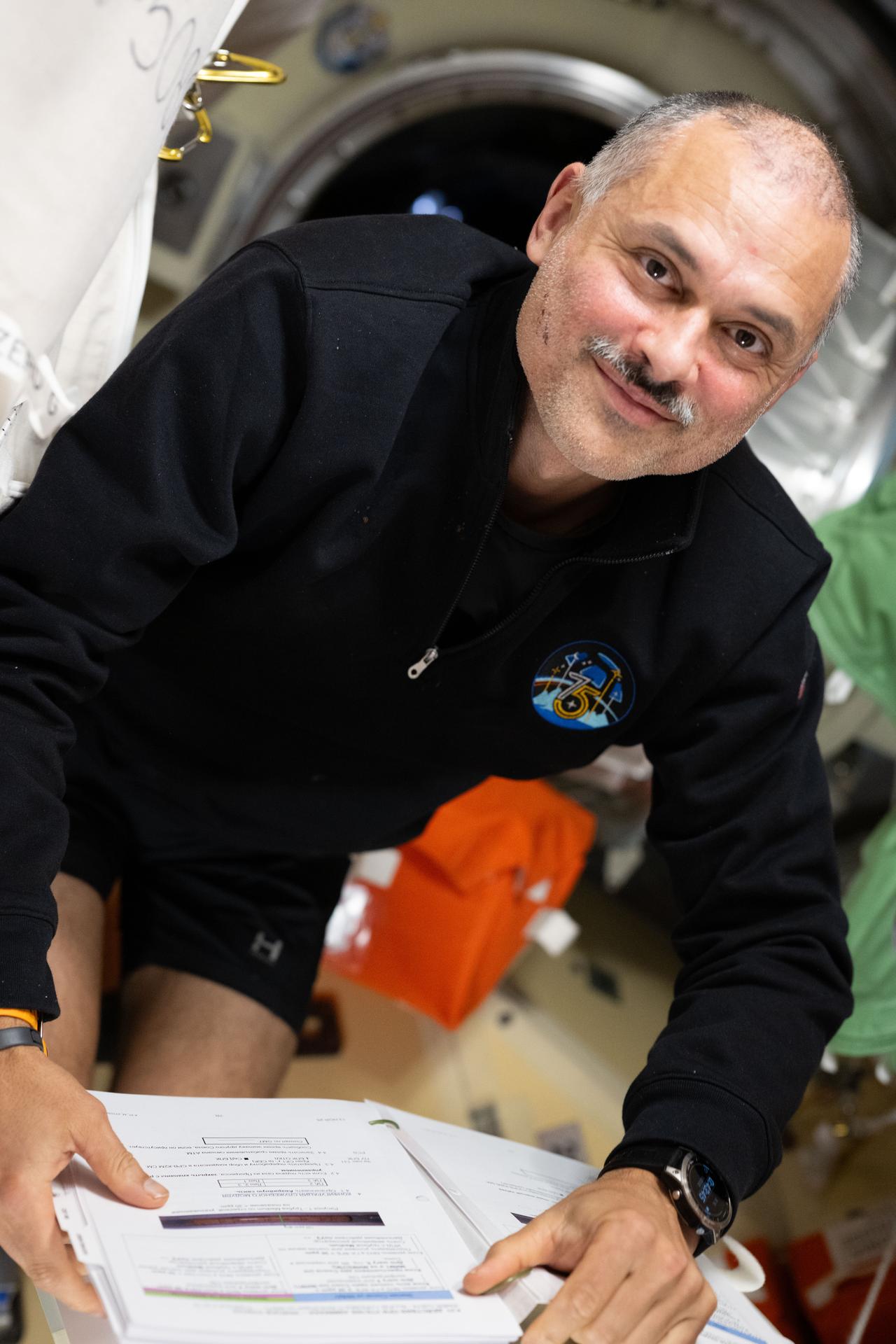
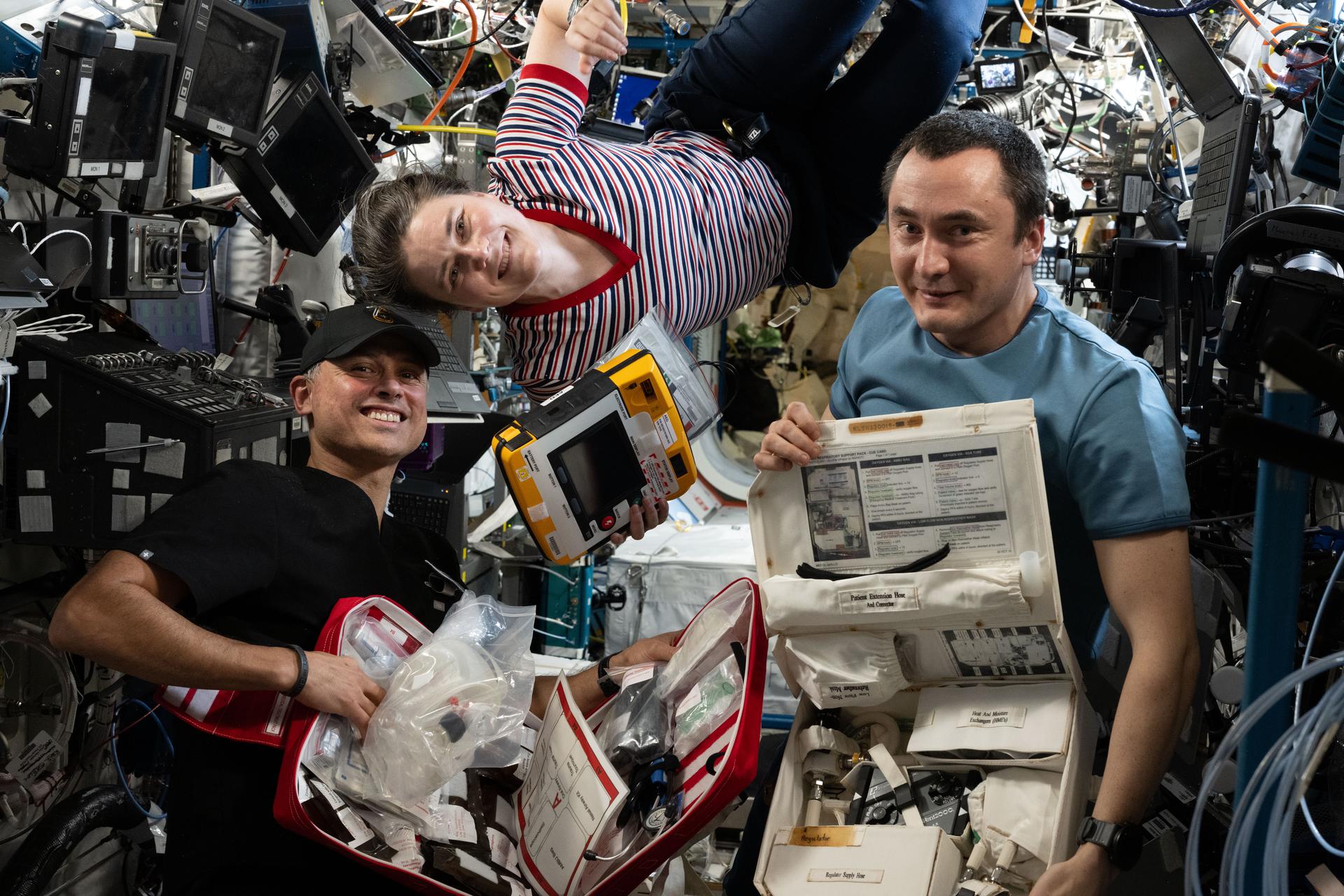
NASA astronaut Anil Menon reviews procedures for emergency scenarios while aboard the International Space Station as part of his long-duration science and research mission.
Credit: NASA

Editor’s Note: This feature was updated Sept. 22, 2026, to note the time change for the in-flight call with students. 

Students in New Hampshire will hear from NASA astronaut Anil Menon as he answers prerecorded STEM questions while aboard the International Space Station.

The Earth-to-space call will begin at 11:40 a.m. EDT Thursday, Sept. 24, and will stream live on the agency’s Learn With NASA YouTube channel.

This event is hosted by the McAuliffe-Shepard Discovery Center in Concord, New Hampshire, for students in grades K-12, and members of the community. This unique opportunity aims to deepen understanding of space exploration and enhance awareness of STEM careers.

Media interested in covering the event must RSVP no later than 5 p.m. EDT, Wednesday, Sept. 23, to Kelly Thompson at [email protected].

For more than 25 years, people have lived and worked continuously aboard the International Space Station, advancing scientific knowledge and making research breakthroughs not possible on Earth. The space station helps NASA understand and overcome the challenges of human spaceflight, expand commercial opportunities in low Earth orbit, and build on the foundation for long-duration missions to the Moon, as part of the Artemis program, and to Mars.

For more information on NASA in-flight calls, visit:

https://www.nasa.gov/stemonstation

Source: www.nasa.gov

NASA’s Chandra Finds Unusual Objects in Pinwheel Galaxy

Researchers found 84 so-called hypersoft X-ray sources in M101, Messier 31, and four elliptical galaxies. This newly-discovered class of objects give off very low-energy X-rays and likely high levels of ultraviolet light. Their existence may help explain questions around Type Ia supernova explosions and the intergalactic medium. These images of the face-on spiral galaxy M101 show X-ray data from Chandra and an optical image from the Hubble Space Telescope.
X-ray: NASA/CXC/Univ. of Alabama/M. Muhibullah et al.; Optical: NASA/ESA/STScI; Image Processing: NASA/CXC/SAO/N. Wolk

Using NASA’s Chandra X-ray Observatory, researchers found mysterious objects that give off unusually low-energy X-rays but intense levels of ultraviolet radiation. One of the galaxies they studied, M101, is pictured here in this image released on Sept. 9, 2026. Astronomers suggest these newly spotted objects in other galaxies may help solve not one, but two long-standing questions in astrophysics.

Read more about this discovery.

Image description: X-ray: NASA/CXC/Univ. of Alabama/M. Muhibullah et al.; Optical: NASA/ESA/STScI; Image Processing: NASA/CXC/SAO/N. Wolk

Source: www.nasa.gov

NASA-Funded Research Finds Complex Life Defying Record Heat

6 min read

NASA-Funded Research Finds Complex Life Defying Record Heat

This video shows Incendiamoeba cascadensis motility at 60ºC. When pushed to its limits in the lab, I. cascadensis can remain partially active at 150.8 degrees Fahrenheit (66 degrees Celsius) and can recover from exposure to a staggering 158 degrees Fahrenheit (70 degrees Celsius) for five minutes. However, 80 degrees Fahrenheit (176 degrees Celsius) proved to be too much for the amoeba to come back from.
Beryl Rappaport

NASA-supported scientists have discovered an organism that lives at extreme temperatures previously thought impossible for complex life. High temperatures can cause the destruction of necessary cell components, which is a big problem for cells with complex parts like a nucleus encasing delicate genetic information.

In the heated waters of California’s Lassen Volcanic National Park, a team of scientists observed an amoeba that can reproduce by division at an astonishing 145 degrees Fahrenheit (63 degree Celsius), setting a record for the upper temperature limit for all known eukaryotes. Incendiamoeba cascadensis, also dubbed the fire amoeba, stops reproducing above 145 degrees Fahrenheit but is still active, moving around to search for food at up to 147 degrees Fahrenheit (64 Celsius). The previous limit of 140 degrees Fahrenheit (60 Celsius) for eukaryotes was set by a few species of fungi and red algae. The results were published on Tuesday in the journal Cell.

Astrobiologists have long studied the boundaries of life’s survival on Earth to determine how organisms might live on other worlds like Mars where conditions are less hospitable than our home planet. Organisms that endure at the edges of habitability under extreme temperature, pH levels, radiation, and other environmental conditions are known as extremophiles. Studying them helps scientists understand what life as we know it is capable of. Extremophiles also produce unique proteins that can have promising uses in biotechnology, from industrial applications to medicine.

Previous extremophile research has mostly focused on single-celled bacteria and archaea. The new study shows that the more complex cells of eukaryotes might be more durable than previously thought and could even help scientists understand locations in the universe where complex life could survive.

Complex life on Earth

Life on Earth is broadly divided into two categories, prokaryotes and eukaryotes. Prokaryotes are single-cell organisms that do not have a nucleus or membrane-bound organelles inside their single cell. This means that they have less cellular ‘machinery’ that can be damaged by extremes, such as blistering heat, bitter cold, caustic acidity, or damaging radiation.

Organisms that live in extreme heat are known as thermophiles. To be a true ‘heat-loving’ thermophile, the organism must be able to replicate, move, eat, and survive above 113 degrees Fahrenheit (45 degrees Celsius).

Prokaryotes include bacteria and archaea, with archaea being particularly adept at surviving extremes. Because of their relative simplicity, scientists also believe that prokaryotes were the first forms of life to appear on Earth, billions of years ago when the environment of our planet was much more inhospitable than it is today.

Eukaryotes are more complicated organisms that are thought to have evolved later in the history of life on Earth. These organisms have a separate cell nucleus inside their cells that contains fragile genetic information. Eukaryotes also contain membrane-bound organelles, such as mitochondria and endoplasmic reticulum. These organelles are like mini cellular machines that perform specific functions. Eukaryotes include a wide span of life, from single-celled algae to multicellular organisms like plants and human beings.

Complexity in Extreme Heat

High temperatures lead to the breakdown of proteins and other biomolecules that living cells need to function. Heat also can cause membranes to break apart, thereby destroying cells. It has been suggested that organelle membranes in eukaryotes could not remain stable above 144 degrees Fahrenheit (62 degrees Celsius). The discovery of I. cascadensis proves that assumption wrong.

“In part, studies on eukaryotes may have been limited because of assumptions about membrane stability,” says Beryl Rappaport, graduate student at Syracuse University and lead author of the study. “We are hoping that the discovery of I. cascadensis encourages others to keep searching for high temperature eukaryotes.”

The team sequenced the I. cascadensis genome, studying the expression of genes at multiple temperatures. They found many genes that help the amoeba stabilize DNA and protect it from breaking down. Other genes allow the organisms to sense the external environment. At high temperatures, the expression of certain genes also increased, including those involved in maintaining protein folding.

“We were able to uncover many strategies that could help I. cascadensis survive at high temperatures, and some of these strategies could be used by thermophiles across all life,” says Rappaport. “For instance, some proteins in I. cascadensis have a high positive surface charge that could help them remain stable. These protein charges are similar to those found in thermophilic bacteria and archaea.”

The team also compared genetic information from other studies world-wide. In this trove of data, they found similar pieces of DNA from geothermal samples in places like New Zealand and Yellowstone National Park. This means that additional thermophilic amoebas related to I. cascadensis might be living all around the globe just waiting to be discovered.

The image shows an over the shoulder view of a scientist wearing a long sleeve blue shirt and a brown bucket hat for protection from the bright sun. They also have a high visibility vest on. They are reaching a sampling stick out toward a small stream of thermal water surrounded by tall grass. The water has brown/green slime around the edges.
Lead author Beryl Rappaport collecting samples of Incendiamoeba cascadensis in California’s Lassen Volcanic National Park. The organism’s name means “Fire amoeba coming from the cascades.” California’s Lassen Volcanic National Park is the southernmost active volcanic region in the Cascade Range and includes Lassen Peak, the world’s largest plug dome volcano.
Kristen Skruber

Search for life beyond Earth

Earth is the only planet we know of that is inhabited with life. For life as we know it to survive on other planets in the solar system or beyond, organisms might have to cope with environmental conditions that are very different from those found here at home.

“Studying extremophiles helps us better understand the biochemical and physiological limitations of life as we know it on Earth,” says Alison Olcott, program scientist for Exobiology at NASA Headquarters in Washington. “This information, in turn, helps guide NASA’s search for life as it expands the range of conditions we think life could potentially be inhabiting elsewhere.”

In particular, the study increases our understanding of where and how life with complex cells might persist on Earth and beyond.

“Finding eukaryotes surviving in high temperature environments not only expands our understanding of where life could be found, but also of how complex that life could be,” says Olcott.

However, the researchers do point out that survival depends on many factors that are part of a larger ecosystem.

“It could certainly be possible for complex life like I. cascadensis to survive on another planet, but Earth is the only planet we currently know of to have all the requirements for I. cascadensis to be happy,” says Rappaport. “It’s not just about temperature. An environment also needs the right acidity, oxygen levels, pressure, water, and food. I. cascadensis could not survive on its own. It needs other life to be supported as well.”

For more information on astrobiology at NASA, visit:

https://science.nasa.gov/astrobiology

Details

Last Updated

Sep 22, 2026

Source: science.nasa.gov

Risks of Decompression Sickness and Venous Thromboembolism during Spaceflight and Patent Foramen Ovale Implications

3 min read

Preparations for Next Moonwalk Simulations Underway (and Underwater)

PFO DCS VTE Working Group Photo September 2026
Top Row (from left to right): Michael Stenger, Joe Dervay, Steve Piper, Dave Francisco, Craig Kutz, Matthew Makowski, Alex Garbino, Hiroki Bochimoto, Doug Ebert, James Locke, Raffi Kuyumjian. Bottom Row (from left to right): Mark Crowther, Stephan Moll, Doug Ebersole, Mike Gernhardt, David Southerland, Sarah Taoufik
NASA

The purpose of this working group was to assemble a panel of experts to review the most recent data related to extravehicular activity (EVA) prebreathe testing and decompression sickness (DCS) events, venous thromboembolism (VTE) in-flight occurrences, and patent foramen ovale (PFO) implication as they relate to NASA’s Artemis (lunar and beyond) missions. The recommendations from this working group are built upon and integrate the outcomes of the September 2024 Assessment of Patent Foramen Ovale (PFO) as Related to Decompression Sickness (DCS) in the Spaceflight Environment and During Ground Testing (NASA/SP-20240010473), the April 2026 NASA Risk of Venous Thromboembolism in Spaceflight Working Group (NASA/SP- 20260005258/REV1), and the updated DCS prevention standard reviewed by the DCS panel in NASA-STD-3001 Volume 2 Human Factors, Habitability, and Environmental Health (NASA-STD-3001 Vol 2 Rev F), with a specific focus on risk mitigation interventions such as PFO closure.

Recommendations

The following is a summary of the working group’s recommendations:

  1. Ground-based studies should no longer remove subjects from research solely due to the presence of LVGE. Protocols should balance subject safety with population representativeness, and subjects must be fully informed of their LVGE status and any associated risks.
  2. The consensus was that the presence of a PFO is not considered a major risk factor for VTE formation, nor for complications from an embolism traveling from an initial formation site in the left internal jugular or cerebrum at normoxic or proposed hypoxic space habitats. No changes to astronaut selection criteria regarding PFOs are recommended with respect to VTE.
  3. The consensus of the group is that there is no definitive link between bubble grades and the risk of DCS at altitude for prebreathe protocols involving partial gravity and ambulation.
  4. The panel concluded that while minimizing bubbles is desirable, the predictive value of bubble scores for DCS remains uncertain, especially for lunar surface operations.
  5. It was determined that a “small” PFO (Grade 1 or 2) does not pose a significant risk. There were mixed opinions on whether closing or screening out crew members with a “large” PFO (Grade 3 or above) significantly reduces the risk of a venous gas embolism (VGE) passing to the arterial side and causing a significant mission health event. The group did not recommend universal screening or exclusion of astronauts with large PFOs but emphasized the importance of risk mitigation through protocol design and ongoing data collection. If crews are assessed, they should be informed of their status and offered closure for a large PFO.
  6. The panel concluded that clear clinical guidance is required regarding medication use for all crewmembers prior to Extravehicular Activities (EVAs). Specifically, protocols must address the use of aspirin for Decompression Sickness (DCS) prevention and pain relief. Additionally, guidance is needed for the pre and post-EVA use of analgesics (acetaminophen, ibuprofen, naproxen, celecoxib), as these medications have the potential to mask DCS symptoms.

Source: www.nasa.gov

Perseverance’s View of ‘Turquoise Bay’

1 Min Read

Perseverance’s View of ‘Turquoise Bay’

A panoramic view of a barren, reddish-orange Martian landscape stretching toward distant hills, partially obscured by the jagged black silhouettes of a rover in the foreground.

PIA26815

Credits:
NASA/JPL-Caltech/MSSS

Description

NASA’s Perseverance Mars rover used its Mastcam-Z camera to capture this 360-degree panorama of “Turquoise Bay,” a geologic area of interest in the “Margin Unit.” The 818 images used to create the natural-color panorama were captured between Oct. 5 and Oct. 16, 2023, the 933rd to 944th Martian days, or sols, of the mission.

Figure A is an enhanced-color version, in which color bands were processed to improve visual contrast and accentuate color differences.

NASA’s Jet Propulsion Laboratory, which is managed for the agency by Caltech in Pasadena, California, built and manages operations of the Perseverance rover. Arizona State University leads the operations of the Mastcam-Z instrument, working in collaboration with Malin Space Science Systems in San Diego, on the design, fabrication, testing, and operation of the cameras, and in collaboration with the Niels Bohr Institute of the University of Copenhagen on the design, fabrication, and testing of the calibration targets.

For more about Perseverance: science.nasa.gov/mission/mars-2020-perseverance/

Source: science.nasa.gov

Arctic Melt Season Length Levels Off


2000-2009
2010-2023

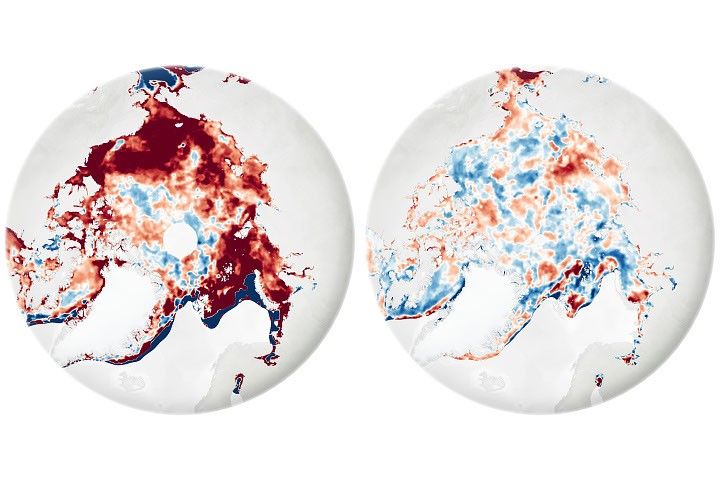
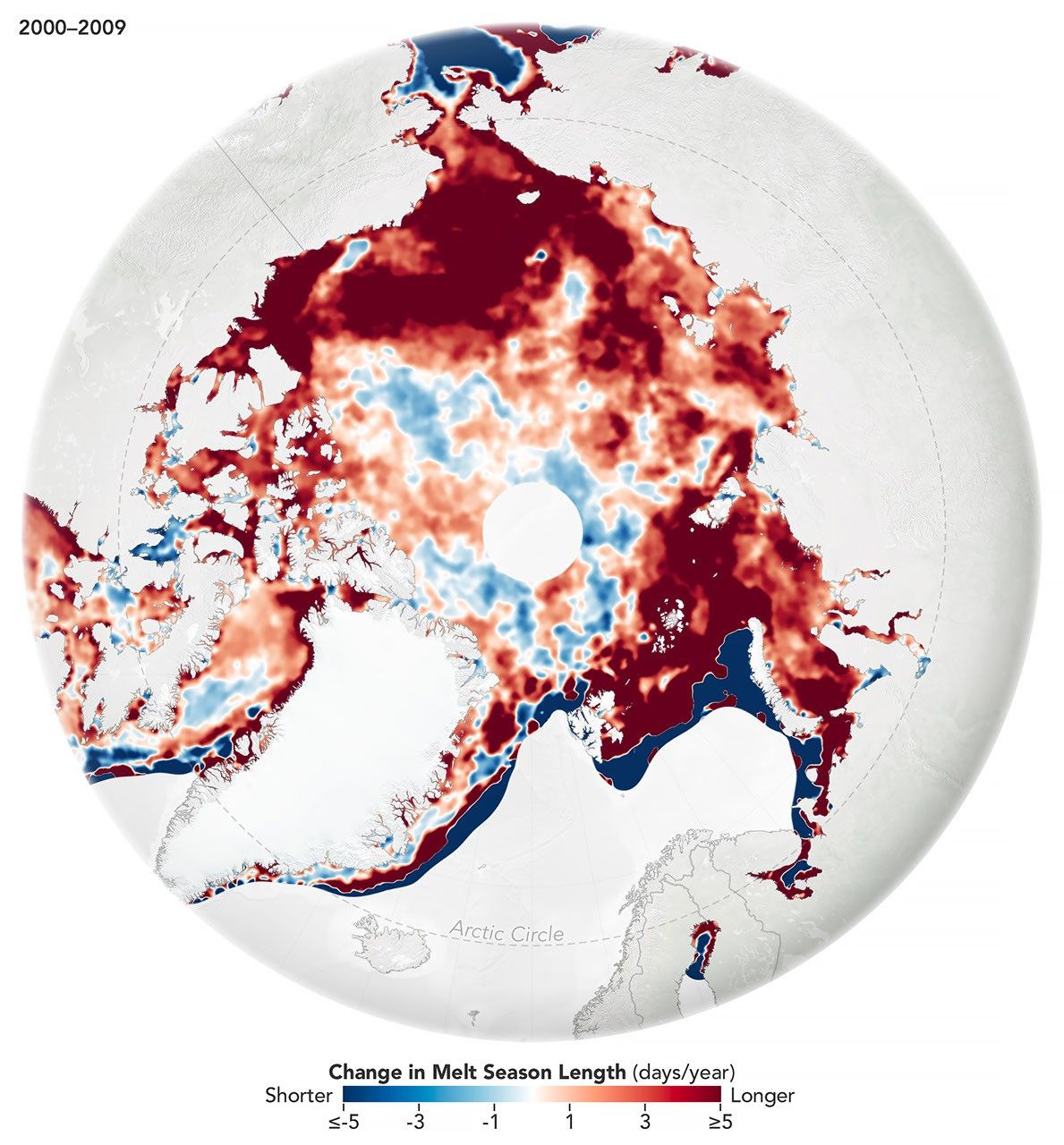
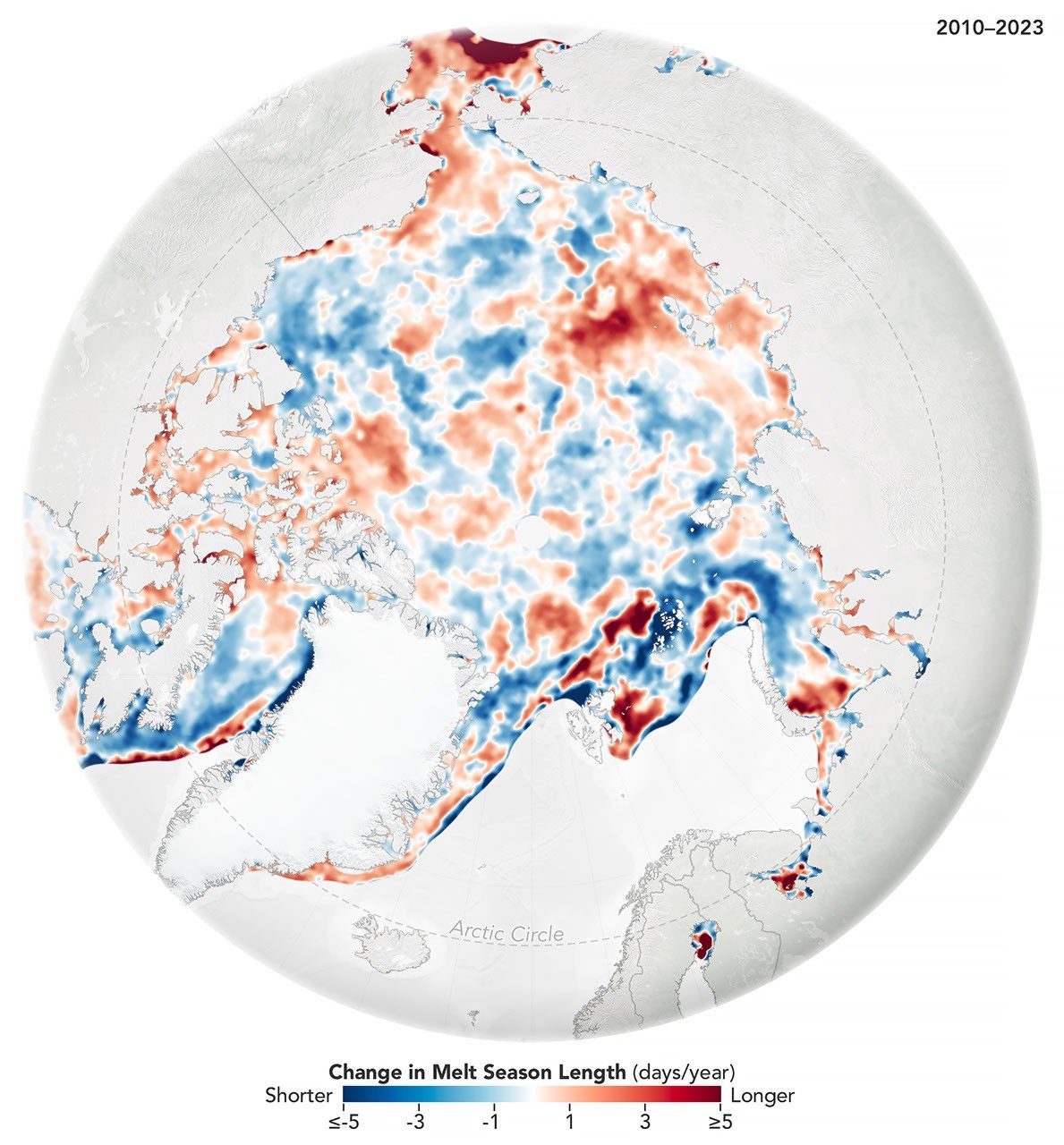
Two Arctic maps compare changes in melt season length by decade. Red indicates areas where the season grew longer; blue, where it grew shorter. The 2000–2009 map is mostly dark red. The 2010–2023 map shows a mix of lighter red and blue, indicating smaller changes.
NASA Earth Observatory/Michala Garrison


2000-2009

2010-2023


Since the start of the satellite record, the Arctic sea ice melt season has lengthened in most decades, particularly in the 2000s (left). Since 2010 (right), the melt season appears to have stabilized. NASA Earth Observatory images by Michala Garrison based on data from Boisvert, L., et al.

For decades, Arctic sea ice has been melting earlier in spring and freezing later in fall, extending the melt season and contributing to widespread ice loss. A new NASA-led study has found that while the Arctic melt season has lengthened dramatically since satellite records began, that trend unexpectedly stabilized around 2010.

The Arctic sea ice melt season is now about 40 days longer than it was in 1979, according to the study. Most of the increase occurred before 2010. Since then, the average melt season length has remained relatively unchanged, despite large year-to-year fluctuations.

Researchers analyzed satellite observations between 1979 and 2023 to track when sea ice begins to melt each spring and refreezes each autumn. They found that the change was driven primarily by sea ice freezing later in the year rather than melting earlier in the spring.

“Previously, there was more of this multiyear ice that didn’t melt away each summer,” said Linette Boisvert, a co-author on the study and ice scientist at NASA’s Goddard Space Flight Center. “Now that the ice is thinner and there’s less of it, there’s a lot more variability.” On average, though, the decline in sea ice thickness and extent that occurred during the 2000s appears to have stopped for the time being.

To understand why, the team examined changes in the Arctic’s energy balance—the net difference between incoming heat from the Sun, atmosphere, and ocean and the outgoing infrared radiation emitted back to space.

During the period of rapid ice loss in the 2000s, reduced ice cover exposed darker ocean water, which absorbed more sunlight. The additional solar energy delayed freezing and helped extend the melt season. In the left map above, the reddest areas mark where the melt season grew fastest that decade, by up to 5 days per year. Much of the Arctic ice today is younger and thinner than the multiyear ice that was once more widespread in the Arctic Ocean, leaving it more vulnerable to variations in cloud cover, storms, and winds.

Since 2010, changing cloud patterns have reduced the amount of sunlight reaching parts of the Arctic Ocean. The result has been a melt season that fluctuates from one year to the next but remains relatively stable over longer periods. The right map above reflects this shift, with the lighter blues and reds showing the more modest rates of change during that decade.  

These findings don’t suggest that shifts in Earth’s climate have stopped affecting the Arctic. The region continues to warm nearly four times faster than the global average, and the remaining sea ice is substantially thinner than it was several decades ago. Instead, the study suggests that the Arctic may have entered a new phase, in which annual weather patterns exert a stronger influence on melt season than they once did.

“Melt season length is much more dependent on atmospheric effects,” Boisvert said. “They seem to be playing a bigger role because the ice is generally thinner and more vulnerable to begin with.”

The researchers caution that the apparent stabilization may prove temporary. Thick Arctic ice still exists throughout the year to the north of Greenland and the Canadian Arctic Archipelago. Continued thinning of ice in those regions could trigger another period of rapid sea ice loss, with the potential to further extend the melt season.

For now, the study highlights the importance of continued satellite observations of Arctic sea ice and the energy balance that controls its growth and melting. Whether the recent stabilization represents a lasting change in the melt season or a pause before another period of rapid change remains an open question.

NASA Earth Observatory images by Michala Garrison, using data from Boisvert, L., et al. (2026). Story by James Riordon/NASA’s Earth Science News Team.

References & Resources

You may also be interested in:

Stay up-to-date with the latest content from NASA as we explore the universe and discover more about our home planet.

A Changing World for Emperor Penguins

7 min read

Experts are analyzing decades of images from Landsat satellites for clues about how the iconic birds have responded to sea…

Article

A Bare Summer for Barnes Ice Cap

4 min read

The expanse of glacial ice on Canada’s Baffin Island lost its snow cover quickly and early in summer 2026, revealing…

Article

Pink Penguin Guano Provides Diet Clues

3 min read

The color of Adélie penguin droppings reveals what the birds are eating, offering scientists a way to track how sea…

Article

Source: science.nasa.gov

APOD: 2026 September 21 – Cocoon Nebula Wide Field

APOD

Astronomy Picture of the Day

Discover the cosmos! Each day a different image or photograph of our fascinating universe is featured, along with a brief explanation written by a professional astronomer.

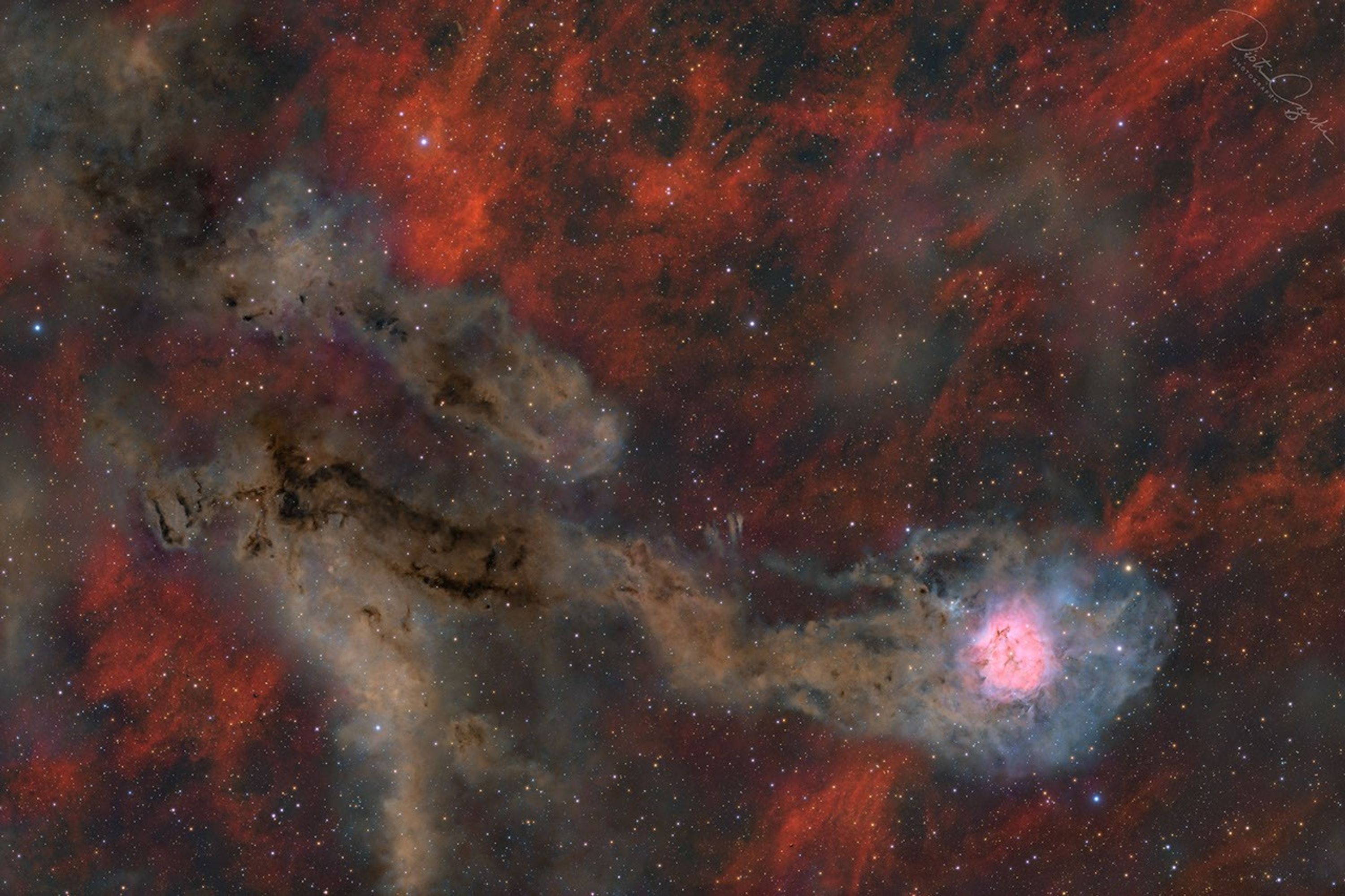
A starfield is shown against a patchy red-glowing background. Two irregular brown trails occur, the lower of which culminates in a bright pink and white region.

Cocoon Nebula Wide Field

Explanation: When does a nebula look like a comet? In this crowded starfield covering over two degrees within the high-flying constellation of the Swan (Cygnus), the eye is drawn to the Cocoon Nebula. A compact star forming region, the cosmic Cocoon punctuates a nebula bright in emission and reflection on the lower right, with a long trail of interstellar dust clouds to the left, making the entire complex appear a bit like a comet. Cataloged as IC 5146, the central bright head of the nebula spans about 10 light years, while the dark dusty tail spans nearly 100 light years. Both are located about 2,500 light years away. A bright star near the colorful nebula’s center likely supplies power and helps clear out a cavity. The long dusty filaments of the tail, although dark in this visible light image, hide stars in the process of formation. The featured image was captured in July from Death Valley, California, USA.

APOD’s main NASA site is moving: From apod.nasa.gov to science.nasa.gov/apod
Tomorrow’s picture: triple eclipse

Date: September 21, 2026
Credit & Copyright: Piotr Czerski
Authors & editors: Robert Nemiroff, Jerry Bonnell, Cecilia Chirenti, Keighley Rockcliffe
A service of: ASD at NASA / GSFC,
NASA Science Activation & Michigan Tech. U.

Source: science.nasa.gov

Johnson Space Center Sparks Curiosity at Houston’s 33rd Annual Japan Festival  

2 Min Read

Johnson Space Center Sparks Curiosity at Houston’s 33rd Annual Japan Festival  

On Sept. 12-13, NASA’s Johnson Space Center employees brought the excitement and wonder of space exploration to Houston’s Japan Festival at Hermann Park. 

Attendees at the Japan Festival in Houston’s Hermann Park try on real astronaut gloves and a helmet while learning about NASA missions on Sept. 12, 2026.
NASA/Hailey Quist

For more than 30 years, the festival has immersed guests in traditional Japanese culture through food, dance, martial arts, music, and more, Johnson has supported the festival as an exhibitor for the past four years.

Johnson’s booth showcased the upcoming Artemis III mission and its crew, as well as NASA’s plans for the Moon Base. Display included models of NASA’s Orion spacecraft and the International Space Station, along with interactive exhibits featuring space food and a real astronaut glove and helmet for attendees to try on.

NASA’s Johnson Space Center volunteers share information about NASA missions with festival attendees.
NASA/Hailey Quist

Johnson employees interacted with over 3,000 festivalgoers, informing them about the agency’s current initiatives, handing out NASA stickers and pins, and inspiring the next generation of space explorers. According to Johnson employees, the highlight of the weekend was seeing the joy and excitement on the faces of children and adults as they explored the exhibits.

“It was amazing to see students as early as high school so passionate about NASA and asking questions on how to prepare for a NASA career,” said Brendan King, software engineer for Johnson’s Flight Dynamics Division.

Next to Johnson’s booth, JAXA (Japanese Aerospace Exploration Agency), displayed a model of the HTV-X1 cargo spacecraft, space food, and images of JAXA’s pressurized rover, which could support future crewed and uncrewed exploration on the Moon. JAXA astronaut Akihiko Hoshide also signed autographs and posed for pictures with festival attendees.

JAXA (Japan Aerospace Exploration Agency) astronaut Akihiko Hoshide signs autographs and poses for pictures with festivalgoers.
NASA/Hailey Quist

The proximity of the booths was no mistake, reflecting the long-standing partnership between NASA and JAXA. From the addition of the Kibo laboratory aboard the space station to Japan’s signing of the Artemis Accords and development of lunar surface hardware. NASA and JAXA’s commitment to innovation and international collaboration continues to advance exploration.

As the hub of human spaceflight, Johnson engages with the public through events like Japan Festival. These events give the Johnson community opportunities to share NASA’s history, ongoing work, and future missions. They also remind Houstonians that Giant Leaps Start Here, right in the heart of Houston.

About the Author

Hailey Quist

NASA OSTEM Intern

Details

Last Updated

Sep 21, 2026

Source: www.nasa.gov